United Egg Producers, a trade association for the egg industry, has begun churning out “kid-friendly” propaganda aimed at free-range egg producers:
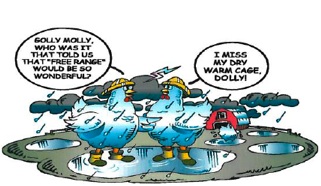
Who knew stuff like this was simply intended to keep the poor things dry and warm?

United Egg Producers, a trade association for the egg industry, has begun churning out “kid-friendly” propaganda aimed at free-range egg producers:
Who knew stuff like this was simply intended to keep the poor things dry and warm?
“…when Theodore Roosevelt, to his lasting discredit, referred to Thomas Paine, without having read him, as ‘a filthy little atheist,’ he was slandering someone whose belief in the traditional doctrines of the existence of a Supreme Power and the immortality of the Soul was much more unqualified than the belief of two thinkers who have been characterized as the leading Protestant theologians of the twentieth century–Paul Tillich and Reinhold Niebuhr.” –Sydney Hook, from his introduction to Common Sense, Rights of Man, and Other Essential Writings of Thomas Paine
Brooklyn’s Blacklist plays an infectious brand of goth-influenced, post-punk pop (more Cure or Sisters of Mercy than Evanescence, thankfully):
A couple of posts providing some interesting criticisms of Michael Pollan’s views on meat eating, here and here.
Pollan’s obviously doing more than nearly anyone to draw attention to the problems with our system of food production, including factory farming. And yet, he seems to have a soft spot for silly atavistic arguments against vegetarianism.
At the First Things blog, Joe Carter has a post challenging the coherence of “theistic evolution.” This view, held by people like Kenneth Miller, accepts the orthodox Darwinist position that the evolution of human beings did not require any special intervention by God (contra both old-school creationists and Intelligent Design proponents). Further, according to an article that Carter quotes, Miller denies that God has human beings specifically in mind. Instead, God “set up” the evolutionary process so that some intelligent creatures capable of offering praise to their Creator would emerge, but not necessarily human beings.
Carter writes:
If God did not have a plan for the specific outcome of evolution, as MIller contends, then he must have at least had a general plan for the process to create some form of creature with “exceptional mental capabilities.” But then the process would no longer be undirected, which means that it is not compatible with the Darwinian view of evolution.
Ironically, the view held by [Francis] Collins and Miller shares much in common with the position of creationists. If evolution is random and undirected then the probability of a “creature capable of praising Him” (i.e., a being similar to humans) coming into existence is extremely low. God would likely need to run the experiment a number of times to get the desired outcome and then select that instantiation (maybe that’s why we have the multiverse). This special selection of results, however, is not so different than creationist’s view of special creation—in each God simply chooses the outcome he desires. Also, Collins’ view of God making evolution appear undirected is similar to the idea that he planted dinosaur fossils and created geological strata to fool us into thinking the earth has been around more than 6,000 years. Creationists have to interpret the evidence to fit their theological preconceptions; Collins has to interpret the evidence to fit his theoretical preconceptions.
I think Carter goes astray here by taking the language of “random and undirected” too literally. Clearly, evolution is not random in any absolute sense: it operates within the constraints provided locally by the environment and the qualities possessed by organisms, and globally by the fundamental constituents of the universe (e.g, the laws that govern the behavior of subatomic particles). There are reasons–which have been widely canvassed–for thinking that the emergence of intelligent life is, if not inevitable, then at least intelligible given the nature of our universe. All a theistic evolutionist is committed to is that God set up those fundamental constraints in such a way that He could foresee–at least with a high degree of probability–that intelligent life would emerge at some point.
The difference between the theistic evolutionist and the ID proponent is that the former doesn’t think we need to appeal to special divine intervention to explain how life (including human life) evolved. We can ask why the universe has the fundamental constituents it does and not others, and this is where the theistic evolutionist might bring in God. But it’s important to note that this doesn’t present a conflict with orthodox Darwinism; biologists qua biologists don’t ask, much less answer, the question of why the universe has the basic features it does. That’s a properly philosophical (and perhaps theological) question. The fact that a high percentage of evolutionary biologists are atheists isn’t particularly relevant. The theistic evolution position is an interpretation of the process as a whole, not an appeal to God as one causal input among others.
I should add that I’m not personally dogmatically committed to the view that God never intervenes in the evolutionary process. There are a variety of models on offer for thinking about how God might do that without giving up the idea of a basically law-like process. Nevertheless, the methodological naturalism of biology is entirely appropriate; I just don’t see how ID constitutes a research program. What we can and should do as Christians is offer a way of integrating the findings of the sciences with a richer picture of reality that takes account of all our experience (moral, aesthetic, religious, etc.). Reality is a many-layered thing.
It also strikes me that Kenneth Miller’s statement that human beings are “an afterthought, a minor detail, a happenstance in a history that might just as well have left us out” is a salutary and properly humbling one. Christian theology has been entirely too anthropocentric, and a more theocentric and creation-centric perspective is urgently needed.
UPDATE: See also this post from the ubiquitous John Schwenkler who, in addition to his other gigs, is now blogging at “dotCommonweal,” the Commonweal magazine blog. I should note, in clarification, that I was assuming, for the purposes of this post, that God is not eternal in the traditional sense of being “outside” of time altogether. I have some problems with the traditional view of God’s timelessness, and I think attributing temporality to God can be combined with a sufficiently robust notion of divine transcendence. I recognize that this is a minority position in the tradition, and John’s approach is certainly a legitimate one to take.
Derek has a good post on those he calls spiritual adventurers/seekers in the Episcopal Church, in the context of debates about messing around with the liturgy. As Derek points out, the liturgy (including, I’d emphasize, the creeds) provides guard rails for the life of the church. A priest or pastor who ignores these for the sake of following his or her own spiritual bliss is doing a disservice to the congregation he or she has been called to serve.
For whatever reason, this seems to be a more prominent phenomenon in TEC than in the ELCA. I don’t know if this is because Lutheranism has a more defined theology, or because the Episcopal priesthood attracts more free spirits, or if it’s some other reason altogether. Personally, I want my pastor to be more theologically conservative than I am. As a layperson I prize my freedom to explore theological possibilities and entertain outlandish and even heterodox theories. Not to say that we should have a double standard for laypeople and clergy, or that laypeople don’t have responsibilities to uphold the faith–we do, as part of our baptismal covenant. But someone who is called to the pastorate/priesthood carries a much heavier and more public burden to hew to orthodoxy in preaching, teaching, and leading worship.
And yet, many of the great reformers, saints, and mystics of the church who were also ordained clergy have pushed the envelope of what’s acceptable and orthodox. (A certain Augustinian monk comes to mind.) If anything, the church has often erred on the side of suppressing the spirit of freedom that allows new insights to be unearthed. This is probably not the biggest problem in mainline churches today where, if anything, an overly-liberal, anything goes attitude holds sway in many quarters. One of Derek’s concluding points strikes the appropriate note:
On one-hand, I’m open to legitimate spiritual adventurism on the part of the clergy in so far as it reflects necessary growth and listening to the Spirit and transformation into the Mind of Christ. On the other hand, I believe that much of it reflects a failure of our discernment and formation processes. Yes, it’s fine to deepen, but I’m seeing a lot more wandering around than rooting down.
I guess the question–which is hard to answer in particular cases–is whether someone’s theological, spiritual, or liturgical gyrations are occurring because they’re on a quest for self-fulfillment or self-expression, or because of a deepening fidelity to Christ and his gospel. I think Derek is right that formation is a prerequisite here–both for clergy and laity–to ensure that we are grounded in the tradition before proposing changes to it. And community discernment is necessary to “test the spirits” of any proposed innovations.
The American Conservative has added two blogs to its already-stellar lineup: Daniel McCarthy’s “Tory Anarchist” and “PostRight.” That latter features a stable of young(ish) writers who “take a jaundiced view of the conventional left-right spectrum.”
Talk of going “beyond left and right” is often just code for a vacuous and muddled “moderation” or “centrism,” but there are definitely underrepresented niches in the political ecology: left- and right-wing decentralists, actual socialists, localists, left-libertarians, etc. When both major parties are all too easily swayed by corporate American and the “Washington consensus,” I’m all for bringing some of these neglected voices into the conversation.
Lately I’ve been trying–with some success–to follow Mark Bittman‘s “vegan before six” (or vegan before dinner) regimen, with one qualification: only during the week. On the weekends I like to leave open the possibility of eggs for breakfast or a grilled cheese sandwich with fresh tomatoes from the farmers’ market for lunch, or what have you.
So, for instance, the menu from today:
Breakfast:
Smoothie
-1/2 cup soy milk
-1/2 cup mixed frozen berries
-1/2 banana
-splash of vanilla extract
Mix in blender/food processor (I use a hand blender)
(and coffee, of course)
Lunch:
Black-eyed peas, long grain rice, and salsa
Carrot sticks
Clif Bar (chocolate almond fudge)
Banana
Delicious stuff and entirely satisfying. Dinner will be vegetarian enchiladas with cheese.
Bittman advocates reducing consumption of animal products for both health and environmental reasons. I’m more moved by animal welfare concerns but don’t see those as incompatible motivations. And this post by vegan dietitian Virginia Messina convinced me that incrementalism is a respectable strategy (indeed, I doubt I’ll ever go 100% vegan). Ms. Messina’s blog, by the way, is full of good, practical, down-to-earth advice on diet for v*gans. For example, here’s a post on why it’s OK to eat convenience foods.
UPDATE: John suggests an amendment to this, noting that people might need more of a nutritional wallop at breakfast and that it would make more sense to reduce animal-product consumption at dinner first, and keep the bacon and eggs. It’s true that the American pattern of eating is backwards in some sense: does it really make sense to have our big, hearty meal at the end of the day? And yet, my sense is that skipping or skimping on breakfast has a lot to do with other patterns, specifically work. My impression (based on highly anecdotal evidence) is that in Europe, for instance, people both eat heartier breakfasts and start work later, whereas in the U.S. I think people are more likely to grab something on the go if they eat breakfast at all. I personally seem to be constituted such that I prefer not to eat a heavy breakfast and have gone years where I scarcely ate breakfast at all (coffee is my one sine qua non for starting the day). Nowadays I eat breakfast daily, but am usually content with a smoothie or a bowl of cereal. But I’m all for bringing breakfast back as the most important meal of the day, noting, for the record, that it’s entirely possible to have a hearty, stick-to-your-ribs vegetarian breakfast too.

