The other day I was listening to a podcast of Christian philosopher William Lane Craig defending a version of the “penal substitutionary” account of the Atonement (“PSA” as it’s often referred to). One thing Craig emphasized was that Jesus must take our punishment in order to “satisfy God’s retributive justice.”
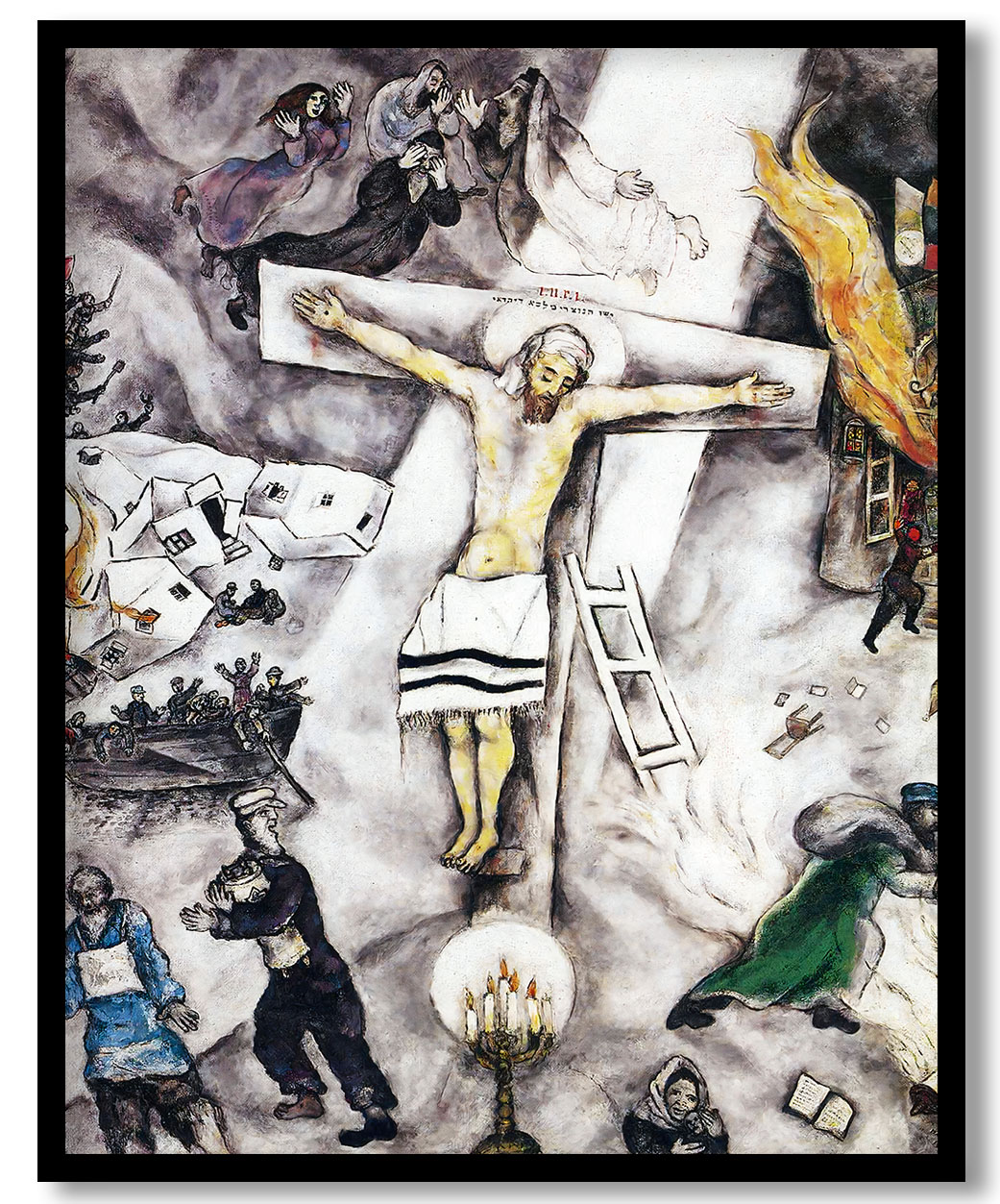
Marc Chagall, White Crucifixion (1938)
It occurred to me, however, that there is considerable tension between this account of the Atonement and the standard accounts of retributive justice.
To take one example, the Stanford Encyclopedia of Philosophy says that the concept of retributive justice is best understood as committed to three principles:
that those who commit certain kinds of wrongful acts, paradigmatically serious crimes, morally deserve to suffer a proportionate punishment;
that it is intrinsically morally good—good without reference to any other goods that might arise—if some legitimate punisher gives them the punishment they deserve; and
that it is morally impermissible intentionally to punish the innocent or to inflict disproportionately large punishments on wrongdoers.
From the perspective of retributive justice, then, it seems that punishing an innocent person be worse than not punishing anyone at all. (Because it would violate both principles 1 and 2, at least.)
Under retributive justice, punishment is specifically supposed to be meted out to those who deserve it. It’s not like there’s just a free-floating quantity of punishment that has to land on someone. Retributive justice is intrinsically tied to the idea of desert.
Of course, a defender of PSA could say that God, being God, can relax the strict requirements of retributive justice, allowing an innocent person (Christ) to take the due punishment in humanity’s stead. But the obvious counter to this is that if God can relax strict retributive justice in this way, why can’t God relax it so as not to require anyone to be punished? Other things being equal, a state of affairs where no one is punished seems preferable to one where only the innocent are punished.
None if this is to say that there aren’t ways PSA defenders can respond to this. Maybe the most promising approach would be to develop the idea of Christ as a kind of “corporate person” who, because he collectively represents humanity, can be said to deserve this punishment in some extended sense. But I think it’s worth teasing out because it’s often assumed that this account of the Atonement is very closely connected to a retributive model of justice, and indeed that retributive justice requires something like PSA.*
———————————
*Of course, many theologians and philosophers have disputed whether a retributive concept of justice is the most appropriate way of thinking about God’s justice. And they have developed Atonement models that don’t rely on retributive logic at all.
I was struck recently by a passage from Catholic theologian Karen Kilby in the entry on “evil” in the St Andrews Encyclopaedia of Theology. Kilby is discussing how Christian theology envisions God responding to evil, but notes that not that theologies vary in how central a place they give to the response to evil:
Christian theologies vary not only according to what dimension of evil and of God’s response to evil they take to be primary, but also in another important way. They vary according to how much the system as a whole is oriented around this theme. God’s saving response to evil is never marginal, but while for some it lives at the absolute centre of theological concern – the thing around which all else pivots – for others it takes a subordinate place.
Martin Luther’s theology, with its focus on the law/gospel dialectic and on the justification of the sinner, is a clear example of the first style of theology. Liberation theology, though very different, is also an example of a theology where the divine response to evil – in this case liberation from oppression – is at the centre. In theological schemes which lay emphasis on the goodness of creation, however, the centre of gravity can be a little different: creation may well be understood to be wounded by sin and so in need of healing, but this is not the only or the primary point of theological interest. Similarly, thinkers who construe salvation as theosis or divinization – as the elevation of the human being to a participation in the divine life – have a place for sin and forgiveness but they do not necessarily put them at the centre of the divine-human relationship.
Kilby offers “supralapsarian” Christologies as an example of this latter type:
One can illustrate the different emphases by asking a question: if there had been no fall, nothing wrong with the world, no presence in it of that which should not be, would there have been an Incarnation? Did Jesus come into the world only in response to a problem, or was the uniting of God and world always part of the divine purposes in creation? Theologians divide over this issue, and even over whether it is legitimate to ask such about such a counterfactual possibility. If one allows the question, however, it provides a helpful illustration of the broader issue. Those who hold the ‘Scotist’ view (the view that the Incarnation would have occurred even without the Fall) have an understanding of God’s relation to the world which can indeed include a divine response to evil but which is not centred on it.
The supralapsarian option — i.e. the idea that the Son would’ve become incarnate even if human beings had not sinned — is a persistent minority report in Christian theology. It suggests that there is a purpose to the Incarnation in addition to redemption for sin, and even that redemption was not the primary purpose.
I’ve recently been reading a bit in this area. In particular, Sam Wells’ Constructing an Incarnational Theology makes a strong argument for the idea that God’s original purpose in creating the universe was the Incarnation. The Incarnation occurs so that God can dwell with God’s creatures. On Wells’ account, the crucifixion is the ultimate example of how far God will go to be with God’s creatures — God wills to be with us even when we kill him! And the resurrection demonstrates that even this isn’t enough to defeat God’s will to be with us. But the defeat of evil is ultimately subordinate to God’s overarching purpose of dwelling with God’s creatures.
We might also consider R. Kendall Soulen’s construal of the biblical narrative as a story of mutual blessing oriented toward a final reign of shalom. God’s work as Consummator, in this telling, is logically prior to God’s work as Redeemer. The drama of sin and redemption fits within this framework rather than being itself the overarching narrative.
That said, any plausible Christian theology has to do justice to the ways in which God acts to redeem the word from evil. This is too prominent in the New Testament for it to be entirely downplayed in favor of a creation-based theology or spirituality. And yet, it does seem to me that there are passages in the New Testament (e.g., in Ephesians, Colossians, John’s gospel) which say that all things were created in and for Christ and that they will be united to Christ at the consummation of all things. This makes it seem like the arc of creation and consummation takes priority to redemption as such. In this light, the drama of fall and redemption can start to look like a subsidiary (albeit very significant!) plotline and not the overarching story.
Choosing one of these broad approaches over another here probably has a lot to do with what parts of the biblical witness and the tradition one finds most compelling. For instance, Luther was clearly gripped by the drama of sin and redemption, which became the centerpiece of his theology (and much subsequent Protestant theology). Plus, different people at different times in their life may find various parts of the Christian message more relevant. And it’s probably worth noting that there may be “mixed” intermediate types between the two approaches.
For myself, I do find the “supralapsarian” creation-and-consummation emphasis deeply appealing. This is not only because it seems to provide a telos for the Christian life beyond “getting out of jail (or hell)” but also because it can potentially incorporate the entire created world in the sweep of God’s plan. At the same time, I wouldn’t want to lose the emphasis that God seeks us out precisely when we’ve gone astray to restore us to our place in this plan.
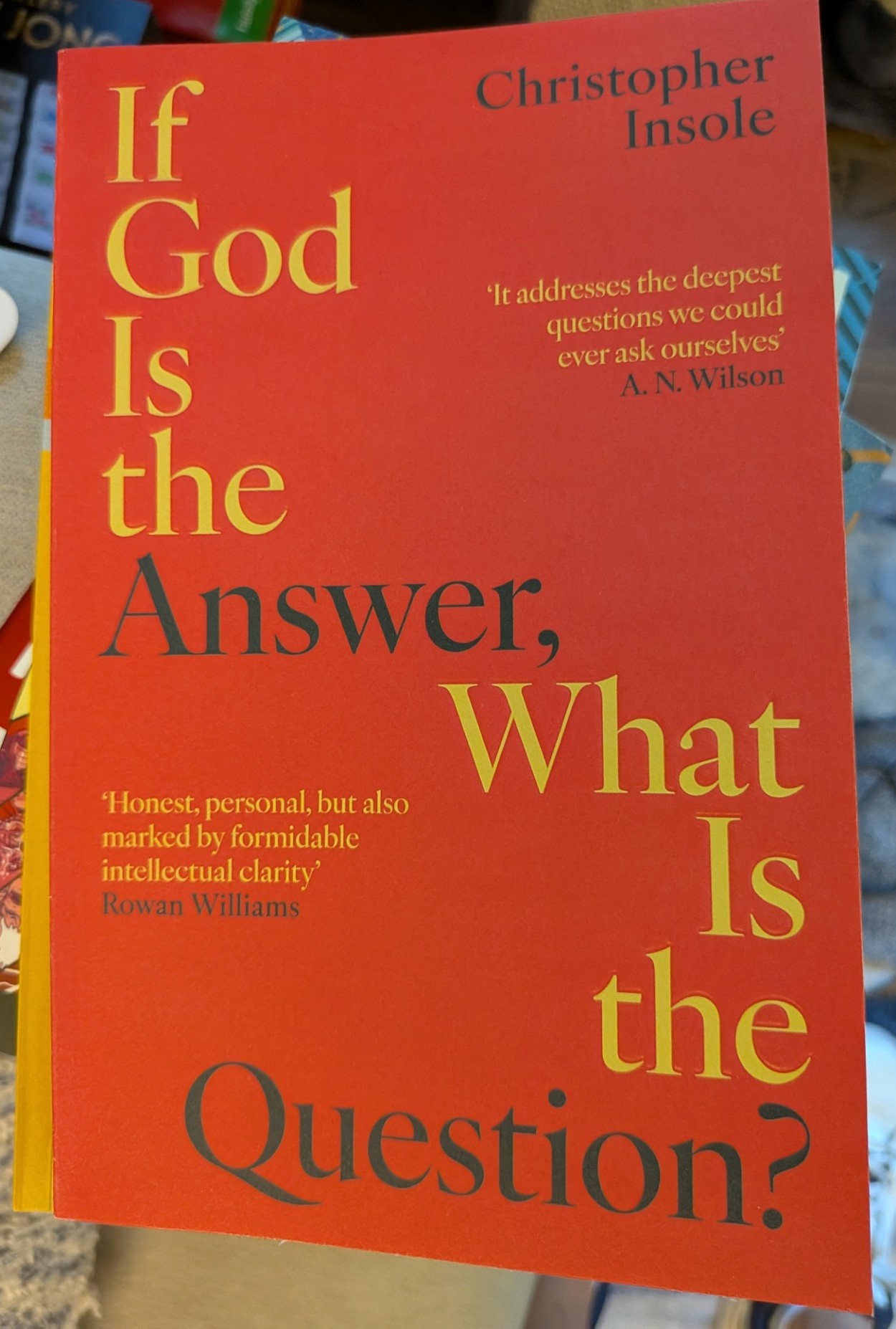
Christopher Insole, If God Is the Answer, What Is the Question? (Oneworld, 2026)
Insole is a philosophical theologian in the UK, but this is not your typical philosophy book. He says up front that he doesn’t really think people’s fundamental convictions about God, morality, the meaning of life, politics, etc. are moved by rational argument. What he’s interested in this book is the deeper motivations behind our quest for meaning and how those affect what types of views about ultimate reality we’re drawn to. In short, he wants to explore what kinds of questions people are asking when they ask about God. Atheists of the Richard Dawkins stripe often assume that God-talk is an attempt at primitive quasi-science — e.g. looking for an explanation of natural phenomena; but Insole notes that the questions driving people are more likely to be things like “What is the significance of my life in this vast universe?” “Why is there evil and suffering and how do I deal with it?” or “How do I get along with other people?”
Insole reviews an eclectic selection of accounts, intending to expand our notion of what “God” might mean beyond the anthropomorphic concept often found in popular discourse (both theist and atheist). These include Stoicism, the naturalistic pantheism of Spinoza, the philosophy of Kant (Insole himself is a noted Kant scholar), the “enchanted atheism” of contemporary Indian philosopher Akeel Bilgrami, and Anselm’s Proslogion. The point of these explorations is not to stump for one over the other, but to show that the notion of God is potentially broader and richer than we might’ve thought, but also that these different accounts of ultimate reality are responding to a variety of human needs and desires.
The last part of the book turns to more personal reflections. He recounts a recurring argument he had with Richard Swinburne, his doctoral advisor, about whether God is in time or outside time. Delving under the surface, he wonders whether their respective positions are driven by particular experiences and psychological dispositions. Based on a long interview Swinburne gave, Insole explores how Swinburne’s lonely childhood may have made the concept of a God-in-time who can be a constant companion more appealing to him. For his own part, Insole talks about how the God outside of time concept gives him with a way of holding the past, present and future together when things threaten to unravel.
This could all make it sound like Insole is a pure projectionist — that the view we hold of God is simply whatever answers to our own needs and wishes. But he is clear that God transcends human consciousness; however, God is big enough, he thinks, that “shards” of divine truth may reveal themselves in a variety of ways to different people (and different cultures, traditions, etc.).
Insole closes the book with a meditation on the life and death of his father, a larger-than-life character by the sounds of things. He says that he didn’t realize until his dad died how much his father’s faith was supporting his own. He had to discover a new kind of faith in the wake of losing his father. “Now I believe in God because of death, and what it reveals about love, the love that remains after life” (p. 238).
In a blurb on the back cover, A.N. Wilson says “reading this book is like having a really interesting conversation with a wise, learned man, by turns dense and learned, by turns light and humorous.” I’d second that assessment – I read the book in a single sitting, which is pretty rare for me. Insole took a risk in writing from a more personal point of view, but it’s one where most people actually live, and one that rarefied abstract arguments rarely touch.