Author: Lee M.

  • A thought on retributive justice and the Atonement

    The other day I was listening to a podcast of Christian philosopher William Lane Craig defending a version of the “penal substitutionary” account of the Atonement (“PSA” as it’s often referred to). One thing Craig emphasized was that Jesus must take our punishment in order to “satisfy God’s retributive justice.”

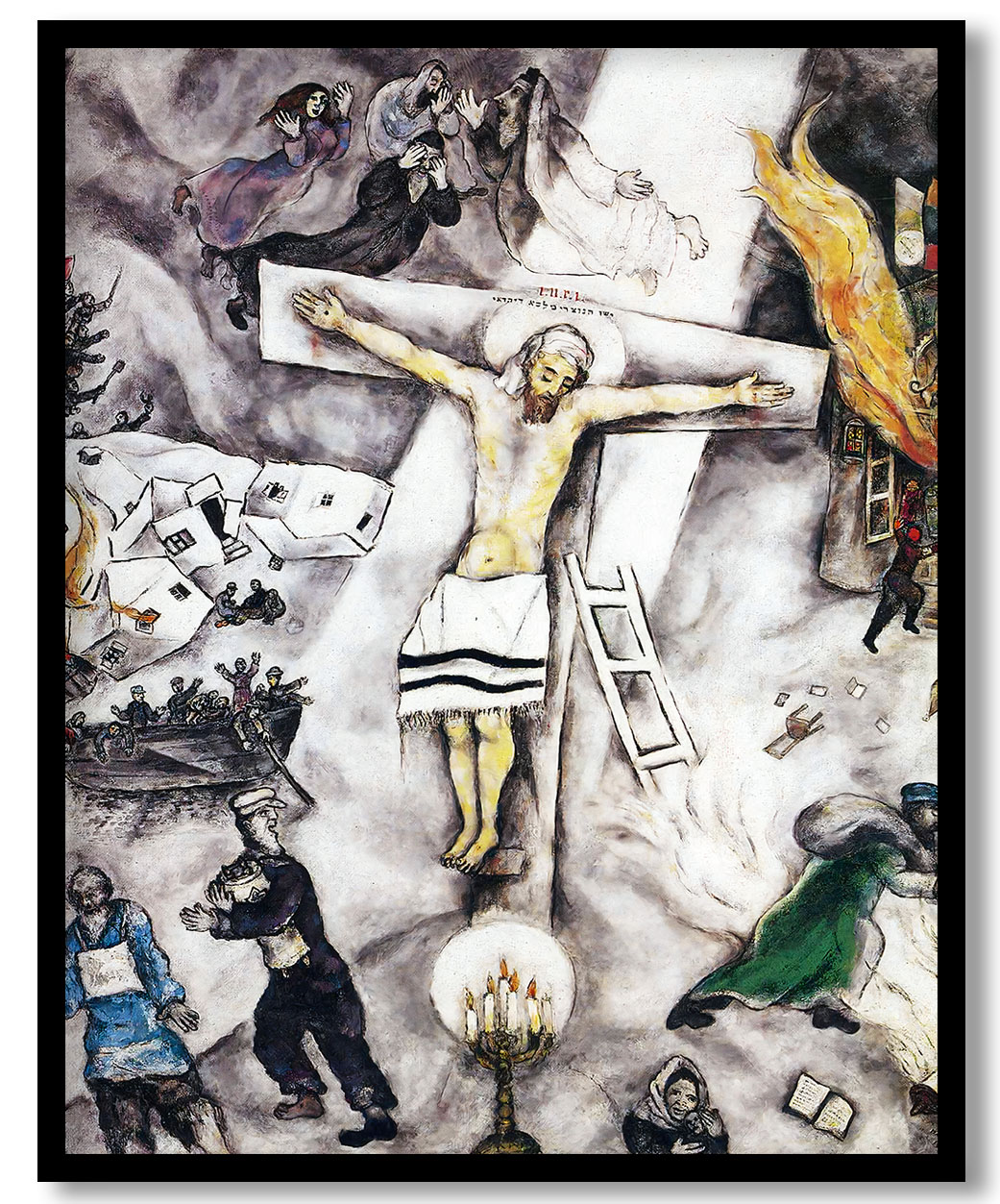
    Marc Chagall, White Crucifixion (1938)

    It occurred to me, however, that there is considerable tension between this account of the Atonement and the standard accounts of retributive justice.

    To take one example, the Stanford Encyclopedia of Philosophy says that the concept of retributive justice is best understood as committed to three principles:

    1. that those who commit certain kinds of wrongful acts, paradigmatically serious crimes, morally deserve to suffer a proportionate punishment;
    2. that it is intrinsically morally good—good without reference to any other goods that might arise—if some legitimate punisher gives them the punishment they deserve; and
    3. that it is morally impermissible intentionally to punish the innocent or to inflict disproportionately large punishments on wrongdoers.

    From the perspective of retributive justice, then, it seems that punishing an innocent person be worse than not punishing anyone at all. (Because it would violate both principles 1 and 2, at least.)

    Under retributive justice, punishment is specifically supposed to be meted out to those who deserve it. It’s not like there’s just a free-floating quantity of punishment that has to land on someone. Retributive justice is intrinsically tied to the idea of desert.

    Of course, a defender of PSA could say that God, being God, can relax the strict requirements of retributive justice, allowing an innocent person (Christ) to take the due punishment in humanity’s stead. But the obvious counter to this is that if God can relax strict retributive justice in this way, why can’t God relax it so as not to require anyone to be punished? Other things being equal, a state of affairs where no one is punished seems preferable to one where only the innocent are punished.

    None if this is to say that there aren’t ways PSA defenders can respond to this. Maybe the most promising approach would be to develop the idea of Christ as a kind of “corporate person” who, because he collectively represents humanity, can be said to deserve this punishment in some extended sense. But I think it’s worth teasing out because it’s often assumed that this account of the Atonement is very closely connected to a retributive model of justice, and indeed that retributive justice requires something like PSA.*

    ———————————

    *Of course, many theologians and philosophers have disputed whether a retributive concept of justice is the most appropriate way of thinking about God’s justice. And they have developed Atonement models that don’t rely on retributive logic at all.

  • Incarnation anyway

    I was struck recently by a passage from Catholic theologian Karen Kilby in the entry on “evil” in the St Andrews Encyclopaedia of Theology. Kilby is discussing how Christian theology envisions God responding to evil, but notes that not that theologies vary in how central a place they give to the response to evil:

    Christian theologies vary not only according to what dimension of evil and of God’s response to evil they take to be primary, but also in another important way. They vary according to how much the system as a whole is oriented around this theme. God’s saving response to evil is never marginal, but while for some it lives at the absolute centre of theological concern – the thing around which all else pivots – for others it takes a subordinate place.

    Martin Luther’s theology, with its focus on the law/gospel dialectic and on the justification of the sinner, is a clear example of the first style of theology. Liberation theology, though very different, is also an example of a theology where the divine response to evil – in this case liberation from oppression – is at the centre. In theological schemes which lay emphasis on the goodness of creation, however, the centre of gravity can be a little different: creation may well be understood to be wounded by sin and so in need of healing, but this is not the only or the primary point of theological interest. Similarly, thinkers who construe salvation as theosis or divinization – as the elevation of the human being to a participation in the divine life – have a place for sin and forgiveness but they do not necessarily put them at the centre of the divine-human relationship.

    Kilby offers “supralapsarian” Christologies as an example of this latter type:

    One can illustrate the different emphases by asking a question: if there had been no fall, nothing wrong with the world, no presence in it of that which should not be, would there have been an Incarnation? Did Jesus come into the world only in response to a problem, or was the uniting of God and world always part of the divine purposes in creation? Theologians divide over this issue, and even over whether it is legitimate to ask such about such a counterfactual possibility. If one allows the question, however, it provides a helpful illustration of the broader issue. Those who hold the ‘Scotist’ view (the view that the Incarnation would have occurred even without the Fall) have an understanding of God’s relation to the world which can indeed include a divine response to evil but which is not centred on it.

    The supralapsarian option — i.e. the idea that the Son would’ve become incarnate even if human beings had not sinned — is a persistent minority report in Christian theology. It suggests that there is a purpose to the Incarnation in addition to redemption for sin, and even that redemption was not the primary purpose.

    I’ve recently been reading a bit in this area. In particular, Sam Wells’ Constructing an Incarnational Theology makes a strong argument for the idea that God’s original purpose in creating the universe was the Incarnation. The Incarnation occurs so that God can dwell with God’s creatures. On Wells’ account, the crucifixion is the ultimate example of how far God will go to be with God’s creatures — God wills to be with us even when we kill him! And the resurrection demonstrates that even this isn’t enough to defeat God’s will to be with us. But the defeat of evil is ultimately subordinate to God’s overarching purpose of dwelling with God’s creatures.

    We might also consider R. Kendall Soulen’s construal of the biblical narrative as a story of mutual blessing oriented toward a final reign of shalom. God’s work as Consummator, in this telling, is logically prior to God’s work as Redeemer. The drama of sin and redemption fits within this framework rather than being itself the overarching narrative.

    That said, any plausible Christian theology has to do justice to the ways in which God acts to redeem the word from evil. This is too prominent in the New Testament for it to be entirely downplayed in favor of a creation-based theology or spirituality. And yet, it does seem to me that there are passages in the New Testament (e.g., in Ephesians, Colossians, John’s gospel) which say that all things were created in and for Christ and that they will be united to Christ at the consummation of all things. This makes it seem like the arc of creation and consummation takes priority to redemption as such. In this light, the drama of fall and redemption can start to look like a subsidiary (albeit very significant!) plotline and not the overarching story.

    Choosing one of these broad approaches over another here probably has a lot to do with what parts of the biblical witness and the tradition one finds most compelling. For instance, Luther was clearly gripped by the drama of sin and redemption, which became the centerpiece of his theology (and much subsequent Protestant theology). Plus, different people at different times in their life may find various parts of the Christian message more relevant. And it’s probably worth noting that there may be “mixed” intermediate types between the two approaches.

    For myself, I do find the “supralapsarian” creation-and-consummation emphasis deeply appealing. This is not only because it seems to provide a telos for the Christian life beyond “getting out of jail (or hell)” but also because it can potentially incorporate the entire created world in the sweep of God’s plan. At the same time, I wouldn’t want to lose the emphasis that God seeks us out precisely when we’ve gone astray to restore us to our place in this plan.

  • What we talk about when we talk about God

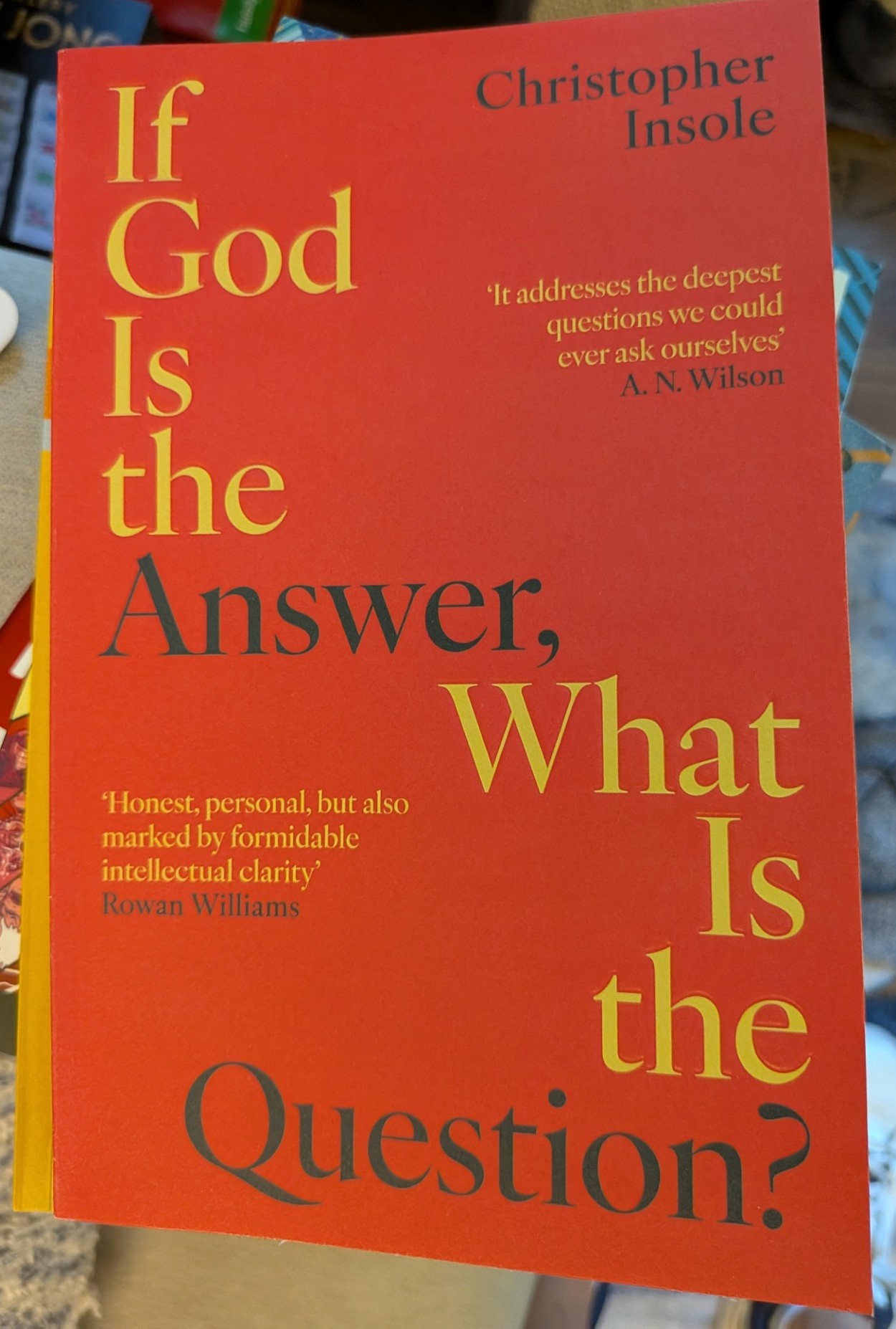
    Christopher Insole, If God Is the Answer, What Is the Question? (Oneworld, 2026)

    Insole is a philosophical theologian in the UK, but this is not your typical philosophy book. He says up front that he doesn’t really think people’s fundamental convictions about God, morality, the meaning of life, politics, etc. are moved by rational argument. What he’s interested in this book is the deeper motivations behind our quest for meaning and how those affect what types of views about ultimate reality we’re drawn to. In short, he wants to explore what kinds of questions people are asking when they ask about God. Atheists of the Richard Dawkins stripe often assume that God-talk is an attempt at primitive quasi-science — e.g. looking for an explanation of natural phenomena; but Insole notes that the questions driving people are more likely to be things like “What is the significance of my life in this vast universe?” “Why is there evil and suffering and how do I deal with it?” or “How do I get along with other people?”

    Insole reviews an eclectic selection of accounts, intending to expand our notion of what “God” might mean beyond the anthropomorphic concept often found in popular discourse (both theist and atheist). These include Stoicism, the naturalistic pantheism of Spinoza, the philosophy of Kant (Insole himself is a noted Kant scholar), the “enchanted atheism” of contemporary Indian philosopher Akeel Bilgrami, and Anselm’s Proslogion. The point of these explorations is not to stump for one over the other, but to show that the notion of God is potentially broader and richer than we might’ve thought, but also that these different accounts of ultimate reality are responding to a variety of human needs and desires.

    The last part of the book turns to more personal reflections. He recounts a recurring argument he had with Richard Swinburne, his doctoral advisor, about whether God is in time or outside time. Delving under the surface, he wonders whether their respective positions are driven by particular experiences and psychological dispositions. Based on a long interview Swinburne gave, Insole explores how Swinburne’s lonely childhood may have made the concept of a God-in-time who can be a constant companion more appealing to him. For his own part, Insole talks about how the God outside of time concept gives him with a way of holding the past, present and future together when things threaten to unravel.

    This could all make it sound like Insole is a pure projectionist — that the view we hold of God is simply whatever answers to our own needs and wishes. But he is clear that God transcends human consciousness; however, God is big enough, he thinks, that “shards” of divine truth may reveal themselves in a variety of ways to different people (and different cultures, traditions, etc.).

    Insole closes the book with a meditation on the life and death of his father, a larger-than-life character by the sounds of things. He says that he didn’t realize until his dad died how much his father’s faith was supporting his own. He had to discover a new kind of faith in the wake of losing his father. “Now I believe in God because of death, and what it reveals about love, the love that remains after life” (p. 238).

    In a blurb on the back cover, A.N. Wilson says “reading this book is like having a really interesting conversation with a wise, learned man, by turns dense and learned, by turns light and humorous.” I’d second that assessment – I read the book in a single sitting, which is pretty rare for me. Insole took a risk in writing from a more personal point of view, but it’s one where most people actually live, and one that rarefied abstract arguments rarely touch.

  • The broken mosaic of truth

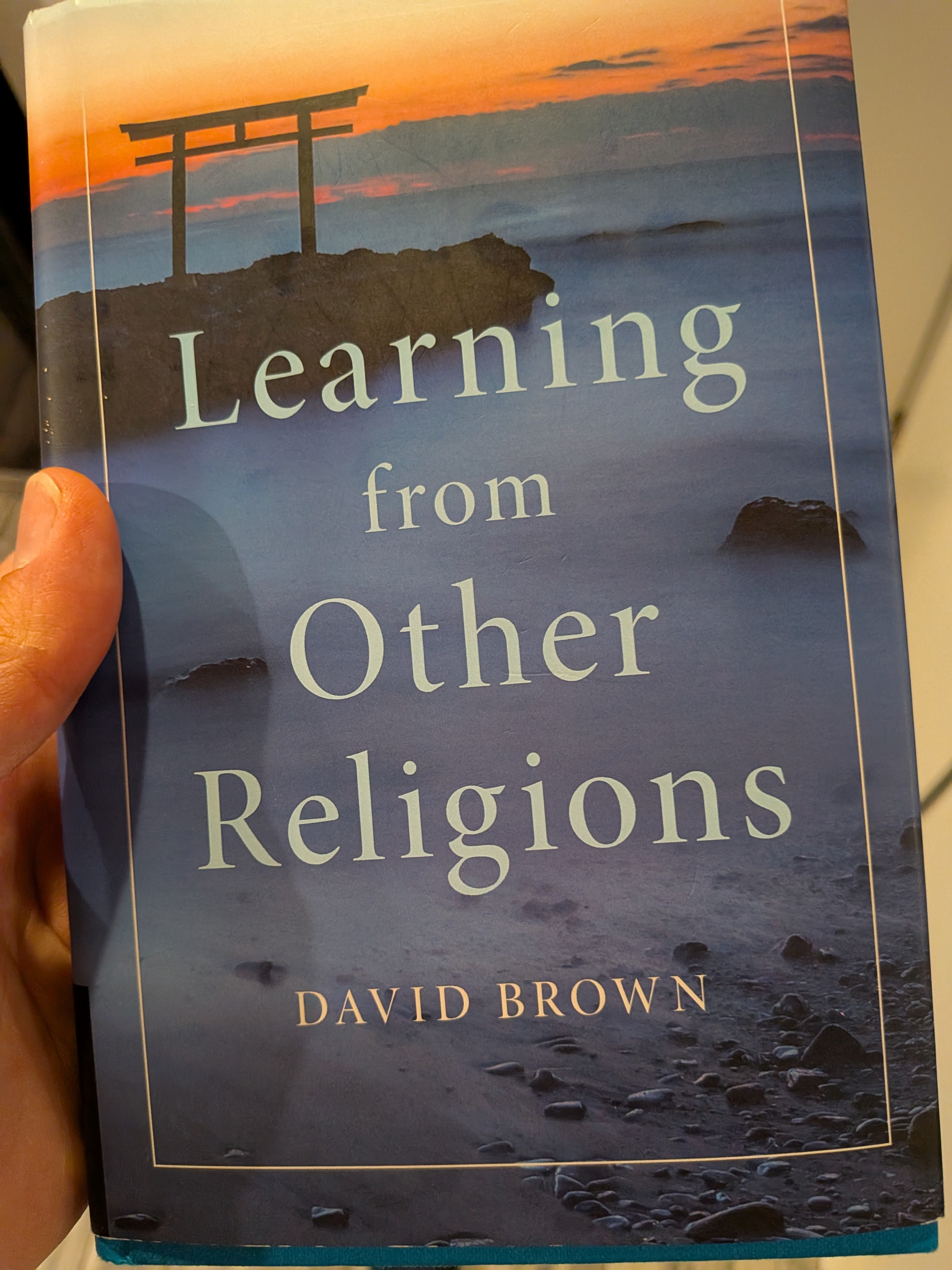
    Learning from Other Religions, David Brown (Cambridge University Press, 2024)

    Arguments about how to understand the relationship among humanity’s various religious traditions have often run in well-worn grooves: Exclusivists hold to the absolute and unique truth of their religion; inclusivists regard the differing faiths as approximations of the one true religion; and pluralists view all the great enduring traditions as more or less pointing to the same truth. There have been occasional attempts to step outside this framing (S. Mark Heim’s proposal of multiple, incommensurate “salvations” comes to mind), but these three options have structured much of the discussion, at least in Western philosophical and theological circles.

    David Brown, an Anglican theologian with wide-ranging interests that include trinitarian doctrine, Christology, and the role of art and culture in religion, offers another attempt to break out of the usual boxes in this engaging book. Brown doesn’t have a pithy name for his approach, but he rejects what he takes to be the three major approaches: no one religion has a monopoly on truth (as in exclusivism), but he also rejects inclusivism and pluralism, at least in their most common formulations.

    Instead, Brown views the various religious traditions as “shards” of a “mosaic” of truth about the divine. No one faith can claim to have the whole picture, and nor are the various religions simply blurry approximations of the religion with the clearest grasp on the truth (e.g. Christianity).

    This is based on a more general position about the nature of divine revelation and religious truth. Brown argues that revelation is conditioned by the social, cultural, psychological and other circumstances of its recipients. Thus, divine truth doesn’t come to us “neat,” but mixed with human perceptions and biases. This is, he thinks, the best explanation for the evident variation within religious traditions — e.g. the parts of the Bible that attribute morally dubious actions or attitudes to God. It makes sense, Brown thinks, that revelation is at times distorted — or that humans are taking in as much truth as is possible for them at that particular point in history. (And this may even be providential — it might not make sense for God to have revealed a truth that human beings were not capable of grasping at a certain point in history.)

    Something else Brown emphasizes is the “imaginative” nature of religious truth. Far from being simply a matter of revealed propositions, religious truth is appropriated through a variety of means, including mythological narratives, music, poetry, and the visual arts. These open up a dimension of reality that often eludes literal description. Accordingly, it’s not always possible to compare tenets from different religions 1-to-1 as though they were operating in the same type of discourse.

    Consequently, Brown argues, different cultures will have received different aspects of the truth, or assimilated it in ways that may mediate those aspects differently (through their art, rituals, scriptures, etc.). Taking this more expansive approach, we should expect that different traditions can reveal different truths, rather than being more-or-less adequate approximations to a single truth clearly revealed in just one tradition. Christians, Brown avers, should accordingly be open to the idea, not just that other religions might dimly reflect Christian truth, but that they might contribute truth that the Christian tradition has failed to identify (or at least has underemphasized).

    One of the most valuable parts of Brown’s book, in my view, is that he spends relatively little time on the schematics of the various views (exclusivism, inclusivism, pluralism). Instead, he tries to put flesh on the bones of his thesis by considering individual traditions (or groups of traditions) in each chapter and providing examples of truths they’ve emphasized and which he thinks Christianity would do well to consider. In some cases, he doesn’t think a major change is necessary, but certain truths should be emphasized that, while present in Christianity, may have received insufficient attention. Some of these are

    • Hinduism’s use of feminine imagery for the divine
    • Sikhism on the im/personal nature of God
    • Daoism’s acceptance of death as a natural part of life
    • Shintoism’s valuing of divine immanence
    • How the Qur’an contextualizes and reinterprets certain biblical stories

    This is neither an exhaustive list nor does Brown necessarily think he has identified the specific changes that Christianity should make. But he does hope to have demonstrated that there are plausible insights from other traditions that are absent or less prevalent in Christianity, but from which Christians have much to learn.

    In his penultimate chapter, Brown offers somewhat more systematic reflections on his model of revelation. He summarizes his position:

    While no religion possesses the totality of what may be known. aspects of the beautiful pattern which reflects ultimate reality can be discerned. It is constituted by a jigsaw of broken potsherds, as it were, with no single religion always in possession of the best perspective on the whole: sometimes patterns overlap; sometimes they are more clearly detectable in one religion rather than another; and sometimes there seems to be a fuzziness that precludes and immediate decision about which perceptible ‘pattern’ is the most accurate guide.

    In advocating such an approach, it was no part of my expectation that a single common mind could easily emerge. Inevitably, each faith will consider certain commitments too fundamental to be readily relinquished (such as the doctrine of the incarnation within Christianity). Nonetheless, such beliefs can now be moderated by humble recognition that, sometimes at least, the divine address has been more adequately grasped in some other faith community. To hostile critics this may seem like an attempt to have it both ways, inclusivist yet also pluralist, but my hope is that something rather more is now in play, an enriched rather than reduced account of revelation. (pp. 310-11)

    At various points throughout the book, Brown has highlighted cases where such a mutual enrichment has happened throughout history (for example, among Hindus, Buddhists and Muslims in Asia, or between Christian and Islamic theologians during the Middle Ages). In practice, if not in principle, religions have always been porous and open to the influence of other traditions to varying degrees. The monolithic, hermetically sealed tradition idealized by some religious conservatives is largely a myth. What Brown is saying, essentially, is that we should be more open and intentional about this process.

    I particularly appreciated Brown’s concrete case studies of how this has or might work. That said, I’ll register a question I have about Brown’s overall approach.

    In this book at least, Brown doesn’t really develop explicit criteria for what should be considered an “authentic” disclosure of the divine. Granted that all revelation (or putative revelation) is conditioned by social, cultural, etc. conditions; yet, the question remains how we’re supposed to discern a genuine insight into ultimate reality. Are these criteria internal to a given tradition (e.g. the teachings and example of Jesus), or are there criteria that transcend traditions? If we take the first path, then it seems we’re back at a form of inclusivism, albeit a perhaps more nuanced one. If we follow the second, then it seems we’ve arrived at a kind of Hickian pluralism or Kantian rationalism where all traditions are judged by how closely they approximate some moral or philosophical ideal. It may be that such considerations are beyond the scope of the book. Perhaps Brown is assuming the standpoint of the adherent of a particular tradition (Christianity in his case) and seeing how far he can extend a sympathetic openness to other religions.

    But this may be an unsatisfying response if at least part of Brown’s intention is to provide a genuine alternative to the usual exclusivist-inclusivist-pluralist schema. These positions, whatever their other flaws, are clear about their criteria for truth/validity in religion. For both the exclusivist and inclusivist, it’s a particular religion that provides the benchmark; for the pluralist it’s usually some kind of external philosophical and/or moral commitment (though often explicitly or covertly occasioned by, if not derived from, a particular tradition). Any alternative to these positions would need to squarely face the question of truth more explicitly, I think.

    All that said, I was largely persuaded by the thesis that other religious traditions might contribute truths to one’s own. I would say my own view is closer to inclusivism, but I do think a capacious inclusivism can adopt many of his arguments and insights. I certainly don’t think a Christian is committed to the view that actually existing Christianity has a monopoly on truths about God or the spiritual life. But I do think the encounter with other faiths will (inevitably?) involve some sifting of claims, and an appeal (implicitly or explicitly) to a criterion of truth.

  • Keith Ward: An appreciation

    As longtime readers are aware (if there are any of you left!), Anglican philosopher-theologian Keith Ward has been a big influence here at ATR. I think the first book of his I read was What the Bible Really Teaches, which at the time was extremely helpful to me by articulating a theology that was open to change but also still broadly orthodox and metaphysically robust. I had been put off by the kind of reductionistic liberalism espoused by figures like John Shelby Spong but was also uncomfortable with much conservative theology. (This also happened to be a time when the acceptance of same-sex relationships in the church was probably the issue roiling mainline Protestantism.) Ward showed that one could be “liberal” while still adhering to the reality of God and the unique significance of Jesus as savior and revealer.

    Since then, Ward has continued to publish at a steady clip, largely in the areas of philosophical theology, the science and religion dialogue, and issues of religious pluralism. In particular, he published three volumes comprising a more-or-less systematic theology in the last decade or so that spell out his version of a broadly orthodox-yet-liberal Christian theology.*

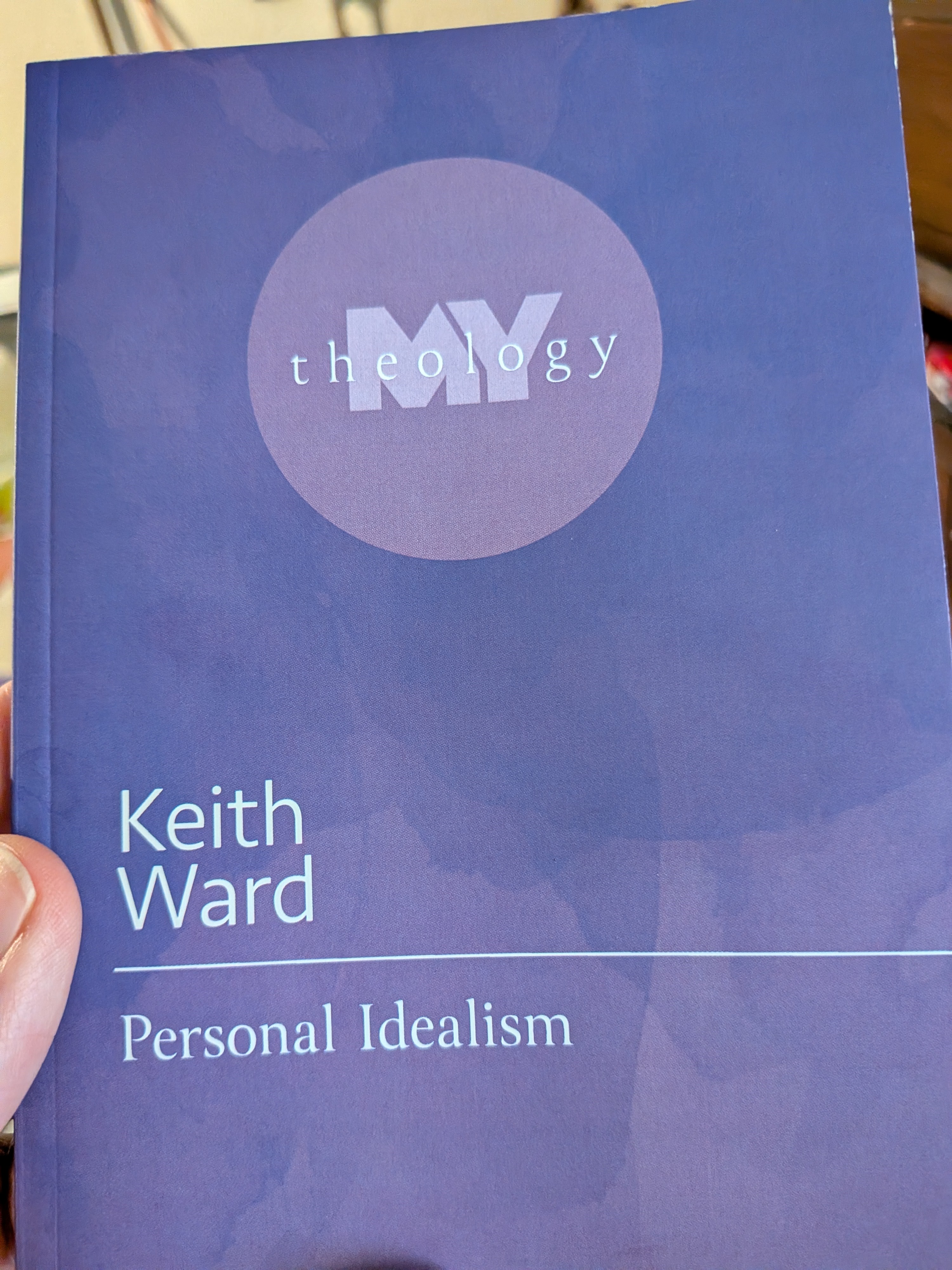
    Ward, now in his 80s, has slowed down more recently, but has still managed to publish several worthy volumes in the last few years. In 2022, he published a very short work (less than 100 pages) as part of Fortress Press’ ‘My theology’ series. The series consists of short summary statements of theological perspective by several contemporary luminaries such as Ilia Delio, Cynthia Bourgeault, Grace Ji-Sun Kim, and Scot McKnight, among others.

    Ward’s contribution is titled Personal Idealism, which is how he characterizes his particular philosophical-theological perspective.

    In short, as an idealist, Ward holds that mind is more fundamental than matter and provides the explanatory principle for the existence of the cosmos. This may sound highly counterintuitive, but Ward argues that consciousness — including feelings, thoughts, and sense-impressions — is actually prior to matter in the order of knowledge. We are more certain that these things exist than that “matter” exists, because they are the medium through which we know anything. Moreover, it’s highly implausible, Ward thinks, that mental events or properties, broadly speaking, are identical or can be reduced to material properties or events. In fact, the world as contemporary physics describes it is highly remote from our experience, consisting of wave/particle dualities, vibrating 11-dimensional stings, and probability waves. Ward thinks that the world of physics is an abstraction from experience — a framework for explaining and predicting events insofar as they are measurable and quantifiable and thus susceptible to the methods of physical science. This unavoidably leaves out a lot.

    But what, you may ask, does this have to do with God? According to Ward, a fully satisfying explanation of the existence of the universe would answer the question of why this universe exists rather than some other. It’s intuitively plausible to think that there are many possible universes, so why this one? Ward suggests that there is an infinite “ocean of possibilities” out of which one set of possibilities has been actualized — namely our universe. But possibilities in themselves are just abstractions — how can they subsist independently, much less have any causal power?

    Ward argues that it makes the most sense to think of the set of all possibilities as residing in an infinite and eternal Mind. This Mind then actualizes the set of possibilities that will contain certain goods — states that are worthwhile for their own sake. This is a personal, axiological explanation for the existence of the cosmos. The universe exists because the Eternal Mind wanted to bring into existence certain worthwhile states such as beauty, creativity, and friendship. These are states that are best actualized by free, rational beings.

    Idealism, in Ward’s sense, is the view that everything that exists either consists of mind (a strong version) or depends on mind (a weaker version). All theists are idealists in the weaker version, since they hold that everything which exists depends on God. According to Ward, the universe can be seen as an environment brought into being by the Eternal Mind so that created agents can further realize new forms of value through interactions with each other and the wider world.

    Now, one might at this point ask what all this has to do specifically with Christianity. Ward suggests that an Eternal Mind (let’s just call it “God” from now on) seeking to realize certain values would have good reason to make rational, intelligent creatures aware of its existence and purposes. Thus we have revelation – the disclosure of the Divine Spirit to people through various mediums such as inspired holy people.

    Ward is clear that he doesn’t think Christianity has a monopoly on divine revelation. Moreover, he argues that no tradition is a monolith: each one changes and evolves over time, so it’s very difficult to say what the Christian (or Buddhist, Hindu, Muslim…) view on a given topic is. Moreover, whether they like to admit it or not, traditions interact and learn from each other, often correcting their own limitations with insights from others. Ward calls his view “expansivism” to contrast it with the usual typology of exclusivism/inclusivism/pluralism. By this he means a view that is committed to a particular tradition, but is open to learning and correction from others.

    The Bible, on this view, is the record of the Jewish people’s wrestling with God and its developing idea of God and sense of universal morality. The New Testament in particular is the witness to Jesus, who Christians believe, discloses the divine as a God of unlimited love who wills the salvation of all. Ward goes on to sketch his views on key doctrines such as the Incarnation, Atonement, and Trinity. As is usually the case, he embraces the intent of the orthodox doctrine while departing from some of the traditional formulations. (For example, he develops the “two natures” theology of Chalcedon in ways that might make some traditionalists nervous, and he rejects forensic “penal substitution” models of the Atonement, preferring to say that God participates in human suffering and unites humanity to Godself.)

    The capstone of Ward’s theology is the union of all created being with God. The Eternal Word, or Logos, unites itself to a particular human being in order to overcome the estrangement between God and humanity that has resulted from our pride, hatred, and greed. In Jesus, the divine and human are united in the closest possible way, which provides the archetype of the new humanity. With the resurrection, new possibilities are created, and God sends the Holy Spirit into the hearts of people so that they can be refashioned according to the pattern of Christ. And our ultimate destiny is to be “partakers of the divine nature” as we are united with the Eternal Christ along with “all things.” As Ward sums up:

    The Trinitarian God — transcendent, finitely expressed in Jesus, and present within all created persons throughout the universe — is the Christian vision of the supreme mind of the cosmos, who calls all creation out of estrangement and suffering into a joyful communion of love. As the New Testament puts it: “God was in Christ, reconciling the world [and I think we need to make clear that, with our expanded knowledge of the universe, this means the whole cosmos] to himself” (1 Corinthians 5:19). (p. 93)

    As I noted at the beginning of this post, Ward has had a significant influence on my thinking (check the archives if you doubt it!). Maybe it’s because I have a background in philosophy, but I appreciate his willingness to bring philosophical tools to bear on theological questions. There has been a trend in theology over the last several decades (though maybe this is waning?) to treat theology as fully autonomous either because it’s supposedly based entirely on revelation or because it constitutes its own thought-world (or “language game”) and thus can’t be critiqued by norms outside itself.

    I’ve always thought this was a dead end. In my view, theology has to make sense in relation to other domains of human knowledge, whether that be science, philosophy, history, or other religious traditions. That doesn’t mean that it should uncritically accept the findings of these other disciplines (which would be impossible in any event, since there are disagreements among practitioners of all those disciplines!). But I do think theology needs an account of how, at least in principle, it relates to truths revealed by other areas of human knowledge. After all, they are all trying to tell us something about the same world — a world that we believe was created by God and is at least in part able to be understood through patient inquiry.

    To take a specific example, it’s all well and good to derive an idea of God from the Bible. But questions will inevitably arise about how that idea relates to what we know about, e.g. how natural processes work or the occurrence of certain historical events. As we bring these domains of discourse into contact, there will likely (inevitably?) be adjustments in our idea of God. Ward is trying to do this in a principled, rather than an ad hoc way. Though, as he readily admits, many (most?) philosophers don’t agree with him about many of these issues.

    Further, Ward is able to give an account of why some doctrinal or theological positions are open to revision without giving the store away, so to speak. He can articulate a robust incarnational faith while rejecting literalism and fundamentalism. Again, many people may disagree on particular points, but surely this is the most viable approach for a theology that wants to remain faithful to the central Christian truths while accepting that the world has changed in myriad ways since the 1st century. (I’d argue that it’s the approach that much Christian theology has historically taken, even when it denies that it’s doing so.)

    One might also complain that Ward’s theology is too abstract and intellectual and therefore doesn’t motivate moral commitment or experiential spirituality. While his writing is generally not warm and fuzzy, his commitment to the ethical upshot of Christianity is clear from a number of works, and he has even written a book of meditations and prayers (which to be fair is still pretty darn intellectual!). What I think is fair is that some Christians aren’t necessarily preoccupied with the issues Ward focuses on and would rather get on with the business of following Jesus. That’s certainly a reasonable stance! But for those who, as Ward says about himself, are interested in these “big questions,” he has provided a rich body of work that helps us to grapple with them.


    *For more, see the following posts: God as Ultimate Mind: Keith Ward’s “Christian Idea of God” and And yet they are not three gods but one God; somehow I never got around to writing about the third volume in this loose trilogy: Sharing in the Divine Nature.

  • Is love always uncontrolling?

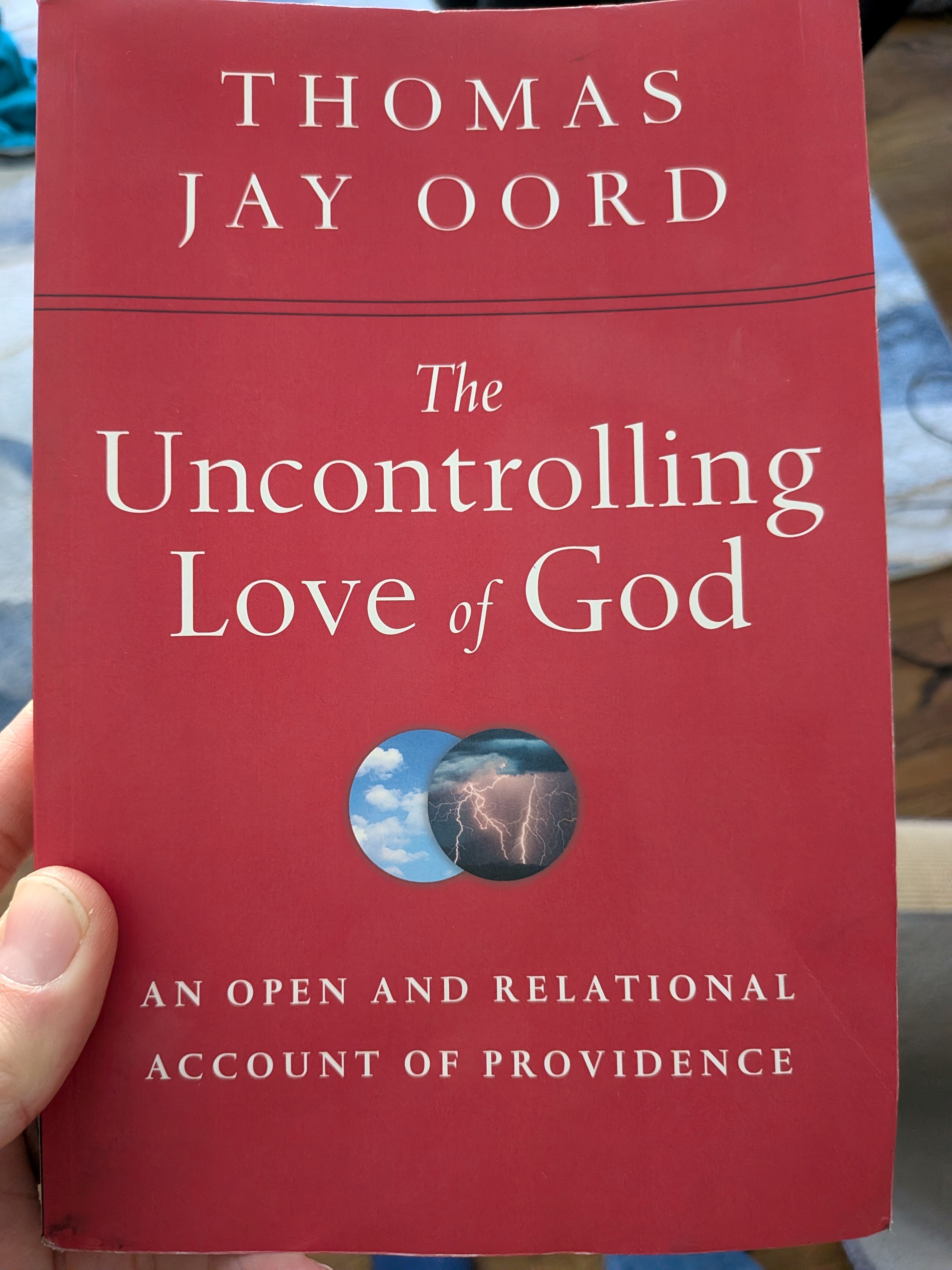
    I recently re-read Thomas Jay Oord’s 2015 book The Uncontrolling Love of God, which made a bit of a splash in certain circles when it first came out. While it’s a stimulating read, I found myself once again not fully convinced by the argument.

    In brief, Oord argues that God cannot — because of the divine nature itself — unilaterally act to guarantee certain outcomes in the world. According to Oord, God’s nature as “kenotic love” is inconsistent with the ability to act in a “coercive” manner. Rather, God’s activity is characterized by an “other-empowering” love that gives created beings the ability to act; however, God cannot, consistent with the loving divine nature, “override” creaturely activities to ensure that events take a particular course. God can act “persuasively” to woo creatures toward the good (similar to process theology) but cannot determine what they will do. In Oord’s view, this is the most satisfying solution to the problem of evil. This is because it allows us to see gratuitous evil as something God can’t prevent (in a very strong sense of “can’t”) rather than something God chooses not to prevent (much less directly wills or causes).

    It’s important to distinguish Oord’s view (and he is at great pains himself to distinguish it) from a family of views which holds that God voluntarily limits the divine power for the sake of creaturely freedom. Oord argues that this type of view leaves God vulnerable to the charge of permitting unnecessary evil because God could, on this view, intervene to prevent evil, but simply chooses not to, at least much of the time. On Oord’s view, by contrast, God cannot do this because the divine nature is such that God’s activity is always other-empowering and never coercive.

    While Oord does offer a strong critique of the “self-limitation” view, one point at which I remain unconvinced is that “kenotic love” must always rule out “coercion” or unilateral action by God. This has a certain plausibility when we’re talking about God’s relationship with human beings, who have (at least on Oord’s view) libertarian free will. In other words, it makes a certain sense to say that it would not be loving for God to unilaterally override my free will, and thus such an action is inconsistent with the divine nature as Oord understands it.

    Where this seems less plausible to me is when we’re talking about non-human creatures, and especially inanimate objects. Is it really the case that it would be a violation of love for God to unilaterally control the activities of creatures without free will (or even consciousness)? It’s far from obvious to me that it would be. It may be a great good for God to call into existence natural processes that by and large run according to their own immanent laws or principles; but would it necessarily be unloving for God to cause changes in these processes, even “coercively”? It’s just not clear to me that “coercion” has the same moral implications when we’re talking about non-human creation.

    Oord might respond that God’s nature simply requires a consistent approach to creatures of all kinds, whether conscious and/or free-will-having or not. But why should this be the case? Being loving doesn’t, at least on its face, seems to require treating everything the same way. It seems to me that God’s loving nature would only rule out unilateral action if such action were in violation of love. But why are we supposed to think this is the case when it comes to the non-human creation? I think the common moral connotations of “controlling” or “coercive” might be leading us to think there is a conflict with love in cases where there actually isn’t.

    Oord has an ancillary argument for why God can’t unilaterally determine any event – namely that God is an “omnipresent spirit” who lacks a localized body and therefore can’t physically intervene. But this seems to me to both prove too little and too much; for, if God can exert any causal influence on material objects (which on Oord’s view, God can, just not “coercive” influence), then why does God’s lack of a localized body mean that God can’t unilaterally determine outcomes? Either the lack of a localized body shows that God can’t exert any influence on physical processes, or it’s no barrier to God exerting influence of whatever kind.*

    In short, while I think Oord’s proposal is intriguing and original, I don’t think the concept of “kenotic love” does quite as much work as he wants it to. At the very least, I think more work would be needed to show that love necessarily rules out all unilateral or “coercive” divine action.


    *One possible solution to this would be to adopt a panpsychist view of creation which holds that all creatures have a mental or quasi-mental aspect. Then, one could perhaps say that God, as spirit, influences just this mental aspect of creatures.

  • Consider the beasts

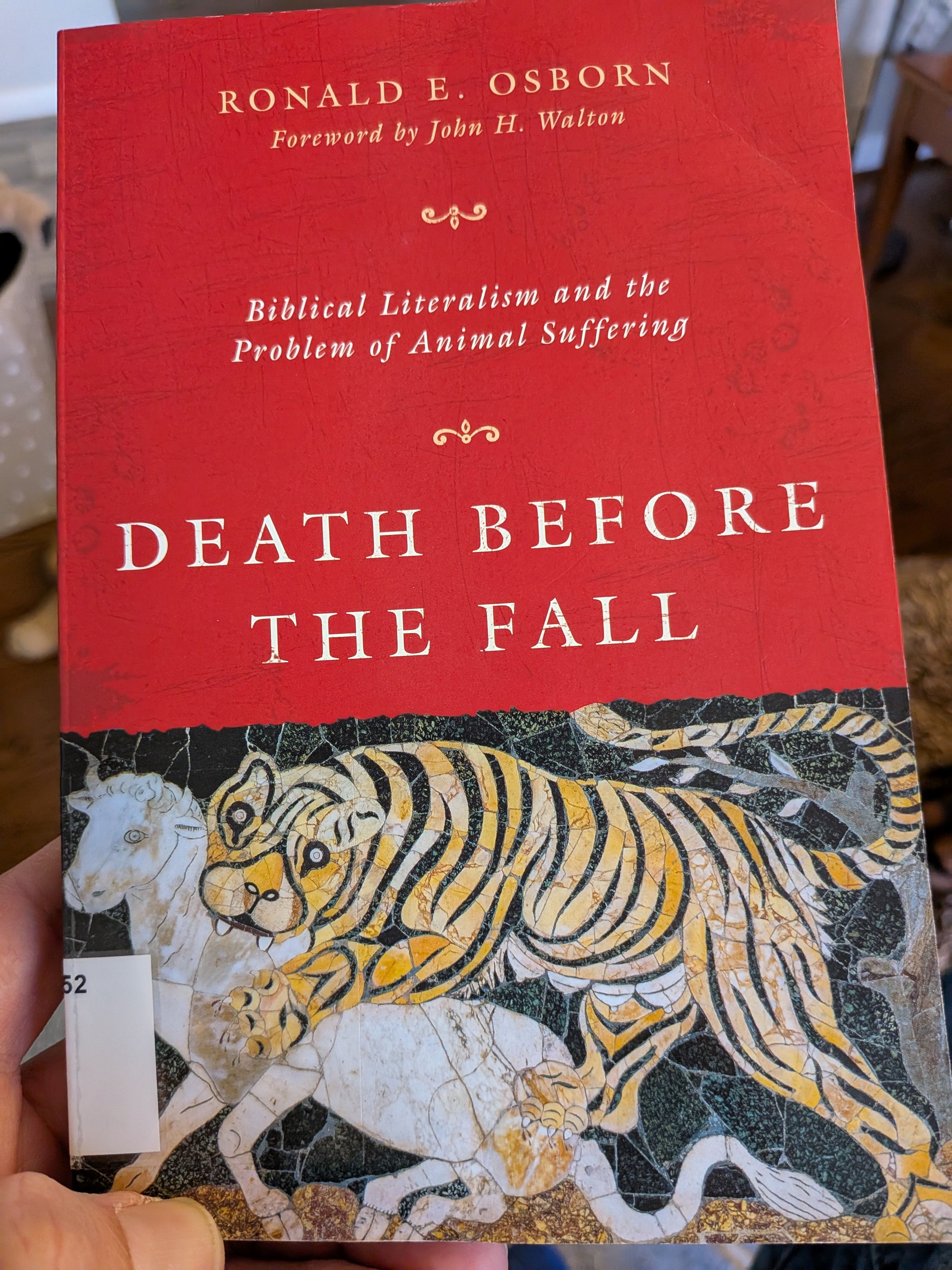
    Death Before the Fall: Biblical Literalism and the Problem of Animal Suffering, Ronald E. Osborn (IVP Academic, 2014)

    Much traditional Christian theology has taught that death and suffering entered the world when Adam and Eve fell into sin. Prior to the fall, many theologians have assumed, the world was free from suffering, sickness and death — and this included the nonhuman world. The prelapsarian world, on this account, was free from predation, parasitism, natural disaster and anything else that causes suffering in the animal kingdom. It was humanity’s sin that, somehow, resulted in all of creation being cursed, leading to the widespread suffering and death that is so evident in nature.

    One advantage of this account is that it, at least ostensibly, exempts God from any moral blame for the suffering of the non-human world. If animal suffering is the result of human sin — either as a penalty or through some more metaphysical connection — then creation as originally made by God did not include these morally troublesome features. God made creation perfect; it was humans who messed it up.

    However, one of the downsides of the traditional view is that it seems to conflict with the well-established findings of modern science. Not only evolutionary biology, but geology, paleontology, and other disciplines, seem to have established beyond a reasonable doubt that death, along with predation, parasitism, natural disasters, and their attendant suffering, long preexisted the appearance of humans on the scene. Accordingly, any theology that wants to make its peace with evolutionary science seems to be presented with a heightened theodicy question: Why would a good God create a world that contains so much animal suffering?

    In Death Before the Fall, Ronald E. Osborn, a scholar and theologian working out of the Seventh-Day Adventist tradition, wrestles with the problem of animal suffering in the context of a rejection of biblical literalism and creationism. This may seem somewhat counterintuitive given the Adventist Church’s affirmation of a literal, six-day creation. But Osborn is one of a number of Adventist scholars who dissent from his church’s official teaching on this point.

    In fact, Osborn spends over half of the book critiquing young-earth creationism and the literalist-fundamentalist readings of the Bible that support it. He argues that creationism ironically adopts an enlightenment-modernist model of knowledge and expects Scripture to conform to the same canons of evidence and factuality as modern science. However, creationism proceeds in a deductive rather than inductive fashion: a literalist reading of the creation story is treated as an unassailable foundation that can’t be questioned. Any facts that seem to contradict it either need to be denied or explained away via increasingly byzantine auxiliary hypotheses.

    This is both bad philosophy and a bad reading of scripture, according to Osborn. For example, he highlights some of the mental gymnastics creationists resort to in order to render the two creation stories in the first chapters of Genesis into one seamless account. These are hardly the result of a “plain” reading of the text!

    Not only does Osborn critique the intellectual supports of creationism, but he also argues that it leads believers into a quasi-gnostic enclave mentality in which any dissent is treated as the first step on the slippery slope to apostasy.

    Osborn has a high view of the inspiration and authority of scripture, but he maintains that this is consistent with reading the creation stories as symbolic-metaphorical narratives (or “saga” to use Karl Barth’s term). He marshals witnesses from history — Augustine, Maimonides, Calvin and Barth — to show that faithful believers have had a range of views on how these stories should be interpreted.

    For me, this was mostly well trod ground since I’ve never been particularly tempted by biblical literalism or been part of a tradition that taught it. But Osborn’s thorough critique allows him to clear the ground for the problem of how, if we reject creationism and a “deathless” prelapsarian world, to reconcile the violence and suffering of nature with the goodness of God the creator.*

    Wisely, in my view, Osborn doesn’t claim to offer an airtight defense or a knock-down solution to the problem of evil. Rather, he points to resources in scripture and tradition that indicate an alternative way of thinking about God’s relationship to creation.

    These resources include the idea of a “cosmic” fall demonic powers as articulated by C.S. Lewis (which is at least in theory consistent with cosmic history as science tells it), the depiction of an untamed creation that is nevertheless loved by God in the book of Job, and the self-emptying life of Jesus as a clue to how God relates to creation. Readers will likely vary in how persuasive they find these responses — but I think the picture that emerges is broadly consistent and appealing. Osborn sees God as creating a “space” where creation can operate according to its own immanent principles, which allow for the possibility that suffering could emerge as a concomitant of these processes. Nevertheless, God works from within creation to draw it toward its fulfillment, and that action is characterize by the “cosuffering humility, nonviolent self-limitation and liberal self-donation” exemplified in Jesus.

    This could be described as a version of the “free process” defense (analogous to the “free will” defense) articulated by John Polkinghorne and others. Essentially, it says that creation has a real, albeit limited, autonomy because God recognizes that it is a great good for created beings to exercise their own causal powers, even if it may lead to consequences God doesn’t’ intend. Many readers will note affinities here with various strains of “open and relational” theology, which is not coincidental, based on some of the references in Osborn’s book. And, cards on the table, my own sympathies are largely with some version of that theology. Certainly, I find it more compelling than the omni-causal deterministic God found in some versions of reformed theology.

    Osborn concludes his book with some reflections on the ethical implications of his vision. One I found particularly interesting was his argument for a recovery of Sabbath-observance as a recognition that human beings are not masters of this world but were made to share in God’s own rest. The Adventist church is one of the few Christian denominations that has maintained observance of the Sabbath, and Osborn suggests that it is importantly distinct from celebrating the Lord’s Day and it could be one way of repenting of Christianity’s long history of anti-Judaism.

    More directly relevant to the topic of the book, he also offers a passionate call for improving our treatment of animals and the rest of God’s non-human creation (it’s worth noting that Adventists are generally expected to practice vegetarianism):

    Herein, it seems to me, lies the most pressing theological dilemma of our age–not the theodicy dilemma of evolutionary biology but the anthropodicy dilemma of late capitalism. Is it still possible to justify the existence of that species that has become a force of such destruction on the planet that it is no longer clear that other species will survive? Does the imago Dei remain, or shall we devour the earth that was left in our care without restraint until it is an utterly scorched desert? Any credible answer to these questions, which grow in urgency every day, must take the form not of the detached theologizing but of concrete and ethical action that brings sabbath peace to our brothers and sisters in the animal kingdom. Their blood may or may not be upon God’s hands. On the third planet of the sun there can be no doubt that it is now upon our own. (p. 175)

    As I perhaps hinted above, I might’ve preferred if Osborn had spent less time critiquing creationism and biblical literalism and more time fleshing out his alternative approach. But that may just be a case of whishing an author wrote a different book than they did. (Readers interested in pursuing some of these ideas further might consult the volume The Work of Love: Creation as Kenosis, edited by John Polkinghorne.) That minor quibble aside, this was a thoroughly stimulating and largely compelling read on a topic that is crucial (and sadly still much neglected) for any credible Christian theology.

    ———————————-

    *It’s worth noting that creationism’s “solution” to the problem of animal suffering isn’t as straightforward as it seems. As Osborn points out, it’s far from clear that it’s just of God to condemn the entire animal creation to untold amounts of suffering as a “punishment” or “curse” resulting from the sin of human beings!

  • Best Theology Books I Read This Year

    Continuing the experiment of dusting off this creaky old blog, here are the best theology books I read this year (not necessarily published this year!):

    Teresa Morgan, Trust in Atonement: Teresa Morgan is a scholar of classical antiquity as well as New Testament and early Christianity, and she brings this perspective to bear in developing a new model of the atonement in this stimulating book. Taking the Greek pistis, with its connotations of “trust” and “trustworthiness,” Prof. Morgan argues that Christ is the one who God entrusts to create trust in human beings. In order to reconcile God and human beings, Jesus creates a “space” where trust can be (re-)established. God entrusts Jesus to us, even at our worst, in order to demonstrate that we can put our trust in God. This is an intriguing work that offers a genuinely fresh alternative to the typically rehearsed atonement models.

    St. Athanasius, On the Incarnation: I decided to revisit Athanasius’ classic treatise this year, which remains one of the touchstones of classic Christian theology. One thing that struck me this time around was that, although Athanasius is sometimes presented as an alternative to “forensic,” “juridical” satisfaction theories of the atonement, there are elements of such accounts in his argument. For example, Athanasius says that in dying for us, Christ discharges a “debt” to God, which sounds positively Anselmian. Though it should be said that the emphasis remains on the ontological change effected through the incarnation. There are certainly arguments one could pick with Athanasius’ treatise (e.g. it says very little about Jesus’ earthly ministry and it’s not clear he has completely absorbed the point that Jesus is fully human), but it remains a lucid presentation of one of the essential truths of Christianity.

    Nijay Gupta, The Affections of Christ Jesus:When there is so much niche scholarship being published on Paul, it’s nice to see someone offer an original interpretation of his thought as a whole. Gupta, professor of New Testament at Northern Seminary, argues that, as the book’s subtitle has it, love is at the heart of Paul’s theology. He applies this insight to Paul’s gospel, his understanding of Christian community, and his ethics, among other topics. “Christianity is about love” may sound trite, but Gupta’s work throws fresh light on Paul’s theology and its relevance for us.

    Mildred Bangs Wynkoop, A Theology of Love: I read and discussed this book a chapter at a time with one of my good friends, who is also a deacon in the United Methodist Church. Wynkoop was a Church of the Nazarene theologian in the Wesleyan-Holiness tradition who tried to interpret the language of her tradition (“sanctification,” “perfection,” etc.) in ways that would make sense for contemporary people. One of her key insights is that doctrine has to connect with life in a meaningful way – too often theological terms become shibboleths that don’t find purchase in our actual experience. For Wynkoop, “holiness” is fundamentally about the flowering of love in our relationship with God and others. It is never a sub-personal, mechanical, or quasi-magical process; rather, it is an intensely personal relationship with the God of love.

    Samuel Wells, Constructing an Incarnational Theology: This is an ambitious work that tries to reframe Christian theology around a “supra-lapsarian” understanding of the incarnation. Wells, a pastor of St. Martin-in-the-Fields in London, former Dean of the Chapel at Duke University, and author of numerous other works, applies his concept of “being-with” to some of the classic loci in Christian theology. Wells argues that, most fundamentally, God desires to be with God’s creatures and all of creation exists for this purpose. Rather than the incarnation being a “plan B” in response to sin, it is the manifestation of God’s desire to be with God’s creation. This is a provocative and original work, though I’m not 100% sold on Wells’ organizing idea of “being-with” as a kind of master key for scripture.

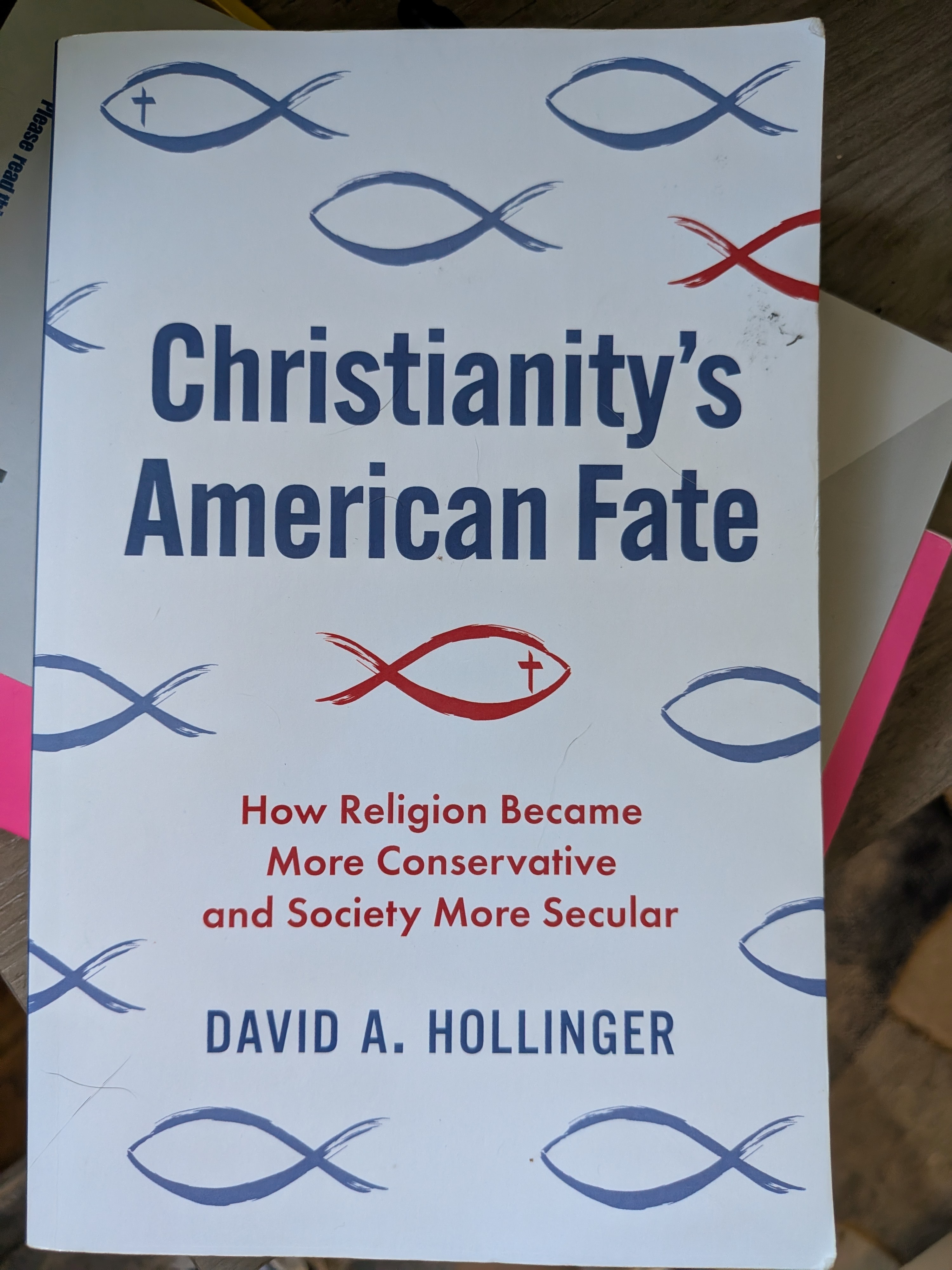
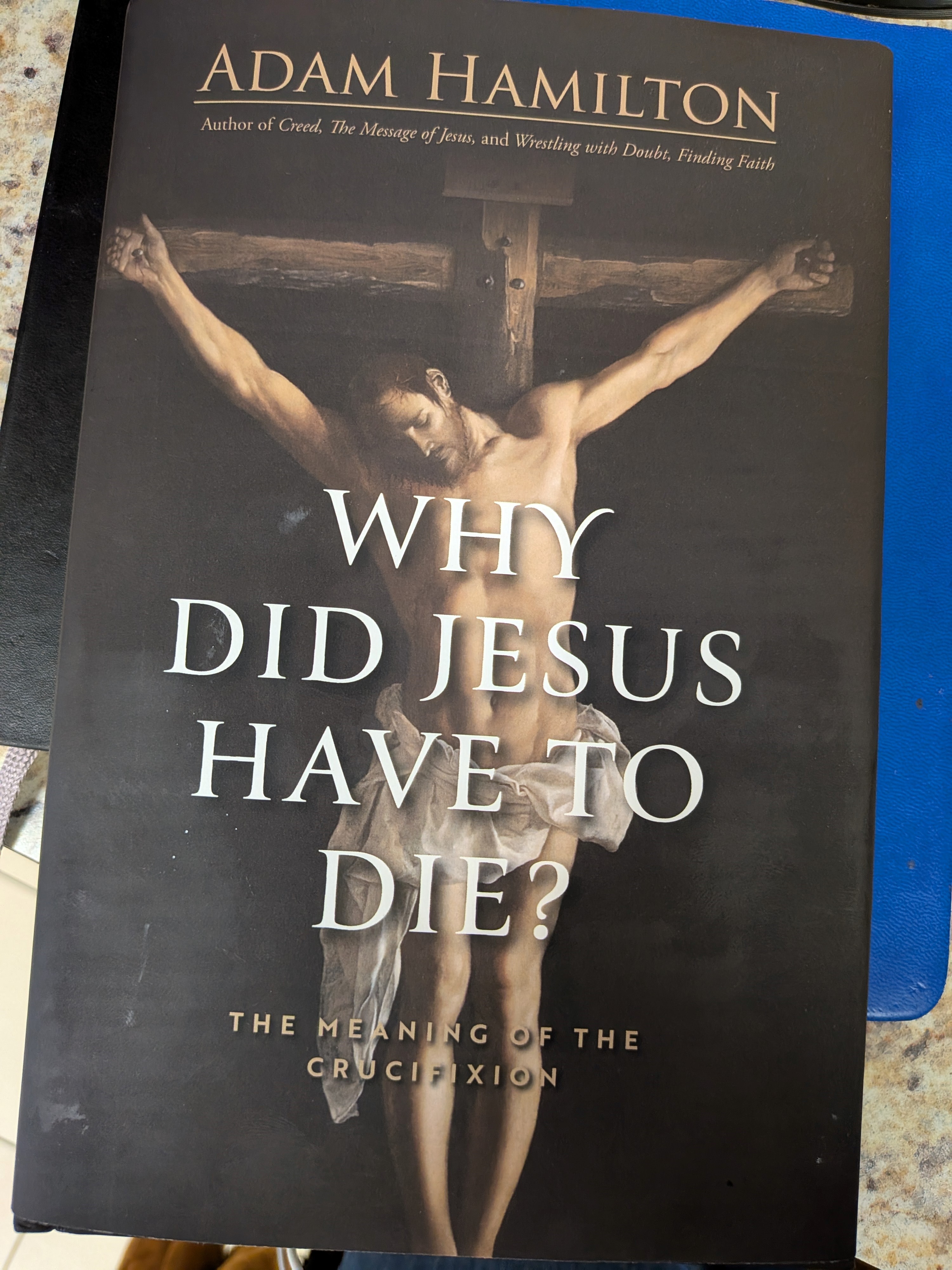
    Adam Hamilton, Why Did Jesus Have to Die? See my review here!

  • The Cross as God’s Word

    Adam Hamilton, Why Did Jesus Have to Die? The Meaning of the Crucifixion (Abingdon Press, 2025)

    Adam Hamilton is the pastor of the Church of the Resurrection in Leawood, KS, one of the largest Methodist churches in the country. He’s also the author of numerous books and bible studies where he’s tried to carve out what I would characterize as an irenic Christian orthodoxy for mainline Protestants. He’s “progressive” in the sense of supporting women in ministry and the full equality of LGBTQ+ folks in the church; but his theology is more in the spirit of a Lewisian “mere Christianity.”

    I co-lead a small group at my church, and we’ve used a number of Hamilton’s books over the years. His latest book, Why Did Jesus Have to Die? is one of the more explicitly theological of his works. In it, he wrestles with several of the traditional “theories” of the Atonement – or how Christ’s death and resurrection reconcile us to God. Since this is a topic I’ve long struggled with, I was interested to see how Hamilton would approach it.

    Maybe the most important move Hamilton makes is how he frames the Atonement. It’s a mistake, he argues, to treat theories of Atonement as though they describe the “mechanism” by which God effects our reconciliation. Instead, he says, we should see the cross as “God’s Word to humanity”:

    Jesus incarnates God’s word, revealing God’s heart and character, God’s action on our behalf to reconcile and heal us, God’s word about the human condition, and God’s word concerning God’s will for our lives. Our task is to hear this word, to receive it, and to allow it to have its intended effect on our lives, and through us, on the world. (p. xviii)

    Hamilton acknowledges that some might see this as a merely “subjective” interpretation of the cross. However, he notes “that claim fails to understand the power of God’s Word and how God works in our world”:

    Throughout scripture God acts by speaking. “God said ‘Let there be light.’ And so light appeared. God saw how good the light was” (Gen. 1:3-4). God speaks and a stuttering sheepherd named Moses becomes the great deliverer. God speaks and the childless Abraham and Sarah conceive a child. God speaks through prophets and kingdoms rise and fall. Paul, as well as the writer of Hebrews, describes God’s word as a sword. But most importantly for our purposes, in his epic prologue, John describes Jesus himself as God’s Word. (p. xix)

    In this perspective, the various New Testament motifs or metaphors for the salvation Jesus brings are better viewed as multifaceted images of the word God speaks in the death and resurrection of Jesus.

    In the succeeding chapters, Hamilton provides an overview of various NT metaphors and the theories of the Atonement that have been built upon them. These include:

    Recapitulation – Jesus is the new human archetype

    Penal substitution – Jesus bears the punishment we deserve

    Sacrifice – Jesus offers himself for our forgiveness

    Passover Lamb – Christ delivers us from slavery and death

    New Covenant – Jesus institutes a new covenant in his blood

    Ransom – Christ frees us from the devil/powers of evil

    Redemption – Jesus purchases our freedom

    In all these cases, Hamilton thinks we can recover the power of these metaphors/images interpreted as aspects or facets of the word God speaks to us.

    An instructive case study is that of penal substitution, which is both the most popular theory of atonement in some Christian circles and the most controversial in others. Hamilton offers strong criticisms of this theory as it’s often presented. These will be familiar to those who’ve followed the debate:

    1. The idea that Jesus’ death was to appease God’s anger seems contrary to the gospel message.
    2. It paints an unflattering image of a God who needs an innocent person to be tortured and killed in order to forgive.
    3. It suggests God cannot forgive sin without punishment. But God is portrayed throughout Scripture as forgiving without punishment.

    There are, of course, more sophisticated and nuanced presentations of penal substitution (e.g. John Stott’s The Cross of Christ). But even the most sophisticated interpretations of penal substitution tend to suggest that Christ’s suffering and death was something God needed in order to be gracious to us.

    Hamilton does think, however, that the motif of Christ suffering for us can be helpful:

    I believe it is we who needed Jesus’ death, not God. It was to change our hearts, not to change God’s heart. God can forgive anyone God chooses and does not require God’s Son’s torturous death in order to appease his anger.

    As God’s Word, we can say that we see God demonstrating the pain he himself experiences as a result of human sin but also the lengths to which he is willing to go to save us from it. (p. 28)

    I might put it this way: The cross reveals that God is always bearing the pain of our sin – and yet always offering mercy and forgiveness. The more “transactional” view suggests that there was a time when this wasn’t the case — that God had to be persuaded or paid off in order to be merciful. Attempts to salvage this by appealing to the Trintiy only get you so far, because you still end up having to say that God is paying Godself off or self-propitiating, which is an obscure idea to say the least.

    Interestingly, given the reputation “moral exemplar” theories have had (almost as bad as penal substitution!), Hamilton spends to chapters expounding and defending multiple versions of this motif.

    Essentially, Hamilton boils this down to two elements:

    1. Christ provides an example of sacrificial love that we are to imitate.
    2. Christ’s death reveals God’s loving heart to us.

    It’s the second of these ideas that Hamilton says he finds the most compelling of the traditional atonement motifs. But what, one might ask, distinguishes the death of Jesus from the deaths of other heroic saints and martyrs throughout history?

    What differentiates Jesus’ death … is his identity as God’s Word enfleshed. In John 14:11, Jesus said “I am in the Father and the Father is in me.” Christians believe that Jesus is the incarnation, the very embodied presence of God the Son. He is God’s anointed King. He is the Word of God enfleshed. He is God, the Son, who willingly dies not just for one person, but for all of humanity. (p. 80)

    As Hamilton puts it:

    [The Cross] reveals the very heart of God for humankind, and the motivation behind Christ’s death. It sees the story of Jesus as a love story portraying God’s steadfast love for humanity climaxing with the highest expression love might take — that of dying for another. When this love is experienced and accepted, it draws us to God, leads us to repentance, transforms our hearts, and, with the help of the Holy Spirit, compels us to live a life of selfless love. (pp. 80-81)

    One could say that the death of Christ reveals God’s love because it was the (inevitable?) outcome of the kind of life he lived — the life of God’s love reaching out to us. God in Christ willed to be with humanity and creation, but human beings, in their sin, rejected God. However, this didn’t (indeed, can’t) deter God’s love, and God “loved his own to the end” (Jn. 13:1). (For a theology that puts God’s desire to be with us at the center, see Samuel Wells’ Constructing an Incarnational Theology.)

    Fittingly, Hamilton concludes the book with an exposition of the “Christ the Victor” motif. All too often, Christian thought has separated the cross from the resurrection. This can suggest that it’s Christ’s death alone which saves us and this was the entire reason for his coming.

    Through his death and resurrection Jesus overcomes the forces of evil. This doesn’t mean these forces have been destroyed — history and current experience give ample evidence that they still plague us. But the cross and resurrection demonstrate that God’s love is sovereign over these powers and they will ultimately be defeated once and for all. Importantly, this means that we can be freed from the fear of death and for works of love for our neighbors.

    Summarizing, Hamilton offers some key takeaways:

    • Jesus didn’t have to die, but he believed God could use his death for a redemptive purpose.
    • Christ’s death is about forgiveness — but also more than forgiveness. It’s about transformation, new life, and victory over death, among other things.
    • Metaphors for atonement shouldn’t be confused with “mechanisms” that explain “how it works.”

    I think some more transactional understandings of the Atonement appeal to our desire for things to be fixed through a quasi-magical act that doesn’t require anything from us. But Hamilton’s insistence that, in the cross, God is reaching out to us emphasizes the personal nature of this relationship. Ultimately, the cross and resurrection are God offering Godself to us through God’s Word, for our reconciliation, forgiveness, liberation and new life.

  • A ransom for many

    I just finished reading Deceiving the Devil: Atonement, Abuse, and Ransom by feminist theologian Darby Kathleen Ray, partly at the suggestion of someone on Twitter. It’s essentially a critique of traditional models of the atonement from a feminist and liberationist perspective, but it creatively mines the tradition for a constructive counter-proposal.

    One strength of this book is the detailed discussion of feminist concerns about certain traditional atonement motifs (e.g. Anselm and Abelard)–namely that they encourage suffering, victimization and passivity in the face of evil. Sometimes these critiques are tossed off without really being substantiated (e.g., vague references to “divine child abuse”). But Ray spends a lot of time explaining exactly what feminist critics find troublesome about these models and how they contribute to suffering. Even if one doesn’t find these criticisms wholly persuasive, there’s a substantial argument here that needs to be engaged with.

    Another contribution of this book is that Ray connects the concerns of (largely) North American feminists to the similar, but also importantly different, issues raised by Latin American liberation theologians and shows how each can enrich the other.

    For example, despite their criticisms of certain traditional interpretations of the atonement, some liberation theologians have developed a more positive account of the significance of Jesus’ death. The suffering Jesus becomes a figure with whom the oppressed poor can identify, and this can give them strength in their struggle. Moreover, liberation theologians have shown how Jesus’ death is consonant with his life and ministry, which on this reading was about bringing mercy to the downtrodden and confronting forces of evil and oppression. On this view, Jesus’ death was a consummation of the way he lived and powerfully shows what nonviolent resistance to the powers that be looks like. Ray thinks this is a useful corrective to some feminist theologians’ refusal to attribute any salvific significance to the crucifixion.

    Ray’s constructive proposal seeks to incorporate these insights but also to go beyond them by reclaiming imagery from the early church. The motif or model she develops is essentially a demythologized version of the patristic “ransom” theory where Jesus’ death tricks Satan into surrendering his rights over humanity. In the colorful images offered by some church fathers, Jesus is the bait on the fishhook or the cheese in the mousetrap that ensnares Satan. Humanity, by sinning, had put itself under Satan’s dominion, but by killing Jesus the innocent one, Satan forfeited any rights over us. (This is dramatically, and famously, portrayed in C.S. Lewis’s The Lion, the Witch and the Wardrobe.)

    In Ray’s demythologized version, Jesus subverts or “outsmarts” evil by responding with nonviolent love instead of with coercive force. By killing Jesus, the forces of evil, which Ray identifies with oppressive social, political and economic structures rooted in a desire to dominate and control others, are exposed as bankrupt and lacking legitimacy.

    The way of Jesus, culminating in his death, reveals the illegitimacy of coercive domination. Humanity’s enslavement to evil is loosened because Jesus, in his life and death, has established a new way of being in resistance of evil. This becomes a permanent possibility, accessible to all human beings, because it was “incarnated” in Jesus. This interpretation of the ransom motif could also be seen as a variety of Christus Victor — Jesus wins a paradoxical victory over the powers of evil be persisting in his mode of non-violent love, even to the point of death.

    This, however, brings me to some of the qualms I have about Ray’s model. In the traditional Christus Victor model, the resurrection of Jesus plays an essential role. By raising him from death, God puts the stamp of approval on Jesus’ ministry, and shows that noncoercive love has the last word in the cosmos, appearances to the contrary notwithstanding. The resurrection is the locus of victory over the evil powers, although its meaning can never be separated from the cross.

    However, the resurrection plays virtually no role in Ray’s discussion. The closest she comes is in saying that the community, when it follows Jesus’ lifestyle of nonviolent love, “resurrects” him. This could be because Ray simply doesn’t believe in a traditional version of Jesus’ resurrection. But it may also be because she wants to avoid seemingly tidy resolutions to the problem of evil.

    Ray emphasizes the “tragic” nature of existence and the fact that all our efforts to resist evil are piecemeal. This seems to lead her to deny that there will be some kind of ultimate resolution–or at least downplay the possibility. She seems to worry that belief in any such divine intervention could lead to complacency about evil, something that she has argued is encouraged by certain traditional interpretations of the atonement.

    I think one has to respect this refusal to prematurely declare victory over evil. Heaven knows that Christianity has been guilty of more than its fair share of triumphalism over the centuries. As Clark Williamson, Rosemary Radford Ruether, and other theologians focusing on Christian anti-Judaism have pointed out, Christianity has often lost the “proleptic” nature of the of redemption–the idea that Jesus’ resurrection is a sort of promissory note for an ultimate redemption that is still to come (whatever that may look like). On this view, evil has not been eradicated but continues to stalk the world in this time between the times. Too often, Christians have conflated the church and the kingdom, losing the eschatological hope for a redeemed creation.

    Such an understanding of redemption might address some of Ray’s concerns about complacency in the face of evil, without surrendering Christianity’s traditional hope in God’s ultimate victory over evil. By downplaying the resurrection Ray’s re-tooled ransom theory ends up looking a lot like another version of exemplarism. Jesus embodies a way of living that Christians (and potentially others) can emulate, and his death reveals the bankruptcy of coercive domination (or what Walter Wink called “the domination system”). While this account of sin and its grip on human beings is powerful and illuminating, I wonder if the atonement as she interprets it is capable of liberating human beings from its power. In other words, it’s not clear on this account how Jesus’ life and death (and resurrection) save, as opposed to being inspiring examples of nonviolent resistance. 

    What this understanding of sin calls for, it seems to me, is a power that can truly liberate humans and which promises fulfillment and salvation for all. Of course, there’s always the possibility that such a hope is a form of wishful thinking and we should be content with what Scottish theologian John Macquarrie called the “austere ending” as one possible interpretation of the story of Jesus.* But I at least continue to hope that the alternative, “happy ending” is the true one. I’m also hopeful that this story can be a source of love and freedom for all creation rather than something that fosters abuse and suffering.

    —————————————————

    *In his Jesus Christ in Modern Thought, Macquarrie contends that there are two possible endings to the Jesus story, based on the historical evidence and a responsible theological interpretation. The “happy ending” of the Jesus story is the series of “mysteries” that follow the crucifixion–the descent into hell, the resurrection, the ascension and the second coming. This is obviously the convetional ending, the version of the story taught by most churches and believed by most Christians. It assures us that we will live beyond the grave and that at least some of us will be crowned with everlasting happiness. But there is also an “austere ending” that also provides a plausible interpretation of Jesus’ career and in which we can still find meaning. As Macquarrie writes, “Suppose we omitted the ‘joyful mysteries’ that traditionally came after the cross? Would that destroy the whole fabric of faith in Christ? I do not think so, for the two great distinctive Christian affirmations would remain untouched — God is love, and God is revealed in Jesus Christ. . . . If the highest virtue is the kind of love which the New Testament attributes to Jesus, then it seems to me that his victory over evil was already won in the agonizing hours before his death, and that it would remain decisive even if there were no subsequent events of resurrection and ascension.” (p. 412) Somewhat similar to Ray, in his treatment of the work of Christ, Macquarrie develops a demythologized version of Christus Victor, in which Jesus’ atonement consists in his loving to the point of death and establishing a new template or possibility for human living.