Learning from Other Religions, David Brown (Cambridge University Press, 2024)
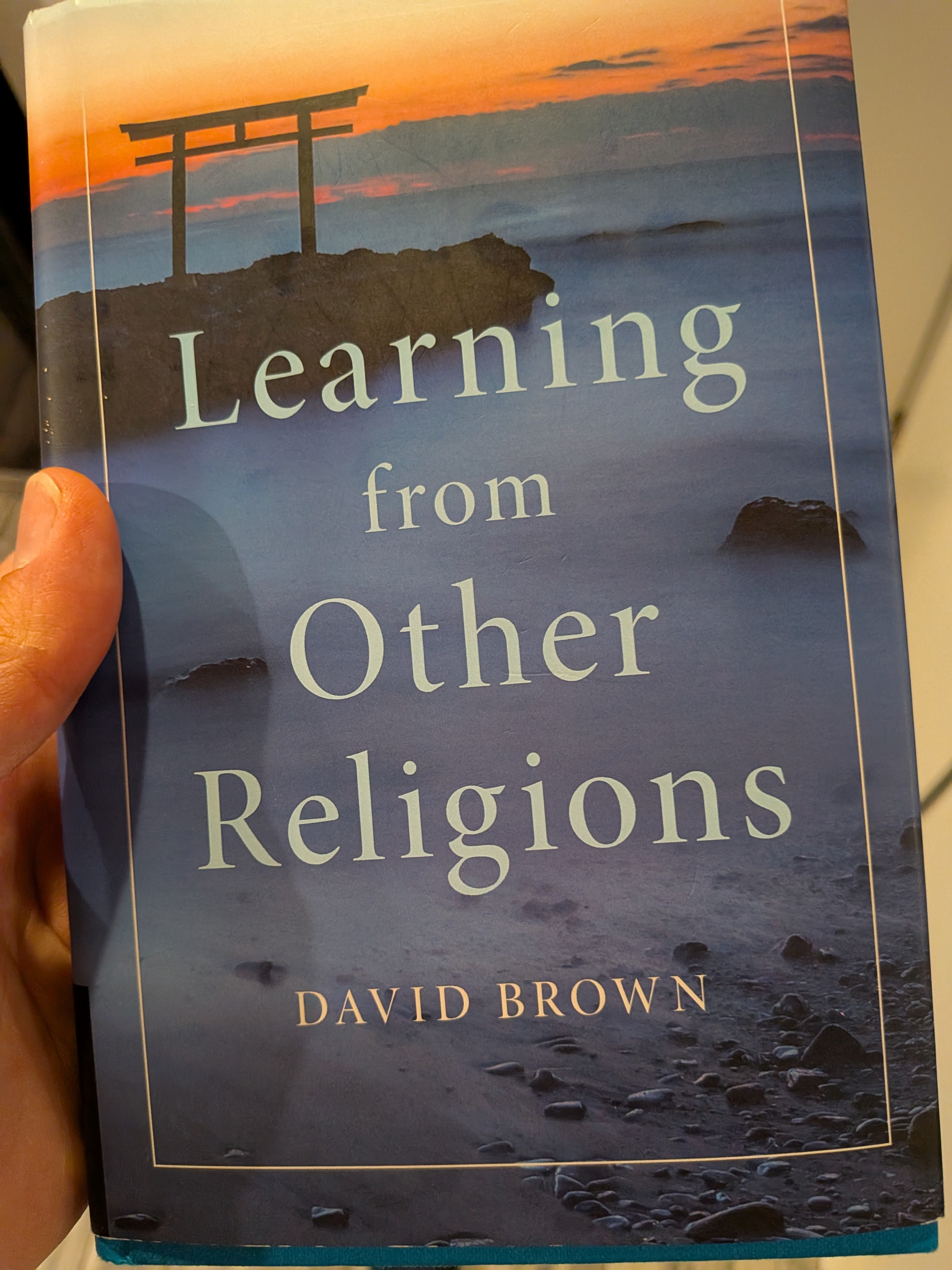
Arguments about how to understand the relationship among humanity’s various religious traditions have often run in well-worn grooves: Exclusivists hold to the absolute and unique truth of their religion; inclusivists regard the differing faiths as approximations of the one true religion; and pluralists view all the great enduring traditions as more or less pointing to the same truth. There have been occasional attempts to step outside this framing (S. Mark Heim’s proposal of multiple, incommensurate “salvations” comes to mind), but these three options have structured much of the discussion, at least in Western philosophical and theological circles.
David Brown, an Anglican theologian with wide-ranging interests that include trinitarian doctrine, Christology, and the role of art and culture in religion, offers another attempt to break out of the usual boxes in this engaging book. Brown doesn’t have a pithy name for his approach, but he rejects what he takes to be the three major approaches: no one religion has a monopoly on truth (as in exclusivism), but he also rejects inclusivism and pluralism, at least in their most common formulations.
Instead, Brown views the various religious traditions as “shards” of a “mosaic” of truth about the divine. No one faith can claim to have the whole picture, and nor are the various religions simply blurry approximations of the religion with the clearest grasp on the truth (e.g. Christianity).
This is based on a more general position about the nature of divine revelation and religious truth. Brown argues that revelation is conditioned by the social, cultural, psychological and other circumstances of its recipients. Thus, divine truth doesn’t come to us “neat,” but mixed with human perceptions and biases. This is, he thinks, the best explanation for the evident variation within religious traditions — e.g. the parts of the Bible that attribute morally dubious actions or attitudes to God. It makes sense, Brown thinks, that revelation is at times distorted — or that humans are taking in as much truth as is possible for them at that particular point in history. (And this may even be providential — it might not make sense for God to have revealed a truth that human beings were not capable of grasping at a certain point in history.)
Something else Brown emphasizes is the “imaginative” nature of religious truth. Far from being simply a matter of revealed propositions, religious truth is appropriated through a variety of means, including mythological narratives, music, poetry, and the visual arts. These open up a dimension of reality that often eludes literal description. Accordingly, it’s not always possible to compare tenets from different religions 1-to-1 as though they were operating in the same type of discourse.
Consequently, Brown argues, different cultures will have received different aspects of the truth, or assimilated it in ways that may mediate those aspects differently (through their art, rituals, scriptures, etc.). Taking this more expansive approach, we should expect that different traditions can reveal different truths, rather than being more-or-less adequate approximations to a single truth clearly revealed in just one tradition. Christians, Brown avers, should accordingly be open to the idea, not just that other religions might dimly reflect Christian truth, but that they might contribute truth that the Christian tradition has failed to identify (or at least has underemphasized).
One of the most valuable parts of Brown’s book, in my view, is that he spends relatively little time on the schematics of the various views (exclusivism, inclusivism, pluralism). Instead, he tries to put flesh on the bones of his thesis by considering individual traditions (or groups of traditions) in each chapter and providing examples of truths they’ve emphasized and which he thinks Christianity would do well to consider. In some cases, he doesn’t think a major change is necessary, but certain truths should be emphasized that, while present in Christianity, may have received insufficient attention. Some of these are
- Hinduism’s use of feminine imagery for the divine
- Sikhism on the im/personal nature of God
- Daoism’s acceptance of death as a natural part of life
- Shintoism’s valuing of divine immanence
- How the Qur’an contextualizes and reinterprets certain biblical stories
This is neither an exhaustive list nor does Brown necessarily think he has identified the specific changes that Christianity should make. But he does hope to have demonstrated that there are plausible insights from other traditions that are absent or less prevalent in Christianity, but from which Christians have much to learn.
In his penultimate chapter, Brown offers somewhat more systematic reflections on his model of revelation. He summarizes his position:
While no religion possesses the totality of what may be known. aspects of the beautiful pattern which reflects ultimate reality can be discerned. It is constituted by a jigsaw of broken potsherds, as it were, with no single religion always in possession of the best perspective on the whole: sometimes patterns overlap; sometimes they are more clearly detectable in one religion rather than another; and sometimes there seems to be a fuzziness that precludes and immediate decision about which perceptible ‘pattern’ is the most accurate guide.
In advocating such an approach, it was no part of my expectation that a single common mind could easily emerge. Inevitably, each faith will consider certain commitments too fundamental to be readily relinquished (such as the doctrine of the incarnation within Christianity). Nonetheless, such beliefs can now be moderated by humble recognition that, sometimes at least, the divine address has been more adequately grasped in some other faith community. To hostile critics this may seem like an attempt to have it both ways, inclusivist yet also pluralist, but my hope is that something rather more is now in play, an enriched rather than reduced account of revelation. (pp. 310-11)
At various points throughout the book, Brown has highlighted cases where such a mutual enrichment has happened throughout history (for example, among Hindus, Buddhists and Muslims in Asia, or between Christian and Islamic theologians during the Middle Ages). In practice, if not in principle, religions have always been porous and open to the influence of other traditions to varying degrees. The monolithic, hermetically sealed tradition idealized by some religious conservatives is largely a myth. What Brown is saying, essentially, is that we should be more open and intentional about this process.
I particularly appreciated Brown’s concrete case studies of how this has or might work. That said, I’ll register a question I have about Brown’s overall approach.
In this book at least, Brown doesn’t really develop explicit criteria for what should be considered an “authentic” disclosure of the divine. Granted that all revelation (or putative revelation) is conditioned by social, cultural, etc. conditions; yet, the question remains how we’re supposed to discern a genuine insight into ultimate reality. Are these criteria internal to a given tradition (e.g. the teachings and example of Jesus), or are there criteria that transcend traditions? If we take the first path, then it seems we’re back at a form of inclusivism, albeit a perhaps more nuanced one. If we follow the second, then it seems we’ve arrived at a kind of Hickian pluralism or Kantian rationalism where all traditions are judged by how closely they approximate some moral or philosophical ideal. It may be that such considerations are beyond the scope of the book. Perhaps Brown is assuming the standpoint of the adherent of a particular tradition (Christianity in his case) and seeing how far he can extend a sympathetic openness to other religions.
But this may be an unsatisfying response if at least part of Brown’s intention is to provide a genuine alternative to the usual exclusivist-inclusivist-pluralist schema. These positions, whatever their other flaws, are clear about their criteria for truth/validity in religion. For both the exclusivist and inclusivist, it’s a particular religion that provides the benchmark; for the pluralist it’s usually some kind of external philosophical and/or moral commitment (though often explicitly or covertly occasioned by, if not derived from, a particular tradition). Any alternative to these positions would need to squarely face the question of truth more explicitly, I think.
All that said, I was largely persuaded by the thesis that other religious traditions might contribute truths to one’s own. I would say my own view is closer to inclusivism, but I do think a capacious inclusivism can adopt many of his arguments and insights. I certainly don’t think a Christian is committed to the view that actually existing Christianity has a monopoly on truths about God or the spiritual life. But I do think the encounter with other faiths will (inevitably?) involve some sifting of claims, and an appeal (implicitly or explicitly) to a criterion of truth.

