Strangest thing I saw on my trip: a sidewalk pamphleteer handing out literature attacking President Obama’s “socialist” health care plan. In Canada.
Author: Lee M.
-
Home again
My lovely wife and I returned today from our great trip north. Montreal and Quebec City are both lovely, as are the people who live there, at least as far as I can tell. (I practiced saying “Je ne parle pas français” a lot.) We spent most of our time walking around soaking in the sights and stuffing ourselves silly, with the former hopefully offsetting the latter to some degree. We spent the last night of our trip in Burlington, Vermont, which is also a lovely place, perched as it is on the shore of Lake Champlain. Delicious flatbread pizza and locally brewed beer were the order of the night, followed by Ben & Jerry’s of course.
I won’t pretend to have any brilliant insights into Canadian culture, much less French Canadian culture, though I did get that feeling, as I have on previous trips to Canada, of being in a kind of alternate-reality U.S. Most things seem familiar, but there are enough differences to let you know you’re in a foreign country. (Not that Canadians think of themselves as the goateed-Spock version of the U.S.; or would we be the evil version of Canada?) Also, the Canadian media seems just as obsessed with Michael Jackson’s death as the American.
Here are a few highlights:

Montreal from Mont Réal 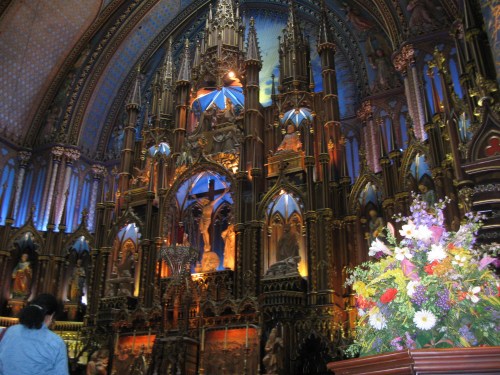
Notre Dame Basillica, Montreal 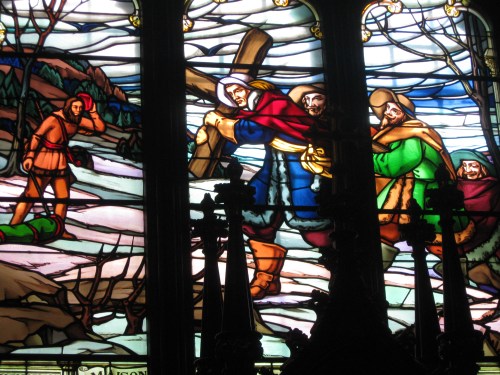
Jesus(?) on the frontier 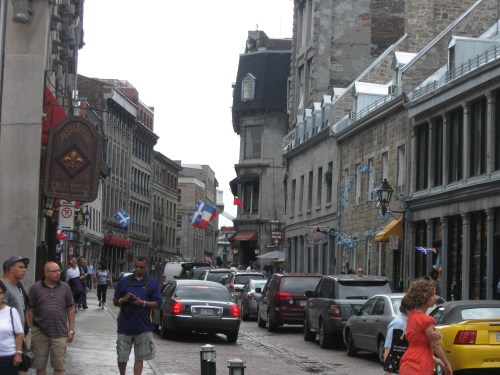
Old Montreal 
Delicious, delicious pastry 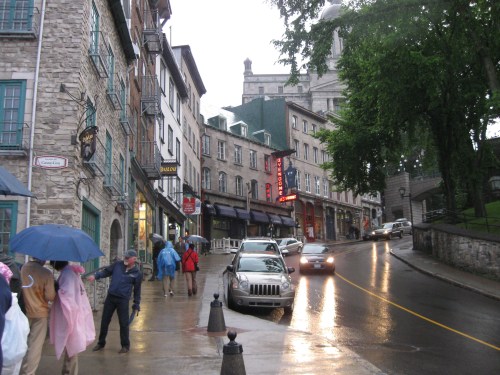
Quebec City – in the rain 
Québec libre! 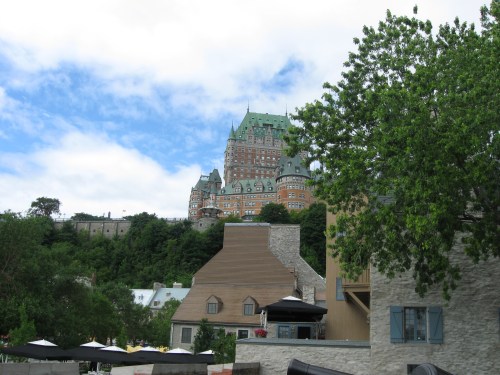
The Chateau Frontenac, overlooking lower Quebec City 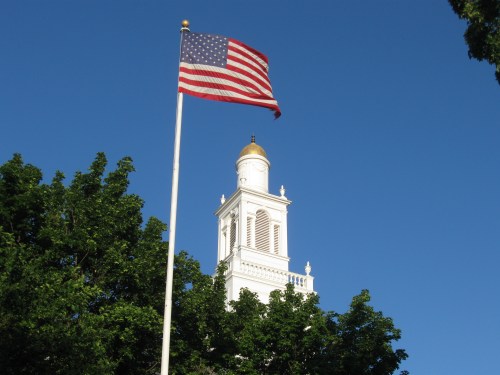
Home again! (Well, in VT anyway) 
Sunset over Lake Champlain 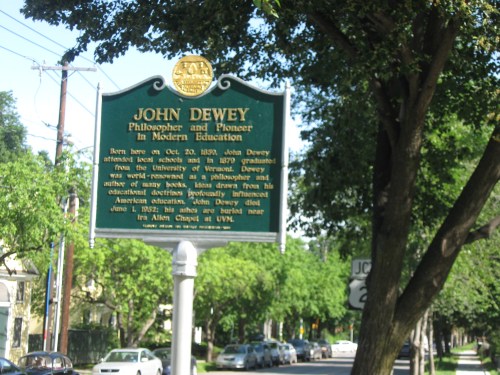
The birthplace of pragmatism (okay, exept for C.S. Peirce and William James) -
O Canada!
Well, it’s Canada Day, and what better way to celebrate than by…going to Canada?
That’s what I’m doing, anyway. My honey and I are leaving tomorrow for Montreal, followed by Quebec City (or just “Quebec” to the Canadians).
It seems a bit unpatriotic to leave the country over Independence Day weekend, but I’ll think of it as a goodwill visit to our northern cousins.
Posting will be light to nil until sometime next week at least.
Enjoy the fireworks and burgers, my fellow Americans.
-
Looking beyond the labels
James McWilliams, author of the forthcoming Just Food: Where Locavores Get It Wrong and How We Can Truly Eat Responsibly, looks at the lives of free-range pigs. While emphasizing that they’re far better off than their factory-farmed counterparts, McWilliams finds some serious ethical problems with the practice.
McWilliams’ conclusion is a measured one:
As responsible consumers, it’s easy to decide to avoid factory-farmed pork. The hard part is what to make of the most acceptable alternative. Does free-range farming justify the mutilation that’s often required to keep pigs outdoors? As an ethical matter, the question is open to endless debate. What the conscientious meat eater can take away from it is not so much a concrete answer as a more nuanced way to think about our food choices. In this age of deeply convincing attacks on factory farms, consumers must be careful not to immediately assume that every alternative to factory farming is as “all natural” or humane as its advocates will inevitably declare. The alternatives might require still more alternatives.
This call to look beyond the labels is important across the “food issue” spectrum. Pollan and others have made a similar point with the “organic” label: there are big farms that are technically organic but are a far cry from the small bucolic family farms that the term may conjure up. Which isn’t to say they’re necessarily bad either. A world of small bucolic family farms may not even be a possibility at this point, in which case, big organic might be a very desirable alternative. What I take McWilliams to be saying here (and elsewhere and, I presume, in his forthcoming book) is that there’s no silver bullet solution to eating sustainably that can be captured in a handy slogan (e.g., buy organic, buy local). This argument has also been made by Peter Singer and Jim Mason in The Ethics of What We Eat, which tries to go beyond simplistic labeling and trace the origins of different kinds of meals and their attendant costs in terms of animal welfare, human well-being, and environmental sustainability. In their reckoning, “local” and “organic” don’t always come out ahead.
What the situation seems to call for is more nuanced discussion, more informed consumers, and more truth in advertising, along with reform at the level of the food system as a whole.
(Link via Erik Marcus)
-
More on Anselm, death, and redemption
Christopher has an excellent follow-up post on Anselm and atonement, addressing some of the worries I had about Jesus’ death being a payment of sorts. Instead of trying to summarize it, I encourage you to read the whole thing.
Some of what Christopher wrote brought to mind a passage from Denis Edwards’ Ecology at the Heart of Faith (which I talked about in the previous post). Here Edwards is discussing Karl Rahner’s account of redemption:
[Rahner’s] focus is not on a forensic view of redemption, on Christ making up for human sin in legal terms, but on God embracing humanity and the world so that they are taken into God and deified.
[…]
He sees the death and resurrection of Jesus as two distinct sides of the one event. In death, Jesus freely hands his whole bodily existence into the mystery of a loving God. In the resurrection, God adopts creaturely reality as God’s own reality. Jesus, in his humanity and as part of a creaturely world, is forever taken into God. God’s self-bestowal to the world in the incarnation reaches its culmination in the resurrection, when God divinizes and transfigures the creturely reality of Jesus. (Ecology at the Heart of Faith, p. 87)
What I read Edwards as saying here is that Jesus offers his death, not as a payment, but as an act of total self-offering in trust. Because Jesus has made the perfect response to the Father, humanity–indeed, creaturehood–is taken into the divine life.
-
Climate action and public corruption
A pork-ridden Waxman-Markey passed the House yesterday, and heaven only knows what version of the bill will come out of the Senate and the subsequent process of reconciling the two. George Monbiot calls the U.S. a “failed state” when it comes to climate action and says that addressing political corruption (“corporate money and an unregulated corporate media”) is necessary for meaningful action. Here’s an account of the particularly egregious behavior of the farm lobby.
-
Barr on faith and evolution

