David A. Hollinger, Christianity’s American Fate: How Religion Became More Conservative and Society More Secular (Princeton University Press, 2022)
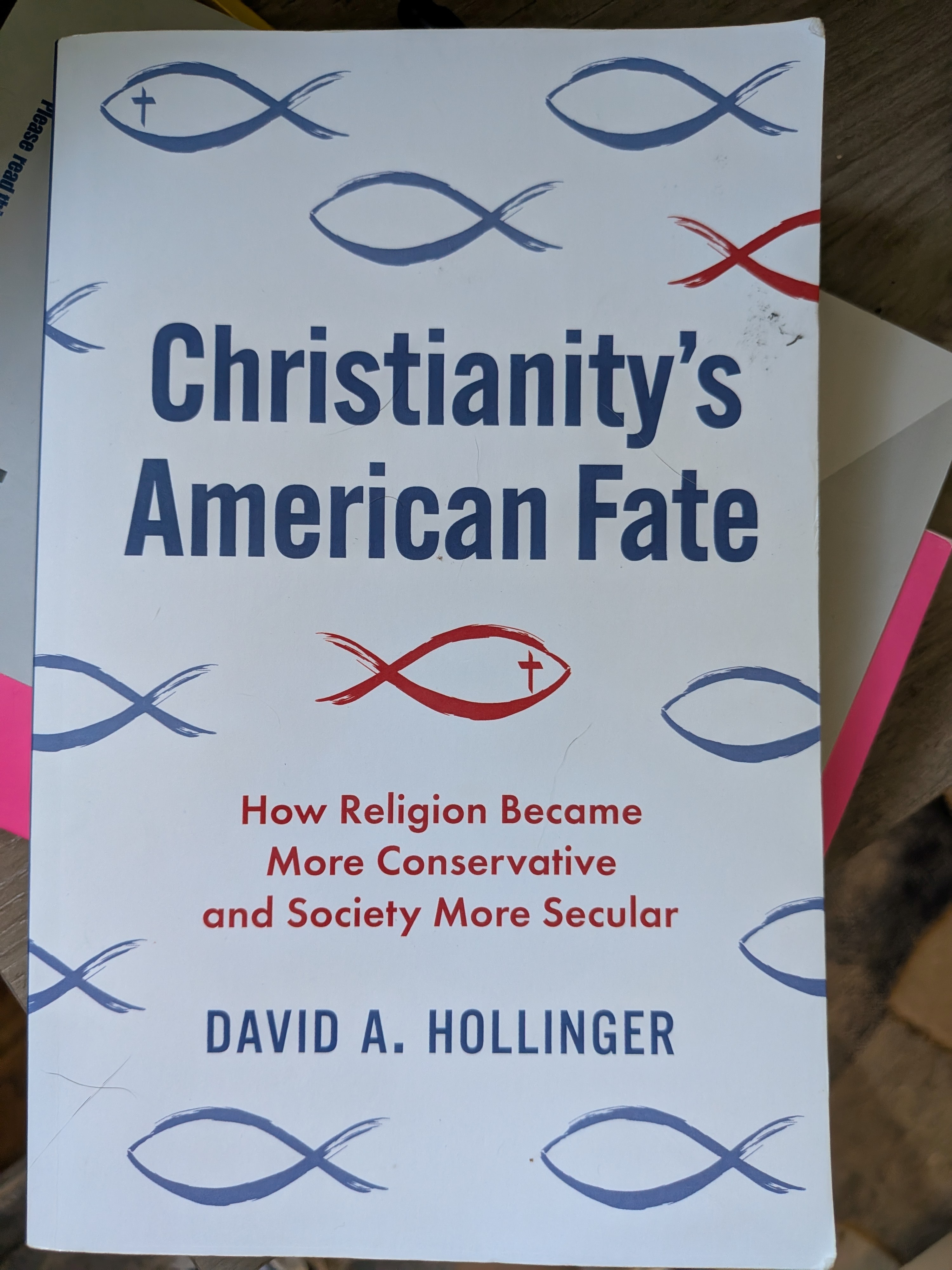
David A. Hollinger is a historian at UC Berkeley who has written previously on the fate of mainline (or as he prefers “ecumenical”) Protestantism in the United States (see, e.g. his After Cloven Tongues of Fire). In this slim but substantive volume, Hollinger seeks to explain how white evangelicalism became the dominant public face of Christianity in America, while ecumenical Protestantism lost the position it once held.
Typically, histories of modern Christianity trace the evolution of mainline Protestantism to actors like the rise of modern science, the advent of critical studies of the Bible, and other forces that led to a reckoning with the modern world. While he doesn’t ignore these phenomena, Hollinger focuses on two less-heralded reasons for the development of a more “cosmopolitan” Protestantism in the mainline churches. The first is the increased prominence of Jewish Americans in the country’s culture, politics, and intellectual life well out of proportion to their numbers. In Hollinger’s view, this spurred ecumenical Protestant leaders to gradually modify or abandon their inherited Christian supremacist assumptions in favor a more pluralistic outlook. Similarly, the discusses what he calls the “missionary boomerang effect.” This refers to the fact that many influential leaders and public intellectuals had been foreign missionaries or hailed from Protestant missionary families. In many cases, the effect of missions was not to “convert the heathen” but to create in the missionaries themselves a new respect for foreign peoples and their cultures, including their indigenous religions. This led to a reevaluation of both the superiority of Anglo-Protestant culture and Christianity itself. Moreover, it often served as a wake-up call to global injustice, including that perpetrated by the United States and its allies. The embrace of pluralism and globalism, many ecumenical Protestants came to believe, called for a rethinking of the church’s mission and message. As Hollinger puts it:
Ecumenical leaders deliberated about this while they tried to act more comprehensively on their growing historical sophistication, their increasingly resolute globalism, and their accelerating recognition of the diversity of American society. They tried to develop a version of Christianity suitable for their own time and place, yet consistent with a single, universally applicable gospel.
What might that gospel be? How might Christianity look if it were true to its deepest values yet functional in a demographically diverse, sexually and racially egalitarian, globally engaged, and scientifically literate society welcoming to Jews and other non-Christians? And a society that was, moreover, experiencing rapid urbanization, the expansion of education at all levels, and greater immersion in world affairs? (pp. 66-67)
This led to what Hollinger calls the “apotheosis” of mainline Protestantism. During the first half of the 20th century, ecumenical Protestant leaders threw themselves with gusto into movements for economic justice and civil rights and against war and colonialism. This coincided with a high-water mark for the mainline in the 1950s, both in terms of membership and cultural and political influence. Church leaders had retooled their message to be relevant to the modern age, focusing more on social and political justice and less on the drama of individual salvation.
The 1960s, however, marked the beginning of the now all-too-familiar story of mainline decline. Contributing to that decline, Hollinger says, is that the leadership may have gotten too far ahead of the people in the pews. This included avant garde theological positions (the so-called Death of God theologians, e.g.) and increasingly radical positions on hot-button political issues like civil rights and Vietnam. Hollinger notes that the leadership was demanding more and more of its parishioners in terms of social and political commitment. This drove a wedge between the national and regional leadership and the rank-and-file members. Meanwhile, a newly confident evangelicalism was making inroads with a comparatively simpler and more straightforward message of individual redemption (and social and political conservatism).
Rank-and-file white churchgoers in ecumenical churches were aware of these critiques [i.e. criticisms from conservatives] and sometimes worried about them. Had their own Methodist and Presbyterian and Episcopalian leaders become too radical, not only on race, but on Vietnam and a host of other issues? The gap between the cosmopolitan leadership and the provincial laity (and many small-town and rural pastors) within ecumenical churches widened. Church officials found themselves increasingly on the defensive in national and regional governance bodies. The people in the pews and many of their pastors refused to approve funding for projects they did not like. (p. 97)
Ultimately, mainline churches gradually lost membership to attrition, lower birth rates, and the sense among the increasingly well-educated children of mainliners that one could live a fulfilling life without going to church. Hollinger also notes that was increasingly possible to be a “respectable” evangelical: As evangelicals built their own cultural cachet and sophistication, “upwardly mobile” evangelicals no longer needed to “graduate” to one of the mainline churches to attain social respectability, as had once been the case.
The mainline/ecumenical effort to forge a more cosmopolitan Protestantism ultimately allowed conservative evangelicalism to seize the mantle of “true” Christianity. Because mainliners had embraced pluralism and even a degree of relativism in their attitude to Christian beliefs, evangelicals could claim, with some plausibility, to be the true heirs of the Christian tradition. They also rejected the social and political progressivism of mainline leaders. As Hollinger notes, evangelicalism had long been comfortable with business interests and a laissez-faire approach to political economy. They were also taught to resent federal oversight of their institutions (or intrusion as they saw it). This made the burgeoning alliance with the Republican Party seem natural (the 1980 election being the key turning point). Hollinger emphasized that this alliance long predates Trump, though it has reached new heights in the Trump era (odd as this has seemed to many observers).
While the Democratic Party retains the loyalty of African American voters, who tend to be religiously observant, as well as religious liberals, the fastest growing portion of the coalition may be the “nones,” including those who Hollinger calls “post-Protestants.” (Catholics, who one might argue get short shrift in the book, remain roughly split between the parties.) Post-Protestants are those who left the church but retain what scholar of religion Martin Marty has called a “Protestant deposit” that shapes their worldview and values.
This leads to what may be the most provocative argument in Hollinger’s book. Contrary to those he labels “survivalists” who lament the decline of the mainline, he suggests that the greatest gift the mainline has bequeathed to American society may be “an environment in which it became more possible to engage sympathetically a vast panorama of ethnoracial, sexual, religious, and cultural varieties of humankind” (p. 128). These churches, he says, provided for many people a kind of way-station or transit to a form of secular liberal humanism that supports a multi-racial, pluralistic democracy. Even if the mainline churches vanish, the degree to which they fostered liberal values in the broader society could be seen as a worthwhile legacy. One might–with a touch of irony–call this a kind of “kenosis”: The church empties itself for the sake of social progress.
Now, as a non-conservative who remains committed to the church, I find this argument suggestive, but it also provides cold comfort. If you’re someone who actually cares about the Gospel of Christ, it’s hard to reconcile yourself to the disappearances of churches that provide a visible alternative to Trump-ified evangelical Protestantism. (Though, again, one might plausibly argue that Catholicism provides an arguably more-vibrant, if very different, alternative.) The gospel is not reducible to liberal values of tolerance and pluralism, however important those are.
This leads to another reservation I have about the book: Hollinger seems at times overly dismissive of evangelicalism. He sees its appeal primarily in offering simple answers to life’s difficulties while offering little critique of the capital-friendly status quo. On his telling, Billy Graham-style evangelicalism’s appeal lay in protecting its adherents from having to grapple with the challenges posted by modern science and historical research or the systemic injustices of American society.
While there’s undoubtedly truth to this characterization, I think there’s more to it than that. Heaven knows I’m not going to defend the evangelical church writ large, but I also think it’d be wrong to ignore the ways in which many people have had their lives changed for the better in various evangelical milieux. I’m confident that many, many people have encountered Christ, felt their sins forgiven, and been transformed in evangelical churches. Not to mention the ways that these churches provide community and supportive connections for people experiencing the slings and arrows of fortune in an often heartless world. One doesn’t have to whitewash the politics of these churches or the ways in which they may have harmed their members with toxic preaching and teaching to recognize this.
This may also provide a clue to some of what has ailed the ecumenical Protestant churches. Mainline leaders embraced what many of us would consider the laudable goals of civil rights, economic justice and peace. And this undoubtedly made a lot of conservative (or just complacent) churchgoers uncomfortable. But did the mainline also de-emphasize some of the things that have allowed evangelical churches to thrive? And more importantly, things that are integral to the gospel? People still need ways to connect with God through worship and prayer, deliverance from guilt and shame, and support when their relationships crumble or they get sick or lose their jobs. Social and political action, however good and necessary, can’t replace that. It does seem that mainline churches have not always held the social and personal aspects of the faith together successfully. (Personal and social holiness as John Wesley would have it.)
None of what I’m saying is new, of course. But holding these aspects together does seem essential to any holistic Christianity worth the name. (And happily, this seems to be increasingly recognized in mainline circles, though one can’t help but wonder if it’s too little, too late.) A church that fosters positive values in society may be doing something good, but it’s not necessarily being a church.


Leave a comment