Author: Lee M.

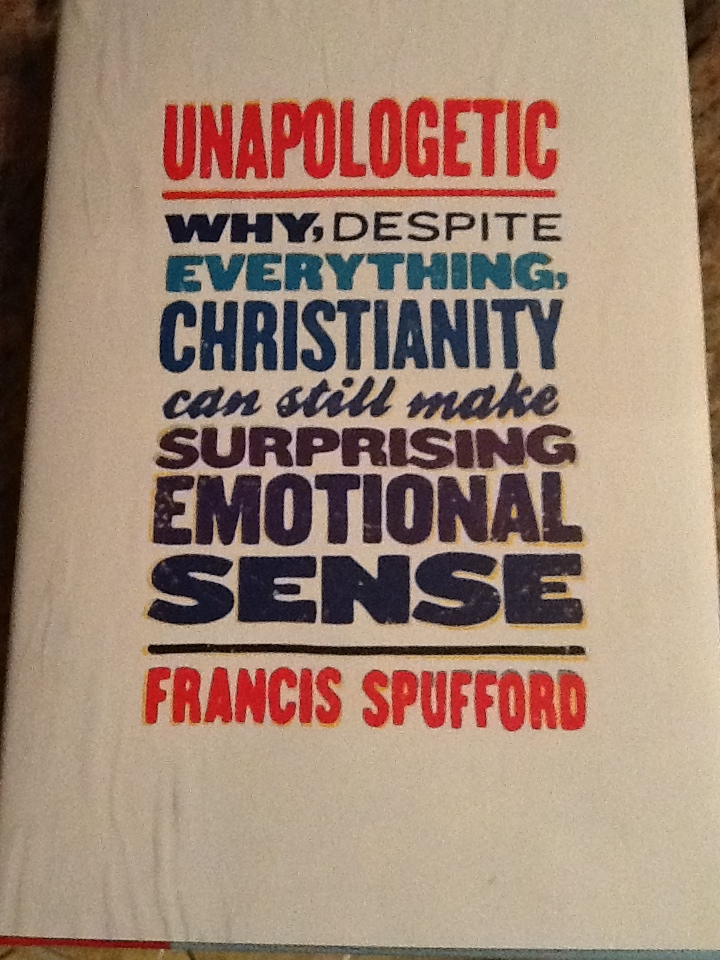
  • A non-review of Francis Spufford’s “Unapologetic”

    You should read this book.
    You should read this book.

    I’ve been having trouble thinking of something to say about Francis Spufford’s Unapologetic other than “I really, really liked it.” It’s not like any other “religious” book I can remember reading. The closest analogue I can think of are the books of Anne Lamott, who similarly writes about the life of faith with brutal honesty and without pious cant.

    The title has a double meaning: Spufford is unapologetic in the sense of not being ashamed of his belief, but he’s also not offering an “apology” in the sense of a reasoned defense of Christianity–the sort of thing you get from some of C. S. Lewis’s writings (not to mention those of many lesser lights). Spufford’s goal is to describe from the inside what being a Christian is like–specifically for an educated Englishman living in a “post-Christian” culture–and to show that it can be an emotionally authentic response to the human condition. He doesn’t shy away from the blots on Christianity’s historical record or from tough theological questions (he’s particularly unsparing of pat theological answers in his discussion of theodicy). But he is equally insistent that, at its best, it provides a compelling response to what he cheekily calls the “human propensity to fuck things up” (or “HPtFtU” as he abbreviates it).

    Spufford is a more-or-less orthodox Christian, but he considers theological propositions as secondary to a the immediate emotional experience of faith (not unlike an earlier defender of religion against its cultured despisers). This is the experience of a graceful presence underlying the messy and ambiguous world of daily life–a presence we encounter most piercingly when we have screwed things up. Christians see this presence most fully manifested in Jesus, and Spufford’s retelling of the gospel story provides the theological heart of the book. He recognizes that his faith is a wager–he doesn’t know whether or not there is a God, but “neither does Richard bloody Dawkins.”

    What I do know is that, when I am lucky, when I have paid attention, when for once I have hushed my noise for a little while, it can feel as if there is one. And so it makes emotional sense to proceed as if He’s there; to dare the conditional. And not timid death-fearing emotional sense, or cowering craven master-seeking sense, or censorious holier-than-thou sense, either. Hopeful sense. Realistic sense. Battered-about-but-still-trying sense. The sense recommended by our awkward sky fairy, who says: don’t be careful. Don’t be surprised by any human cruelty. But don’t be afraid. Far more can be mended than you know. (p. 220)

    Despite the intellectual bravado of some professional Christians, I think that this is far closer to how many of us–particularly those of us in the West–experience our faith. But nothing I can write will do justice to Spufford’s book; I encourage you to read it for yourself.

  • Francis Spufford on the “gnostic Jesus”

    The Jesus of the orthodox story treats people with deep attention even when angry. [The gnostic] Jesus zaps people with his divine superpowers if they irritate him. Orthodox Jesus says that everyone needs the love of God, and God loves everyone. Their Jesus has an inner circle you can be admitted to if you collect enough crisp packets. Orthodox Jesus likes wine, parties, and grilled fish for breakfast. Their Jesus thinks that human flesh and its appetites are icky. Orthodox Jesus is disconcertingly unbothered about sexuality, and conducts his own sexual life, if he has one, off the page. Their Jesus can generate women to have sex with out of his own ribs, in a way that suggests the author had trouble talking to girls. Orthodox Jesus says, “Don’t be afraid. I am always with you.” The Jesus of these documents says, “Advance, Blue Adept, to the 17th Jade Portal of Amazingness, and give the secret signal with your thumbs.” Read much of the rival “gospels,” and you start to think that the Church Fathers who decided what went into the New Testament had one of the easiest editorial jobs on record. It wasn’t a question of suppression or exclusion, so much as of seeing what did and didn’t belong inside the bounds of a basically coherent story.

    –Francis Spufford, Unapologetic, pp. 153-4

  • “Physical” vs. “spiritual” resurrection?

    Liberal Christian icon Marcus Borg recently joined the blogosphere, and one of his first posts was an attempt to clarify his views on the resurrection of Jesus. Borg has been accused of denying the independent reality of the resurrection, reducing it to a subjective experience the disciples had after the crucifixion. But Borg maintains that he believes in a real resurrection, just not a physical one. Jesus is really alive and manifested himself to his followers following his death, but his body was not raised physically from the tomb.

    I’m not sure I find the “physical”/”spiritual” distinction particularly helpful or important. First, it presumes that we have a clear idea of what “matter” is and how it contrasts with “spirit.” Modern physics, if nothing else, has called that kind of Cartesian dichotomy into question. But more fundamentally, the New Testament stories themselves don’t seem particularly interested in answering that question. Even if we take the resurrection stories at face value, we have a Jesus who is both “physical” in the sense of being a tangible presence, who eats with his disciples and shows them the still-present wounds in his body, but who also can appear and disappear at will and whom the disciples don’t immediately recognize as being the same person. The only thing that comes through clearly here is that, for the NT writers, Jesus’ post-resurrection state involved both continuity (he was the same person, the crucified one) and discontinuity (he had been radically transformed and raised to a different state of existence).

    Keith Ward has suggested that Jesus’ resurrection involved a transformation of his body (i.e., the tomb was empty) to a “spiritual” state. But “spiritual” here doesn’t mean the opposite of “physical”; rather it means something more like a state of being fully infused with God’s Spirit. Jesus lives in the power and presence of God, but in a form that radically transcends his earthly, pre-resurrection existence. It’s not clear that asking whether this constitutes a “physical” or “spiritual” resurrection is a particularly meaningful question. The point is that the resurrection signifies God’s victory over the forces of sin, alienation, and death and promises a consummation of God’s purposes for creation.

  • La Visitacion

    Yesterday I took my daughter to the museum at Dumbarton Oaks in Georgetown. It’s privately funded and thus was not affected by the (recently concluded) government shutdown.
    The museum is small, but it features a wonderful collection from the Byzantine Empire and an impressive exhibit of pre-Columbian American artifacts. It also has, tucked away in the corner of one of the rooms, this marvelous painting by El Greco:

    Image

    What struck me was that the painting manages to convey great emotion even though both Mary’s and Elizabeth’s faces are almost totally obscured. Well worth the schlep to Georgetown if you live in or are visiting the D.C. area.

  • Christianity is not inherently right-wing

    To those of us of a more moderate or liberal disposition, the tendency of conservative Christians to identify right-wing politics with Christianity per se is a source of no small irritation. Today at Salon, Elizabeth Stoker and Matt Bruenig point out that the American Christian Right’s approach to wealth and poverty is an outlier when compared with Christian attitudes in other parts of the world:

    The notable exclusion of poverty from the Christian agenda would doubtlessly puzzle European Christians, whose support of Christian ethical approaches to family life have always been paired with a deep and vigorous concern for the poor. And, unlike their American counterparts, European Christians haven’t been willing to leave poverty up to individual charity or the market to handle. Quite the contrary: Just as public morality is an arena fit for intervention by a Christian-informed government, so too is welfare.

    The case is only bolstered if you take Catholic social teaching, Latin American liberation theology, or other non-American traditions into account. The identification of Christianity with laissez-faire economics appears to be a peculiarly American phenomenon.

    In a similar vein, in an interview with (somewhat ironically) the American Conservative, novelist and essayist Marilynne Robinson stands up for the much-derided tradition of liberal Christianity:

    Well, what is a Christian, after all? Can we say that most of us are defined by the belief that Jesus Christ made the most gracious gift of his life and death for our redemption? Then what does he deserve from us? He said we are to love our enemies, to turn the other cheek. Granted, these are difficult teachings. But does our most gracious Lord deserve to have his name associated with concealed weapons and stand-your-ground laws, things that fly in the face of his teaching and example? Does he say anywhere that we exist primarily to drive an economy and flourish in it? He says precisely the opposite. Surely we all know this. I suspect that the association of Christianity with positions that would not survive a glance at the Gospels or the Epistles is opportunistic, and that if the actual Christians raised these questions those whose real commitments are to money and hostility and potential violence would drop the pretense and walk away.

    Liberal Christianity undoubtedly has its problems. But even some of the theological critics of liberalism–like the Niebuhr brothers and Paul Tillich–were not “conservatives” in contemporary political terms. They were decidedly men of the Left, even while they critiqued liberal theology’s tendency toward sentimentality and moralism. To Tillich, for example, love and justice were inseparable, and the political expression of the Kingdom of God would be some form of democratic socialism. In fact, I have a hard time thinking of a major modern or contemporary theologian who is a full-blown right-winger.

  • Tillich: Why the “historical Jesus” is not the foundation of faith

    Paul Tillich’s discussion of historical Jesus research in volume 2 of his Systematic Theology is a minor tour de force and could still apply today without too much change. The problem of historical Jesus research, Tillich says, is that you can’t get “behind” the New Testament documents to the “real” historical Jesus of Nazareth because the records we have were shaped in very fundamental ways by the authors’ conviction that Jesus was the Christ. And any overall “portrait” of the historical Jesus is likely to be heavily dependent on which specific facts about or sayings of Jesus one takes to be historical. (For example, if one thinks that the historical Jesus applied the title “Son of Man” to himself, this will have a big effect on one’s overall picture of him.) Historical research can, at best, provide statements of greater or lesser probability. As Tillich notes bluntly, “The search for the historical Jesus was an attempt to discover a minimum of reliable facts about the man Jesus of Nazareth, in order to provide a safe foundation for the Christian faith. This attempt was a failure” (p. 105).

    One attempt to get around this was to shift the focus away from the facts about Jesus and onto his words, or teachings. This was done in one of two ways. First, they can be regarded as general moral truths or insights into human nature. “As such, they belong to law, prophecy, or Wisdom literature such as is found in the Old Testament. They may transcend all three categories in terms of depth and power; but they do not transcend them in terms of character” (pp. 105-6). The second, “more profound” approach is to focus on Jesus’ announcement of the imminent arrival of the Kingdom of God. This is not a set of general rules, but a “concrete demand,” and the proper response is to decide for the Kingdom.

    The problem with both approaches, Tillich says, is that neither one addresses the existential predicament of human beings–our estrangement from God. This isn’t something we can overcome through our own efforts. What we need is not a new law or a new set of teachings, but a new form of existence:

    But neither method can answer the question of wherein lies the power to obey the teachings of Jesus or to make the decision for the Kingdom of God. This these methods cannot do because the answer must come from a new reality, which, according to the Christian message, is the New Being in Jesus as the Christ. The Cross is the symbol of a gift before it is the symbol of a demand. But, if this is accepted, it is impossible to retreat from the being of the Christ to his words. The last avenue of the search for the historical Jesus is barred, and the failure of the attempt to give a foundation to the Christian faith through historical research becomes obvious. (p. 106)

    The only foundation for Christian faith, Tillich argues, is “the appearance of that reality which has created the faith” (p. 114).

    This reality is the New Being, who conquers existential estrangement and thereby makes faith possible. This alone faith is able to guarantee–and that because its own existence is identical with the presence of the New Being. Faith itself is the immediate (not mediated by conclusions) evidence of the New Being within and under the conditions of existence. Precisely that is guaranteed by the very nature of the Christian faith. No historical criticism can question the immediate awareness of those who find themselves transformed into the state of faith. (p. 114)

    In other words, the experience of the “New Being”–Tillich’s term for the state of overcoming the forces of sin and estrangement–is itself its own warrant. It requires no outside justification.

    But surely this has something to do with Jesus? Otherwise, what makes this specifically Christian? Tillich says that the “power which has created and preserved the community of the New Being is not an abstract statement about its appearance; it is the picture of him in whom it has appeared (p. 114). Specifically he means the picture of Jesus in the New Testament. This isn’t an “empirically factual” portrait like the one a historian might attempt. It is the record of the impact Jesus had on those who first encountered and were transformed by him. Tillich says there is an “analogy between the picture and the actual personal life from which it has arisen”:

    It was this reality, when encountered by the disciples, which created the picture. And it was, and still is, this picture which mediates the transforming power of the New Being. One can compare the analogia imaginis suggested here with the analogia entis–not as a method of knowing God but as a way (actually the only way) of speaking of God. In both cases it is impossible to push behind the analogy and to state directly what can be stated only indirectly, that is, symbolically in the knowledge of God and mediated through faith in the knowledge of Jesus. But this indirect, symbolic, and mediated character of our knowledge does not diminish its truth-value. For in both cases what is given to us as material for our indirect knowledge is dependent on the object of our knowledge. The symbolic material through which we speak about God is an expression of the divine self-manifestation, and the mediated material which is given to us in the biblical picture of the Christ is the result of the reception of the New Being and its transforming power on the part of the first witnesses. The concrete biblical material is not guaranteed by faith in respect to empirical factuality; but it is guaranteed as an adequate expression of the transforming power of the New Being in Jesus as the Christ. (p. 115)

    Just as the symbols we use about God can mediate God’s self-manifestation, the picture of Christ in the New Testament can mediate the “New Being” of which he is the bearer. The only possible validation of this is the experience of being transformed. The proof of the pudding is in the eating, as it were.

    The positions Tillich criticized live on in contemporary Christianity. More conservative Christians sometimes use historical research as a basis of apologetics, on the assumption that establishing certain historical facts about Jesus can prove, or at least provide warrant for, theological claims. On the other side of the spectrum, more liberal or progressive Christians sometimes try to identify a core set of “teachings of Jesus” that can be detached from the claims the New Testament makes about his status as the Christ. Tillich would argue that both of these approaches are doomed to failure because they try to build faith on varying degrees of historical probability.
  • Tillich: beyond naturalism and supranaturalism

    At the beginning of the second volume of his Systematic Theology, Paul Tillich provides a recap of the major themes of the first volume, in part to address criticisms he had received since its publication. In particular, Tillich discusses his doctrine of God. He characterizes the “basic intention” of his position as an attempt to go “beyond naturalism and supranaturalism.”

    Tillich identifies three ways of interpreting the meaning of “God.” The first treats God as “the highest being” who “brought the universe into being at a certain moment (five thousand or five billion years ago), governs it according to a plan, directs it toward an end, interferes with its ordinary processes in order to overcome resistance and fulfil his purpose, and will bring it to consummation in a final catastrophe” (p. 6). The problem with this view, according to Tillich, is that it “transforms the infinity of God into a finiteness which is merely an extension of the categories of finitude” (p. 6). In other words, it treats God as a being alongside other beings, one cause among many, etc. He says this view fails to adequately respect “the infinity of the infinite, and the inviolability of created structures of the finite” (p. 6). There is a qualitative difference between God and the created order.

    The second position is “naturalism,” which “identifies God with the universe, with its essence or with special powers within it” (p. 6). This is not the same as simply identifying God with the “totality of things,” which would be absurd. But its God is the “dynamic and creative center of reality”–the deus sive natura of pantheistic thinkers like Baruch Spinoza. For Tillich, however, naturalism also “denies the infinite distance between the whole of finite things and their infinite ground, with the consequence that the term ‘God’ becomes interchangeable with the term ‘universe’ and therefore is semantically superfluous” (p. 7). An essential element in human religious experience, Tillich maintains, is that the holy can be encountered as a numinous presence set over against us.

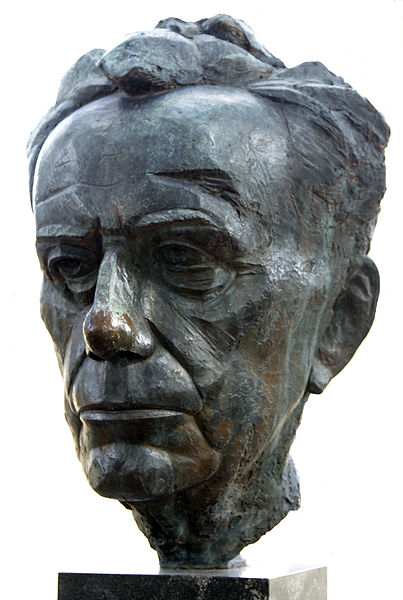
    403px-Bust_of_Paul_Johannes_Tillich_(daylight)

    Tillich proposes a “third way”–which he insists is not new, but a position found, albeit not always clearly, in the great theologians of the tradition. It emphasizes both God’s immanence and God’s transcendence. Against supranaturalism, God is not one being among others, even if the highest, but “the creative ground of everything that has being” or “the infinite and unconditional power of being.” God is “neither alongside things nor even ‘above’ them; he is nearer to them than they are to themselves” (p. 7). At the same time, parting ways with naturalism, Tillich insists that God “infinitely transcends that of which he is the ground” (p. 7). There is a certain mutual freedom between God and creation such that creatures can encounter God as something “outside” of themselves.

    Moreover, this freedom creates the possibility of creaturely alienation from God. If “God” simply named the power at the heart of the natural processes of the world, then it wouldn’t make sense to talk about human estrangement from God. Spatial imagery of God being “in” us, or “above” us can be misleading; but the concept of “finite freedom” allows us to say more precisely that created being is both “substantially independent of the divine ground” and yet “remains in substantial unity with it” (p. 8).

    Tillich’s theology has sometimes been characterized (caricatured?) as atheism dressed up in religious symbolism. But I think it’s clear here (as elsewhere) that his intention, at least, was to affirm the reality of a transcendent God, even if he was dissatisfied with certain popular formulations of theism.