Author: Lee M.

  • Getting by without infallibility

    An exaggerated or inaccurate view of Scripture is not a high view of Scripture, it is just a wrong view of Scripture. A high view of Scripture takes the Bible seriously, while also taking its historical context and the humanity of its authors seriously. A high view of Scripture is held by those who actually read Scripture, seek to understand why the human authors wrote what they did, and how they convey God’s timeless will for us today. A high view of Scripture includes not only reading the Bible, but seeking to live its timeless messages, which are discerned in the light of Jesus Christ, who is the definitive Word of God.

    That’s from an interview with UMC mega-church pastor Adam Hamilton. (Yes, we mainliners have mega-churches too.)

    It’s become a bit of a truism that any adequate Christian view of the Bible has to acknowledge both its human and divine character. What a lot of people worry about, though, is this: if you admit that the Bible contains some errors, even about peripheral matters, then how do you know it isn’t wrong about the major stuff?

    The short answer, I think, is you don’t know. But underlying this worry is a questionable model of how God acts, and one which the Bible itself seems to contradict.

    What do I mean? Well, people sometimes talk about the inspiration of the Bible in a way that suggests God overrode the freedom of the authors (and presumably editors and compilers) to ensure that not one jot or tittle of the text was wrong. Even though most proponents of such a theory would deny that’s what’s happening, it’s hard to see how “inerrancy” could work any other way. Human beings are finite, limited, prone to error, and sinful; for God to inspire them to write without error would seem to require, essentially, annulling their finitude.

    But is this consistent with how the Bible itself presents the relationship between God and humans? Consider the apostles. They all responded to Jesus, who Christians confess is the incarnate Word of God. Presumably this response was elicited, at some level, by God’s Spirit (since Christians generally deny that someone can turn to God without the action of the Spirit). But this didn’t prevent the apostles from erring–sometimes grievously–about what Jesus was saying to them.

    If Jesus himself didn’t (couldn’t?) compel an “inerrant” response from the apostles (not to mention from the religious leaders and Roman authorities), does this tell us something about how inspiration works? At the very least, it suggests that there are cases where God allows human beings to err, even though God would presumably prefer they make a different kind of response.

    So, unless we have good reasons for thinking that the composition of the Bible occurred under the influence of an entirely different kind of inspiration, isn’t it reasonable to think that the biblical authors could also have been prone to error in what they wrote?

    What becomes of faith then? It would be in trouble if we thought that faith is based on a prior belief in the inerrancy or infallibility of the Bible. But why should this be the case? And on what independent grounds could we come to the conclusion that the Bible is infallible in the first place?

    What I believe, and what I think many other Christians believe, is that the Bible presents a broadly reliable portrait of Jesus and that the New Testament (along with the Old Testament) provides the authoritative context for interpreting the meaning of Jesus.

    But I don’t believe this because of some prior theory about the Bible’s inspiration. I believe it based on my experience (and the experiences of others) as part of the Christian community. There’s an irreducible degree of circularity here, but it needn’t (I think) be of the vicious variety. We trust the Bible because our encounter with Jesus–in the pages of Scripture, in the sacraments, in prayer, in Christian community–has changed us. Yes, we could be wrong. But that’s an unavoidable risk for creatures such as us.
  • Buyer’s remorse, reader’s guilt

    When I was young–particularly when I was in college and grad school–I had a lot of time to read. Hours upon hours if I wanted to. What I didn’t have was a lot of money to buy books. And these were the pre-Amazon days when it wasn’t easy to come by any book they didn’t carry at the bookstore in the local mall. Just going to Barnes & Noble in those days was like a religious pilgrimage.

    Now things are different. I have a lot more money than I did as a student, but time is now a much scarcer commodity. With two small kids at home, my discretionary time is probably at an all-time minimum. If I’m lucky I might have an hour to myself after everyone else in my house has gone to bed.

    And yet, like a once-starving man who can’t help but gorge himself when presented with a limitless supply of food, I can’t stop acquiring books. I get them from Amazon (often used from third-party sellers), from yard sales, from boxes people leave on the sidewalk, from library book sales–you name it. I have a very hard time passing up a book that I think I might conceivably, some day want to read–especially if it’s cheap, or free.

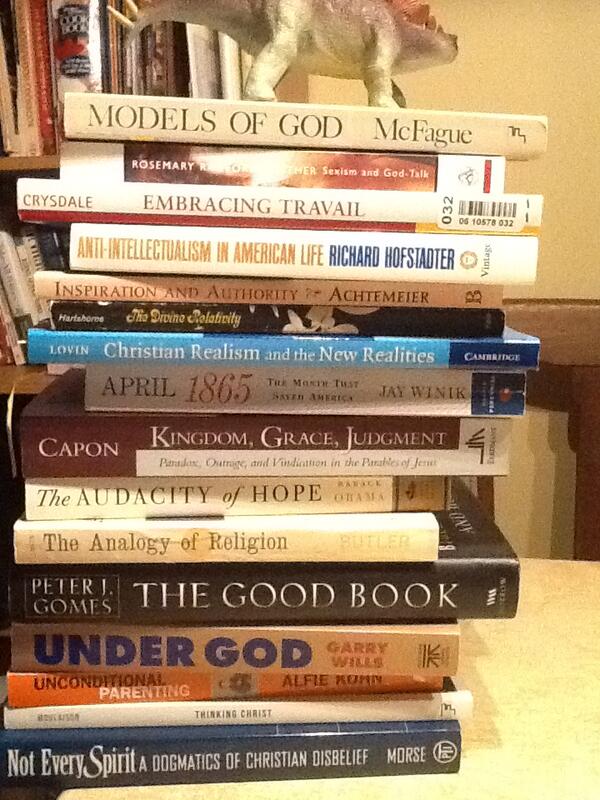
    And the results look like this:

    On my dining room table, staring at me reproachfully.
    On my dining room table, staring at me reproachfully.

    Yep, that’s a pile of books–most of them good I’m sure–that I acquired months, or in some cases years, ago but just haven’t gotten around to reading. (Well, that and a stegosaurus.) And these are just non-fiction; they don’t even include the novels. Not to mention e-books–I have a bunch of Kindle books languishing in electronic purgatory too.

    I’m now at the point where I can acquire books much more quickly and effortlessly than I can read them. Which isn’t to say I don’t still read–I’m reading Ursula Le Guin’s The Left Hand of Darkness right now, and I recently finished a hefty biography of F.D.R.  Despite my (imagined?) lack of free time, I still managed to read a couple dozen books last year, at least if my Goodreads account is to be trusted.

    But I’m not sure how I can keep justifying the never-ending acquisition of more and more books. When exactly do I think I’m going to read them? Once my kids go to college? Am I still going to be interested in reading Sexism and God-Talk or The Divine Relativity  fifteen years from now? Maybe. But there’s going to come some point when the number of books I own outstrips the number I can reasonably expect to read during my remaining decades on earth.

    I also worry that I get distracted by books that catch some fleeting interest while neglecting “classic” works. After all, few of the books in the pile above probably rank as stone-cold classics. My choice of reading has usually been a result of serendipity as much as anything else, but that was back when I could afford to be promiscuous with my time. But now I wonder when I’m going to get around to reading War and Peace? Or this? Or this?

    I’m not sure there’s a good solution to this (admittedly, “first-world”) problem. Probably I just need to be more disciplined and intentional in what I choose to read (or buy). Now, if you’ll excuse me, there’s a title I saw on Amazon earlier that I wanted to check out a little more closely. . .

  • Is the welfare state Christian?

    There’s been some back-and-forth in the comments to this post about whether Christianity is really compatible with social democracy (or we might just as accurately say welfare-state liberalism). Does Christian ethics require provision for the poor to take place at the local level and/or through private organizations rather than being carried out by the federal government?

    This article from Elizabeth Stoker provides a timely response. She says that there are good reasons for Christians to support state-based welfare, not instead of private charity, but in addition to it.

    So what is the Christian argument, then, for supporting a compound structure of state welfare programs and private charity when it comes to addressing the stresses of life, which range from poverty to illness and old age? Foremost is the idea that human dignity entitles people to an “existence minimum” which guarantees their basic needs will be reliably met without discrimination based on caprice, race, gender, creed, orientation, or any other marker. Since the guarantee of stability promised by an existence minimum is the foundation upon which lives can be built — and because voluntary private charity is by nature not a guarantee — the state is the best mechanism to deliver a baseline standard of living.

    She goes on to point out that, as Reinhold Niebuhr argued, relying on private charity leaves existing power structures in place because the wealthy are still calling the tune.

    I think it’s important not to be dogmatic here. Programs should be evaluated on a case-by-case basis and and by the results they produce. Some programs–Social Security and Medicare, for instance–have been very successful. Others–the old Aid to Families with Dependent Children program comes to mind–had, by general consensus, serious problems, even if there was less agreement about what should replace them. (My view is that the program which replaced AFDC–Temporary Assistance to Needy Families–is also seriously flawed.) The point is that the specific programs should be subordinate to the results we’re trying to achieve. If you’re clear on those, you can be flexible on program design. The state can commit to ensuring a “social minimum” while using a trial-and-error approach to bringing it about. In theory, this should allow for at least some cooperation and give-and-take between liberals and conservatives.

    It’s kind of strange that the “private charity only” position has come to be so closely associated with Christianity. Not only is it at odds with the practice elsewhere in the world, but it tends to ignore much of the history of Christian social reform in America.  As Christians (and others) have worked to ameliorate poverty and other social ills, they have often found that this requires large-scale structural or institutional changes that can best (or only) be carried out by the national government. Individual conversion, local efforts, and private charity–while essential–aren’t sufficient.

  • “Jesus’ wife” revisited

    It looks like the so-called Gospel of Jesus’ Wife papyrus fragment has been shown to be authentic–meaning that it comes from a legitimately ancient document, and may represent a tradition going back to a fairly early point in Christian history:

    A wide range of scientific testing indicates that a papyrus fragment containing the words, “Jesus said to them, my wife” is an ancient document, dating between the sixth to ninth centuries CE. Its contents may originally have been composed as early as the second to fourth centuries.

    The fragment does not in any way provide evidence that the historical Jesus was married, as Karen L. King, the Hollis Professor of Divinity at Harvard Divinity School, has stressed since she announced the existence of the fragment in the fall of 2012. Rather, the fragment belongs to early Christian debates over whether it was better for Christians to be celibate virgins or to marry and have children. The fragment is weighing in on this issue, according to King.

    “The main topic of the fragment is to affirm that women who are mothers and wives can be disciples of Jesus—a topic that was hotly debated in early Christianity as celibate virginity increasingly became highly valued,” King explained.

    I blogged about the theological implications of this back when the fragment’s existence was announced. (Short version: there aren’t many.) There are ample resources in canonical Christianity to support the value of married and family life and the equality of the sexes. If anything, the existence of women disciples who were not linked romantically to Jesus seems to make a stronger case for equality.


  • The liberality of John Calvin

    The Lord commands us to do “good unto all men,” universally, a great part of whom, estimated according to their own merits, are very undeserving; but here the Scripture assists us with an excellent rule, when it inculcates, that we must not regard the intrinsic merit of men, but must consider the image of God in them, to which we owe all possible honour and love; but that this image is most carefully to be observed in them “who are of the household of faith,” inasmuch as it is renewed and restored by the spirit of Christ. Whoever, therefore, is presented to you that needs your kind offices, you have no reason to refuse him your assistance. Say he is a stranger; yet the Lord has impressed on him a character which ought to be familiar to you; for which reason he forbids you to despise your own flesh. Say that he is contemptible and worthless; but the Lord shows him to be one whom he has deigned to grace with his own image. Say that you are obliged to him for no services; but God has made him, as it were, his substitute, to whom you acknowledge yourself to be under obligations for numerous and important benefits. Say that he is unworthy of your making the smallest exertion on his account; but the image of God, by which he is recommended to you, deserves your surrender of yourself and all that you possess. If he not only deserved no favour, but, on the contrary, has provoked you with injuries and insults,–even this is no just reason why you should cease to embrace him with your affection, and to perform to him the offices of love. He has deserved, you will say, very different treatment from me. But what has the Lord deserved? who, when he commands you to forgive all men their offences against you, certainly intends that they should be charged to himself.

    — John Calvin, quoted by Marilynne Robinson, “Open Thy Hand Wide: Moses and the Origins of American Liberalism,” in her collection When I Was a Child I Read Books.

    According to Robinson, the much-derided Calvinist and Puritan strain in American Protestantism emphasized caring for the needy, because of, rather than in spite of, its supposed “legalism.” That is, because it valued the Old Testament more highly than some other Christian traditions, the Calvinist-Puritan synthesis was more influenced by the demands for social justice that are found in the Pentateuch.  God’s “liberality” as expressed in these demands is at the root of “liberalism” as a project of institutionalizing justice for the poor.

  • The case for American social democracy–4: final thoughts

    (Previous posts: here, here, and here.)

    My summary can’t do justice to Kenworthy’s book, largely because it leaves out the impressive array of data he uses to buttress his arguments. I’m hardly a data-wonk, but in most cases the evidence he presents is clear and fairly persuasive in showing how the policies he favors can ameliorate the problems of economic stagnation and inequality. He’s also fair and level-headed in addressing objections, and generally un-dogmatic about his conclusions.

    There are still things to argue with in this book, though. One of the more interesting arguments, to me anyway, is whether liberals/leftists/social democrats should agree with Kenworthy in accepting a future consisting in large part of relatively low-wage service jobs “cushioned” by generous government spending and services, or whether they should work toward reestablishing, in some form, the high-wage industrial model of the mid-20th century. I don’t know the answer to this, but in support of Kenworthy’s position, I think it’s fair to say that no one has yet come up with a way of recreating that model, despite it being the object of a lot of nostalgia on the center-left.

    I’d also liked to have seen more discussion of the “intangible” aspects of work–its meaning, the extent to which it engages our capacities and creativity, whether it allows for some degree of autonomy and self-direction, etc. Making sure everyone has sufficient material resources is absolutely a prerequisite for a decent society, but a good society should also allow for everyone, to the extent possible, to exercise their distinctively human capabilities. That doesn’t have happen through paid labor, but given that many people spend a large chunk of their waking hours at work, making it more fulfilling should be on the agenda.

    All that said, however, I’m inclined to support most if not all of Kenworthy’s policy prescriptions. Most of them are good ideas on their own merits, even if they may not be sufficient to solve the problems he identifies. I also consider it a mark in this agenda’s favor that it wouldn’t require an unlikely and radical break with past progress, but its natural continuation. If nothing else, it certainly gives the center-left plenty to do in the years to come.

  • The case for American social democracy–3: how do we get there?

    (See previous posts: here and here.)

    Observers of 21st-century American politics might be forgiven for thinking that the policies Kenworthy proposes are so much pie-in-the-sky dreaming. After all, the resurgent radical right bitterly opposes much of the existing welfare state, much less new programs. And haven’t the Democrats largely embraced corporate centrism and deficit-fetishism?

    Surprisingly, perhaps, Kenworthy thinks the long-term trend of American social policy is toward providing more services, and once programs are adopted, they are very hard to undo. Simply put, the economic trends producing insecurity, lack of opportunity, and uneven economic gains are likely to continue, if not worsen. Policy makers will try to solve these problems, and the kinds of programs that exist here and abroad have a proven track record of helping. So, at least sometimes, they will succeed in expanding or implementing these programs.

    He’s not unaware of the obstacles to these kinds of reforms, but argues that, on balance and over time (the next 50 years or so), many of these policies are likely to be enacted. He points out, for instance, that although many polls show that Americans are opposed to “big government” in theory, they largely support individual programs like Social Security and Medicare. And once a policy is adopted and has been in effect, support tends to go up.

    Given yesterday’s Supreme Court ruling, it might be worth focusing on the role of money in politics. This ruling lifted a cap on the total amount someone could contribute during a particular period, while leaving intact limits on contributions to individual candidates. It’s another step down the same path as the controversial 2010 Citizens United ruling, which prohibited limits on independent spending by corporations and unions.

    For many folks on the left, the ever-expanding role of money in politics is one of the most powerful obstacles to progressive reform, if not the most powerful. Kenworthy is aware of this, but argues that the role of money in determining political outcomes is overstated:

    Even if money totals continue to favor Republicans, it’s unclear how much that will matter. There are diminishing returns to money in influencing election outcomes: when a lot is already being spent, additional amounts have limited impact. The Democrats had less money in 2012, yet they were competitive in the presidential, House, and Senate elections. (p. 163)

    In general, he says, the “history of campaign finance in national elections in the past four decades is one of each party and its backers seeking new ways to raise and spend large amounts of money in spite of existing regulations” (p. 163). If this pattern continues, Democrats will find new ways to offset Republicans’ advantages arising from a changed legal and regulatory landscape.

    But to many on the left this misses the point: even if Democrats can continue to be electorally competitive, hasn’t the influence of big money pushed them to the right and led them to promote policies that favor the rich? A common story is that over the last several decades the influence of liberals in the party has waned, while corporatist, “third-way” Democrats have triumphed.

    Kenworthy considers this objection and responds by showing that, in fact, patterns of voting on economic issues by Democratic legislators at the federal level do not show a shift to the center. If anything, the pattern since 1950 shows a slight shift to the left (see p. 164). (This is partly due to the exodus of conservative southern lawmakers from the party in the wake of civil rights, but even if you factor them out, the pattern holds.) He concedes, however, that focusing exclusively on voting could be misleading since many important policy-shaping decisions are made before a proposal even comes up for a vote. It’s possible that if we could measure this we’d see that the influence of campaign contributions has successfully moved policy to the right. (This strikes me as a fairly significant caveat.)

    Nonetheless, the Democrats, while historically more of a centrist than a true leftist party, remain electorally competitive, and the Democratic Party has historically been the main vehicle for implementing progressive economic policies. It’s also worth noting, anecdotally, that in the last few years there seems to have been at least a slight shift toward a more “populist” economic posture among Democrats, which isn’t what you’d expect if big-moneyed interests were all-powerful.

    Another major obstacle that many liberals and Democrats would highlight is influence of a more radical and intransigent faction of the right on the GOP (i.e. the tea party). Kenworthy admits that the current GOP and its anti-government rhetoric pose a problem for a social democratic program like his. But he we can expect that the party will move back to the center. Reasons for this would be if the GOP loses an otherwise winnable election and the increasing importance of working-class whites as a Republican constituency. (In fact, last year’s government shutdown fiasco seems to already have provided something of a moderating influence.)  Over time, he thinks, the GOP will find its way back to the middle and come to more closely resemble center-right parties in Western Europe. Its focus will then be not so much on how much the government does, but how it does it.

    These claims will probably strike different readers as having varying degrees of probability, and some of the discussion does strike me as a bit Pollyanna-ish. But Kenworthy goes on to point out that, even since the 70s, headway has been made on a number of fronts (e.g., expansions in the EITC, expansions in unemployment insurance, expanded Medicaid access, the Medicare prescription drug benefit, and others). Indeed, the Affordable Care Act, for all its problems, is probably the single largest expansion of the welfare state since LBJ’s Great Society and shows that significant progress is still possible.

    Next: Final thoughts