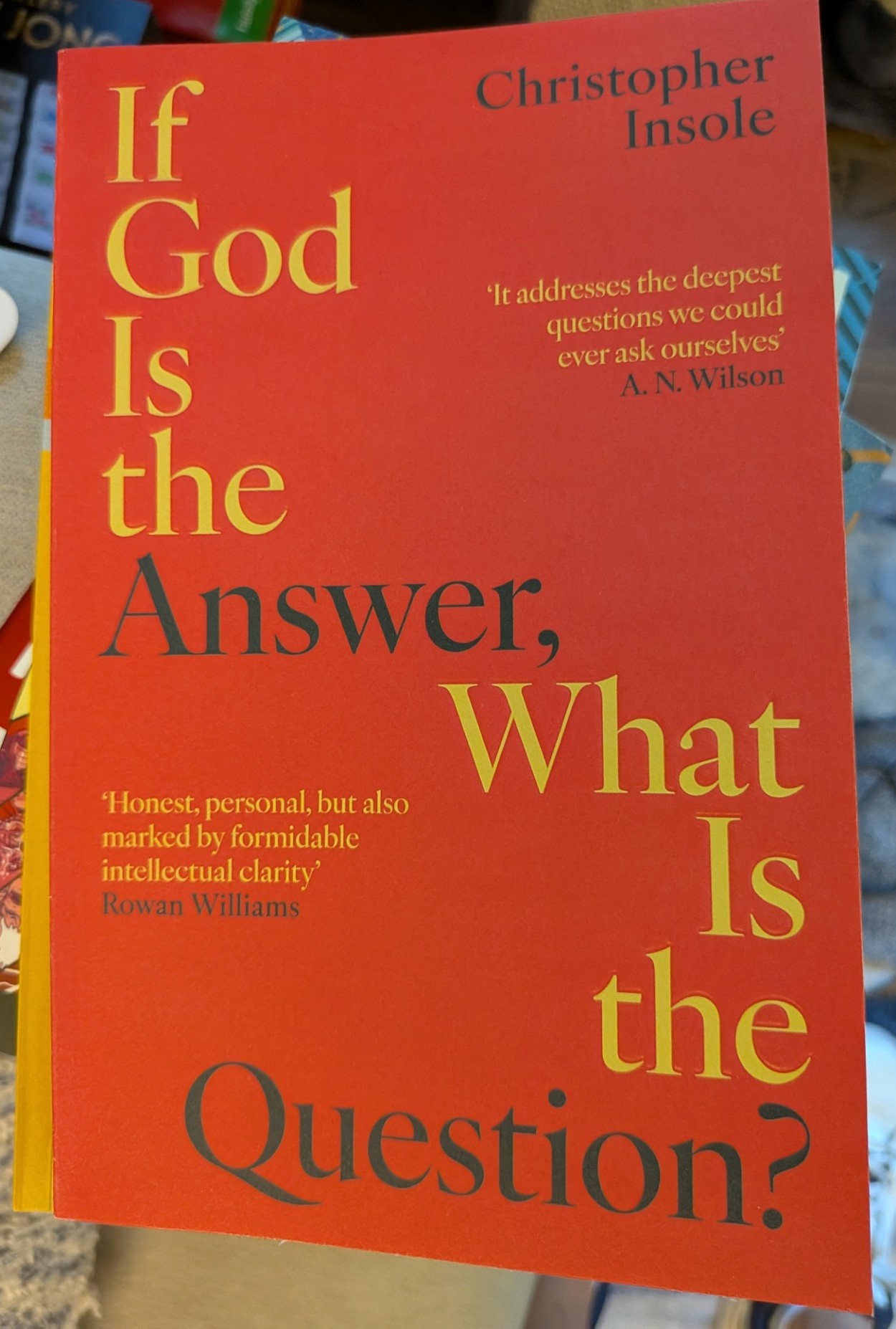
Christopher Insole, If God Is the Answer, What Is the Question? (Oneworld, 2026)
Insole is a philosophical theologian in the UK, but this is not your typical philosophy book. He says up front that he doesn’t really think people’s fundamental convictions about God, morality, the meaning of life, politics, etc. are moved by rational argument. What he’s interested in this book is the deeper motivations behind our quest for meaning and how those affect what types of views about ultimate reality we’re drawn to. In short, he wants to explore what kinds of questions people are asking when they ask about God. Atheists of the Richard Dawkins stripe often assume that God-talk is an attempt at primitive quasi-science — e.g. looking for an explanation of natural phenomena; but Insole notes that the questions driving people are more likely to be things like “What is the significance of my life in this vast universe?” “Why is there evil and suffering and how do I deal with it?” or “How do I get along with other people?”
Insole reviews an eclectic selection of accounts, intending to expand our notion of what “God” might mean beyond the anthropomorphic concept often found in popular discourse (both theist and atheist). These include Stoicism, the naturalistic pantheism of Spinoza, the philosophy of Kant (Insole himself is a noted Kant scholar), the “enchanted atheism” of contemporary Indian philosopher Akeel Bilgrami, and Anselm’s Proslogion. The point of these explorations is not to stump for one over the other, but to show that the notion of God is potentially broader and richer than we might’ve thought, but also that these different accounts of ultimate reality are responding to a variety of human needs and desires.
The last part of the book turns to more personal reflections. He recounts a recurring argument he had with Richard Swinburne, his doctoral advisor, about whether God is in time or outside time. Delving under the surface, he wonders whether their respective positions are driven by particular experiences and psychological dispositions. Based on a long interview Swinburne gave, Insole explores how Swinburne’s lonely childhood may have made the concept of a God-in-time who can be a constant companion more appealing to him. For his own part, Insole talks about how the God outside of time concept gives him with a way of holding the past, present and future together when things threaten to unravel.
This could all make it sound like Insole is a pure projectionist — that the view we hold of God is simply whatever answers to our own needs and wishes. But he is clear that God transcends human consciousness; however, God is big enough, he thinks, that “shards” of divine truth may reveal themselves in a variety of ways to different people (and different cultures, traditions, etc.).
Insole closes the book with a meditation on the life and death of his father, a larger-than-life character by the sounds of things. He says that he didn’t realize until his dad died how much his father’s faith was supporting his own. He had to discover a new kind of faith in the wake of losing his father. “Now I believe in God because of death, and what it reveals about love, the love that remains after life” (p. 238).
In a blurb on the back cover, A.N. Wilson says “reading this book is like having a really interesting conversation with a wise, learned man, by turns dense and learned, by turns light and humorous.” I’d second that assessment – I read the book in a single sitting, which is pretty rare for me. Insole took a risk in writing from a more personal point of view, but it’s one where most people actually live, and one that rarefied abstract arguments rarely touch.

