Category: Theology & Faith

  • Lewis on the “true myth” of Redemption

    No doubt readers are getting a bit tired of this, but the Lewis letters are so bloggable. Maybe because, at least as they appear in the book, they’re almost like blog-entries themselves.

    In the fall of 1931 Lewis is on the verge of embracing Christianity. In September he’d had an important conversation with Hugo Dyson and Tolkien about the importance of myth and how Christianity is the “true myth.”

    In October he writes to his good friend Arthur Greeves:

    What has been holding me back (at any rate for the last year or so) has not been so much a difficulty in believing as a difficulty in knowing what the doctrine meant: you can’t believe a thing while you are ignorant what the thing is. My puzzle was about the whole doctrine of Redemption: in what sense the life and death of Christ “saved” or “opened salvation to” the world. I could see how miraculous salvation might be necessary […]. What I couldn’t see was how the life and death of Someone Else (whoever he was) two thousand years ago could help us here and now — except in so far as his example helped us. And the example business, tho’ true and important, is not Christianity: right in the centre of Christianity, in the Gospels and St Paul, you keep on getting something quite different and very mysterious expressed in those phrases I have so often ridiculed (“propitiation” — “sacrifice” — “the blood of the Lamb”) — expressions wh. I cd only interpret in senses that seemed to me either silly or shocking.

    Now what Dyson and Tolkien showed me was this: that if I met the idea of sacrifice in a Pagan story I didn’t mind it at all: again, that if I met the idea of a god sacrificing himself to himself (cf. the quotation opposite the title page of Dymer) I liked it very much and was mysteriously moved by it: again, the idea of the dying and reviving god (Balder, Adonis, Bacchus) similarly moved me provided I met it anywhere except in the Gospels. The reason was that in Pagan stories I was prepared to feel the myth as profound and suggestive of meanings beyond my grasp even tho’ I could not say in cold prose “what it meant.”

    Now the story of Christ is simply a true myth: a myth working on us in the same way as the others, but with this tremendous difference that it really happened: and one must be content to accept it in the same way, remembering that it is God’s myth where the others are men’s myths: i.e. the Pagan stories are God expressing Himself through the minds of poets, using such images as He found there, while Christianity is God expressing Himself through what we call “real things”. Therefore it is true, not in the sense of being a “description” of God (that no finite mind could take in) but in the sense of being the way in which God chooses to (or can) appear to our faculties. The “doctrines” we get out of the true myth are of course less true: they are translations into our concepts and ideas of that wh. God has already expressed in a language more adequate, namely the actual incarnation, crucifixion, and resurrection. Does this amound to a belief in Christianity? At any rate I am now certain (a) That this Christian story is to be approached, in a sense, as I approached the other myths. (b) That it is the most important and full of meaning. I am also nearly certain that it really happened… (pp. 288-9)

    Lewis picks up on this distinction between the thing itself and the doctrines about it later in Mere Christianity where, in his chapter on Redemption, he emphasizes that the theories about the Atonement are not the objects of belief, but the event itself:

    Theories about Christ’s death are not Christianity: they are explanations about how it works. […] A man can accept what Christ has done without knowing how it works: indeed, he certainly would not know how it works until he has accepted it.

    We are told that Christ was killed for us, that His death has washed out our sins, and that by dying He disabled death itself. That is Christianity. That is what has to be believed. Any theories we build up as to how Christ’s death did all this are, in my view, quite secondary: mere plans or diagrams to be left alone if they do not help us, and, even if they do help us, not to be confused with the thing itself. (pp. 54-56)

    What I find intriguing here is Lewis’s insistence that the “true myth” itself can “work on us” without our having an explicit theory about how it works. On the face of it, this makes a lot of sense. Many (perhaps most?) Christians throughout history have no doubt enjoyed Christ’s benefits without having much in the way of an explicit theory of Atonement. Maybe it’s a legacy of intellectualistic Protestantism to put so much emphasis on holding the correct doctrine. More sacramental forms of Christianity have always believed that the benefits of Christ’s work come to us in tangible (edible!) forms, not just through understanding.

    Of course, there’s a danger in reducing Christianity to a kind of “magic;” there must, we think, be some cognitive element. An interesting question is raised here about people who are severely mentally handicapped and may have little or no grasp of doctrine. Surely we don’t think that precludes them from being beneficiaries of Christ’s work? But, leaving aside these hard cases, it does seem that an understanding of the “how” might not be completely “separable” from the “what.” There might be understandings of the Atonement, for instance, that are so wrong-headed that they preclude a decent grasp on what Jesus’ life, death, and resurrection do for us. And it’s not clear to me at least that believing that “Christ was killed for us, that His death has washed out our sins, and that by dying He disabled death itself” doesn’t entail some further beliefs about how this works. “Narrative” and “story” have become important notions in some recent theology, but is first-order narrative sufficient without some second-order doctrinal reflection?
  • C. S. Lewis on the Bible

    A couple more nuggets from Lewis’s letters:

    To “Mrs Ashton”, November 8, 1952:

    It is Christ Himself, not the Bible, who is the true word of God. The Bible, read in the right spirit and with the guidance of good teachers, will bring us to Him. When it becomes really necessary (i.e. for our spiritual life, not for controversy or curiosity) to know whether a particular passage is rightly translated or is myth (but of course myth specially chosen by God from among countless myths to carry a spiritual truth) or history, we shall no doubt be guided to the right answer. But we must not use the Bible (our fathers too often did) as a sort of Encyclopedia out of which texts (isolated from their context and not read with attention to the whole nature and purport of the books in which they occur) can be taken for use as weapons.

    To Clyde S. Kilby, May 7, 1959:

    To me the curious thing is that neither in own Bible-reading nor in my religious life as a whole does the question [of the inspiration of the Bible] in fact ever assume that importance which it always gets in theological controversy. The difference between reading the story of Ruth and that of Antigone — both first class as literature — is to me unmistakable and even overwhelming. But the question “Is Ruth historical?” (I’ve no reason to suppose it is not) doesn’t really seem to arise till afterwards. It can still act on me as the Word of God if it weren’t, so far as I can see. All Holy Scripture is written for our learning. But learning of what? I should have thought the value of some things (e.g. The Resurrection) depended on whether they really happened, but the value of others (e.g. the fate of Lot’s wife) hardly at all. And the ones whose historicity matters are, as God’s will, those where it is plain…

    …That the over-all operation of Scripture is to convey God’s Word to the reader (he also needs his inspiration) who reads it in the right spirit, I fully believe. That it also gives true answers to all the questions (often religiously irrelevant) which he might ask, I don’t. The very kind of truth we are often demanding was, in my opinion, not even envisaged by the ancients.

  • Jesus got out of the way

    In lieu of our weekly community group/Bible study, we attended the Solemn Mass for the Feast of the Ascension last night. Lovely as usual. The guest preacher was the Rev. Charles Hefling, a professor of theology at BC and editor of the Anglican Theological Review.

    Fr. Hefling asked: why did Jesus leave? I have to admit this isn’t a question that really ever occurred to me, but it’s a darn good one. As part of an answer he quoted a line from Rowan Williams to the effect that, since Jesus is “the Way” he had to “get out of the way.” This is a clever way of saying that Jesus opened the door to our union and fellowship with God by reconciling us to God, but we now have to go through that door by treading the path he trod.

    But this is only part of the answer because, Fr. Hefling pointed out, we can’t follow this way, at least not by ourselves. Following the way of the cross, the way of self-giving (and forgiving) love, doesn’t come naturally to us. This is why God sends the Holy Spirit. Jesus is God with us; the Spirit is God within us, empowering and enabling us to follow Jesus.

  • Is religion dangerous?

    Saw an ad for this in the new First Things: Keith Ward (see here) has written a response of sorts to the “new atheist” crowd. I imagine it’s the usual kind of irenic, thoughtful stuff Ward is known for.

    I’ve often thought that the whole issue of whether “religion” is on the whole good or bad is a pretty muddled one. In addition to the probably insoluble matter of deciding what exactly counts as a religion, there’s no religion-less society to act as a control group in determing whether the influence of religion has been on the whole good or bad. And beyond that it’s very difficult to see how you would weigh the moral improvements against the moral defects that are arguably attibutable to a particular religion. Was the Inquisition worth the outlawing of infanticide? and so on. Plus there’s the issue of casuality: how do we know what’s attributable to religion? For instance, several scholars, including secular ones, have made the case that modern science arose in the West in part precisely because of the Christian worldview. The idea of a God who creates a universe that displays a rational order served as an impetus to discovering that order. But such a hypothesis hardly admits of definitive proof one way or the other.

  • Christians and war revisited

    Doug Bandow has an article worth reading on Christians and the Iraq war.

    I think we see here one of the problems with Just War theory, a problem that many pacifists have pointed out, namely that it can be so flexible as to (rhetorically at least) justify virtually any war.

    However, Just War adherents obviously think that pacifism is too high a price to pay for a bright, clear line about when to go to war. But Bandow articulates what some JW thinkers have called the presumption against the use of force:

    Christians should be particularly humble before advocating war. War means killing, of innocent and criminal alike. It means destroying the social stability and security that creates an environment conducive for people to worship God, raise families, create communities, work productively, and achieve success – in short, to enjoy safe and satisfying lives. Wars rarely turn out as expected, and the unintended consequences, as in Iraq, often are catastrophic.

    Indeed, in Iraq the U.S. has essentially killed hundreds of thousands of people in the name of humanitarianism. Christians, even more than their unbelieving neighbors, should be pained by the horror of sectarian conflict unleashed by the actions of their government with their support. Believers especially should eschew nationalistic triumphalism in pursuit of war. And when they err, like predicting health, wealth, liberty, and happiness in occupied Iraq, they should acknowledge fault – and seek forgiveness. At the very least they should exhibit humility before saddling their white horses to begin another crusade.

    I tried to make a similar point here, specifically with respect to proposed humanitarian interventions. A lot depends on whether we see war as an extraordinary last resort, or as a routine tool of statecraft. Andrew Bacevich and others have argued that Americans have come to see war as the latter, with disastrous results. And Bandow is surely right the Christians, even if they’re not pacifists, should be wary of war and set the bar high for supporting it.

  • C. S. Lewis on Barthians

    I was reading selections last night from a volume of C.S. Lewis’ letters and came across an interesting (and rather amusing) one to his brother on February 18, 1940. Apparently Lewis had recently encountered a group of zealous students of this newfangled theologian Karl Barth:

    Did you fondly believe – I did – that where you got among Christians, there, at least, you would escape (as behind a wall from a keen wind) from the horrible ferocity and grimness of modern thought? Not a bit of it. I blundered into it all, imagining that I was the upholder of the old, stern doctrines against modern quasi-Christian slush: only to find that my “sterness” was their “slush.” They’ve all been reading a dreadful man called Karl Barth, who seems the right opposite number to Karl Marx. “Under judgment” is their great expression. They all talk like Covenanters or old Testament prophets. They don’t think human reason or human conscience of any value at all: they maintain, as stoutly as Calvin, that there’s no reason why God’s dealings should appear just (let alone, merciful) to us: and they maintain the doctrine that all our righteousness is filthy rags with a fierceness and sincerity which is like a blow in the face…

    I don’t know if Lewis ever changed his opinion about Barth in light of the latter’s developed thought, but it’s interesting to see Lewis, the old-fashioned Christian humanist and upholder of reason in matters of faith and morals, clashing with the upstart “neo-orthodox” theology. Certainly “Barthians” of various stripes seem to dominate much of the field of academic theology nowadays, which makes you wonder where Lewis would fit in if he were still around. His critical approach to the Bible would not find favor with a lot of conservative evangelicals, but the high value he placed on human reason wouldn’t sit well with various neo-Barthian, “radically orthodox,” and post-liberal theologies.

  • Notes on a theocentric ethic of creation, 3

    Heavenly Father, your Holy Spirit gives breath to all living things; renew us by this same Spirit, that we may learn to respect what you have given and care for what you have made, through Jesus Christ our Lord. – Andrew Linzey

    This prayer from Andrew Linzey nicely encapsulates the themes of a genuine Christian ethic of creation. I think in light of earlier posts on this topic, what’s needed is a way of reconciling a due respect and care for God’s creation with a proper commitment to human flourishing.

    However, given that a lot of what seems to drive our abuse of creation is our relentless pursuit of material wealth, and that this pursuit may actually at some point hinder human happiness rather than promote it, the reconciliation may not be as difficult as it first appears.

    For Christians in particular, human well-being isn’t measured by increases in material well-being. It’s important, of course, and we’re called to make sure that those in need have adequate material sustenance. But the energy and resources we devote to what earlier generations of Christians would’ve contemptously referred to as “luxury” may indicate that we’ve strayed considerable from a Christian vision of the good life.

    In a liberal society wealth-creation offers a convenient lowest common denominator-type goal that everyone can agree on despite differences over religious values, the meaning of life, etc. But if we’re pushing against the limits of what is sustainable, this won’t be a viable option must longer.

    What we need to learn, and what any public philosophy founded essentially on self-interest seems incapable of fostering, is self-limitation. What Christians may need to recover is the practice of asceticism, not understood as a form of joyless self-denial, but as a way of orienting the self to love of God and neighbor, the contemplation of truth and beauty and the pursuit of genuine human flourishing.

    In this interview, Linzey points out that there are aspects of the world that our practices of reducing creation to mere “resources” blind us to:

    [Our mistreatment of animals is] an impediment to spiritual pleasure. That’s why I think vegetarianism is implicitly a theological act. It’s not about saying “No” but about saying “Yes.” About enjoying the lives of other creatures on this earth so much that even the thought of killing them is abhorrent. I think God rejoices in Her creatures, takes pleasure in their lives, and wants us to do so too. So much of our exploitation of animals stems from a kind of spiritual blindness: if we sensed and really felt the beauty and magnificence of the world, we would not exploit it as we do today.

    From this point of view, something like vegetarianism may serve as a spiritual practice that actual allows us to see the world differently. Of course, there are other ways of doing this. The novelist and philosophy Iris Murdoch wrote that the necessary precondition for moral growth is learning to perceive reality as existing in itself and not as something for us. She thought art was particularly suited to this since it’s goal is to make reality present to us. By learning to attend to something for its own sake, which often involves hard work, we go out of ourselves and gradually inhabit a less self-centered, and therefore more accurate, perspective on reality. This is the key to human flourishing.

    Obviously human beings need, as Wendell Berry reminds us, to use the world. But spiritual disciplines that teach us to look at the world as something more than mere material for our use may lead us to redefine what our needs are, and to distinguish genuine needs from spurious ones. And, somewhat paradoxically, genuine human flourishing can only occur when we stop seeing ourselves as the center of the world. But Christians of all people should be ok with this, since we have it on good authority that self-seeking is the surest path to self-destruction and that only by losing our lives to we truly find them.

  • Jesus Our Redeemer

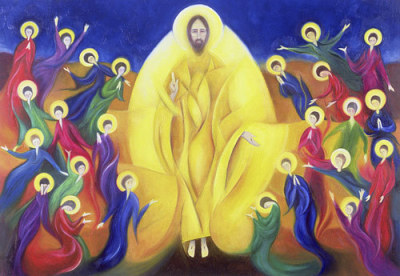
    Gerald O’Collins, S.J. is an Australian Jesuit who’s taught at Gregorian University in Rome since the 70s. I greatly enjoyed his book on the Trinity (and blogged a bit about it here), so was pleased to discover that early this year he published Jesus Our Redeemer: A Christian Approach to Salvation in which O’Collins offers a systematic soteriology. He covers the topics of creation, original sin, atonement, the role of the Holy Spirit and the church, the salvation of non-Christians, the final resurrection, and the redemption of creation. I just received the copy that I ordered and am eager to dig in. Expect posts soon.

    It also has a really lovely cover image from Sophie Hacker a contemporary religious artist:

    resurrection-icon.jpg

  • Notes on a theocentric ethic of creation, 2

    In addition to theocentricity and what I’ve called a “qualified” anthropocentrism, any Christian ethic of creation needs to address the issue of the “fallenness” of creation. This is a controversial topic since, while most theologians have no problem with the idea of human fallenness (in some sense), the idea that the non-human creation is somehow not what it should be seems to smack of pre-modern mythological thinking. Given what we know about the scientific laws of the universe, do we need to posit some pre-historic cosmic cataclysm to explain the existence of suffering, predation, death, natural disasters and the like? The view sometimes put forth that all these things are somehow the result of human (or maybe angelic) sin seems incredible to many Christians.

    However, I don’t think we can dismiss the idea of a cosmic Fall so easily. If we take nature as it is, how do we reconcile the presence of so much suffering and death with the existence of a Creator of unlimited love and power? Certain modernist theologians have contended that a universe structured the way ours is, with all its attendant pain and suffering, is necessary to bring into existence rational, personal creatures who can respond to and enter into a relationship with the Divine. This line of thought is supported by the oft-noted “anthropic” features of the cosmos that make it appear to be “fine-tuned” for the emergence of life. But this is unsatisfactory for a couple of reasons. First, it seems to relegate the entire non-human creation to a mere ancillary role in God’s plan. Second, as it stands it doesn’t address the moral issue raised by the suffering of so many sentient creatures, who, on this telling, are mere means to the creation of rational beings like ourselves.

    If I can wax Anselmian for a minute, it strikes me as “unfitting” that God would create solely to bring into existence human beings (and perhaps other rational creatures elsewhere) but have no additional purposes for creation. The Bible, for one, seems to envision a redeemed creation, not simply a redeemed humanity.

    Another attempt to have Christian theology without the Fall is found in the “creation spirituality” of Matthew Fox. Fox posits an “original blessing” (as opposed to original sin) and thinks that we should embrace the ethos of nature as unambiguously good and not in need of redemption. Unfortunately, this and similar views border on pantheism and nature worship and overlook the fact that deriving our ethics from the natural world can yield cruelty as much as compassion. Nature is God’s good creation, but it’s also “red in tooth and claw” and can’t set the standard for our ethics or theology in any straightforward way.

    But does this mean that there was some pre-historical state of perfection from which the created world fell, as the result of human or angelic sin? David B. Hart has defended such an idea in his book The Doors of the Sea. But, as I argued previously, I think Hart comes dangerously close to gnosticism in his positing of a perfect eternal creation that somehow “preceded” the world as it exists now. It’s hard, on Hart’s account, to identify the empirical world we see around us with God’s good creation. Just as our doctrince of original sin shouldn’t efface the basic goodness of human nature, any doctrince of cosmic fall and redemption shouldn’t obscure the goodness of the world as we actually experience it.

    The view I lean toward is that creation is good, but incomplete and in need of redemption, or deliverance from evil. God’s world will not ultimately contain the evils of suffering and death, but this is because it will be transformed, not annihilated. This view doesn’t require the existence of a pre-historic cosmic fall, but it does see the story of the Fall as containing the important truth that creation is unfinished and not what it should be. This prevents us from treating death and suffering as “natural” in the deepest sense (and therefore good), but it also avoids Hartian quasi-gnosticism about the natural world.

    This implies, at a minimum, that we not take the “struggle for survival” as the template for our thinking about the natural world, much less mimic it in our relationships with one another. But it should also caution us against utopian attempts to remake nature in a way that is free from the inherent limitations of a fallen creation. Nature is neither perfect as it is, but nor is it “fixable” by us. This side of the eschaton it would be pointless and cruel to try and make the lion lie down with the lamb.

    But what I think it does point to is that we shouldn’t exacerbate the violence of nature with our own violence. Whatever we think about the story of the Fall, it’s clear that we now have the power to “corrupt” nature with our sinfulness in a very straightforward way. Our ability to change natural processes, to pollute, to deforest, and to manipulate the natures of living creatures far outstips anything our ancestors had, and in all likelihood outstrips our wisdom. But another part of our uniqueness as human beings is our ability to look toward, and in some degree anticipate, that redeemed state that we hope for.

    In part three I’ll try to tie some of these threads together…