Category: Theology & Faith

  • Animal rights is more than Peter Singer

    Tony Jones posted a link to a Peter Singer article arguing, among other things, that animal-welfare concerns should trump claims to religious liberty in cases like humane slaughter laws. Whatever the merits of Singer’s argument (Brandon pretty thoroughly demolishes it here), the post at Tony Jones’ blog provides an example of how Christians often react to Singer’s work. At least a couple of commenters dismiss Singer out of hand because of his views on abortion/infanticide/euthanasia.

    Now, as someone who would like animal-rights arguments to get a wider hearing in the Christian community, I’m disheartened by this type of response. It seems that many people–not least Christians–treat “Singerian” views on the status of non-human animals as being of a single piece with his views on issues at the boundaries of human life.

    But I think this is a mistake for at least a few reasons. First, it’s not clear that someone who accepts Singer-style arguments against irrational species prejudice (say) is committed to embracing his conclusions about the status of fetuses or newborns. It’s possible to accept Singer’s conclusion that animal interests should be included in our moral calculus without accepting his view that it’s okay to painlessly kill beings that lack certain future-oriented preferences.

    Second, even within the world of secular theorizing about animal rights, Singer’s approach is far from the only one on offer. In fact, it’s a bit ironic that he’s sometimes referred to as “the father of animal rights” considering that Singer’s moral theory does not include rights as a fundamental component. But there are thinkers who do put rights into the foundation of their theory (e.g., Tom Regan), as well as those who argue for radical changes to the way we treat animals on the basis of contractarian, feminist, neo-Aristotelian, and other moral approaches. And most of these approaches avoid the implications of Singer’s utilitarian ethic that so many balk at.

    Finally, the Christian tradition itself has resources for re-thinking our treatment of animals, as I’ve tried to document on this blog. The works of theologians like Andrew Linzey, Stephen Webb, Richard Alan Young, and Jay McDaniel, to name just a few, deploy traditional theological motifs to support an ethical agenda similar to that proposed by secular animal liberationists. They argue that the gospel, rightly understood, demands that we modify or abandon certain practices (such as factory farming) that do violence to the flourishing of God’s beloved creatures.

    My personal view is that Peter Singer’s work has contributed to the way we should think about our obligations to non-human animals (and to other vulnerable groups like the global poor). But I also agree with Singer’s many Christian critics that at least some of his other views are objectionable. Whatever one’s stance on Singer’s work, though, it shouldn’t serve as an excuse for Christians not to engage with the challenges to our traditional ways of using animals.
  • Skepticism, orthodoxy, and the life of faith

    Ben Myers at Faith and Theology wrote a post recently on the Virgin Birth in which he made the case for accepting the historic faith of the church rather than criticizing beliefs that may not seem to pass the test of critical historical investigation. “It’s a good thing to believe something that you didn’t invent for yourself. It’s a good thing to have a certain framework, a story that tells you what kind of place the world really is, so that there are some basic questions that are already settled, that you don’t have to go on wringing your hands and wondering about.”

    This generated a vigorous response from Jeremy at An und für sich, who characterizes Myers position as “provid[ing] the individual a way to escape the existential anxiety of life by offering a coherent narrative that diminishes the stress of having to make decisions and take responsibility for his/her desires.” Jeremy identifies as a Christian but agrees with, inter alia, Wolfhart Pannenberg that “theology has to be historical” and that certain doctrines should be rejected “if they do not stand up to the historical method, a method that Ben finds irrelevant.”

    When I read Ben Myers’ post, I did have a problem with the view that he attributes to Karl Barth about the historical status of miracles:

    Barth always insists that acts of divine revelation are ‘not historical’. But he doesn’t mean they never happened. All he means is that revelation is a unique event, an act of God. It’s not part of the normal historical sequence, it doesn’t belong to a chain of cause-and-effect, and so there’s no use trying to verify or disprove it on historical grounds.

    So in the case of the virgin birth, Barth argues that it’s not subject to the methods of historiography. Its truth isn’t for historians to decide. But he certainly believes that it really happened, that it happened in time and space, within the real material human world. It involved Mary’s body, her real flesh and blood. In this section of Church Dogmatics, Barth’s brilliant critique of Brunner rests on the assumption that the virgin birth really happened. His point is just that it happens as revelation, as an act of God.

    I think it’s safe to assume that Myers has gotten Barth right here (or at least, I’m in no position to judge matters of Barthian exegesis). However, as a piece of theology (or metaphysics), I find it confused. If the Virgin Birth–or any other purportedly miraculous event–“happened in time and space,” then I don’t see how Barth can simultaneously say that “it doesn’t belong to a chain of cause-and-effect.” Even if an event is “an act of God”–that is to say it doesn’t have a “natural” cause, or at least is not fully explicable in terms of natural causes–once it has occurred it presumably becomes part of successive chains of cause-and-effect. Otherwise, it would not have “really happened” in space-and-time but would float docetically and epiphenomenally above the natural chain of cause-and-effect.

    But if this is right, then we can’t say that miracles are per se beyond the reach of historical investigation. Any event that has historical effects is–in principle–open to historical investigation. Now, the Virgin Birth seems to be largely beyond the reach of the tools of history simply as a practical matter. After all, we’re talking about a purported miracle that occurred in a woman’s womb over 2,000 years ago. So the kind of verifiable evidence that a historian would use to corroborate it is notably lacking by the very nature of the case. But something more “public”–the Resurrection of Jesus is the obvious example–would be a different matter. If the Risen Christ appeared in time and space to specific people–as the New Testament seems to unanimously claim–then a historian can in principle investigate such claims, even if she can never–qua historian–conclude that the Resurrection was an act of God. And this suggests that religious doctrines can, in principle, be revised in light of developments in historical (and other “secular”) knowledge. Barth, by contrast, seems to want to have his cake and eat it too: miracles “really happened” but can never be evaluated by secular intellectual tools.

    That said, I’m sympathetic to Ben Myers’ overall position in this sense: living a Christian life isn’t primarily about constantly revisiting individual articles of the creed to determine anew if you “really” believe them. There is a sense in which, once you’ve become a Christian, certain things should be treated as “settled” (at least to some extent) so you can get on with the business of living a Christian life. Here’s an analogy: in our political lives we aren’t constantly questioning the fundamental merits of liberal democracy or constitutionally guaranteed rights, but are trying (ideally) to create a more just and workable society within those parameters. That’s not to say that the fundamentals should never be criticized, but simply that critical reflection isn’t the whole–or even the main–business of life. Clearly new events or evidence can call into question things we had treated as settled–and these present occasions for critical reflection upon and modification of our “framework.” But if we were constantly interrogating our own beliefs (religious or otherwise), we couldn’t use them as a guide for living. I think this makes the life of faith a balancing act: we can never simply rest secure in a “faith once delivered,” but we also have to start in medias res, and therefore take a lot for granted.

  • C.S. Lewis on Jesus’ fear of death

    In 1932, C.S. Lewis wrote a letter to his good friend Owen Barfield on the topic of Jesus’ fear of death, particularly as presented in the Garden of Gethsemane scenes in the gospels. Barfield was apparently troubled by the idea that the Son of God should’ve experienced such terror in the face of death when many lesser men had apparently overcome their fear of death.

    In response, Lewis distinguishes three classes of people with respect to the fear of death: the “very bad” who fear death because it represents the defeat of their “false freedom” of egoistic self-determination; the “virtuous,” who are only able to overcome their fear of death with the aid of some other sentiment that depends on a “defect” of some kind (such as pride or weariness); and, finally the “Perfect.”

    Lewis suggest that Jesus–as the Perfect One–in some ways more closely resembles the first class than the second. This is because for him, death also represents a defeat of freedom, but it is “Real Freedom”:

    What is it to an ordinary man to die, if once he can set his teeth to bear the merely animal fear? To give in–he has been doing that nine times out of ten all his life. To see the lower in him conquer the higher, his animal body turning into lower animals and these finally into the mineral–he has been letting this happen since he was born. To relinquish control–easy for him as slipping on a well worn shoe. But in Gethsemane it is essential Freedom that is asked to be bound, unwearied control to throw up the sponge, Life itself to die. Ordinary men have not been so much in love with life as is usually supposed: small as their share of it is they have found it too much to bear without reducing a large portion of it as nearly to non-life as they can: we have drugs, sleep, irresponsibility, amusement, are more than half in love with easeful death–if only we could be sure it wouldn’t hurt! Only He who really lived a human life (and I presume that only one did) can fully taste the horror of death. (Letters of C.S. Lewis, W.H. Lewis, ed., p. 305)

    Note that Lewis is saying that Jesus’ experienced the fear of death more intensely because he “really lived a human life.” Lewis disdains the idea (which he attributes to Barfield) that Christ suffered simply “from the mere fact of being in the body” as “mythological in the bad sense.” Jesus feared death more because he loved life more.

  • Human origins, sin, and “fiduciary” atonement

    This article by theologian George L. Murphy today is a very helpful discussion of how an evolutionary understanding of human origins affects the Christian doctrines of sin and salvation. Murphy begins by arguing that the evolutionary account is more consistent with a broadly “Eastern” view of original sin (Irenaeus) than with a “Western” one (Augustine). That is to say, humanity was not created perfect but rather was made good but immature. The fall into sin consisted of a deviation from the path God intended us to travel toward the new creation:

    We have then a picture of a divinely intended growth of humanity rather than the appearance of fully mature persons. But once sin comes into the world that growth is distorted. […] The picture that we get in the early chapters of Genesis is not so much one of a single abrupt “fall” from perfection in Genesis 3 but of a gradual “falling away” that begins there and worsens in succeeding chapters, which is the point made in Genesis 6:5-7 as it introduces the Flood story.

    The root of this “falling away” is a failure to trust God and that our good consists in following the path God intends for us:

    Humanity could, with difficulty, have followed the path of development that God intended, for we are not hardwired, either through genes or enculturation, to behave in particular ways. Temptations would, however, have been strong. Sin was, in words of Reinhold Niebuhr, not “necessary” but “inevitable.”

    Refusing to trust and obey God, humanity turned from the goal that God intended and chose another path. Soon we had gone astray. Moving away from God, we were lost in the woods and night was falling.

    The longer this goes on, the more deeply successive generations are mired in sin, due to a combination of genetic endowment and social-cultural environment. And our idols proliferate as we put our trust in finite things instead of God.

    In light of this understanding of sin as departure from the divinely willed path of development, Murphy proposes an account of salvation that emphasizes new creation. “Since the basic problem as I’ve sketched it is that sin has gotten human history off course, new creation can be spoken of as reorientation of the trajectory of creation.”

    Drawing on the thought of Lutheran theologian Gerhard Forde, Murphy sketches an account of the atonement that focuses on how the death and resurrection of Jesus concretely bring reconciliation (at-one-ment) between humanity and God by creating trust (i.e., faith).

    The fundamental problem that got humanity going on the wrong road, moving away from God, is failure to put our trust in the true God. Instead, as Paul argues in Romans 1, people place their confidence in all kinds of idols. That is why humanity was estranged from God, and that is what God had to correct in order to turn the course of history back to his intended goal—that is, to reconcile humanity with himself. God must destroy our faith in idols and create faith in himself.

    In the life, death, and resurrection of Jesus, God acts to destroy our trust in these idols and create trust in him. The cross shows us that those things we put our trust in (e.g., governments, religion, morality) can become the instruments by which God-in-the-flesh is killed! But the resurrection shows that God returns as the crucified one who brings not condemnation, but peace.

    Murphy calls this a “fiducial influence” theory of the atonement. Like the more familiar “moral influence” theories associated with Peter Abelard, this account emphasizes that it’s humans who need to be reconciled to God, not vice versa, and that the cross of Christ is what makes possible that needed transformation. It differs, however, in emphasizing that it’s faith, not morality, that saves us.

    The “Christ-event” creates this trust/faith, which makes possible our re-orientation onto the path God intended for us:

    God’s initial work of bringing sinners from spiritual death is followed by continual renewal of faith and sanctification throughout life. The lives of people are turned back toward God, part of the process in which God reorients the course of creation toward accomplishment of his plan spoken of in Ephesians 1:10, to unite all things in Christ.

    This re-orientation has social and even cosmic implications, as “a renewed humanity taking seriously God’s call to care for the earth as God’s garden and to exercise responsible stewardship for creation.” Being rightly related to God allows us to be rightly related to each other and to the rest of creation.

    I’ve long found Forde’s discussion of the atonement to be helpful because of its focus on how the concrete actuality of the cross effects reconciliation (rather than on some metaphysical “transaction” happening behind the scenes). And I agree with Murphy that his “fiduciary” theory is more consistent with an evolutionary understanding of human origins than certain traditional atonement theories–for example those which presuppose that physical death is a result of human sin.

  • Praying with Marjorie Suchocki

    I’ve found that of all the process theologians I’ve read, Marjorie Suchocki is the best at applying process categories and concepts in a meaningful way that avoids much of the forbidding technical jargon. He short book In God’s Presence: Theological Reflections on Prayer is a good example of this.

    Suchocki applies a “process-relational” understanding of God and God’s interaction of the world to some of the thornier problems of prayer, such as: How can prayer make a difference to what happens in the world? In doing so, she illuminates both the practice of prayer and the process understanding of God.

    In the first two chapters, Suchocki provides a succinct and elegant summary of her overall epistemological and metaphysical approach. In brief, God, in Suchocki’s process-based understanding, is continually providing the world with an impulse toward realizing its best available possibility for increasing well-being. In turn, in each moment, the world is offering back to God its realization of new possibilities–whether these are the ones God hopes for or whether we fall short in some way. God experiences this new actuality and responds to it in a new set of possibilities. And so on. This “dance” of mutual relation is how Suchocki understands God’s relation to the world. Unlike some traditional understandings of God, the process view sees God as working with and through the created order, rather than bringing things about by divine fiat.

    So imagine with me the dynamics of relationship between God and the world. Think of it as a dance, whereby in every moment of existence God touches the world with guidance toward its communal good in that time and place, and that just as the world receives energy from God it also returns its own energy to God. God gives to the world and receives from the world; the world receives from God and gives to God, ever in interdependent exchange. Imagine this dance to be initiated by the everlasting God acting out of divine freedom, and therefore out of everlasting faithfulness–for if God is free, then God is free to act in consistency with God’s own character. Thus every touch of God is a giftedness reflecting to some degree God’s own character. But only to some degree. For if this dancing God truly relates to the manyness of the world, then God relates to the particularities of the world. God relates not to some ideal world, but to the reality of this world. (p. 24)

    Prayer, then, is a special case of this more general relationship between God and the world. In prayer, we self-consciously make ourselves aware of God’s presence–listening for the voice of God in calling us to realize our possibilities for greater well-being, and offering our prayers to God, to be incorporated into God’s self and made part of future possibilities for the world. Prayer thus “makes a difference” both to us and God.

    In a series of chapters, Suchocki applies this understanding of prayer to intercession, prayers for healing, confession, and other traditional topics. But she puts her unique spin on these by showing how her view of God affects how we understand them. For example, when we pray for someone else, God receives our prayers into the divine experience, and they become part of future possibilities presented to the world. Thus our prayers may have effects far beyond what we can imagine. This threads a line between quasi-magical views of prayer that simply expect God to do what we ask and reductionistic views that see the effects of prayer merely as psychological.

    Suchocki boldly says that God needs prayer because it is part of how God works with creatures to bring about the divine purposes, which she identifies with “communal well-being” for the entire creation. Suchocki doesn’t try to prove that God must do it this way–which is helpful if, like me, you find aspects of process theology appealing, but aren’t necessarily prepared to swallow the whole complicated conceptual apparatus. What she denies, though, that God works without us, which will put her at odds with at least some traditional understandings of prayer, as will her insistence that God is changed and affected by our prayer.

    One strength of the book is that it shows how process thought can make sense of our practices of prayer–we often do pray as though our prayers of petition, intercession, etc. make a difference to God and how things go in the world. On the assumption that God is utterly unchangeable, by contrast, these are harder to make sense of (though theologians have tried to do so in a variety of ways). So you could see In God’s Presence as a kind of argument for the superiority of the process-relational view on the grounds that it makes better sense of certain religious experiences. At the same time, it provides an impetus for praying–prayer really does make a difference and is an indispensable part of the church’s calling.

    Lest this makes it sound like this is a dry, academic tome, Suchocki writes very straightforwardly, avoiding most of the convoluted jargon associated with process theology. She also uses (gasp!) concrete examples–stories of prayer in her life and the life of others–to illustrate her points. While I don’t necessarily agree with the whole of the process perspective, this book changed my perspective on prayer–and more importantly, it made me want to put the book down and actually pray.

  • Evolution and “making God the author of evil”

    I’ve argued before that the question of a “historical” Adam and Eve and the related question of a “historical” Fall is not a “gospel issue.” That is to say, universal human sinfulness is such a self-evident fact that the question of its origin is secondary. The gospel speaks to this phenomenon of universal sinfulness with its offer of universal grace.

    But as Richard Beck points out in a thought-provoking post, the hard problem evolution poses for orthodox Christian theology isn’t one of soteriology (what are we saved from and how are we saved) but one of theodicy (how can an all-good God permit such evil as we see in our world). Beck is responding to a critique of evangelical scholar Peter Enns’ book The Evolution of Adam by neo-Calvinist theologian James K.A. Smith. Briefly, Smith doesn’t think Enns takes seriously enough the importance of the orthodox doctrine of the Fall. And Beck thinks that Smith may be right that Enns, by focusing on the origin of humanity, may overlook the broader context that brings the theodicy issue to the fore.

    The problem is this: if the evolutionary story of how life came into being is right (and it’s cleary the best account going), then it looks like evil (suffering, death, sickness, predation, etc.) is built into creation so to speak. In other words, if God uses evolution to bring life into existence–as “theistic” evolutionists contend–then it seems that God is directly responsible for the evil that attends this process. And if that’s so, then can we say that God is truly wholly good?

    Beck argues that the point of the traditional doctrine of the Fall isn’t so much to account for human sinfulness as it is to safeguard God’s goodness by exculpating God from responsibility for the existence of evil. He goes on to point out, however, that the orthodox story isn’t quite as air-tight in safeguarding God’s goodness as we might think. He notes, for instance, that in the Bible the serpent (representing evil?) is already present in the garden, tempting Adam and Eve. No account is given of its origin. Only much later was the story of a “fall” of Satan and his angels from heaven posited as a kind of prequel to the Adam and Eve story. And needless to say, this just pushes the problem back a step–after all, whence comes the angels’ propensity toward sin? St. Augustine, for one, rather famously wrestled with this question and never reached a wholly satisfactory solution.

    Beck concludes:

    At the end of the day, theodicy doesn’t really boil down to the origins of evil. It boils down to this: Why’d God do it in the first place? Why, given how things turned out, did an all-knowing and all-loving God pull the trigger on Creation? Why’d God do it?

    No one knows of course. Not Smith. Not Enns. Not me. My point here is simply to note that this is a live and acute question for everybody. So I think it right and proper for Smith to point this out for Enns. But the same question is pointed at orthodox theology and it doesn’t have any better answers, just a “mystery” that allows it, often in cowardly ways, to retreat from answering the questions directly.

    Theodicy has always been the root problem of Christian theology, orthodox or heterodox. There’s no getting around that. The problem is no less acute here than there.

    Readers may be aware of my ongoing interest in this problem. For instance, in my blogging on Christopher Southgate’s book on animal theodicy, I discussed his “only way” argument. This is the argument that creating by means of an evolutionary process–with all that entails in terms of evil and suffering–was the only way for God to get creatures like us in the context of a law-governed universe. God is “off the hook” as it were because there was no other way for God to achieve his ends. Whatever problems there may be with this view (and there are some), it does try to account for evil in a way that doesn’t make God the author of (avoidable) evil. But as Beck says, this is a challenge for all theology, whether it accepts evolution or not.

  • Better theology needed in the public debate over homosexuality

    One criticism I’ve seen of mainline churches is that they don’t do a very good job of connecting theology to congregational, individual, or public life. Whether or not this is true as a general matter, one area where it does seem to me to happen is the public debate–particularly in American Christianity–over the place of lesbian, gay, bisexual, and transgender (LGBT) people in the church. To hear people talk, you wouldn’t know that theologians have been grappling with these issues for literally decades or that over this time, a rich body of biblical and theological material has been developed supporting the case for the full equality of LGBT people. (Case in point: this recent exchange between Ross Douthat and William Saletan; to read this, you would never know that there was more than one “Christian” position here.)

    It would seem that very little of the work that has been done in rethinking Christian attitudes toward LGBT people–largely by academics in theology and biblical studies–has filtered down to the congregational level and out into the public sphere. We still find ourselves rehashing the same half-dozen or so “clobber texts” and framing the debate in terms of “traditionalists” who uphold orthodox faith and “liberals” who are moral and doctrinal relativists. What this leaves out is, for example, the robustly theological (or theological-ethical) case for equality that has been developed by people like James Allison, Eugene Rogers, Gareth Moore, and others, or the work that has been done on the meaning and context of the relevant biblical texts. Bringing this to bear on the discussion would scramble the usual narrative of “liberals” being indifferent or hostile to theological arguments.

    Mainline congregations have often exhibited good instincts in this area, basing their stance of equality for LGBT folks more on concrete experience than theory. But this leaves mainline Christians ill-equipped to make the case in theological and biblical terms, and they often end up ceding the theological high ground to their conservative opponents. It also allows more conservative forms of Christianity to be seen as the sole legitimate public expressions of the faith.

  • The Resurrection is not a bludgeon

    If Jesus cannot be accepted as the true revelation of God in his life and teaching, then his resurrection carries no weight. The moral challenge comes first. In his lifetime Jesus had constantly refused to perform supernatural conjuring tricks in order to impress. This still holds good. The resurrection is not there to bludgeon into submission those for whom the Gospel of the sovereignty of God exercised through the absolute and universal law of love is a closed book; for it is a vindication of this sovereignty, and of Jesus as its agent and manifestation. To everyone else it is meaningless and therefore incredible. Appearances to his enemies or to the pagans would thus convey nothing, or, worse still, the wrong thing. Only to those who have already caught the spirit of Jesus’ love will Easter bring true joy, for this joy is precisely that Love reigns at the heart of the universe.

    –John Austin Baker, The Foolishness of God, pp. 259-260

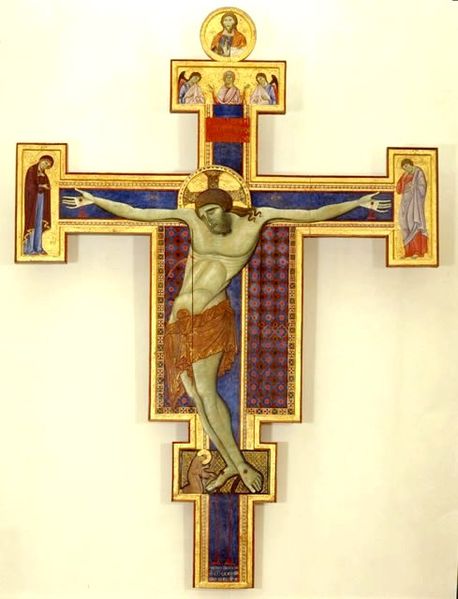
  • Good Friday

    So let me offer another picture of why Jesus is treated in this manner: because that’s what happens in the world. Each and every day, people suffer torment – sometimes physical, sometimes emotional, and sometimes spiritual. And so God comes in love in order to live not only with us but also as one of us, taking on our lot and our life and experiencing all that we experience so as to understand us and stand with us completely and fully.

    In the person of Jesus, therefore, we discover not only that God understands us, not only that God loves us enough to take on our lot and our life, but also that all of this suffering, and even death itself, cannot put an end to God’s love. So that as Jesus is raised on the third day, we have hope that our suffering and even our own deaths will not define us or defeat us but that we, too, will be raised by God’s love.

    David Lose, Meditation on Mark 15:16-20

  • Re-thinking Wright

    James K.A. Smith puts his finger on something that’s worried me about N.T. Wright in his review of Wright’s latest book. Wright sometimes gives the impression that post-New Testament development of Christian theology was a decline and that it’s possible–or desirable–for us to re-inhabit the thought-world of the 1st century (with the help of some judiciously applied knowledge of second-temple Judaism, of course). While understanding the historical context of Jesus’ life and mission is obviously important, Christians have always “translated” the gospel into different cultural idioms. Arguably this process starts in the NT itself: the theological frameworks of the synoptic gospels, John’s gospel, Paul’s letters, the letter to the Hebrews, and Revelation all have their differences. In the post-NT period, this picks up steam with the translation of the Christian gospel into language and concepts borrowed from Hellenistic philosophy, culminating in the debates at Nicaea and Chalcedon.

    It’s possible, I suppose, to see all this as a departure from a pristine, “original” gospel. But to do that, you have to explain how we, as 21st-century Christians, are supposed to embrace the worldview (assuming there’s just one worldview) of the NT without qualification. A more promising approach, in my view, is to acknowledge that the gospel is always undergoing a process of reinterpretation and translation, and that this can be done faithfully. The earliest expressions of the faith–while clearly normative in an important sense–aren’t necessarily adequate for all later generations of Christians. For a different, and more positive, take on this process of reinterpreting the gospel through the centuries, I’d recommend Keith Ward’s book Re-thinking Christianity.