Category: Books

  • C. S. Lewis on Barthians

    I was reading selections last night from a volume of C.S. Lewis’ letters and came across an interesting (and rather amusing) one to his brother on February 18, 1940. Apparently Lewis had recently encountered a group of zealous students of this newfangled theologian Karl Barth:

    Did you fondly believe – I did – that where you got among Christians, there, at least, you would escape (as behind a wall from a keen wind) from the horrible ferocity and grimness of modern thought? Not a bit of it. I blundered into it all, imagining that I was the upholder of the old, stern doctrines against modern quasi-Christian slush: only to find that my “sterness” was their “slush.” They’ve all been reading a dreadful man called Karl Barth, who seems the right opposite number to Karl Marx. “Under judgment” is their great expression. They all talk like Covenanters or old Testament prophets. They don’t think human reason or human conscience of any value at all: they maintain, as stoutly as Calvin, that there’s no reason why God’s dealings should appear just (let alone, merciful) to us: and they maintain the doctrine that all our righteousness is filthy rags with a fierceness and sincerity which is like a blow in the face…

    I don’t know if Lewis ever changed his opinion about Barth in light of the latter’s developed thought, but it’s interesting to see Lewis, the old-fashioned Christian humanist and upholder of reason in matters of faith and morals, clashing with the upstart “neo-orthodox” theology. Certainly “Barthians” of various stripes seem to dominate much of the field of academic theology nowadays, which makes you wonder where Lewis would fit in if he were still around. His critical approach to the Bible would not find favor with a lot of conservative evangelicals, but the high value he placed on human reason wouldn’t sit well with various neo-Barthian, “radically orthodox,” and post-liberal theologies.

  • Mitchell’s 8 Ways

    I took the red-eye home last night from the meeting I was attending in SF and so took most of today off from work to catch up on sleep and stuff around the house.

    I also started reading a fascinating book called 8 Ways to Run the Country by Brian Patrick Mitchell. Mitchell, the Washington Bureau chief for Investor’s Business Daily is seeking to complexify the Left-Right dichotomy in a way that makes sense of various ideological groups in American politics.

    Like some other political taxonomies such as the Nolan Chart, Mitchell posits a two-axis grid to plot various ideological groupings. But unlike the Nolan Chart with its rather simplistic axes of “personal freedom” and “economic freedom” (criteria which bias it towards libertarianism in a fairly obvious way), Mitchell plots along the axes of arche and kratos. Arche is social authority and kratos is political power. Thus various political positions can be identified according to the attitude they have to these two concepts.

    Thus you get the classic left-right spectrum of attitudues toward authority – the various -archies such as hierachy, the patriarchy, etc. and a top-bottom axis of attitudes toward political power, with akratists (those opposed to all political power) at the top. So, in Mitchell’s terminology, an anarchist, properly speaking, is someone who wants to abolish all social hierarchy, but wouldn’t necessarily oppose political power. Meanwhile, an akratist is primarily concerned with the use of force or coercion and may for that reason oppose government while being ok with social authority.

    Intriguingly, Mitchell says that this two-axis categorization is possible only in the west because it’s the west which separated social authority from political power in the first place. Christendom vested authority in the church and power in the state (obviously the reality is a bit more complex than that). This distinction makes possible political positions with varying attitudes toward these two social phenomeneon.

    With the grid in place Mitchell sees four major traditions of American political thought vying for dominance throughout our history. In the lower left are Progressive Democrats who oppose social hierarchy and want to use the power of the state as a means to bring about greater equality. In the upper right are Libertarian Individualists who oppose social authority (bourgeois morality, etc.) and government power. In the top right are Republican Constitutionalists who want to check state power in order to allow the institutions which embody social authority, such as church, family, and community, to flourish, and in the bottom right you have Plutocratic Nationalists who are comfortable using centralized state power to shore up the national community and seek a harmony among business, government, and social institutions.

    Adding to this already interesting mix, Mitchell refines these four quadrants, so you end up with a circle of eight positions plotted according to their views on arche and kratos with anarchists on the far left and akratists at the top:

    Communitarian (bottom-center): a pro-government pragmatist and technocrat “whose focus is always on the good of the community”

    Paleolibertarian (top-center): Anti-government but more comfortable with social authority than left-leaning cultural libertarians.

    Theoconservative (right-center): Primary concern is for the social instutitions that shore up family and faith; not overly fond of government, but willing to use state power to shore up these institutions.

    Radical (left-center): Chief concern is to overturn oppression and social hierarchy; like the Theocon on the opposite side of the circle, is suspicious about government, but willing to pragmatically use state power to serve the interests of the oppressed.

    Individualist (top-left): Takes a negative attitude toward government power and social authority; primary concern is personal, individual freedom.

    Neoconservative (bottom-right): Characterized by “belief in a strong central government to defend the established order, with all necessary cooperation between the social and political powers–church and state, business and government.”

    Paleoconservative (top-right): Suspicious of government precisely because he believes that the modern state is corroding traditional forms of life and culture. Wants a decentralized polity that allows local communities to set their own standards.

    Progressive
    (bottom-left): Wants to use government power to aid social progress; anti-traditionalist and “confident that the human condition can be infinitely improved if we just keep trying.” More focused on democracy than individual rights and liberties.

    This is a really fruitful way to make sense of political ideologies that goes beyond Left and Right and even some of the more complex typologies. For one thing, it helps me makes sense of my own political views a little bit. I definitely tend toward akratism in Mitchell’s terms in that I’m highly ambivalent about the use of force and coercion and consequently can sympathize at least somewhat with Radicals, Libertarians, Paleolibertarians, Paleocons and Theocons. I’m far less enamored of the centralizers in the bottom half of Mitchell’s compass: the big-government progressives, the communitarians (at least in their nationalizing variety), and the neocons.

    Subsequent chapters, which I’ve just started to get into, define each position in more detail, largely with quotes from representative figures. The book is brief and clearly written and yet adds a great deal of nuance to the ways most of us think about Americal politics.

  • Jesus Our Redeemer

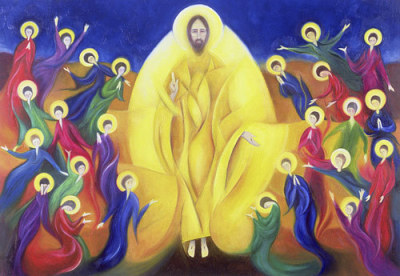
    Gerald O’Collins, S.J. is an Australian Jesuit who’s taught at Gregorian University in Rome since the 70s. I greatly enjoyed his book on the Trinity (and blogged a bit about it here), so was pleased to discover that early this year he published Jesus Our Redeemer: A Christian Approach to Salvation in which O’Collins offers a systematic soteriology. He covers the topics of creation, original sin, atonement, the role of the Holy Spirit and the church, the salvation of non-Christians, the final resurrection, and the redemption of creation. I just received the copy that I ordered and am eager to dig in. Expect posts soon.

    It also has a really lovely cover image from Sophie Hacker a contemporary religious artist:

    resurrection-icon.jpg

  • Beyond antrhopocentrism and misanthropy

    I’ve been reading a short collection of essays by Wendell Berry called Another Turn of the Crank. I’m not ready to sign on to Berry’s agrarian vision, but I do think he makes some important observations. In an essay called “The Conservation of Nature and the Preservation of Humanity,” he points out that much of the environmental movement sets up a dichotomy between pristine “wilderness” and land that has been exploited and abused by human beings. But what we really need, Berry says, are models for good fruitful use of the land by humans, not an idealized human-free landscape:

    That there have been and are well-used landscapes we know, and to leave these landscapes out of account is to leave out humanity at its best. It is certainly necessary to keep in mind the image of the human being as parasite and wrecker–what e.e. cummings called “this busy monster manunkind”–for it is dangerous not to know this possibility in ourselves. And ceratinly we must preserve some places unchanged; there should be places, and times too, in which we do nothing. But we must also include ourselves as makers, as economic creatures with livings to make, who have the ability, if we will use it, to work in ways that are stewardly and kind toward all that we must use. That is, we must include ourselves as human beings in the fullest sense of the term, understanding ourselves in the fullness of our cultural inheritance and our legitimate hopes. (p. 72)

    Berry’s point is simple: “as we cannot exempt ourselves from living in this world, then if we wish to live, we cannot exempt ourselves from using the world.”

    Even the most scrupulous vegetarians must use the world–that is, they must kill creatures, substitute one species for another, and eat food that otherwise would be eaten by other creatures. And so by the standard of absolute harmlessness, the two available parties are not vegetarians and meat eaters but rather eaters and noneaters. Us eaters have got ’em greatly outnumbered. (p. 73)

    The trick is to combine use with care. And to treat our fellow-creatures with care requires us to dig into the roots of our ethical and religious traditions. Contrary to a scientism that would reduce living creatures to an assemblage of mechanical parts care “allows creatures to escape our explanations into their actual presence and their essential mystery”

    In taking care of fellow creatures, we acknowledge that they are not ours; we acknowledge that they belong to an order and a harmony of which we ourselves are parts. To answer to the perpetual crisis of our presence in this abounding and dangerous world, we have only the perpetual obligation of care. (p. 77)

    But, as they say, charity begins at home. “Misanthropy is not the remedy for ‘anthropocentrism.’ Finally we must see that we cannot be kind toward our fellow creatures except by the same qualities that make us kind toward our fellow humans.” Interestingly, Berry takes abortion as a chief exemplar of the ways in which we have cheapened human life. And this is of a piece with the rest of our violence. “If we cannot justify violence to unborn human beings, then how can we justify violence to those who are born, or to the world they are born into?”

    Obviously the guiding principle of “care” needs to be fleshed out in ways that take into account conflicts of interests. Berry concedes as much himself when he concedes that, though he believes abortion to be wrong, he can imagine situations where choosing it would be the lesser evil. One problem is that it’s so easy for us to privilege the claims of the relatively strong over the weak and voiceless. This is one of the limits of a rights-based ethic: rights-bearers are often identified by their ability to make claims on their own behalf. Thus those who are unable to claim their rights, at least in our approved language of public philosophy, are held to have none.

    But his main point, which strikes me as sound, is that, in general, any policy of sustainability has to be rooted in the possibility of thriving human communities. A sustainable human way of life has to also be a sustainable human way of life.

  • D.M. Baillie on the Jesus of history and the Christ of faith

    This weekend I re-read Donald Baillie‘s brief book God Was In Christ. Though originally published in 1948 it still strikes me as fresh and contemporary, not least in the way that it treats the problem of the “historical Jesus” and/vs. the “Christ of Faith.”

    Baillie is waging a two-front war here. On the one side are “liberals” who, so intoxicated by research into the historical Jesus, want to keep Jesus but jettison Christology. Why not be content, they ask, with the “simple religion of Jesus” rather than the religion about Jesus, which overlays the message of God’s fatherly love with obscure Christological dogma.

    On the other side are those who Baillie calls “neo-confessionalists.” He has in mind here folks like Barth, Brunner, and Bultmann, who, in spite of their differences, downplay the importance of the Jesus of history in favor of the Christological dogmas about Jesus. They ironically accept the most radical biblical criticism of their day, but use it to undermine the optimistic liberal version of the historical Jesus and to buttress the authority of the church’s proclamation of the God-man.

    What’s interesting here is that these two poles are in many ways still with us. A liberal like Marcus Borg or John Dominic Crossan would have us abandon the church’s proclamation about Jesus with its Christological baggage and focus instead on Jesus as an exemplar of religious consciousness and an advocate for social justice.

    Meanwhile, Christians overly impressed with some strands of postmodernism dismiss “historical Jesus” research and, in light of various epistemological critiques, see the church’s web of belief and practice as epistemically prior to any purely historical questions about “what really happened” back in 1st century Palestine. Thus the church’s proclamation about Christ and its portraits of him in the Gospels are rendered immune to challenge from purely secular sources of knowledge.

    Baillie, however, is unhappy with both approaches and seeks to thread a middle way. He deploys a rather ingenious argument against the “liberal” position. He points out that “the faith of Jesus” can’t be so easily disentangled from claims about who Jesus was/is. In other words, any adequate theology will require a Christology. This is because the God that Jesus reveals is not a remote deity to which humans must ascend by their own efforts, but a gracious father who takes the initiative and seeks the lost. To see Jesus as an examplar, even the supreme exemplar, of this quest fails to do justice to the faith of Jesus himself:

    If Jesus was right in what He reported, if God is really such as Jesus said, then we are involved in saying something more about Jesus Himself and His relation to God, and we must pass beyond words like ‘discovery’ and even ‘revelation’ to words like ‘incarnation.’ ‘In order to give us authentic tidings of the character of God’, I quoted from a philosopher, ‘Jesus did not require actually to be God.’ Is that, then, all that Jesus did–to bring us authentic tidings, as from a distant realm, of a God who takes no initiative Himself to seek us out? If God is like that, then Jesus was wrong about Him, the tidings He brought were not authentic, and He was not even a true discoverer. But if He was right, then there is something more to be said, something Christological; and if we leave it out, we are leaving out not only something vital about Jesus, but something vital about God. That is to say, if we have not a sound Christology, we cannot have a sound theology either. (pp. 64-5)

    Baillie has a different bone to pick with those he calls the “neo-confessionalists.” Skeptical about the ability of historical research to tell us much at all about the life and personality of Jesus, it falls back on the church’s proclamation of Christological dogma. Thus it makes a virtue out of necessity, even going so far to say that knowledge of the life and career of Jesus would be positively no help in coming to faith. Kierkegaard, who had influenced this neo-confessionalist strain, went so far as to say that “If the contemporary generation had left behind them nothing but the words, ‘we have believed that in such and such a year God appeared among us in the humble figure of a servant, that He lived and taught in our community, and finally died,’ it would be more than enough” (quoted by Baillie, p. 49).

    But, Baillie asks, is the sheer brute fact of the Incarnation a sufficient foundation on which to build an adequate Christology? He is happy to concede that the various “historical Jesus” schools have overreached both in what we can really know about Jesus and in trying to isolate the “history” from the divine drama of redemption. But at the same time, to take the Incarnation seriously means that it matters what kind of life God in the flesh lived on earth. The personality or character of Jesus is itself a revelation of the nature of God. “[Barth] has reacted so violently against the ‘Jesus of history’ movement that he does not seem interested in the historical Jesus at all. His theology has become so austerely a theology of the Word that (if one may venture with the greatest respect to say so) it is hardly a theology of the Word-made-Flesh” (p. 53).

    I’m not in a position to assess whether this is a fair critique of Barth, but what I take two points away from this. First, the personality or character of Jesus matters. If the Christian message were confined to the mere report of the dying and rising of the God-man and made no mention of the kind of man he was, it would be radically incomplete. Secondly, it matters whether Jesus really did do and say the kinds of things ascribed to him in the Gospels. However much legitimate criticism there is to be made of the methods and conclusions various “historical Jesus” reconstructions, Christians can’t simply shrug off the historical question by taking refuge in the church’s confession. Honest seekers will always want to know what relationship the story of Christ that the church tells bears to reality.

    With all its emphasis on the incursion of the Divine into human life once for all in Jesus Christ, [neo-confessionalist theology] has no interest in studying the resultant life as an historical phenomenon; and this is not because it would put back the hands of the clock by rejecting modern historical criticism (far from it!) but because ‘the Jesus of history is not the same as the Christ of faith’ (Brunner). I do not believe that this can be a stable position for theology. It would ultimately stultify the whole doctrine of the Incarnation. ‘If righteousness is by the Law,’ said St. Paul to the first Christian generation, ‘then Christ died for nothing’; and we might now say, in this twentieth century: If revelation is by the Word alone, then Christ lived for nothing, and the Word was made flesh in vain. That is the ultimate answer to our question as to whether we can dispense with the Jesus of history. (pp. 53-4)

    Baillie’s point is that it’s not enough to take refuge in the dogmas, tradition, language, or practices of the church, however essential those are. Although current theology is more interested in Jesus’ character and teachings, there is a tendency among the heirs of Barth to insulate the church’s story from the issue of historical veracity, often by appeal to a kind of postmodern relativism of epistemologies. If no one has access to the unmediated truth of things, then the church’s version of events is no worse off (and, of course, no better off) than anyone else’s version. The question is whether safety from external critique is purchased at the price of universal relevance. If the Incarnation was a public event, a revelation of the divine character and purpose in the life of an actual historical human being, then it matters what that life was like. It seems to me that we risk embracing a new kind of gnosticism if we say that knowledge of Jesus is only possible within the “narrative” of the Christian community.

    Baillie contends that, even taking into consideration the results of historical criticism, it’s still possible to discern the character of the historical Jesus. Against the “form criticism” school that tries to understand the Gospel elements in terms of the rhetorical or homiletical purposes, Baillie points out that this doesn’t exclude “biographical” information about Jesus. It’s become a cliche to say that the Gospel writers weren’t interested in writing history or biography in the modern sense, but it hardly follows that they had no interest in historical recollections about Jesus. As Baillie says, “surely we should expect those men, believing what they did about Jesus, to be immensely interested in recalling anything that He had said or done, simply because He had said or done it, however remote they might be from the modern ‘biographical’ interest” (p. 57).

    Thus I cannot believe that there is any good reason for the defeatism of those who give up all hope of penetrating the tradition and reaching an assured knowledge of the historical personality of Jesus. Surely such defeatism is a transient nightmare of Gospel criticism, from which we are now awaking to a more sober confidence in our quest of the Jesus of history. (p. 58)

    While I think there’s a lot to be said for the kind of critique of the “historical Jesus” industry offered by someone like Luke Timothy Johnson, I think Baillie is correct that a truly incarnational faith can’t detach itself from its roots in history. At the same time, he’s also correct that the “Jesus of history” is insufficient as the basis for a living faith. The church’s experience of Easter and Pentecost, as well as its ongoing life, are surely indispensable for understanding the meaning of Jesus in the divine drama of our salvation.

  • The thirsty God

    This book I’m reading by Stephen Cottrell is really terrific. It’s part theology, part mediation, part devotional, and incorporates a section on Christian practice into each chapter, connecting the meditation on Christ’s cross with Lenten practices like fasting, almsgiving, Bible reading, prayer, etc. (which really are just Christian practices). He takes the passion according to John as his main text, but draws connections to other parts of the biblical story throughout.

    Cottrell, the Bishop of Reading, uses Jesus’ words “I thirst” to illuminate the passion story. “They are such sorrowful words, so simple and yet so very human: Christ, the thirsty one, one who shares deeply in the mess and muddle of human living” (p. 12). He emphasizes the themes of divine solidarity with human suffering and the love that is poured out through the life and death of Jesus. God not only shares our lot, but the cross is the definitive revelation of God as love, demonstrated by Jesus’ determination to love “to the end.” This is the victory that he wins over the powers of sin and evil.

    On the flight back from DC this morning I finished chapter 4, “The Tenacity of Love,” which I think is fair to call the heart of the book. In previous chapters Bp. Cottrell has dealth with the events leading up to the passion, but here he deals with the crucifixion itself.

    [What happens on the cross] is what I call ‘the tenacity of love’: Jesus keeps on loving those who keep on hating. He defeats sin and death by the resolute persistence of his love. To the soldiers who nail him to the cross he speaks words of understanding and forgiveness: ‘Father, forgive them; for they do not know what they are doing’ (Luke 23:34). To the thief who hangs alongside him he promises a share in Paradise (Luke 23:43). These beautiful words spoken out of the horror of the cross embody his life’s teaching, that we should love our enemies, pray for those who persecute us, walk the second mile. It is the love that carries on loving, right to the end. (p. 115-6)

    But, of course, for Christians Jesus is not just a good man who persevered and died a martyr’s death. He reveals the nature of God as Love:

    If Jesus had given in to the taunts and indignity and sheer bloody awfulness of the cross, then love would have failed. It would have become less than love, and less powerful than hate. But by allowing himself to be handed over to this passion, and by fulfilling the vocation of love, God triumphs. He triumphs in the all-too-human flesh that Jesus now redeems. He risks the possibility of failure, as today he risks the possibility that we may never recognize the nature of his triumph. But that is the way with love. All it can do is go on loving. It can never coerce, and it can never wantonly hurt or manipulate that which it loves.

    The words ‘I thirst’ sum up this love because they witness to the frightful horror of what is happening — the indignity, the humiliation, the pain. But they also penetrate the deepest purposes of God. ‘I thirst for you,‘ says Jesus from the cross. ‘I do this for you: I am the faithful one who lays down his life for his friends. I do this for God: I drink the cup the father sets before me. I desire your salvation. Like a dry, weary land where there is no water, so I thirst for you and I thirst to do God’s will. See how much I love you. See the depths of the Father’s love. See my arms stretched out in love for you. Allow yourself to be embraced by my love. Allow yourself to be transformed.’ (p. 116)

    To use the all-too-familiar typology, Bp. Cottrell seems to be combining elements of an Abelardian and Christus Victor understanding of the cross. Jesus, in loving to the end, reveals God’s love to us, or, maybe better, enacts it, pours it out. “His silence before his accusers, his forgiveness of those who persecute him, his complete lack of hatred, most reveal the true nature of God’s unconditional love” (p. 108). And yet at the same time, this is the defeat of sin and hatred: “Sin and death are brought to submission by the persistence of Christ’s love. All their forces are spent upon him, but he carries on loving” (p. 116). Love, not hate, has the last word. God in Jesus takes the brunt of our sin upon himself and absorbs it, “[l]ike a lightning conductor pulling the energy of the storm out of the sky and burying it safely in the earth” (p. 115). This turns penal substitution on its head in that it’s not God punishing Jesus, but us (which is clearly much closer to the literal truth of things). And yet this fury and hate is absorbed and defeated by God’s inexorable love.

    Bp. Cottrell goes on to connect this profound understanding of God’s love with the Christian’s practice of prayer. Prayer, he says, is founded on “God’s affirmation of love for us, and our responding with the same heartfelt desire” (p. 132):

    Prayer is first of all about what God says to us. It is about allowing ourselves to be changed and shaped by God’s agenda for God’s world. We come into the presence of God with thankful hearts for all he has done for us in Christ. We thank him for the gift of life — and this can happen anywhere and at any time. We still ourselves: we are in the presence of the one who loves us and we allow ourselves to hear his voice speaking his words of love. Sometimes we need the voice of God that speaks to us through the Bible, or through the liturgy of the church, to communicate this message of love. Or sometimes it is expressed to us through songs of praise. Sometimes we arrive at a place of complete silence, where it is sufficient just to know we are in God’s presence. In each case we allow God to nurture within us, through his Holy Spirit, a deep sense of our being the beloved, of knowing we are loved. Then we can live and act with the same affirmation that sustained Christ, which enabled him to love others, which even made it possible for him to love his enemies. Only by knowing God’s love for us, by knowing that we are worthy of his love, and therefore able to love ourselves more, can we reach out with love to others. (p. 132-3)

    By my lights this is good evangelical stuff in the best sense of the word. Our response to God and to the world is based on the good news of God’s prior act of love in creating, sustaining, and redeeming us. God’s favor is sheer grace, but that grace, which is simply the love of God, calls forth a response from us. And the “the old, old story of Jesus and His love” is one we need to rehearse, in prayer and liturgy, word and sacrament, to make this good news a living reality in our lives.

  • JPII and Gerhard Forde on the Scandal of the Cross

    I have this feeling that I’ve posted on this before at the old blog, but I was flipping through Pope John Paul II’s Crossing the Threshold of Hope this weekend, and found him to have some illuminating things to say about the mystery of the Cross.

    The book is written in a kind of Q&A format with the questions offered by Italian journalist Vittorio Messori. In response to a question about the problem of suffering, the Pope gives an interpretation of the meaning of the Cross that is in some ways the reverse of the view that Jesus’s death is a way of satisfying God:

    In the preceding questions you addressed the problem precisely: Was putting His Son to death on the Cross necessary for the salvation of humanity?

    Given our present discussion, we must ask ourselves: Could it have been different? Could God have justified Himself before human history, so full of suffering, without placing Christ’s Cross at the center of that history? Obviously, one response could be that God does not need to justify Himself to man. It is enough that He is omnipotent. From this perspective everything He does or allows must be accepted. This is the position of the biblical Job. But God, who besides being Omnipotence is Wisdom and-to repeat once again-Love, desires to justify Himself to mankind. He is not the Absolute that remains outside of the world, indifferent to human suffering. He is Emmanuel, God-with-us, a God who shares man’s lot and participates in his destiny. This brings to light another inadequacy, the completely false image of God which the Enlightenment accepted uncritically. With regard to the Gospel, this image certainly represented a step backward, not in the direction of a better knowledge of God and the world, but in the direction of misunderstanding them.

    No, absolutely not! God is not someone who remains only outside of the world, content to be in Himself all-knowing and omnipotent. His wisdom and omnipotence are placed, by free choice, at the service of creation. If suffering is present in the history of humanity, one understands why His omnipotence was manifested in the omnipotence of humiliation on the Cross. The scandal of the Cross remains the key to the interpretation of the great mystery of suffering, which is so much a part of the history of mankind.

    Even contemporary critics of Christianity are in agreement on this point. Even they see that the crucified Christ is proof of God’s solidarity with man in his suffering. God places Himself on the side of man. He does so in a radical way: “He emptied himself, / taking the form of a slave, / coming in human likeness; / and found human in appearance, / he humbled himself, / becoming obedient to death, / even death on a cross” (Phil 2:7-8). Everything is contained in this statement. All individual and collective suffering caused by the forces of nature and unleashed by man’s free will-the wars, the gulags, and the holocausts: the Holocaust of the Jews but also, for example, the holocaust of the black slaves from Africa.

    I say this reverses the common understanding of the Cross because, instead of seeing the Crucifixion as the means by which humanity is able to satisfy God’s justice or wrath, it portrays God as, in a sense, seeking to justify himself before humanity, by demonstrating that he is a God of love.

    The Pope goes on to say:

    God is always on the side of the suffering. His omnipotence is manifested precisely in the fact that He freely accepted suffering. He could have chosen not to do so. He could have chosen to demonstrate His omnipotence even at the moment of the Crucifixion. In fact, it was proposed to Him: “Let the Messiah, the King of Israel, come down now from the cross that we may see and believe” (Mk 15:32). But He did not accept that challenge. The fact that He stayed on the Cross until the end, the fact that on the Cross He could say, as do all who suffer: “My God, my God, why have you forsaken me?” (Mk 15:34), has remained in human history the strongest argument. If the agony on the Cross had not happened, the truth that God is Love would have been unfounded.
    Yes! God is Love and precisely for this He gave His Son, to reveal Himself completely as Love. Christ is the One who “loved to the end” (Jn 13:1). “To the end” means to the last breath. “To the end” means accepting all the consequences of man’s sin, taking it upon Himself. This happened exactly as prophet Isaiah affirmed: “It was our infirmities that he bore, /We had all gone astray like sheep, / each following his own way; / But the Lord laid upon him / the guilt of us all” (Is 53:4-6).

    The Man of Suffering is the revelation of that Love which “endures all things” (1 Cor 13:7), of that Love which is the “greatest” (cf. 1 Cor 13:13). It is the revelation not only that God is Love but also the One who “pours out love into our hearts through the Holy Spirit” (cf. Rom 5:5). In the end, before Christ Crucified, the man who shares in redemption will have the advantage over the man who sets himself up as an unbending judge of God’s actions in his own life as well as in that of all humanity.

    Thus we find ourselves at the center of the history of salvation. The judgment of God becomes a judgment of man. The divine realm and the human realm of this event meet, cross, and overlap. Here we must stop. From the Mount of the Beatitudes, the road of the Good News leads to Calvary, and passes through Mount Tabor, the Mount of the Transfiguration. The difficulty and the challenge of understanding the meaning of Calvary is so great that God Himself wanted to warn the apostles of all that would have to happen between Good Friday and Easter Sunday.

    This is the definitive meaning of Good Friday: Man, you who judge God, who order Him to justify Himself before your tribunal, think about yourself, if you are not responsible for the death of this condemned man, if the judgment of God is not actually a judgment upon yourself. Consider if this judgment and its result-the Cross and then the Resurrection-are not your only way to salvation. (all emphasis mine)

    I see a certain similarity between what John Paul says here and what the late Lutheran theologian Gerhard Forde has written about the work of Christ. God’s “problem,” says Forde, is how to be a God of love for us when we won’t have it. We are the problem, the ones who need to be reconciled to God.

    Forde writes:

    Why does God abandon Jesus to be murdered by us? The answer, it would seem, must lie in that very unconditional love and mercy he intends to carry out in act. God, I would think we can assume, knows full well that he is a problem for us. He knows that unconditional love and mercy is “the end” of us, our conditional world. He knows that to have mercy on whom he will have mercy can only appear as frightening, as wrath, to such a world. He knows we would have to die to all we are before we could accept it. But he also knows that that is our only hope, our only salvation. So he refuses to be wrath for us. He refuses to be the wrath that is resident in all our conditionalism. He can indeed be that, and is that apart from the work of Christ. But he refuses ultimately to be that. Thus, precisely so as not to be the wrathful God we seem bent on having, he dies for us, “gets out of the way” for us. Unconditional love has no levers in a conditional world. He is obedient unto death, the last barrier, the last condition we cannot avoid, “that the scriptures might be fulfilled”—that God will have mercy on whom he will have mercy. As “God of wrath” he submits to death for us; he knows he must die for us. That is the only way he can be for us absolutely, unconditionally. But then, of course, there must be resurrection to defeat that death, lest our conditionalism have the last word. (Forde, Caught in the Act)

    Both John Paul and Forde see the rvelation of God as love simultaneously as a judgment upon humanity. Perfect love enters our world and is caught in the net of human perfidy, beaten, mocked, tortured, and ultimately killed. And yet, in the Resurrection Love has the last word. The Cross is the inevitable outcome of God’s determination to be a God of Love, a determination that our sin is unable to defeat.

  • Notes on Anselm’s Cur Deus Homo: 10

    Faced with the need for some kind of satisfaction for sin, Anselm deduces that “If it be necessary, therefore, as it appears, that the heavenly kingdom be made up of men, and this cannot be effected unless the aforesaid satisfaction be made, which none but God can make and none but man ought to make, it is necessary for the God-man to make it” (Bk. Two, Ch. VI). No fallen human being can possibly make satisfaction for sin; only God can do so. And yet, it’s appropriate that a human being be the one who makes satisfaction, since “as Adam and his whole race, had he not sinned, would have stood firm without the support of any other being, so, after the fall, the same race must rise and be exalted by means of itself” (Bk. Two, Ch. VIII).

    Anselm affirms the traditional Chalcedonean definition of Christ’s two natures: he is fully God and fully man. The two natures aren’t mixed and they do not compose some tertium quid neither fully God nor fully human. “For God will not do it, because he has no debt to pay; and man will not do it, because he cannot. Therefore, in order that the God-man may perform this, it is necessary that the same being should perfect God and perfect man, in order to make this atonement” (Bk. Two, Ch. VII).

    But how, exactly, does Anselm think that the God-man makes atonement for sin? We have seen that Anselm thinks that any rational creature, by its very nature, owes God perfect obedience. Humanity has failed at this, and as a consequence we now owe God our death. However, the God-man, while he owes God obedience as all rational creatures do, doesn’t owe God his death, because he hasn’t sinned. “For, if Adam would not have died had he not committed sin, much less should this man suffer death, in whom there can be no sin, for he is God” (Bk. Two, Ch. X).

    The God-man, then, in voluntarily giving up his life, renders to God something which was not owed, and this gift outweighs the debt of human sin. To show this, Anselm asks Boso to engage in a thought experiment. Imagine, he says, that the God-man was standing before you and that you were told that the entire created universe would be destroyed if you didn’t kill him. Would it be right to do it? He further tells Boso to suppose that if he didn’t kill the God-man “all the sins of the world will be heaped upon you.”

    Boso replies: ” I would far rather bear all other sins, not only those of this world, past and future, but also all others that can be conceived of, than this alone. And I think I ought to say this, not only with regard to killing him, but even as to the slightest injury which could be inflicted on him” on the grounds that a “sin committed upon his person exceeds beyond comparison all the sins which can be thought of, that do not affect his person.”

    Anselm praises Boso for his answer and adds that “sins are as hateful as they are evil, and that life is only amiable in proportion as it is good. And, therefore, it follows that that life [i.e. the life of the God-man] is more lovely than sins are odious.” So, for the God-man to lay down his life is to offer a git that “surpasses all the sins of men.”

    Recall that Anselm has said earlier that Christ was not killed by God, but that his life of perfect obedience in a sinful world led to his death. So, in what sense does he lay down his life? Anselm’s view is that death isn’t natural to human nature, but only occurs as a result of sin. So the God-man, being sinless, wouldn’t naturally have died. However, he could voluntarily give up his life and did so precisely to offer that priceless gift that “taketh away the sin of the world.”

    I imagine that for us this strikes a bit of a false note. Contemporary theology has so strongly emphasized the humanity of Jesus that it sounds strange, to say the least, to say that he was somehow naturally immune to death. It seems to make more sense to say that if, somehow, Jesus hadn’t been killed by the religious and political authorities of his day he still would’ve died eventually of natural causes. Knowing what we know about human nature we no longer think of death as unnnatural, but as part of the natural process by which living things come into and pass out of being. As part of the process of life, death seems necessary.

    Maybe Anselm could accept the foregoing and point out that it still wasn’t necessary for Christ to die a violent, shameful death. That is, he chose to throw his lot in with sinners, to be found among them, to be tortured as one of them, and finally killed. Might not this gift be understood to contain the saving power Anselm describes as his voluntarily laying down his life? It might be said that even if incarnation necessarily entails mortality, the Son of God, being sinless, couldn’t possibly have owed God this kind of death. And indeed, it’s this identification with sinners that gives the story of Jesus’ life and death so much of its power, it seems to me.

    Of course, even given all this, we might still wonder how this gift is applied to us? How does the God-man’s life of perfect obedience, culminating in his freely offered death, reconcile us with God?

    Anselm’s argument goes like this:

    The Son of God’s gift of himself, his obedience, his life, and his death, is a gift that “surpasses all the sins of men,” and this unsurpassable gift earns for the Son a reward from the Father.

    But, how “can a reward be bestowed on one who needs nothing, and to whom no gift or release can be made?” In other words, everything that belongs to the Father also belongs to the Son, so he has no need of reward. Yet “if a reward so large and so deserved is not given to him or any one else, then it will almost appear as if the Son had done this great work in vain.” Therefore, the reward “must be bestowed upon some one else, for it cannot be upon him.”

    And what, Anselm asks, could be more proper than that the reward be bestowed “upon those for whose salvation, as right reason teaches, he became man; and for whose sake, as we have already said, he left an example of suffering death to preserve holiness?” Namely, human beings, who “weighed down by so heavy a debt, and wasting through poverty, in the depth of their miseries, he should remit the debt incurred by their sins, and give them what their transgressions had forfeited.”

    The interesting thing here is that Anselm makes no mention of faith or works as necessary conditions for reaping the benefits of Christ’s sacrifice. And, if his gift of himself is so surpassing in beauty and goodness that it outweighs the entire world’s sin, why not embrace universalism? Obviously Anselm doesn’t draw this conclusion, and indeed he specifically says that there are human beings who will not be saved, but if the gift really does blot out all the sins of the world, it’s hard to see on what grounds he shouldn’t draw this conclusion. After all, if God the Son asks that the merits of his death be applied to his brethren, what grounds, apart from some inscrutable will, would there be for applying it to some and denying it to others. After all, ex hypothesi, we are all completely unable to atone for our own sins.

    As Holy Week is drawing to a close I think I’m going to make this the last post on this topic. There are other topics Anselm discusses which might make worthy tangents, such as an argument for something like the Immaculate Conception, as well as his discussion of in what sense Christ is an example for us. But I’ll put that off for another time.

    My goal hasn’t been to argue that Anselm provides the correct account of the Atonement (assuming we’re even capable of such a thing). But I hope I have given some indication that his thought is more complex, interesting, and even appealing than it’s often given credit for. Far from being an arbitrary tyrant, Anselm’s God is defined by his goodness, which upholds the order and beauty of the universe, and, when we had fallen into sin, finds a way to restore us to himself while maintaining that beauty and blotting out the evil of sin. The God-man is the incarnate expression of the love of God the Son for God the Father, whereby he gives himself back to the Father in a trinitarian movement that, in George Lindbeck’s words, “irradiat[es] the universe and mak[es] it a far, far better place than it would ever have been without Christ’s coming and inevitable death.”
  • Notes on Anselm’s Cur Deus Homo: 9

    Okay, the argument so far: Anselm has contended that humankind has fallen into sin by failing to render to God the honor due him (i.e. obedience). As a result we threaten to fail to acheive God’s intended purpose for us, namely, being part of the “celestial estate” and consequently we disrupt the order and beauty of God’s good creation. God won’t suffer the order of creation to be disrupted, since otherwise he would not be all-good and all-powerful. For the order to be restored and the goodness of creation to be upheld sin must be punished or satisfaction must be made for it. Human beings, already owing everything they have to God, are unable to make satisfaction for sin. And yet if God were simply to punish sin his purpose for humankind – their sharing in the celestial estate – would be frustrated. Therefore, God will make satisfaction for sin.

    In Book Two, Anselm turns to discuss in more detail how it is that God makes satisfaction for sin. In Book Two, Chapter Five Boso raises the objection that saying that God must make satisfaction for sin seems to put God under the constraints of some kind of compulsion or necessity. Moreover, if God acts of necessity why should we be grateful for what he does?

    But, Anselm replies, this isn’t an absolute necessity, but only necessary given that God has purposes for human beings and will do whatever is necessary to make those purposes effective. God’s original grace to us is our creation and that he destines us for eternal life; how much more grace, then, does he show in that he stoops to bring us to that destination even after we have fallen into sin?

    Much more, therefore, do we owe all thanks to God for completing his intended favor to man; though, indeed, it would not be proper for him to fail in his good design, because wanting nothing in himself he begun it for our sake and not his own. For what man was about to do was not hidden from God at his creation; and yet by freely creating man, God as it were bound himself to complete the good which he had begun. In fine, God does nothing by necessity, since he is not compelled or restrained in anything. And when we say that God does anything to avoid dishonor, which he certainly does not fear, we must mean that God does this from the necessity of maintaining his honor; which necessity is after all no more than this, viz., the immutability of his honor, which belongs to him in himself, and is not derived from another; and therefore it is not properly called necessity. Yet we may say, although the whole work which God does for man is of grace, that it is necessary for God, on account of his unchangeable goodness, to complete the work which he has begun.