Ross Douthat makes a point not unlike the point I made here. Much as I enjoy Ron Paul’s red-meat isolationism, the chances that such a view will actuall carry the day are slim to none. With Romney, Guliani, and McCain all trying to out-hawk each other, it would be great if the realist-internationalist school of thought was represented in the current debate. Unfortunately, Chuck Hagel seems more interested in playing will-he-or-won’t-he with the press than making substantive contributions to the current debate.
Author: Lee M.
-
C. S. Lewis on Barthians
I was reading selections last night from a volume of C.S. Lewis’ letters and came across an interesting (and rather amusing) one to his brother on February 18, 1940. Apparently Lewis had recently encountered a group of zealous students of this newfangled theologian Karl Barth:
Did you fondly believe – I did – that where you got among Christians, there, at least, you would escape (as behind a wall from a keen wind) from the horrible ferocity and grimness of modern thought? Not a bit of it. I blundered into it all, imagining that I was the upholder of the old, stern doctrines against modern quasi-Christian slush: only to find that my “sterness” was their “slush.” They’ve all been reading a dreadful man called Karl Barth, who seems the right opposite number to Karl Marx. “Under judgment” is their great expression. They all talk like Covenanters or old Testament prophets. They don’t think human reason or human conscience of any value at all: they maintain, as stoutly as Calvin, that there’s no reason why God’s dealings should appear just (let alone, merciful) to us: and they maintain the doctrine that all our righteousness is filthy rags with a fierceness and sincerity which is like a blow in the face…
I don’t know if Lewis ever changed his opinion about Barth in light of the latter’s developed thought, but it’s interesting to see Lewis, the old-fashioned Christian humanist and upholder of reason in matters of faith and morals, clashing with the upstart “neo-orthodox” theology. Certainly “Barthians” of various stripes seem to dominate much of the field of academic theology nowadays, which makes you wonder where Lewis would fit in if he were still around. His critical approach to the Bible would not find favor with a lot of conservative evangelicals, but the high value he placed on human reason wouldn’t sit well with various neo-Barthian, “radically orthodox,” and post-liberal theologies.
-
Confessions of a thirtysomething right-wing peacenik
Marvin points to a blog post discussing a poll indicating that we thirtysomethings are the only age group still giving majority support to the Iraq war. Much speculation abounds in the comment thread about us children of the 80s having been brainwashed by the evil Reagan.
Coming near the tail end of this cohort (I’m 32), I’ve always been anti-war, beginning with my teenage skepticism of the Gulf War propaganda fed to us by the classroom “news” program Channel One when I was in high school. I did have a slight deviation during the Afghanistan conflict, seeing it at the time as a justifiable response to the 9/11 attacks (I’m a bit more ambivalent about that now).
Perhaps surprisingly, it was really the liberal “humanitarian” wars of Bill Clinton that put me solidly in the anti-war camp. A truly self-defensive war I could theoretically get behind, but the whole idea of dropping bombs on foreigners to make them get along better always struck me as incredibly corrupt and perverse. I think this is actually part of the reason I became something of a right-winger in the late 90s – in those days it was the congressional Republicans who were opposing the President’s wars! This trend of Republican dovishness probably peaked with candidate George W. Bush’s “more humble” foreign policy and skepticism about nation-building.
Obviously times have changed, and the anti-war position is only represented in the current crop of GOP candidates by Dr. Ron Paul. Dr. Paul made the case that non-intervention is the traditional conservative and constitutional position, though it might be a bit of a stretch to call Ike an isolationist of any sort. It’s indicative of how surreal these debates are that Paul, a radical libertarian “fringe” candidate, is the only GOP contender who comes anywhere close to the position of the majority of Americans on the war, even if not us warmongering thirtysomethings.
-
Against beer snobbery
I largely agree with this.
Also, not only are Bud and Miller union-made brews (as Matthew Yglesias points out), “macro” brews are often more likely to be vegetarian/vegan than many microbrews.
Now, look: I enjoy microbrews, but for an everyday drinkin’ beer I’d just as soon crack open a Bud or a High Life as most of them. Sue me.
-
Mitchell’s 8 Ways
I took the red-eye home last night from the meeting I was attending in SF and so took most of today off from work to catch up on sleep and stuff around the house.
I also started reading a fascinating book called 8 Ways to Run the Country by Brian Patrick Mitchell. Mitchell, the Washington Bureau chief for Investor’s Business Daily is seeking to complexify the Left-Right dichotomy in a way that makes sense of various ideological groups in American politics.
Like some other political taxonomies such as the Nolan Chart, Mitchell posits a two-axis grid to plot various ideological groupings. But unlike the Nolan Chart with its rather simplistic axes of “personal freedom” and “economic freedom” (criteria which bias it towards libertarianism in a fairly obvious way), Mitchell plots along the axes of arche and kratos. Arche is social authority and kratos is political power. Thus various political positions can be identified according to the attitude they have to these two concepts.
Thus you get the classic left-right spectrum of attitudues toward authority – the various -archies such as hierachy, the patriarchy, etc. and a top-bottom axis of attitudes toward political power, with akratists (those opposed to all political power) at the top. So, in Mitchell’s terminology, an anarchist, properly speaking, is someone who wants to abolish all social hierarchy, but wouldn’t necessarily oppose political power. Meanwhile, an akratist is primarily concerned with the use of force or coercion and may for that reason oppose government while being ok with social authority.
Intriguingly, Mitchell says that this two-axis categorization is possible only in the west because it’s the west which separated social authority from political power in the first place. Christendom vested authority in the church and power in the state (obviously the reality is a bit more complex than that). This distinction makes possible political positions with varying attitudes toward these two social phenomeneon.
With the grid in place Mitchell sees four major traditions of American political thought vying for dominance throughout our history. In the lower left are Progressive Democrats who oppose social hierarchy and want to use the power of the state as a means to bring about greater equality. In the upper right are Libertarian Individualists who oppose social authority (bourgeois morality, etc.) and government power. In the top right are Republican Constitutionalists who want to check state power in order to allow the institutions which embody social authority, such as church, family, and community, to flourish, and in the bottom right you have Plutocratic Nationalists who are comfortable using centralized state power to shore up the national community and seek a harmony among business, government, and social institutions.
Adding to this already interesting mix, Mitchell refines these four quadrants, so you end up with a circle of eight positions plotted according to their views on arche and kratos with anarchists on the far left and akratists at the top:
Communitarian (bottom-center): a pro-government pragmatist and technocrat “whose focus is always on the good of the community”
Paleolibertarian (top-center): Anti-government but more comfortable with social authority than left-leaning cultural libertarians.
Theoconservative (right-center): Primary concern is for the social instutitions that shore up family and faith; not overly fond of government, but willing to use state power to shore up these institutions.
Radical (left-center): Chief concern is to overturn oppression and social hierarchy; like the Theocon on the opposite side of the circle, is suspicious about government, but willing to pragmatically use state power to serve the interests of the oppressed.
Individualist (top-left): Takes a negative attitude toward government power and social authority; primary concern is personal, individual freedom.
Neoconservative (bottom-right): Characterized by “belief in a strong central government to defend the established order, with all necessary cooperation between the social and political powers–church and state, business and government.”
Paleoconservative (top-right): Suspicious of government precisely because he believes that the modern state is corroding traditional forms of life and culture. Wants a decentralized polity that allows local communities to set their own standards.
Progressive (bottom-left): Wants to use government power to aid social progress; anti-traditionalist and “confident that the human condition can be infinitely improved if we just keep trying.” More focused on democracy than individual rights and liberties.This is a really fruitful way to make sense of political ideologies that goes beyond Left and Right and even some of the more complex typologies. For one thing, it helps me makes sense of my own political views a little bit. I definitely tend toward akratism in Mitchell’s terms in that I’m highly ambivalent about the use of force and coercion and consequently can sympathize at least somewhat with Radicals, Libertarians, Paleolibertarians, Paleocons and Theocons. I’m far less enamored of the centralizers in the bottom half of Mitchell’s compass: the big-government progressives, the communitarians (at least in their nationalizing variety), and the neocons.
Subsequent chapters, which I’ve just started to get into, define each position in more detail, largely with quotes from representative figures. The book is brief and clearly written and yet adds a great deal of nuance to the ways most of us think about Americal politics.
-
I left my heart in Boston, but the rest of me is in San Francisco
I’m here in beautiful San Francisco for a company meeting, set up in a posh hotel on Nob Hill. You forget how great this place is when you’ve been away: perfect weather, beautiful architecture, terrific restaurants,… sigh.
I flew in last night from Boston and boy are my arms tired! Ba-dum-bum!
But seriously folks…
I woke up this morning at the crack of dawn as my body’s still on east coast time, and since the sessions I’m supposed to attend don’t start till noon I got up and went for a run (boy those SF hills are rough!), came back, checked email and then walked up to Grace Episcopal Cathedral, which is just about a block up the hill from where I’m staying. I got there just in time for Morning Prayer. There were five of us, including the officiant, a layman by all appearances; it was straight Rite II, no liberal funny business. ;). I lingered around the cathedral for a while and got to see the Keiskamma Altarpiece, a huge triptych created by women in a poverty and AIDS-stricken village in South Africa. Obviously this resonates tremendously with the Cathedral community which has its own (much smaller) triptych created by Keith Haring which is housed in their AIDS memorial chapel which commemorates the ravages of the disease here. It was a very moving piece of work and a testament to the faith and resilience of those folks who’ve suffered so much.
After that I took a stroll around the area in the perfect Bay Area weather (currently sunny, upper 70s and breezy), sauntering through North Beach, got a cup of coffee from an Italian bakery and did a little browsing at City Lights books. It’s days like this that make you wonder why you left…
-
Notes on a theocentric ethic of creation, 3
Heavenly Father, your Holy Spirit gives breath to all living things; renew us by this same Spirit, that we may learn to respect what you have given and care for what you have made, through Jesus Christ our Lord. – Andrew Linzey
This prayer from Andrew Linzey nicely encapsulates the themes of a genuine Christian ethic of creation. I think in light of earlier posts on this topic, what’s needed is a way of reconciling a due respect and care for God’s creation with a proper commitment to human flourishing.
However, given that a lot of what seems to drive our abuse of creation is our relentless pursuit of material wealth, and that this pursuit may actually at some point hinder human happiness rather than promote it, the reconciliation may not be as difficult as it first appears.
For Christians in particular, human well-being isn’t measured by increases in material well-being. It’s important, of course, and we’re called to make sure that those in need have adequate material sustenance. But the energy and resources we devote to what earlier generations of Christians would’ve contemptously referred to as “luxury” may indicate that we’ve strayed considerable from a Christian vision of the good life.
In a liberal society wealth-creation offers a convenient lowest common denominator-type goal that everyone can agree on despite differences over religious values, the meaning of life, etc. But if we’re pushing against the limits of what is sustainable, this won’t be a viable option must longer.
What we need to learn, and what any public philosophy founded essentially on self-interest seems incapable of fostering, is self-limitation. What Christians may need to recover is the practice of asceticism, not understood as a form of joyless self-denial, but as a way of orienting the self to love of God and neighbor, the contemplation of truth and beauty and the pursuit of genuine human flourishing.
In this interview, Linzey points out that there are aspects of the world that our practices of reducing creation to mere “resources” blind us to:
[Our mistreatment of animals is] an impediment to spiritual pleasure. That’s why I think vegetarianism is implicitly a theological act. It’s not about saying “No” but about saying “Yes.” About enjoying the lives of other creatures on this earth so much that even the thought of killing them is abhorrent. I think God rejoices in Her creatures, takes pleasure in their lives, and wants us to do so too. So much of our exploitation of animals stems from a kind of spiritual blindness: if we sensed and really felt the beauty and magnificence of the world, we would not exploit it as we do today.
From this point of view, something like vegetarianism may serve as a spiritual practice that actual allows us to see the world differently. Of course, there are other ways of doing this. The novelist and philosophy Iris Murdoch wrote that the necessary precondition for moral growth is learning to perceive reality as existing in itself and not as something for us. She thought art was particularly suited to this since it’s goal is to make reality present to us. By learning to attend to something for its own sake, which often involves hard work, we go out of ourselves and gradually inhabit a less self-centered, and therefore more accurate, perspective on reality. This is the key to human flourishing.
Obviously human beings need, as Wendell Berry reminds us, to use the world. But spiritual disciplines that teach us to look at the world as something more than mere material for our use may lead us to redefine what our needs are, and to distinguish genuine needs from spurious ones. And, somewhat paradoxically, genuine human flourishing can only occur when we stop seeing ourselves as the center of the world. But Christians of all people should be ok with this, since we have it on good authority that self-seeking is the surest path to self-destruction and that only by losing our lives to we truly find them.
-
The Middle East: not that important?
I don’t agree with everything in this Edward Luttwak article (particularly the stuff about the hopeless backwardness of Arab culture and the “perfectly understandable hostility of convinced Islamists towards the transgressive west”), but he makes some points that need making. Our political class is way over-invested in the idea that the Middle East is of tantamount importance. Also, it’s obvious that our support for Israel is the cause of a lot of the anger aimed at the US in that part of the world. However, I’m not convinced we should abandon our support of Israel even if that were a political possibility. It would be better, I think to work for a just settlement of the Israeli-Palestinian conflict in order to defuse some of the hostility toward the US and otherwise get the heck out of there. With the Cold War over and the OPEC oil cartel weakened, what strategic interest does America have in maintaining a major presence in the Middle East?
-
Jesus Our Redeemer
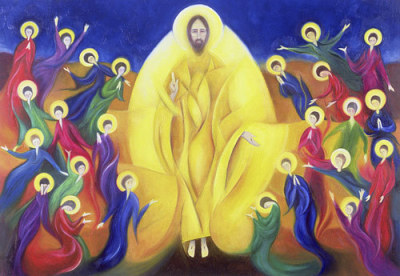
Gerald O’Collins, S.J. is an Australian Jesuit who’s taught at Gregorian University in Rome since the 70s. I greatly enjoyed his book on the Trinity (and blogged a bit about it here), so was pleased to discover that early this year he published Jesus Our Redeemer: A Christian Approach to Salvation in which O’Collins offers a systematic soteriology. He covers the topics of creation, original sin, atonement, the role of the Holy Spirit and the church, the salvation of non-Christians, the final resurrection, and the redemption of creation. I just received the copy that I ordered and am eager to dig in. Expect posts soon.
It also has a really lovely cover image from Sophie Hacker a contemporary religious artist:
 A Thinking Reed