I sometimes wonder what the people who were first exposed to Johnny Cash via his angsty late-90s output (the “Hurt” video, etc.) think of his super-earnest religious songs.
Personally, I love it all.
I sometimes wonder what the people who were first exposed to Johnny Cash via his angsty late-90s output (the “Hurt” video, etc.) think of his super-earnest religious songs.
Personally, I love it all.
On “justification by grace through faith”:
A word must be said about the expression “Justification by grace through faith.” It is often used in the abbreviated form of “Justification by faith.” But this is extremely misleading, for it gives the impression that faith is an act of man by which he merits Justification. This is a total and disastrous distortion of the doctrine of Justification. The cause is God alone (by grace), but the faith that one is accepted is the channel through which grace is mediated to man (through faith). (Systematic Theology, vol. 2, p. 179)
On the “Protestant principle”:
How can a faith which has doubt as an element within itself be united with creedal statements of the community of faith? The answer can only be that creedal expressions of the ultimate concern of the community must include their own criticism. It must become obvious in all of them–be they liturgical, doctrinal or ethical expressions of the faith of the community–that they are not ultimate. Rather, their function is to point to the ultimate which is beyond all of them. This is what I call the “Protestant principle,” the critical element in the expression of the community of faith and consequently the element of doubt in the act of faith. Neither the doubt nor the critical element is always actual, but both must always be possible within the circle of faith. From the Christian point of view, one would say that the Church with all its doctrines and institutions and authorities stands under the prophetic judgment and not above it. Criticism and doubt show that the community of faith stands “under the Cross,” if the Cross is understood as the divine judgment over man’s religious life, and even over Christianity, though it has accepted the sign of the Cross. (Dynamics of Faith, p. 33)
Needless to say, contemporary Protestant churches frequently fall short both by treating faith as a “work” we perform to earn God’s favor and by absolutizing expressions of their faith–doctrinal, moral, institutional, or whatever. But the Reformation message of God’s free and unconditional grace is meant to free us from reliance on our works–including our religious works–and our tendency to turn them into idols.
Keith Ward’s Religion and Creation (RC) is part of his multi-volume “comparative theology.” Its goal is to develop a contemporary Christian theology in genuine conversation with both modern science and other religious traditions.
The focus of RC is the doctrine of God. Ward argues that recent representative figures from four major religious traditions (Judaism, Christianity, Islam, and Hinduism) all make similar moves in revising the classical understanding of God.* They have qualified the traditional insistence on God’s complete immutability and impassibility with an emphasis on the importance of the spatio-temporal creation to God. The particular moves they make differ, but they agree that the creation makes a difference to God in a way that classical forms of theism generally denied. In some cases, this means affirming that God experiences time, change, and empathy with the sufferings of creatures.
In the book’s final chapter, Ward discusses the Christian doctrine of the Trinity in relation to creation. He suggests that creation of some kind may be necessary for God to realize the capacity for loving what is truly other. As he says elsewhere, it is “a love for what is other than God but can be united to the life of God in fellowship.”
Ward rejects the view, proposed by some theologians, that God can be perfectly loving in Godself because of the love that exists between the three persons of the Trinity. This strongly “social” view of the Trinity sees the godhead as comprising three divine persons or centers of consciousness whose unity consists of their loving fellowship.
According to Ward, some forms of social Trinitarianism border on polytheism, though a “rather cosy and harmonious polytheism” (p. 322). Social Trinitarians have a difficult time accounting for the necessary unity of the three persons, and attempts to do so often look like subordinationism (i.e., by making the Son and Spirit derivative from, and less than, the Father). Or they treat love as a reified, abstract principle that somehow stands “above” the three persons and binds them together.
It’s better, he proposes, to talk about “one ultimate subject which possesses three distinct forms of action and awareness” (p. 323). The problem with social Trinitarianism, he says, is that it tends to veer into speculation about three divine individuals with intra-divine relations apart from any relation to created reality. Trinitiarian thinking should be rooted in the biblical witness, which does not speak of “three divine individuals in continuing conversation” (p. 327). Rather, “belief in the one God of monotheism, who is somehow mediated to [the apostles] through Jesus and intimately present in the power of the Spirit. The idea of the Trinity does not supersede monotheism; it interprets it, in light of a specific set of revelatory events and experiences” (p. 327).
Threefold-ness is a real aspect of God, but it is manifested in relation to creation (p. 329). Theology shouldn’t posit some purely immanent, intra-trinitarian relation of the persons: “intra-Trinitarian being is given to us only in revelation” (p. 329). The basis of trinitarian doctrine is the apostolic experience of Jesus making God present in a new way:
[T]he simple historical source of this doctrine is the apostolic experience of God as loving Father, Jesus as the obedient Son, the Father’s image on earth, and the Spirit as the one who makes Jesus present to every time and place, and unites ll in him. (pp. 330-1)
While the Trinity corresponds to something real in God’s being, we only have access to the “economic” Trinity–that is, the threefold activity of God as we see it in the history of salvation. The economic Trinity is God-in-relation–responding to and affected by the actions of creatures. “This is the responsive aspect of the Divine, which interacts with created beings to check tendencies to disintegration and guide them actively toward perfection” (p. 340).
I’ve always been a bit skeptical of social Trinitarianism, particularly when it’s combined with political theologies which suppose that human communities can and should reflect the intra-Trinitarian life (Kathryn Tanner and Karen Kilby have both powerfully criticized this view). They often seem to rest on just the sort of speculative divine metaphysics Ward is criticizing, and draw what are, to my mind, improper analogies between human communities and the divine “community.” (Obviously there’s a lot more that can be, and has been, said on this topic, both pro and con.)
Even if we reject social Trinitarianism, though, couldn’t we say that God perfectly loves the divine self and would do so even if God had not created a world? Ward would say, however, that God would still have failed to realize the capacity for loving what is genuinely other than God, and that this form of love is a great good. In Ward’s view, it is better to have a universe with creatures who can enter into freely chosen fellowship with God, even if this also creates the possibility of their estrangement. Therefore, he thinks, creation does make a difference to God, enriching the divine life beyond what it would’ve been had God not created.
——————————————————–
*The four 20th-century figures Ward focuses on are Abraham Joshua Heschel (Judaism), Karl Barth (Christianity), Mohammad Iqbal (Islam), and Aurobindo Ghose (Hinduism).
The AV Club posted a nice beginner’s guide to The Who this week.
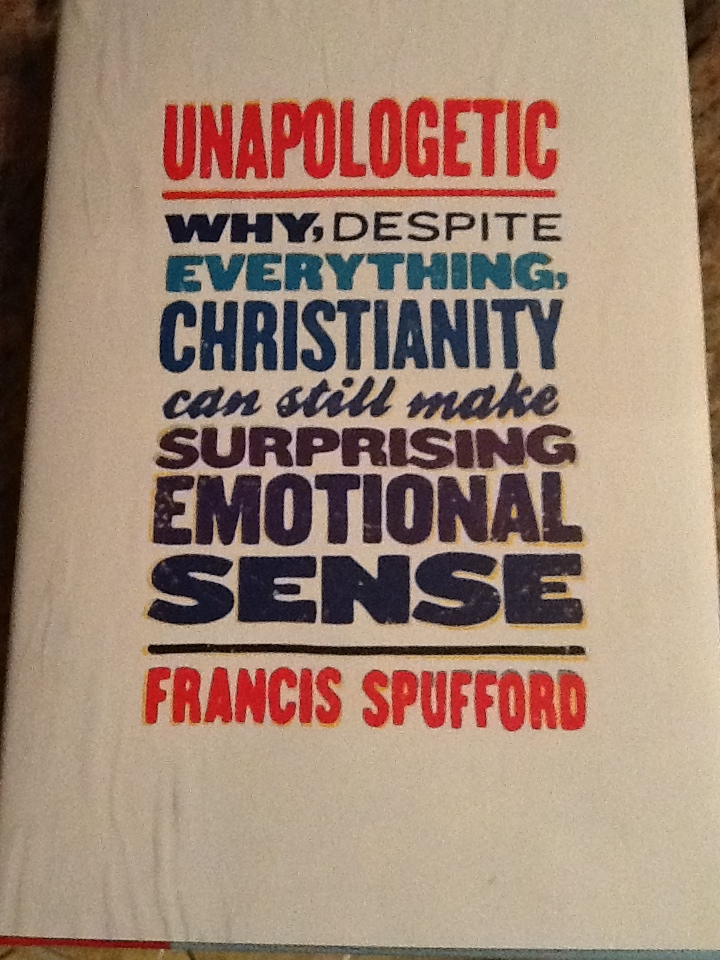
I’ve been having trouble thinking of something to say about Francis Spufford’s Unapologetic other than “I really, really liked it.” It’s not like any other “religious” book I can remember reading. The closest analogue I can think of are the books of Anne Lamott, who similarly writes about the life of faith with brutal honesty and without pious cant.
The title has a double meaning: Spufford is unapologetic in the sense of not being ashamed of his belief, but he’s also not offering an “apology” in the sense of a reasoned defense of Christianity–the sort of thing you get from some of C. S. Lewis’s writings (not to mention those of many lesser lights). Spufford’s goal is to describe from the inside what being a Christian is like–specifically for an educated Englishman living in a “post-Christian” culture–and to show that it can be an emotionally authentic response to the human condition. He doesn’t shy away from the blots on Christianity’s historical record or from tough theological questions (he’s particularly unsparing of pat theological answers in his discussion of theodicy). But he is equally insistent that, at its best, it provides a compelling response to what he cheekily calls the “human propensity to fuck things up” (or “HPtFtU” as he abbreviates it).
Spufford is a more-or-less orthodox Christian, but he considers theological propositions as secondary to a the immediate emotional experience of faith (not unlike an earlier defender of religion against its cultured despisers). This is the experience of a graceful presence underlying the messy and ambiguous world of daily life–a presence we encounter most piercingly when we have screwed things up. Christians see this presence most fully manifested in Jesus, and Spufford’s retelling of the gospel story provides the theological heart of the book. He recognizes that his faith is a wager–he doesn’t know whether or not there is a God, but “neither does Richard bloody Dawkins.”
What I do know is that, when I am lucky, when I have paid attention, when for once I have hushed my noise for a little while, it can feel as if there is one. And so it makes emotional sense to proceed as if He’s there; to dare the conditional. And not timid death-fearing emotional sense, or cowering craven master-seeking sense, or censorious holier-than-thou sense, either. Hopeful sense. Realistic sense. Battered-about-but-still-trying sense. The sense recommended by our awkward sky fairy, who says: don’t be careful. Don’t be surprised by any human cruelty. But don’t be afraid. Far more can be mended than you know. (p. 220)
Despite the intellectual bravado of some professional Christians, I think that this is far closer to how many of us–particularly those of us in the West–experience our faith. But nothing I can write will do justice to Spufford’s book; I encourage you to read it for yourself.
The Jesus of the orthodox story treats people with deep attention even when angry. [The gnostic] Jesus zaps people with his divine superpowers if they irritate him. Orthodox Jesus says that everyone needs the love of God, and God loves everyone. Their Jesus has an inner circle you can be admitted to if you collect enough crisp packets. Orthodox Jesus likes wine, parties, and grilled fish for breakfast. Their Jesus thinks that human flesh and its appetites are icky. Orthodox Jesus is disconcertingly unbothered about sexuality, and conducts his own sexual life, if he has one, off the page. Their Jesus can generate women to have sex with out of his own ribs, in a way that suggests the author had trouble talking to girls. Orthodox Jesus says, “Don’t be afraid. I am always with you.” The Jesus of these documents says, “Advance, Blue Adept, to the 17th Jade Portal of Amazingness, and give the secret signal with your thumbs.” Read much of the rival “gospels,” and you start to think that the Church Fathers who decided what went into the New Testament had one of the easiest editorial jobs on record. It wasn’t a question of suppression or exclusion, so much as of seeing what did and didn’t belong inside the bounds of a basically coherent story.
–Francis Spufford, Unapologetic, pp. 153-4
Liberal Christian icon Marcus Borg recently joined the blogosphere, and one of his first posts was an attempt to clarify his views on the resurrection of Jesus. Borg has been accused of denying the independent reality of the resurrection, reducing it to a subjective experience the disciples had after the crucifixion. But Borg maintains that he believes in a real resurrection, just not a physical one. Jesus is really alive and manifested himself to his followers following his death, but his body was not raised physically from the tomb.
I’m not sure I find the “physical”/”spiritual” distinction particularly helpful or important. First, it presumes that we have a clear idea of what “matter” is and how it contrasts with “spirit.” Modern physics, if nothing else, has called that kind of Cartesian dichotomy into question. But more fundamentally, the New Testament stories themselves don’t seem particularly interested in answering that question. Even if we take the resurrection stories at face value, we have a Jesus who is both “physical” in the sense of being a tangible presence, who eats with his disciples and shows them the still-present wounds in his body, but who also can appear and disappear at will and whom the disciples don’t immediately recognize as being the same person. The only thing that comes through clearly here is that, for the NT writers, Jesus’ post-resurrection state involved both continuity (he was the same person, the crucified one) and discontinuity (he had been radically transformed and raised to a different state of existence).
Keith Ward has suggested that Jesus’ resurrection involved a transformation of his body (i.e., the tomb was empty) to a “spiritual” state. But “spiritual” here doesn’t mean the opposite of “physical”; rather it means something more like a state of being fully infused with God’s Spirit. Jesus lives in the power and presence of God, but in a form that radically transcends his earthly, pre-resurrection existence. It’s not clear that asking whether this constitutes a “physical” or “spiritual” resurrection is a particularly meaningful question. The point is that the resurrection signifies God’s victory over the forces of sin, alienation, and death and promises a consummation of God’s purposes for creation.
 A Thinking Reed