Adam Hamilton, Why Did Jesus Have to Die? The Meaning of the Crucifixion (Abingdon Press, 2025)
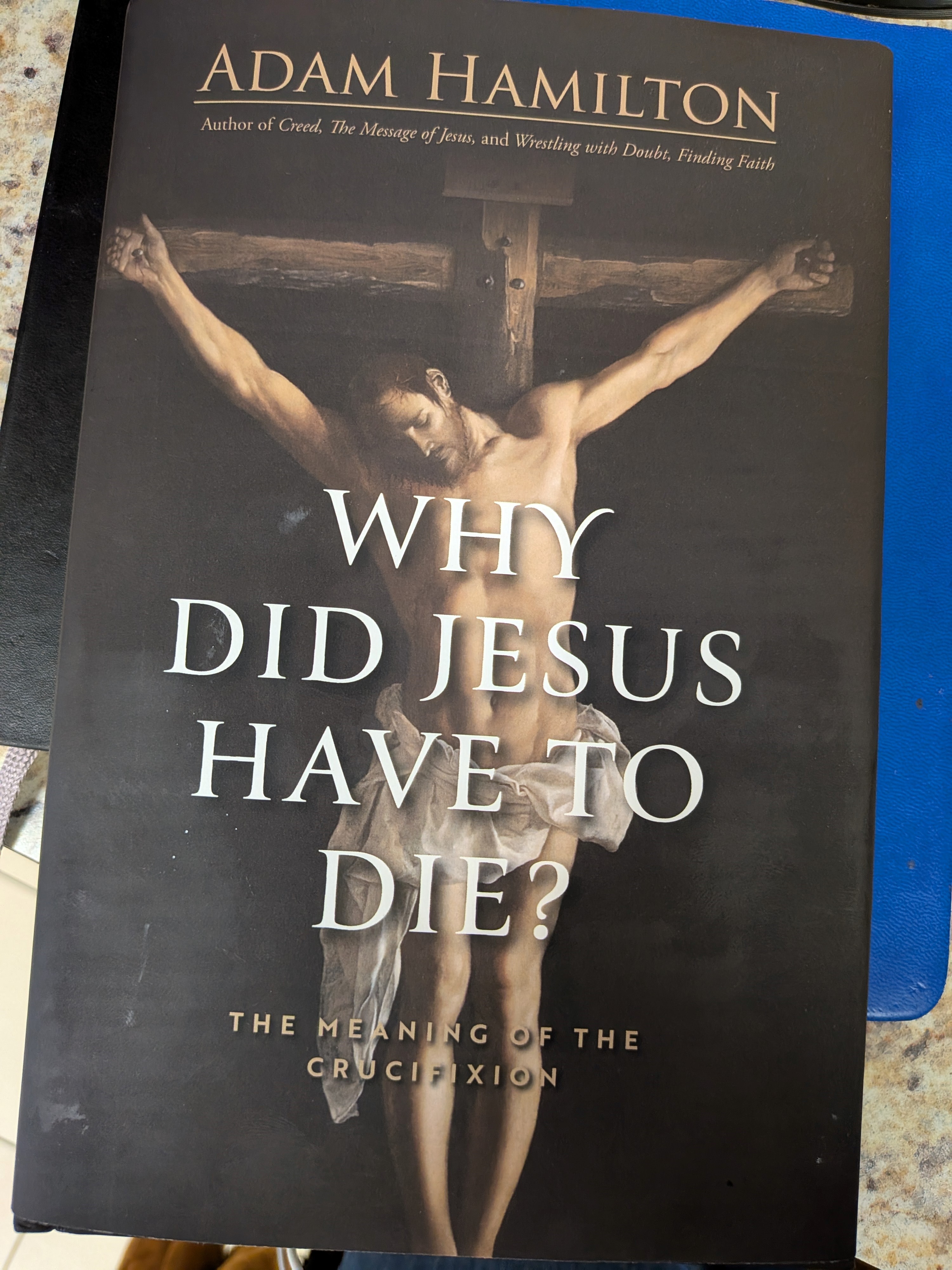
Adam Hamilton is the pastor of the Church of the Resurrection in Leawood, KS, one of the largest Methodist churches in the country. He’s also the author of numerous books and bible studies where he’s tried to carve out what I would characterize as an irenic Christian orthodoxy for mainline Protestants. He’s “progressive” in the sense of supporting women in ministry and the full equality of LGBTQ+ folks in the church; but his theology is more in the spirit of a Lewisian “mere Christianity.”
I co-lead a small group at my church, and we’ve used a number of Hamilton’s books over the years. His latest book, Why Did Jesus Have to Die? is one of the more explicitly theological of his works. In it, he wrestles with several of the traditional “theories” of the Atonement – or how Christ’s death and resurrection reconcile us to God. Since this is a topic I’ve long struggled with, I was interested to see how Hamilton would approach it.
Maybe the most important move Hamilton makes is how he frames the Atonement. It’s a mistake, he argues, to treat theories of Atonement as though they describe the “mechanism” by which God effects our reconciliation. Instead, he says, we should see the cross as “God’s Word to humanity”:
Jesus incarnates God’s word, revealing God’s heart and character, God’s action on our behalf to reconcile and heal us, God’s word about the human condition, and God’s word concerning God’s will for our lives. Our task is to hear this word, to receive it, and to allow it to have its intended effect on our lives, and through us, on the world. (p. xviii)
Hamilton acknowledges that some might see this as a merely “subjective” interpretation of the cross. However, he notes “that claim fails to understand the power of God’s Word and how God works in our world”:
Throughout scripture God acts by speaking. “God said ‘Let there be light.’ And so light appeared. God saw how good the light was” (Gen. 1:3-4). God speaks and a stuttering sheepherd named Moses becomes the great deliverer. God speaks and the childless Abraham and Sarah conceive a child. God speaks through prophets and kingdoms rise and fall. Paul, as well as the writer of Hebrews, describes God’s word as a sword. But most importantly for our purposes, in his epic prologue, John describes Jesus himself as God’s Word. (p. xix)
In this perspective, the various New Testament motifs or metaphors for the salvation Jesus brings are better viewed as multifaceted images of the word God speaks in the death and resurrection of Jesus.
In the succeeding chapters, Hamilton provides an overview of various NT metaphors and the theories of the Atonement that have been built upon them. These include:
Recapitulation – Jesus is the new human archetype
Penal substitution – Jesus bears the punishment we deserve
Sacrifice – Jesus offers himself for our forgiveness
Passover Lamb – Christ delivers us from slavery and death
New Covenant – Jesus institutes a new covenant in his blood
Ransom – Christ frees us from the devil/powers of evil
Redemption – Jesus purchases our freedom
In all these cases, Hamilton thinks we can recover the power of these metaphors/images interpreted as aspects or facets of the word God speaks to us.
An instructive case study is that of penal substitution, which is both the most popular theory of atonement in some Christian circles and the most controversial in others. Hamilton offers strong criticisms of this theory as it’s often presented. These will be familiar to those who’ve followed the debate:
- The idea that Jesus’ death was to appease God’s anger seems contrary to the gospel message.
- It paints an unflattering image of a God who needs an innocent person to be tortured and killed in order to forgive.
- It suggests God cannot forgive sin without punishment. But God is portrayed throughout Scripture as forgiving without punishment.
There are, of course, more sophisticated and nuanced presentations of penal substitution (e.g. John Stott’s The Cross of Christ). But even the most sophisticated interpretations of penal substitution tend to suggest that Christ’s suffering and death was something God needed in order to be gracious to us.
Hamilton does think, however, that the motif of Christ suffering for us can be helpful:
I believe it is we who needed Jesus’ death, not God. It was to change our hearts, not to change God’s heart. God can forgive anyone God chooses and does not require God’s Son’s torturous death in order to appease his anger.
As God’s Word, we can say that we see God demonstrating the pain he himself experiences as a result of human sin but also the lengths to which he is willing to go to save us from it. (p. 28)
I might put it this way: The cross reveals that God is always bearing the pain of our sin – and yet always offering mercy and forgiveness. The more “transactional” view suggests that there was a time when this wasn’t the case — that God had to be persuaded or paid off in order to be merciful. Attempts to salvage this by appealing to the Trintiy only get you so far, because you still end up having to say that God is paying Godself off or self-propitiating, which is an obscure idea to say the least.
Interestingly, given the reputation “moral exemplar” theories have had (almost as bad as penal substitution!), Hamilton spends to chapters expounding and defending multiple versions of this motif.
Essentially, Hamilton boils this down to two elements:
- Christ provides an example of sacrificial love that we are to imitate.
- Christ’s death reveals God’s loving heart to us.
It’s the second of these ideas that Hamilton says he finds the most compelling of the traditional atonement motifs. But what, one might ask, distinguishes the death of Jesus from the deaths of other heroic saints and martyrs throughout history?
What differentiates Jesus’ death … is his identity as God’s Word enfleshed. In John 14:11, Jesus said “I am in the Father and the Father is in me.” Christians believe that Jesus is the incarnation, the very embodied presence of God the Son. He is God’s anointed King. He is the Word of God enfleshed. He is God, the Son, who willingly dies not just for one person, but for all of humanity. (p. 80)
As Hamilton puts it:
[The Cross] reveals the very heart of God for humankind, and the motivation behind Christ’s death. It sees the story of Jesus as a love story portraying God’s steadfast love for humanity climaxing with the highest expression love might take — that of dying for another. When this love is experienced and accepted, it draws us to God, leads us to repentance, transforms our hearts, and, with the help of the Holy Spirit, compels us to live a life of selfless love. (pp. 80-81)
One could say that the death of Christ reveals God’s love because it was the (inevitable?) outcome of the kind of life he lived — the life of God’s love reaching out to us. God in Christ willed to be with humanity and creation, but human beings, in their sin, rejected God. However, this didn’t (indeed, can’t) deter God’s love, and God “loved his own to the end” (Jn. 13:1). (For a theology that puts God’s desire to be with us at the center, see Samuel Wells’ Constructing an Incarnational Theology.)
Fittingly, Hamilton concludes the book with an exposition of the “Christ the Victor” motif. All too often, Christian thought has separated the cross from the resurrection. This can suggest that it’s Christ’s death alone which saves us and this was the entire reason for his coming.
Through his death and resurrection Jesus overcomes the forces of evil. This doesn’t mean these forces have been destroyed — history and current experience give ample evidence that they still plague us. But the cross and resurrection demonstrate that God’s love is sovereign over these powers and they will ultimately be defeated once and for all. Importantly, this means that we can be freed from the fear of death and for works of love for our neighbors.
Summarizing, Hamilton offers some key takeaways:
- Jesus didn’t have to die, but he believed God could use his death for a redemptive purpose.
- Christ’s death is about forgiveness — but also more than forgiveness. It’s about transformation, new life, and victory over death, among other things.
- Metaphors for atonement shouldn’t be confused with “mechanisms” that explain “how it works.”
I think some more transactional understandings of the Atonement appeal to our desire for things to be fixed through a quasi-magical act that doesn’t require anything from us. But Hamilton’s insistence that, in the cross, God is reaching out to us emphasizes the personal nature of this relationship. Ultimately, the cross and resurrection are God offering Godself to us through God’s Word, for our reconciliation, forgiveness, liberation and new life.
 A Thinking Reed
Leave a reply to Best Theology Books I Read This Year – A Thinking Reed Cancel reply