Here’s the text of a meditation I gave at a mid-week Lenten service at our church. We were instructed to select a piece of art depicting a scene from the last week of Jesus’ life according to Mark’s gospel. I selected the confession of the centurion at the foot of the cross and used a painting by Lucas Cranach the Elder as my visual aid. I don’t know that this sort of thing is my forte, particularly, but here it is for what it’s worth:
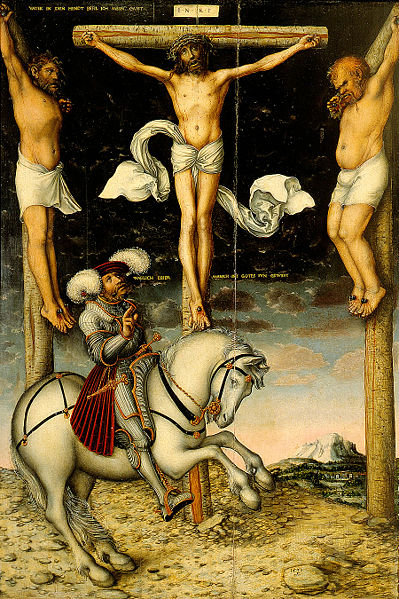
This image is by Lucas Cranach the Elder, a friend of Luther and one of the most important painters of the early Lutheran movement; the scene is the centurion’s confession recorded in Mark 15:39:
“Now when the centurion, who stood facing him, saw that in this way he breathed his last, he said, ‘Truly this man was God’s Son!’”
This event was beloved by early Protestants because it vividly illustrates the doctrine of salvation by faith alone. But it also highlights that the object of that faith – Christ crucified – doesn’t match our expectations about the divine.
Scholars tell us that Mark’s gospel emphasizes the “messianic secret” of Jesus’ identity. Throughout most of the gospel, supernatural powers – a heavenly voice and demons that Jesus exorcises – are the only ones who recognize who he truly is. The first human to confess Jesus’ identity is Peter (Mk. 8:27-30), but Peter “stumbles” when Jesus tries to explain to the disciples that “the Son of Man must suffer, be rejected, and killed and rise again.
The disciples – Peter in particular – can’t accept this. They want – and expect – Jesus to restore Israel, kick out the Romans, and give them, his loyal followers, positions of power and influence in the new administration. They also, understandably, don’t want their friend and teacher – who they love – to die a cruel and painful death.
Mark’s gospel, maybe more than any of the others, turns this expectation about what the Messiah – and what God – is like upside down. That the Messiah should be rejected and killed, dying the death of an outcast and criminal, certainly flies in the face of how we expect God’s power to show itself.
I know that what I usually want from God is for him to engineer things in my life to go better for me.
I pray for things to happen – for a job interview to go well, or for a medical test to turn out a certain way, or generally for things to go the way I want them to. These aren’t all self-centered prayers either; often I’m praying for others. But the sentiment is similar – I want God to do something, to make things happen (according to how I judge best).
In this sense I guess I’m like the disciples. I have very specific expectations about how I think God should behave.
And maybe being in the “in group,” one of the religious, upstanding citizens can blind us to a true perception of God. Certainly the gospels suggest this over and over. The “righteous” – the scribes and Pharisees – are often the ones least likely to catch on to what Jesus is about. In a similar way, we think we know what God is about, and maybe this can make us blind to surprises that God has in store.
Which might give us a clue why the only human confession of Jesus’ status as Son of God should come from the centurion at the foot of the cross. From a gentile, a Roman soldier, part of the occupying power. Not someone we would expect to be clued in to the ultimate truth about Jesus and God.
But this agent of the occupying power, a man who has probably inflicted both large and small cruelties on the subject population, perceived in Jesus’ suffering and death something divine. Is this, in part, because, as an “outsider” he didn’t have expectations, but was able to be open to what God was revealing?
Mark’s passion story is un-nerving. We don’t get the serene, “in charge” Jesus of John’s gospel, or even the forgiving Jesus of Luke. Instead we get Jesus’ stark cry of terror and abandonment: “My God, my God, why have you forsaken me?”
So why here, of all places, does the centurion – and Mark – locate something divine? Why in the cross rather than, say, the resurrection?
Many theologians have wrestled with the meaning of the cross, but one of the most profound is the suggestion that in Jesus’ death, God himself enters into the suffering, pain, and darkness of the human condition–and the entire creation. In the cross, God reveals something about the very nature of divinity as self-giving love and presence in suffering, instead of an all-powerful king. This isn’t what we would expect God to be like at all!
Martin Luther suggested that faith is basically a stance of receiving: only when we recognize that we don’t have anything to offer–that we’re “beggars”–can we receive the gift God wants to give us. He also believed that our knowledge of God must begin at the cross–a God revealed as humble and suffering rather than by power and glory.
Is the centurion able to see God’s power “made perfect in weakness” as Paul would say, because as an outsider he isn’t full of expectations?
Maybe to receive this mystery–the mystery of the crucified messiah–we need to let go of some of our expectations and let God surprise us.
Amen.
 A Thinking Reed
Leave a reply to Ben Cancel reply