A Thinking Reed

"Man is but a reed, the most feeble thing in nature, but he is a thinking reed" – Blaise Pascal

Book review: Andrew Linzey’s Animal Theology

I just finished reading Andrew Linzey’s Animal Theology. Linzey, a Church of England priest and theologian is also a long-time animal rights activist. His book presents a strong challenge to Christians who think of animal rights as a concern confined to the likes of PETA and Peter Singer, and who see concern for animals as peripheral to the gospel at best and anti-Christian at worst.

What sets Linzey’s approach apart from secular animal rights theorists like Tom Regan is that, for Linzey, rights are grounded in God, not in anything inherent to the subject of rights (human or animal). He calls these (in a rather unfortunate neologism) “theos-rights.” By this he means that animals exist for the sake of God, not for human beings, and consequently we must reject a purely instrumentalist view of animals that subordinates them to human purposes. “Creation exists for its Creator” (p. 24). And God, as Christianity conceives of him, is for Creation. In his overflowing grace, God’s will for creation, including animals, is for flourishing and well-being. “The notion of ‘theos-rights’ then for animals means that God rejoices in the lives of those differentiated beings in creation enlivened by the Spirit. In short: If God is for them, we cannot be against them” (p. 25).

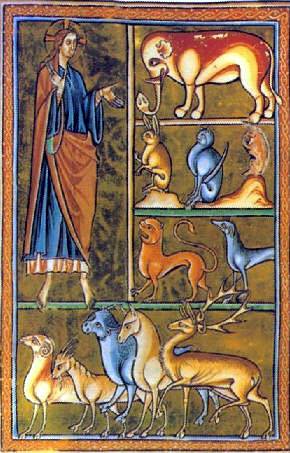
Linzey argues that just as Jesus is the Good Shepherd who lays his life down for his sheep, we are called to exhibit costly and sacrificial love in our relationships with others, especially those who are powerless and at our mercy as animals undoubtedly are. This is what he calls “the moral priority of the weak.” What makes humans unique and how we image God, he says, is that we are the “servant species;” like Jesus was can live in service to others rather than seeking our own advantage.

This implies that we should eliminate or mitigate the harm of those practices which inflict unnecessary suffering on animals for the sake of human ends. Linzey is pretty radical in what he thinks that entails, calling for an end to meat-eating, animal experimentation, hunting, and genetic engineering. Linzey is no utopian, and he realizes that we can never be “pure” in that we are inevitably enmeshed in systems and practices that inflict harm. So self-righteousness is not an option. And he is aware that such a change in our lifestyles would involve some measure of sacrifice. But he thinks that Christians are called to live in a way that anticipates the advent of God’s peaceable kingdom where predation and suffering are abolished. This eschatological vision recognizes that the creation as it is fails to reflect the creator’s intentions in many respects.

One thing that makes Linzey difficult to dismiss is that the theological basis for his arguments are thoroughly Christological, Trinitarian and orthodox. A belief in the Triune God who works to redeem all of creation through the incarnation of the Son and sending of the Spirit and whose will for that creation is peace forms the context for the whole argument. Nearly everyone will quibble with some of his conclusions. One minor complaint I might make is that Linzey isn’t always clear to what extent he sees this as an aspirational ideal for Christians, or a ethic that can be instutionalized in the wider society. At any rate, I find it difficult to disagree with the main thrust of his argument. Surely the degree of suffering we inflict on our fellow creatures, often for trivial reasons, is not something that should sit easily with professed followers of the Good Shepherd.

12 responses to “Book review: Andrew Linzey’s Animal Theology”

  1. If God created X then (a) X is for the sake of God, (b) God is for X, and (c) we cannot be against X.

    Oh?

    Try X = the Black Plague, Pol Pot, Lucifer, or any number of created evils.

    Is this post a coincidence, or did you see the one over at American Leftist called, “Will Everyone be a Vegetarian in a Hundred Years?”

    Absolutely nobody there took me up on my claim that a non-cognitivist like Singer writing normative ethics is the most wretched hypocrisy, much like an atheist with an agenda preaching it as God’s will to the believing masses.

    Oh, wait. Liberal theology? Well, some of it, anyway.

    Which leads to another question. Since when have you become a theological voluntarist in ethics?

    Seems to me with posts like this you are getting very close to it, if you aren’t actually already there.

    Drifting toward Calvin, are we? And away from St. Thomas? That’s a very periflous journey.

  2. Btw, Didn’t Jesus distribute loaves and fishes?

  3. 1. All being qua being is good (St. Augustine), so yes even Lucifer insofar as he exists is good. His will may be turned toward evil, but nothing that God creates is evil per se.

    Of course, that doesn’t mean that we may not need to defend ourselves against certain created things like Pol Pot or the Black Plague (or Lucifer!), a point that Linzey makes.

    2. Is Singer a noncognitivist? I was under the impression he was a utilitarian. Either way I don’t really have a stake in his philosophical position since I’m neither. Besides, even a stopped clock, etc.

    3. I’m not an ethical voluntarist. If anything I’m a Platonist. All created being is good, not because of its instrumental value for us, but because it reflects God’s glory. Linzey’s argument is that God has rights over his creation and that animals belong to him not us, thus there are properly restraints on what we can do to animals. What’s voluntarist about that?

  4. Maurice Frontz

    1. It would seem that some animals owe the very continuation of the existence of their species to the human need for them. Cows, for example, or chickens. So if human beings were to cease depending upon these animals, they would no longer exist. Comment?

    2. Does Linzey address the problem of human coexistence with wild animals, and does he advocate conscious human population control rather than animal population control in order to “give moral priority” to the weak? In that case, you seem to be merely substituting one power – the power of those who insist that animals are more important than humans, for another. This is where I think that your question is on the mark regarding an ethic for the wider society. Such an argument might quickly morph into misanthropism rather than be simply pro-animal.

    3. I am not sure how a Church which holds Holy Scripture (thinking particularly of the book of Genesis) as the source and norm of its tradition can “evolve” out of a world-view in which human beings, while sharing the planet with animals, are the only creatures created in the image of God, and are creatures who are given dominion by God over the other creatures. When it is stated that “animals exist for the sake of God, not for human beings,” that is very true. However, it would seem that God, for God’s sake, set human beings in a particular relationship with animals. If you are ready to elevate the other animals to the status of “in God’s image,” you are rejecting out of hand the worldview of Genesis.

    Perhaps the question of animal cruelty arises in a particularly industrial world, where the organic relationship between animal and human is destroyed. (Yet that image of the organic relationship is stubborn – I think especially of children’s literature in this regard.) While rejecting the assumptions of the industrial approach to animal use, I think we dare not assume that animal needs must have priority over human need in most cases. To do so, as I said above, seems to be more misanthropic than anything else.

    I await your reply with eagerness.

  5. Okay – good comments. I’ll attempt to respond:

    1. Linzey doesn’t address this and I’m not sure what he would say about it. One thing he does do is distinguish between forms of animal use that are purely exploitative and ones that are more symbiotic (i.e. humans and animals both benefit). Pets would perhaps be an example of this – cats and dogs seem to benefit from their symbiotic relationship with humans. So, maybe there are forms of animal husbandry that could also be mutually beneficial in this way. Of course, this would go against Linzey’s opposition to meat-eating, so I’m not sure how he would square that circle.

    One other point though, I think we don’t want to say that the fact that certain animals owe their existence to human actions means that we can therefore treat them any way we want, right? We certainly wouldn’t say that about, say, kids!

    2. This is another thing he doesn’t directly address. Though he does say that humans have a right to defend themselves against animals or use them in cases of necessity. For instance, he admits that there are times and places where being a vegetarian simply wouldn’t be feasible (including, perhaps, 1st c. Palestine where non-animal sources of protein may well have been scarce, to address Gaius’ comment about loaves and fishes).

    Linzey is also careful to emphasize that it’s impossible to be “pure” in one’s relation with the rest of creation. We compete with animals for resources, for instance. His view is that you should start by focusing on the most egregious abuses.

    For what it’s worth, he has also written against experimentation on human embyros and sees them and children as among “the weak” who need our protection.

    3. I was probably not sufficiently clear on this point. Linzey’s view is that dominion in Genesis means that humans are charged with taking care of God’s creation as what we might call viceregents of God. In other words our dominion should reflect the character of God’s rule, which is seen most clearly in Christ – ruling by serving. This is what it means, he thinks, to say that humans are made in God’s image.

    Granted that I haven’t adequately defended the theological and exegetical argument he makes, but that’s the basic picture.

  6. Singer is both a noncognitivist and a utilitarian.

  7. 1. I always saw Singer as a antidistestablishmentarianist noncognitivist utilitarian neo-Pythagorean Marxist. Comment?

    B. Linzey make any mention of the Noahic covenant in Genesis? It seems to include the animals as well as the surviving humans, making them partners (albeit ones that will be eaten) in that covenant. That passage has been on my mind a lot recently.

    III. Do you think his perspective might be compatible with some sort of “merciful” meat-eating? Or does his arguement elimate any possbility for that?

  8. a. Linzey does address the Noah story. He uses that as partial support for an argument that the Bible frequently doesn’t make an absolute distinction between humans and animals and that animals are included in God’s purposes.

    7. I think the question about “merciful meat-eating” is a good one. I think part of this depends on your eschatology – to what degree can Christians be free from sinful structures in the here and now, and to what degree is creation still “groaning” for a release from bondage that won’t be realized til the end?

    I think there’s a similarity here with the question of war & violence. Even though we think that violence is generally bad, most Christians see it as at least sometimes the least bad option in a world of sin.

    Likewise, even if you agree with Linzey that God’s ultimate will for creation is no violence among his creatures, you still have to ask what is the best choice we can make under present imperfect conditions. So, if there can be “just war” under some conditions maybe there can also be “just meat eating” even if we agree that ideally there would never be a cause for war or killing other creatures. Don’t know if that makes sense.

    XVII. Personally, I’m not prepared to say that meat-eating per se is bad. And I think there’s a lot to be said for a plurality of approaches. Other things being equal, I think more people buying more humanely and naturally raised meat would be a good thing. This also goes back to Maurice’s comment – maybe a world where people humanely raised (and ate) cows, chickens, pigs, etc. would be better than one where there weren’t any of those creatures?

  9. Hi!
    I’m writing my Master’s Thesis in Finland on Linzey’s theological ethics and I thought I’d comment on the question of domesticated animals who wouldn’t exist without humans. Humans have bred the modern domestic animals from their wild ancestors. They cannot live in freedom, because breeding develops in them characteristics that are useful to humans and at the same time removes the characteristics that the animals themselves would need in the wild. Many of them have been bred so far that their chances for good life are nonexistent.

    The growth of meat chickens is so fast that their legs can’t bear their body weight. The cows would step on their udders if they were not tied up, and they produce so much milk that their lifespan is only a sixth of what it could be. A lot of the meat animals have so much flesh tissue, that their hearts can’t take it. It is not even possible to humanely keep animals bred to such extremities. It would be better for the animals themselves, if they wouldn’t be produced to live in captivity in such distorted bodies. Instead, the natural habitats of their relatives in the wild should be secured so that animals could live in the bodies shaped not by humans, but God. In the wild, the animals evolve into what’s best for them; the breeding by humans serves not animals, but humans.

    It is often said that cows, pigs, and chickens benefit from the meat industry, since without it, they wouldn’t exist. That’s not true. They would exist, they’d be wild animals, not bred to their present state, in which they cannot survive in their original surroundings.

  10. Thanks for your comment, Laura and good luck on the thesis – sounds great!

  11. […] I reviewed Linzey’s Animal Theology here. […]

  12. As far as the Bible is concerned, only the Humans were thrown out of Paradise.

    When our technological advances and our continued advances in polluting the earth and extinguishing even more species finally reaches its climax, I think the animals that remain will be quite able and content to get along without us.

Leave a reply to Joshie Cancel reply