Author: Lee M.

  • The Making and Unmaking of Technological Society 3: The Christian revolution

    (See previous posts here and here.)

    In chapter 8 Jardine discusses what he calls the cosmological and anthropological revolution wrought by Christianity and why it holds the key to facing the dilemma of the technological society. That dilemma, recall, is that we human beings have found ourselves with the capacity to radically alter our environment but without a moral understanding adequate to direct us in using that power. Traditional moral theories, such as those inherited from Greek philosophy, have assumed a static order both in the natural world and in human nature. Consequently, natural law theories don’t provide guidance in how we should use our ability to alter what was previously thought to be an unchanging order.

    Furthermore, Jardine thinks, liberalism doesn’t provide an answer to this dilemma either. This is because of its inbuilt tendency toward nihilism. While liberalism recognizes the human capacity for altering the environment, in seeking a “neutral” ethic that prescinds from making judgments about the good it fails to set direction or limits to that capacity. Thus, he thinks, individual preference becomes the sole source of value in a liberal society.

    Despite the fact that Christianity would seem to be one of the main foundations of Western civilization, Jardine thinks that we haven’t sufficiently assimilated its cosmological and anthropoligical outlook. Unlike either ancient paganism or Greek rationalism, Christianity is characterized by two distinct tenets that can help re-orient our technological society. First, Christianity recognizes that human beings, while creatures, have a share in God’s creative power. We are co-creators in a sense. Secondly, the Bible views the universe as a dynamic expression of the divine being. In “the word” we find the key metaphor for understanding the biblical view of the universe.

    God, Genesis tells us, speaks the world into existence. Unlike ancient paganism which viewed the gods as capricious, the biblical God is trustworthy and faithful. Thus his creation will display a certain order and reliability. But unlike Greek rationalism, which saw the world’s order as unchanging, the biblical God is dynamic and involved in history. History becomes a key concept for understanding the creation: it is more like an ongoing process with new potentialities unfolding over time. This dual view of humans as co-creators and the universe as an orderly but dynamic process, Jardine thinks, is much more in tune with the world revealed by our technological capcities and scientific knowledge.

    And this view provides the foundation for an ethic that can grapple with the problems of being co-creators in such a world. Just as God speaks the world into being, humans can think of themselves as speakers before God. Speech is key because, in a sense, speech is what allows us to create new worlds of possibility and thus is at the root of our creative capacities. “Using language in certain ways creates human capacities that could not exist otherwise” (p. 175). Our creative powers are real, though limited.

    The proper response of such creatures, living in a dynamically ordered world created by a good God, is to try to be “faithful speakers before God.” Jardine provides an illuminating interpretation of the story of the Fall. The human situation is that we seek to transgress the limits of our knowledge and creative powers in order to be like God:

    We are creators, but we are also creatures. As such, there are limits to our creative capacities, and limits to our knowledge. But because we are creators, we will have a powerful tendency to forget, or willfull ignore, the fact that we are creatures, and we will frequently try to be only creators–that is, to be God. This behavior is what is meant by the term sin, and its paradigm is attempting to claim absolute knowledge, which of course only God can have.

    The reason people sin is precisely because of our ambiguous situation as creators and creatures. As creatures we are limited beings, but as creators we can imagine ourselves as unlimited beings, and thus we will tend to attempt to cast off all limitations–or, in theological terms, we will be tempted to be like God. Or, putting this in terms of our model of creating a world through speech, sin is the attempt to become creators only, instead of cocreators, and to create our own little world. This is precisely what one does when one lies; one attempts to replace the world created by God and the speech of other humans with a world created only by oneself. More generally, all attempts to dominate other people are cases of trying to create one’s own world by force. Similarly, the delight that humans sometimes–indeed, rather often–take in acts of destruction can be understood as another attempt to create one’s own world by force. Stating the idea of sin in these terms makes it clear that fundamentally, sin comes from a lack of faith, that is, a lack of trust, in God and his created world; it is an attempt to replace God’s creation with our own. Sin means essentially unfaithful human acts.(pp. 186-7)

    If sin is essentially unfaithfulness, then faithfulness will be embodied in an ethic of unconditional love. Since human beings are co-creators with the capacity to create their own “worlds” plurality is an essential feature of the human condition. You and I may well disagree about how we should live together, or how our powers of creativity should be used. Jardine defines unconditional love as the persistent attempt to understand and empathize with those whose perspective differs from our own. Concretely, this means practicing forgiveness and mutual correction. These balance each other because while we must stop the person who is sinning, a recognition of the limits of our knowledge highlights the importance of forgiveness.

    Jardine goes on to distinguish this Christian ethic from that of liberalism. Unconditional love is not the same thing as liberal tolerance. Tolerance implies a kind of indifference to what others are doing so long as they harm no one but themselves. But unconditional love corrects and forgives out of a concern for the well-being of the other. “From the standpoint of an ethic of unconditoinal love, liberal tolerance is, for the most part, indifference, and fails to help or correct people unless their actions affect others in a direct, blatant way” (p. 189).

    Indeed, Jardine goes on to argue that “[g]enerally speaking, liberalism is best understood as a distortion of–or better yet, a reductionisitc version of–Christiainity, or more specifically of the Christian ethic of unconditional love” (p. 189). Liberalism enjoins toelrance and avoiding persecution rather than the deeply involved personal love commanded by the Christian ethic. Christianity may have inspired the idea that all people are fundamentally equal and thus one could engage in productive exchanges with those outside of one’s family, clan, or culture, but liberalism goes too far in reducing all social relationships to market exchanges. The Christian ethic of unconditional love provides the foundation for faithful speaking before God and communal deliberation about the good.

    I think this would be a good point to ask some critical questions. Jardine has argued that liberalism leads to nihilism and that only Christianity can provide the means for a fruitful deliberation about the good, providing some guidance in the use of our powers as cocreators in a dynamic and creative, but ordered and reliable universe. He maintains that liberalism is a reduction of the Christian idea of equality and unconditional love to a bland tolerance. However, does he grapple sufficiently with what gave rise to liberal tolerance in the first place? As good as mutual correction and forgiveness sounds, it’s very difficult to see how this would apply to society as a whole, rather than to close-knit Christian communities. Liberalism flourished initially in part because the churches were being rather too zealous in the cause of fraternal correction. In other words, “mere” tolerance is no mean accomplishment and not something to be dismissed lightly. In a vast society tolerance may be the best thing we can give to a lot of our fellow citizens. Mutual correction requires a degree of intimacy and trust that isn’t easily attained. As Alasdair MacIntyre has argued, the modern nation-state may well be incapable of being a genuine community in the sense of providing an arena for communal deliberation about the good.

    Secondly, Jardine seems to conflate political liberalism, understood as a regime that refrains from enforcing a particular vision of the good, with liberalism as a way of life. The latter takes human autonomy as the highest good and is in that sense itself a comprehensive philosophy of life. But not all political liberals are liberals in this sense. In his book Two Faces of Liberalism the political philosopher John Gray distinguishes between liberalism understood as a way of life and liberalism understood as a kind of modus vivendi that allows different ways of life to peacefully co-exist. A modus vivendi liberalism isn’t necessarily committed to enforcing liberalism as a way of life, the kind of philosophy of life that may well lead to nihilism as Jardine fears.

    It might be worth pointing out that most people in modern Western liberal societies are not in fact nihilists. And this may be because they have adopted more of a modus vivendi style of liberalism that allows different ways of life to co-exist. This doesn’t mean that every person in a liberal society suddenly becomes an atomized individual unattached to any larger context for making sense of her life. Granted that liberalism as a way of life has certainly made inroads in these societies, it doesn’t seem to follow, either empirically or as a matter of logic, that it must overwhelm all more communitarian or traditional ways of life.

    And this brings me to one more point. Jardine, like some writers in the Radical Orthodoxy school of thought, holds that liberalism necessarily leads to nihilism and that only Christianity provides a viable alternative to liberalism. But I think we’re well beyond the point where Christian thinkers can ignore the plurality of other points of view in the world and treat secular liberalism as though it were the only serious rival to Christianity. The irreducible fact of pluralism – of a diverse array of religious and philosophical ways of life – is, in my view, precisely the best argument for some variety of modus vivendi liberalism. This would be an order that allows people to live in relative peace without denuding themselves of their particular religious, cultural, and other kinds of identity.

    That said, Jardine’s re-interpretation of the story of the fall and its relation to our technological capacities is suggestive, and something I think Christians would do well to bring to the debate on how those capacities should be used. They might well find common ground here with believers from other traditions. In the next (and probably final) post in this series I’ll talk a little about Jardine’s concrete proposals for social change in light of the discussion so far.

  • Does God want us to be free?

    (Switching gears here; we’re talking about political freedom now, not the metaphysical variety.)

    There’s been an interesting debate recently, swirling around some of President Bush’s more exuberant comments about political freedom being a “gift from the Almighty.” The reference comes from a recent David Brooks column (not accessible to us proles who don’t subscribe to the Times), the implication being that Bush’s confidence in the policies he’s pursued is rooted in a conviction that a providentially-ordered history is on his side.

    This belief has met with a storm of criticism from some of the more thoughtful conservative pundits and bloggers (Andrew Sullivan, Ross Douthat, Daniel Larison, Rod Dreher), with Ramesh Ponnuru offering something of a defense.

    The issue I take it has two parts. Bush, allegedly, believes that there is something of an innate telos toward freedom in the created order in virtue of God’s creative and providential care. The second part is that his policies have a good long-run chance of success precisely because they are aligned with the “grain of the universe” so to speak. It might be helpful to point out that these two claims are detachable. Even if there is an inherent tendency toward freedom in human nature, it doesn’t follow that the best way to promote that tendency is the way Bush has chosen. In fact, it seems to me that there are good reasons to think otherwise, since going to war with and invading other countries requires coercion on a massive scale.

    But regarding the first claim – whether political liberty is part of what God wills for his creatures – I come at this from a slightly different angle. My take is that political liberty follows from human fallenness. Precisely because human beings are frail, selfish, limited in knowledge, prone to self-assertion, and vulnerable, liberty is necessary to create a sphere within which people are protected from the impositions of others. As fallen creatures we are prone to mistake our partial visions of the good with the Good itself and to be insufficiently modest in trying to get our fellow creatures to go along with them. If people weren’t sinners, political liberty as we know it would be superfluous because everybody would spontaneously do the right thing. Because our own knowledge is limited and our motives are suspect, the political order should limit the extent to which we can enforce our preferences on others. So, I guess I’m something of a post-lapsarian about freedom.

    It should be obvious that this is a more modest version of liberalism than the kind of progressive optimistic Whiggery criticized by some of the conservatives cited above. In fact, Christopher Insole, whose book on theology and political liberalism helped me clarify some of these ideas, expressly distinguishes a liberalism of human frailty from what he calls “crusading liberalism.” This is Whiggish liberalism that identifies the triumph of freedom with a single kind of political and economic order that will spread by means of inevitable historical progress.

    So you might say that the institutions that foster political liberty are a means of protecting vulnerable human selves from each other. This view doesn’t identify liberalism with any kind of utopia or “end of history,” and it recognizes that liberty can be embodied in a diversity of forms. It is also respectful of historically developed institutions that have acheived a measure of freedom and stability and would be wary of rashly overturning them in the name of some revolutionary project. Certainly I think any Christian would say that God wills the flourishing of human beings in this good but fallen world, and to the extent that the institutions of liberty contribute to that by creating spaces for human flourishing we can indeed say that God wants us to be free.

  • Could we turn out not to have free will?

    Ramesh Ponnuru wrote a blog post suggesting that some forms of atheism make free will and moral reasoning absurd. Will Wilkinson responded by essentially saying that this is a psuedo-problem (link via Unqualified Offerings).

    I think Wilkinson doesn’t really acknowledge the source of the worry here. He writes:

    Here are two things you know: free will exists (it is obvious: go ahead, touch your nose) and the universe is made of whatever it is made of (obvious, if anything is). Therefore, you know the conjunction of those two things. Therefore, you know that the crazy proposition that says that one of them must be false isn’t true! There’s no need to get hung up on an arbitrary conjecture about the trascendental conditions for the very possibility of the existence of something when things you already know rule it out.

    He seems to want to say that this is a psuedo-problem because we already know that we have free will, so whatever the universe turns out to be like must be compatible with that fact.

    But the whole point of the worry about determinism or physicalism that Ponnuru originally raised was that, if the universe turned out to be a certain way, we might not have free will after all as we originally supposed. In other words, there are possible ways the universe might be that are, on closer inspection, incompatible with free will.

    Wilkinson is certainly right that we can distinguish voluntary from involuntary actions, and that this distinction isn’t threatened by whatever metaphysical account of reality we come up with. But this isn’t the meaning of “free will” that people who worry about determinism and/or physicalism (incompatibilists in the philosophical jargon) usually have in mind.

    There worry is something more like this: if the universe consists entirely of the sorts of things and events described by physics, then it seems that what we take to be actions based on reasoning and choice would turn out to be really explained by the laws of physics. Moreover, these laws make no reference to things like intention or value, so it would appear to be false that the cause of my choosing x was that I believed it to be the best course of action all things considered. Rather the real explanation would make reference to various physical events in my brain, body, and environment.

    Essentially, it boils down to this: free will (in a deeper sense than just voluntary action) appears to be threatened if the real springs of our actions lie in non-rational causes, whether this be some Freudian subconscious motive or the interactions of subatomic particles. It is the question whether rational thought and choice are causally efficacious in virtue of their own unique properties, or whether they are “epiphenomena” generated by other non-rational causes.

  • Disfranchised

    I see the signs for DC Vote all over the place.

    Is there a compelling reason why residents of the District shouldn’t have congressional representation?

    For those of a more radical bent there’s also the DC Statehood Party (which merged with the Greens).

    You can also get yourself the (quite popular) “Taxation without Representation” license plate.

    dc01.jpg

  • Green is the new Right(?)

    Philosopher Roger Scruton has a pretty good piece on conservatives and the environment in the latest American Conservative. He mostly avoids the ususal conservative pitfalls when talking about the environment, namely snarky dismissal or ad hominem attacks against Al Gore and dirty hippies.

    Scruton does make some solid points about the dangers of any “movement”: how it can take on crusade-like qualities. He contrasts this with a genuinely political approach to environmental problems that assume the legitimacy of various interests and try to reach a reasonable accomodation among them.

    He also emphasizes conservative distrust of centralized statist solutions but also points out that it is a cardinal conservative principle that one should take responsibility for the consequences of ones actions. In other words, costs should be internalized wherever possible. He also thinks that a specific contribution that Anglo-American conservatives can make is the idea of our environmental inheritance as a “trust” – something that we received from earlier generations and will pass on to the generations after us.

    One criticism I have is that Scruton seems to underestimate the degree to which legal remedies are a necessary part of environmental stewardship. He’s certainly right that popular grassroot initiatives are preferable to the heavy hand of centralized top-down control other things being equal, but regulation has acheived a lot, especially in terms of clean air and water. If the state has a role in ensuring that people don’t foist the cost of their actions off on others, then this applies to the environment as well. And if climate change is as serious a problem as we’re led to believe, it will likely require government action and coordination between nations, even though Scruton is rightly skeptical about some of the proposed approaches.

    Further reading here and here.

  • Fun with blog ads

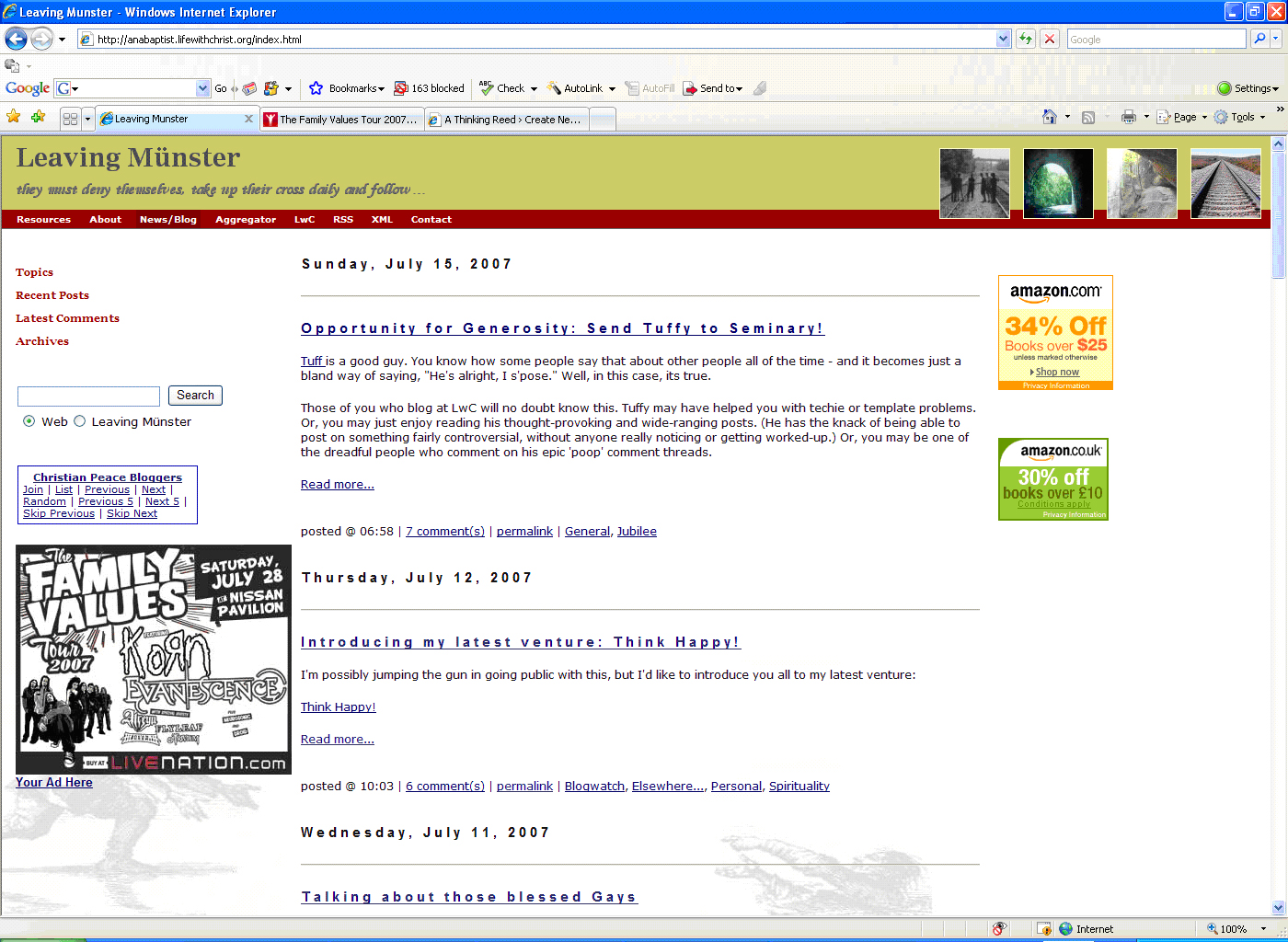
    I couldn’t help but notice that blog-friend Graham at Leaving Muenster is sporting an ad for the “Family Values” tour on his site!

    leavingmunster1.jpg

    Now, I could be going out on a limb here, but I’m going to bet that Graham is probably not a fan of Korn, Evanescence, Atreyu, Hellyeah, or Trivium.

    Gotta be careful what you write about there, Graham! One minute you’re critiquing the Religious Right’s distorted view of what constitutes “family values,” the next you’re shilling for Korn!

    By the way, Hellyeah is the new project of former Pantera drummer Vinnie Paul.

    Here’s a video of Vinnie buying $1000 worth of Jagermeister – it doesn’t get much more metal than that, friends (n.b. some bad language):

    Here’s Trivium, “Entrance of the Conflagration”:

  • Rudy as Nixon and the varieties of conservatism

    Evangelical Christian and former Bush speechwriter Michael Gerson, who left his job at the White House, writes in today’s Washington Post that Rudy Giuliani is more of a Nixonian conservative than a religious one:

    In his elections, Nixon appealed to conservatives and the country as a culture warrior who was not a moral or religious conservative. “Permissiveness,” he told key aides, “is the key theme,” and Nixon pressed that theme against hippie protesters, tenured radicals and liberals who bad-mouthed America. This kind of secular, tough-on-crime, tough-on-communism conservatism gathered a “silent majority” that loved Nixon for the enemies he made.

    By this standard, Giuliani is a Nixon Republican. He is perhaps the most publicly secular major candidate of either party — his conflicts with Roman Catholic teaching make him more reticent on religion than either Hillary Clinton or Barack Obama. But as a prosecutor and mayor of New York, he won conservative respect for making all the right enemies: the ACLU, advocates of blasphemous art, purveyors of racial politics, Islamist mass murderers, mob bosses and the New York Times editorial page.

    Gerson goes on to point out that Giuliani is nevertheless at odds with his Church and its “consistent ethic of life” on nearly all issues:

    Giuliani is not only pro-choice. He has supported embryonic stem cell research and public funding for abortion. He supports the death penalty. He supports “waterboarding” of terror suspects and seems convinced that the conduct of the war on terrorism has been too constrained. Individually, these issues are debatable. Taken together, they are the exact opposite of Catholic teaching, which calls for a “consistent ethic of life” rather than its consistent devaluation. No one inspired by the social priorities of Pope John Paul II can be encouraged by the political views of Rudy Giuliani.

    What I think is interesting and significant here is the prying apart of Nixon-style social conservatism from a more religiously-inspired moral traditionalism. The former emphasizes law and order, patriotism, and a strong foreign policy, whereas the latter is more concerned with transcendent moral issues surrounding the dignity of the human person (Gerson might have added that the Vatican has frowned on preventive war too). These two types of “conservatism” have been contingently linked in the broader conservative coalition and blurred together under the rubric of “cultural conservatism,” but there’s no necessary connection between them, and I think Gerson’s right that in Giuliani we see how they can actually be at odds.

  • My mama told me, “You’d better shop around”

    We’ve been in DC now for over two weeks, and in that time have visited two different churches. Last week we went to a nearby ELCA congregation. It seemed like a nice place – the service was pretty straightforward Lutheran, if a bit low church (very little liturgical singing/chanting, e.g.). The folks we met were friendly, the sermon was decent, etc. Yesterday we attended a small historic Episcopal parish that was also quite low church (is this a DC thing?) and as far as I could tell, quite liberal (not that there’s anything wrong with that!). I’m not sure we really “clicked” with either one, though we’ll probably go back to the Lutheran church again. I think we’re also going to visit St Paul’s on K Street, which is a well-regarded Anglo-Catholic parish in the Episcopal Church.

    Having moved several times in the last few years, it’s always daunting to try to find a new church home. Summer in particular seems like a tough time, because most churches don’t seem to be in full swing in terms of programs and ministries, a lot of people are on vacation, etc., making it somewhat more difficult to get a feel for the life of the congregation.

    But beyond this you face the problem of “church shopping” – you try and identify a list of desiderata and then find the church that best approximates what you’re looking for. I have only a few “deal-breakers”: that there be communion offered every week, that the sermons not be out-and-out heretical (e.g. denying the resurrection), and that it not be too overt or heavy-handed about pushing a political agenda, whether of the Left or the Right. Second tier considerations include things like liturgy, the diversity of the congregation (age, race, class), the size of the congregation, the programs and ministries, etc. And, one of the more important, but also more intangible, considerations is the general “vibe” you get from the people.

    Obviously this raises the specter of a consumerist approach to finding a church. In the olden days you went to whatever church was geographically closest to you. And even after the advent of Protestantism most people probably attended the local church of whatever denomination they identified with. But in our age of greater mobility and diminished denominational loyalty these can no longer be taken for granted. Other things being equal I’d like to attend a church in our neighborhood, but I’m not prepared to rule out going somewhere farther away. And while I still have a loyalty to Lutheranism I could just as easily see us attending an Episcopal parish (as we did for the past year in Boston). So, church-shopping becomes somewhat inevitable.

    Interestingly, there’s a bit of a tension in contemporary Christian approaches to this. On the one hand, most Christians have welcomed, or at least accepted, the demise of the “Christendom” model that simply assumed that everyone with a particular geographic boundary was a member of the local church. Our alleged postmodern condition has highlighted the importance of a more intentional approach to church membership and discipleship. On the other hand, there is also a strong backlash against the consumerist model of choosing a church, rooted partly in a criticism of the encroachment of market forces into the religious sphere and a wariness of a certain idea of liberal individualism that valorizes the autonomous chooser. The new fashion in a lot of theology emphasizes the importance of being rooted in community and the “tradition-constituted” nature of our capicity for reasoning and choosing. How this avoids falling back into the discredited Christendom model of the organic church isn’t entirely clear to me.

    Anyway, my sense remains that there’s something a little troubling about shopping around for a church that seems to fit my preconceived needs or desires. Maybe the right course of action is simply to attach oneself to one’s local congregation. On the other hand, why should geographic proximity be elevated to the highest importance? It may be that any ranking of criteria inevitable involves individual preference and personal judgment, so best just to get on with it and muddle through the best you can.

  • Friday random 10 – packed in boxes style

    On Fridays lot of bloggers like to post lists of a random shuffle of whatever music is on their iPod or computer or what not.

    I, by contrast, am still partly living out of boxes, having just moved. Consequently, I’m grabbing random CDs to listen to from the one open box of CDs near my desk.

    So my recent listening has consisted of:

    Hanks Williams, 20 Greatest Hits
    Dwight Yoakam, A Long Way Home
    Sleater-Kinney, Dig Me Out
    Van Halen, Van Halen
    Bruce Springsteen, Greetings from Asbury Park, NJ
    Soundtrack from the movie Singles
    U2, Zooropa
    Run DMC, Raising Hell
    Killswitch Engage, Alive or Just Breathing
    Shadows Fall, Threads of Life