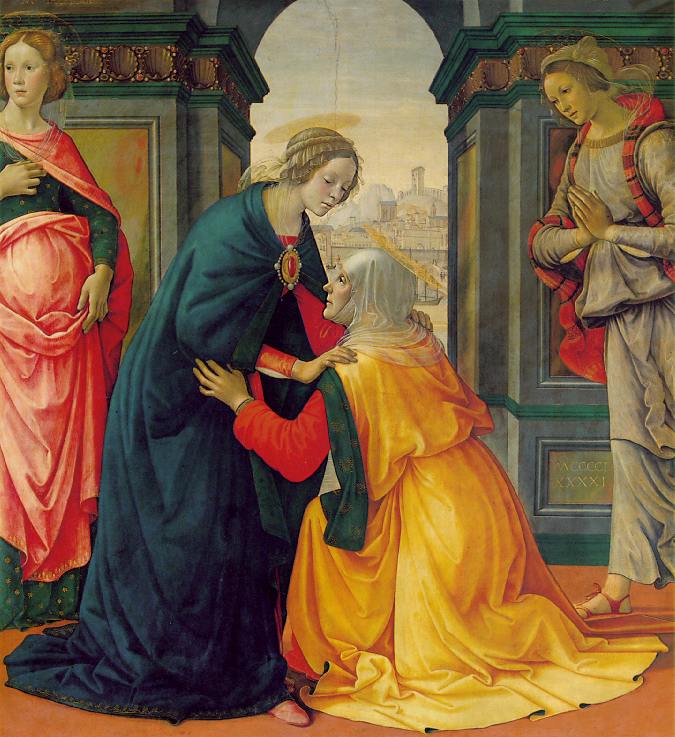
(click for larger image)
From John Paul II’s Redemptoris Mater:
When Elizabeth greeted her young kinswoman coming from Nazareth, Mary replied with the Magnificat. In her greeting, Elizabeth first called Mary “blessed” because of “the fruit of her womb,” and then she called her “blessed” because of her faith (cf. Lk. 1:42, 45). These two blessings referred directly to the Annunciation. Now, at the Visitation, when Elizabeth’s greeting bears witness to that culminating moment, Mary’s faith acquires a new consciousness and a new expression. That which remained hidden in the depths of the “obedience of faith” at the Annunciation can now be said to spring forth like a clear and life-giving flame of the spirit. The words used by Mary on the threshold of Elizabeth’s house are an inspired profession of her faith, in which her response to the revealed word is expressed with the religious and poetical exultation of her whole being towards God. In these sublime words, which are simultaneously very simple and wholly inspired by the sacred texts of the people of Israel, Mary’s personal experience, the ecstasy of her heart, shines forth. In them shines a ray of the mystery of God, the glory of his ineffable holiness, the eternal love which, as an irrevocable gift, enters into human history.
Mary is the first to share in this new revelation of God and, within the same, in this new “self-giving” of God. Therefore she proclaims: “For he who is mighty has done great things for me, and holy is his name.” Her words reflect a joy of spirit which is difficult to express: “My spirit rejoices in God my Savior.” Indeed, “the deepest truth about God and the salvation of man is made clear to us in Christ, who is at the same time the mediator and the fullness of all revelation.” In her exultation Mary confesses that she finds herself in the very heart of this fullness of Christ. She is conscious that the promise made to the fathers, first of all “to Abraham and to his posterity for ever,” is being fulfilled in herself. She is thus aware that concentrated within herself as the mother of Christ is the whole salvific economy, in which “from age to age” is manifested he who as the God of the Covenant, “remembers his mercy.”
 A Thinking Reed
Leave a comment