Tag: Theology

  • Keith Ward: An appreciation

    As longtime readers are aware (if there are any of you left!), Anglican philosopher-theologian Keith Ward has been a big influence here at ATR. I think the first book of his I read was What the Bible Really Teaches, which at the time was extremely helpful to me by articulating a theology that was open to change but also still broadly orthodox and metaphysically robust. I had been put off by the kind of reductionistic liberalism espoused by figures like John Shelby Spong but was also uncomfortable with much conservative theology. (This also happened to be a time when the acceptance of same-sex relationships in the church was probably the issue roiling mainline Protestantism.) Ward showed that one could be “liberal” while still adhering to the reality of God and the unique significance of Jesus as savior and revealer.

    Since then, Ward has continued to publish at a steady clip, largely in the areas of philosophical theology, the science and religion dialogue, and issues of religious pluralism. In particular, he published three volumes comprising a more-or-less systematic theology in the last decade or so that spell out his version of a broadly orthodox-yet-liberal Christian theology.*

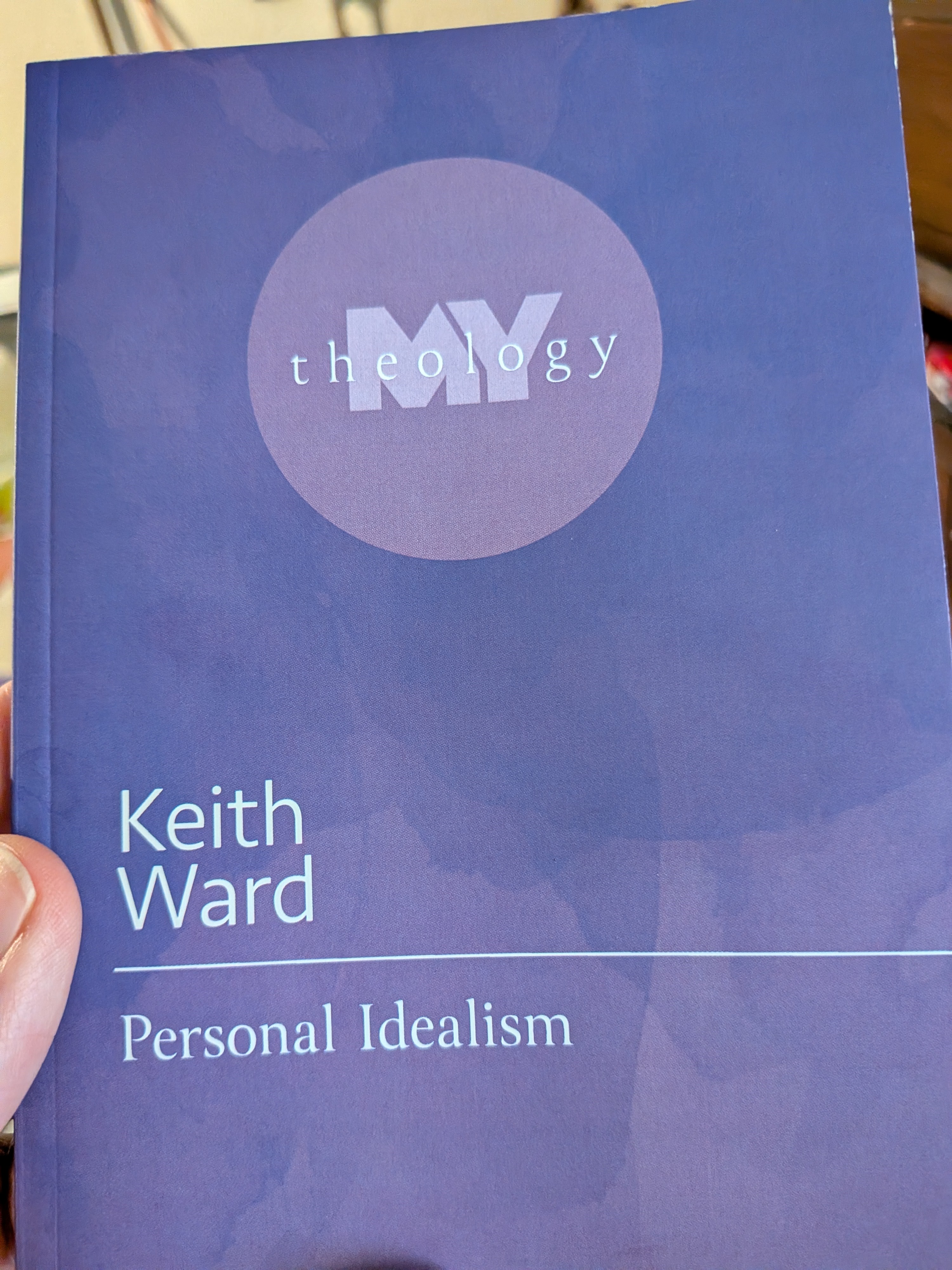
    Ward, now in his 80s, has slowed down more recently, but has still managed to publish several worthy volumes in the last few years. In 2022, he published a very short work (less than 100 pages) as part of Fortress Press’ ‘My theology’ series. The series consists of short summary statements of theological perspective by several contemporary luminaries such as Ilia Delio, Cynthia Bourgeault, Grace Ji-Sun Kim, and Scot McKnight, among others.

    Ward’s contribution is titled Personal Idealism, which is how he characterizes his particular philosophical-theological perspective.
    In short, as an idealist, Ward holds that mind is more fundamental than matter and provides the explanatory principle for the existence of the cosmos. This may sound highly counterintuitive, but Ward argues that consciousness — including feelings, thoughts, and sense-impressions — is actually prior to matter in the order of knowledge. We are more certain that these things exist than that “matter” exists, because they are the medium through which we know anything. Moreover, it’s highly implausible, Ward thinks, that mental events or properties, broadly speaking, are identical or can be reduced to material properties or events. In fact, the world as contemporary physics describes it is highly remote from our experience, consisting of wave/particle dualities, vibrating 11-dimensional stings, and probability waves. Ward thinks that the world of physics is an abstraction from experience — a framework for explaining and predicting events insofar as they are measurable and quantifiable and thus susceptible to the methods of physical science. This unavoidably leaves out a lot.

    But what, you may ask, does this have to do with God? According to Ward, a fully satisfying explanation of the existence of the universe would answer the question of why this universe exists rather than some other. It’s intuitively plausible to think that there are many possible universes, so why this one? Ward suggests that there is an infinite “ocean of possibilities” out of which one set of possibilities has been actualized — namely our universe. But possibilities in themselves are just abstractions — how can they subsist independently, much less have any causal power?

    Ward argues that it makes the most sense to think of the set of all possibilities as residing in an infinite and eternal Mind. This Mind then actualizes the set of possibilities that will contain certain goods — states that are worthwhile for their own sake. This is a personal, axiological explanation for the existence of the cosmos. The universe exists because the Eternal Mind wanted to bring into existence certain worthwhile states such as beauty, creativity, and friendship. These are states that are best actualized by free, rational beings.

    Idealism, in Ward’s sense, is the view that everything that exists either consists of mind (a strong version) or depends on mind (a weaker version). All theists are idealists in the weaker version, since they hold that everything which exists depends on God. According to Ward, the universe can be seen as an environment brought into being by the Eternal Mind so that created agents can further realize new forms of value through interactions with each other and the wider world.

    Now, one might at this point ask what all this has to do specifically with Christianity. Ward suggests that an Eternal Mind (let’s just call it “God” from now on) seeking to realize certain values would have good reason to make rational, intelligent creatures aware of its existence and purposes. Thus we have revelation – the disclosure of the Divine Spirit to people through various mediums such as inspired holy people.

    Ward is clear that he doesn’t think Christianity has a monopoly on divine revelation. Moreover, he argues that no tradition is a monolith: each one changes and evolves over time, so it’s very difficult to say what the Christian (or Buddhist, Hindu, Muslim…) view on a given topic is. Moreover, whether they like to admit it or not, traditions interact and learn from each other, often correcting their own limitations with insights from others. Ward calls his view “expansivism” to contrast it with the usual typology of exclusivism/inclusivism/pluralism. By this he means a view that is committed to a particular tradition, but is open to learning and correction from others.

    The Bible, on this view, is the record of the Jewish people’s wrestling with God and its developing idea of God and sense of universal morality. The New Testament in particular is the witness to Jesus, who Christians believe, discloses the divine as a God of unlimited love who wills the salvation of all. Ward goes on to sketch his views on key doctrines such as the Incarnation, Atonement, and Trinity. As is usually the case, he embraces the intent of the orthodox doctrine while departing from some of the traditional formulations. (For example, he develops the “two natures” theology of Chalcedon in ways that might make some traditionalists nervous, and he rejects forensic “penal substitution” models of the Atonement, preferring to say that God participates in human suffering and unites humanity to Godself.)

    The capstone of Ward’s theology is the union of all created being with God. The Eternal Word, or Logos, unites itself to a particular human being in order to overcome the estrangement between God and humanity that has resulted from our pride, hatred, and greed. In Jesus, the divine and human are united in the closest possible way, which provides the archetype of the new humanity. With the resurrection, new possibilities are created, and God sends the Holy Spirit into the hearts of people so that they can be refashioned according to the pattern of Christ. And our ultimate destiny is to be “partakers of the divine nature” as we are united with the Eternal Christ along with “all things.” As Ward sums up:

    The Trinitarian God — transcendent, finitely expressed in Jesus, and present within all created persons throughout the universe — is the Christian vision of the supreme mind of the cosmos, who calls all creation out of estrangement and suffering into a joyful communion of love. As the New Testament puts it: “God was in Christ, reconciling the world [and I think we need to make clear that, with our expanded knowledge of the universe, this means the whole cosmos] to himself” (1 Corinthians 5:19). (p. 93)

    As I noted at the beginning of this post, Ward has had a significant influence on my thinking (check the archives if you doubt it!). Maybe it’s because I have a background in philosophy, but I appreciate his willingness to bring philosophical tools to bear on theological questions. There has been a trend in theology over the last several decades (though maybe this is waning?) to treat theology as fully autonomous either because it’s supposedly based entirely on revelation or because it constitutes its own thought-world (or “language game”) and thus can’t be critiqued by norms outside itself.

    I’ve always thought this was a dead end. In my view, theology has to make sense in relation to other domains of human knowledge, whether that be science, philosophy, history, or other religious traditions. That doesn’t mean that it should uncritically accept the findings of these other disciplines (which would be impossible in any event, since there are disagreements among practitioners of all those disciplines!). But I do think theology needs an account of how, at least in principle, it relates to truths revealed by other areas of human knowledge. After all, they are all trying to tell us something about the same world — a world that we believe was created by God and is at least in part able to be understood through patient inquiry.

    To take a specific example, it’s all well and good to derive an idea of God from the Bible. But questions will inevitably arise about how that idea relates to what we know about, e.g. how natural processes work or the occurrence of certain historical events. As we bring these domains of discourse into contact, there will likely (inevitably?) be adjustments in our idea of God. Ward is trying to do this in a principled, rather than an ad hoc way. Though, as he readily admits, many (most?) philosophers don’t agree with him about many of these issues.

    Further, Ward is able to give an account of why some doctrinal or theological positions are open to revision without giving the store away, so to speak. He can articulate a robust incarnational faith while rejecting literalism and fundamentalism. Again, many people may disagree on particular points, but surely this is the most viable approach for a theology that wants to remain faithful to the central Christian truths while accepting that the world has changed in myriad ways since the 1st century. (I’d argue that it’s the approach that much Christian theology has historically taken, even when it denies that it’s doing so.)

    One might also complain that Ward’s theology is too abstract and intellectual and therefore doesn’t motivate moral commitment or experiential spirituality. While his writing is generally not warm and fuzzy, his commitment to the ethical upshot of Christianity is clear from a number of works, and he has even written a book of meditations and prayers (which to be fair is still pretty darn intellectual!). What I think is fair is that some Christians aren’t necessarily preoccupied with the issues Ward focuses on and would rather get on with the business of following Jesus. That’s certainly a reasonable stance! But for those who, as Ward says about himself, are interested in these “big questions,” he has provided a rich body of work that helps us to grapple with them.


    *For more, see the following posts: God as Ultimate Mind: Keith Wardโ€™s โ€œChristian Idea ofย Godโ€ and And yet they are not three gods but oneย God; somehow I never got around to writing about the third volume in this loose trilogy: Sharing in the Divine Nature.
  • Best Theology Books I Read This Year

    Continuing the experiment of dusting off this creaky old blog, here are the best theology books I read this year (not necessarily published this year!):

    Teresa Morgan, Trust in Atonement: Teresa Morgan is a scholar of classical antiquity as well as New Testament and early Christianity, and she brings this perspective to bear in developing a new model of the atonement in this stimulating book. Taking the Greek pistis, with its connotations of “trust” and “trustworthiness,” Prof. Morgan argues that Christ is the one who God entrusts to create trust in human beings. In order to reconcile God and human beings, Jesus creates a “space” where trust can be (re-)established. God entrusts Jesus to us, even at our worst, in order to demonstrate that we can put our trust in God. This is an intriguing work that offers a genuinely fresh alternative to the typically rehearsed atonement models.

    St. Athanasius, On the Incarnation: I decided to revisit Athanasius’ classic treatise this year, which remains one of the touchstones of classic Christian theology. One thing that struck me this time around was that, although Athanasius is sometimes presented as an alternative to “forensic,” “juridical” satisfaction theories of the atonement, there are elements of such accounts in his argument. For example, Athanasius says that in dying for us, Christ discharges a “debt” to God, which sounds positively Anselmian. Though it should be said that the emphasis remains on the ontological change effected through the incarnation. There are certainly arguments one could pick with Athanasius’ treatise (e.g. it says very little about Jesus’ earthly ministry and it’s not clear he has completely absorbed the point that Jesus is fully human), but it remains a lucid presentation of one of the essential truths of Christianity.

    Nijay Gupta, The Affections of Christ Jesus:When there is so much niche scholarship being published on Paul, it’s nice to see someone offer an original interpretation of his thought as a whole. Gupta, professor of New Testament at Northern Seminary, argues that, as the book’s subtitle has it, love is at the heart of Paul’s theology. He applies this insight to Paul’s gospel, his understanding of Christian community, and his ethics, among other topics. “Christianity is about love” may sound trite, but Gupta’s work throws fresh light on Paul’s theology and its relevance for us.

    Mildred Bangs Wynkoop, A Theology of Love: I read and discussed this book a chapter at a time with one of my good friends, who is also a deacon in the United Methodist Church. Wynkoop was a Church of the Nazarene theologian in the Wesleyan-Holiness tradition who tried to interpret the language of her tradition (“sanctification,” “perfection,” etc.) in ways that would make sense for contemporary people. One of her key insights is that doctrine has to connect with life in a meaningful way – too often theological terms become shibboleths that don’t find purchase in our actual experience. For Wynkoop, “holiness” is fundamentally about the flowering of love in our relationship with God and others. It is never a sub-personal, mechanical, or quasi-magical process; rather, it is an intensely personal relationship with the God of love.

    Samuel Wells, Constructing an Incarnational Theology: This is an ambitious work that tries to reframe Christian theology around a “supra-lapsarian” understanding of the incarnation. Wells, a pastor of St. Martin-in-the-Fields in London, former Dean of the Chapel at Duke University, and author of numerous other works, applies his concept of “being-with” to some of the classic loci in Christian theology. Wells argues that, most fundamentally, God desires to be with God’s creatures and all of creation exists for this purpose. Rather than the incarnation being a “plan B” in response to sin, it is the manifestation of God’s desire to be with God’s creation. This is a provocative and original work, though I’m not 100% sold on Wells’ organizing idea of “being-with” as a kind of master key for scripture.

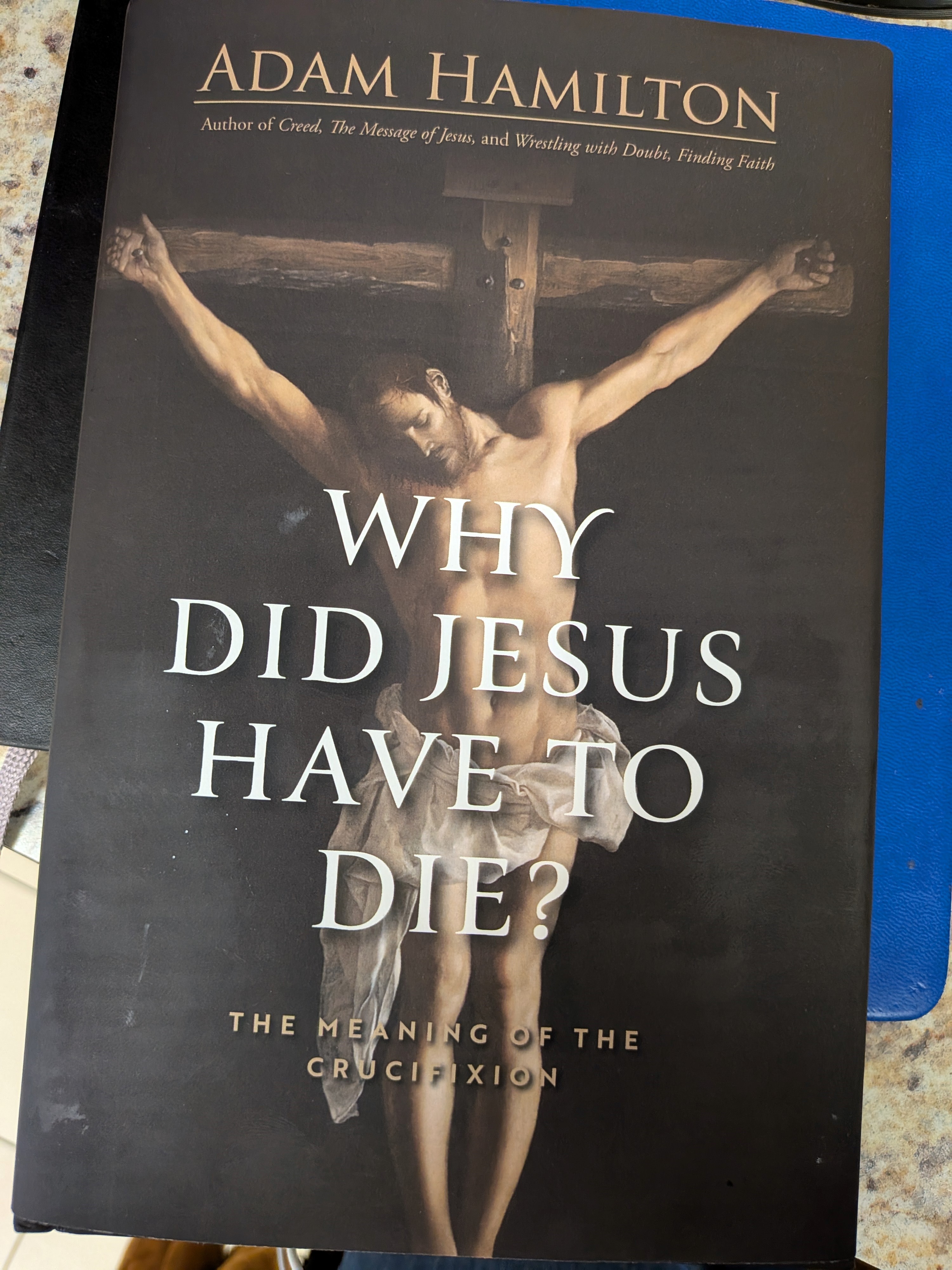
    Adam Hamilton, Why Did Jesus Have to Die? See my review here!

  • The Cross as God’s Word

    Adam Hamilton, Why Did Jesus Have to Die? The Meaning of the Crucifixion (Abingdon Press, 2025)

    Adam Hamilton is the pastor of the Church of the Resurrection in Leawood, KS, one of the largest Methodist churches in the country. He’s also the author of numerous books and bible studies where he’s tried to carve out what I would characterize as an irenic Christian orthodoxy for mainline Protestants. He’s “progressive” in the sense of supporting women in ministry and the full equality of LGBTQ+ folks in the church; but his theology is more in the spirit of a Lewisian “mere Christianity.”

    I co-lead a small group at my church, and we’ve used a number of Hamilton’s books over the years. His latest book, Why Did Jesus Have to Die? is one of the more explicitly theological of his works. In it, he wrestles with several of the traditional “theories” of the Atonement – or how Christ’s death and resurrection reconcile us to God. Since this is a topic I’ve long struggled with, I was interested to see how Hamilton would approach it.

    Maybe the most important move Hamilton makes is how he frames the Atonement. It’s a mistake, he argues, to treat theories of Atonement as though they describe the “mechanism” by which God effects our reconciliation. Instead, he says, we should see the cross as “God’s Word to humanity”:

    Jesus incarnates God’s word, revealing God’s heart and character, God’s action on our behalf to reconcile and heal us, God’s word about the human condition, and God’s word concerning God’s will for our lives. Our task is to hear this word, to receive it, and to allow it to have its intended effect on our lives, and through us, on the world. (p. xviii)

    Hamilton acknowledges that some might see this as a merely “subjective” interpretation of the cross. However, he notes “that claim fails to understand the power of God’s Word and how God works in our world”:

    Throughout scripture God acts by speaking. “God said ‘Let there be light.’ And so light appeared. God saw how good the light was” (Gen. 1:3-4). God speaks and a stuttering sheepherd named Moses becomes the great deliverer. God speaks and the childless Abraham and Sarah conceive a child. God speaks through prophets and kingdoms rise and fall. Paul, as well as the writer of Hebrews, describes God’s word as a sword. But most importantly for our purposes, in his epic prologue, John describes Jesus himself as God’s Word. (p. xix)

    In this perspective, the various New Testament motifs or metaphors for the salvation Jesus brings are better viewed as multifaceted images of the word God speaks in the death and resurrection of Jesus.

    In the succeeding chapters, Hamilton provides an overview of various NT metaphors and the theories of the Atonement that have been built upon them. These include:

    Recapitulation – Jesus is the new human archetype

    Penal substitution – Jesus bears the punishment we deserve

    Sacrifice – Jesus offers himself for our forgiveness

    Passover Lamb – Christ delivers us from slavery and death

    New Covenant – Jesus institutes a new covenant in his blood

    Ransom – Christ frees us from the devil/powers of evil

    Redemption – Jesus purchases our freedom

    In all these cases, Hamilton thinks we can recover the power of these metaphors/images interpreted as aspects or facets of the word God speaks to us.

    An instructive case study is that of penal substitution, which is both the most popular theory of atonement in some Christian circles and the most controversial in others. Hamilton offers strong criticisms of this theory as it’s often presented. These will be familiar to those who’ve followed the debate:

    1. The idea that Jesus’ death was to appease God’s anger seems contrary to the gospel message.
    2. It paints an unflattering image of a God who needs an innocent person to be tortured and killed in order to forgive.
    3. It suggests God cannot forgive sin without punishment. But God is portrayed throughout Scripture as forgiving without punishment.

    There are, of course, more sophisticated and nuanced presentations of penal substitution (e.g. John Stott’s The Cross of Christ). But even the most sophisticated interpretations of penal substitution tend to suggest that Christ’s suffering and death was something God needed in order to be gracious to us.

    Hamilton does think, however, that the motif of Christ suffering for us can be helpful:

    I believe it is we who needed Jesus’ death, not God. It was to change our hearts, not to change God’s heart. God can forgive anyone God chooses and does not require God’s Son’s torturous death in order to appease his anger.

    As God’s Word, we can say that we see God demonstrating the pain he himself experiences as a result of human sin but also the lengths to which he is willing to go to save us from it. (p. 28)

    I might put it this way: The cross reveals that God is always bearing the pain of our sin – and yet always offering mercy and forgiveness. The more “transactional” view suggests that there was a time when this wasn’t the case — that God had to be persuaded or paid off in order to be merciful. Attempts to salvage this by appealing to the Trintiy only get you so far, because you still end up having to say that God is paying Godself off or self-propitiating, which is an obscure idea to say the least.

    Interestingly, given the reputation “moral exemplar” theories have had (almost as bad as penal substitution!), Hamilton spends to chapters expounding and defending multiple versions of this motif.

    Essentially, Hamilton boils this down to two elements:

    1. Christ provides an example of sacrificial love that we are to imitate.
    2. Christ’s death reveals God’s loving heart to us.

    It’s the second of these ideas that Hamilton says he finds the most compelling of the traditional atonement motifs. But what, one might ask, distinguishes the death of Jesus from the deaths of other heroic saints and martyrs throughout history?

    What differentiates Jesus’ death … is his identity as God’s Word enfleshed. In John 14:11, Jesus said “I am in the Father and the Father is in me.” Christians believe that Jesus is the incarnation, the very embodied presence of God the Son. He is God’s anointed King. He is the Word of God enfleshed. He is God, the Son, who willingly dies not just for one person, but for all of humanity. (p. 80)

    As Hamilton puts it:

    [The Cross] reveals the very heart of God for humankind, and the motivation behind Christ’s death. It sees the story of Jesus as a love story portraying God’s steadfast love for humanity climaxing with the highest expression love might take — that of dying for another. When this love is experienced and accepted, it draws us to God, leads us to repentance, transforms our hearts, and, with the help of the Holy Spirit, compels us to live a life of selfless love. (pp. 80-81)

    One could say that the death of Christ reveals God’s love because it was the (inevitable?) outcome of the kind of life he lived — the life of God’s love reaching out to us. God in Christ willed to be with humanity and creation, but human beings, in their sin, rejected God. However, this didn’t (indeed, can’t) deter God’s love, and God “loved his own to the end” (Jn. 13:1). (For a theology that puts God’s desire to be with us at the center, see Samuel Wells’ Constructing an Incarnational Theology.)

    Fittingly, Hamilton concludes the book with an exposition of the “Christ the Victor” motif. All too often, Christian thought has separated the cross from the resurrection. This can suggest that it’s Christ’s death alone which saves us and this was the entire reason for his coming.

    Through his death and resurrection Jesus overcomes the forces of evil. This doesn’t mean these forces have been destroyed — history and current experience give ample evidence that they still plague us. But the cross and resurrection demonstrate that God’s love is sovereign over these powers and they will ultimately be defeated once and for all. Importantly, this means that we can be freed from the fear of death and for works of love for our neighbors.

    Summarizing, Hamilton offers some key takeaways:

    • Jesus didn’t have to die, but he believed God could use his death for a redemptive purpose.
    • Christ’s death is about forgiveness — but also more than forgiveness. It’s about transformation, new life, and victory over death, among other things.
    • Metaphors for atonement shouldn’t be confused with “mechanisms” that explain “how it works.”

    I think some more transactional understandings of the Atonement appeal to our desire for things to be fixed through a quasi-magical act that doesn’t require anything from us. But Hamilton’s insistence that, in the cross, God is reaching out to us emphasizes the personal nature of this relationship. Ultimately, the cross and resurrection are God offering Godself to us through God’s Word, for our reconciliation, forgiveness, liberation and new life.