Category: Uncategorized

  • Justification and liberation

    Since the previous post on Braaten’s soteriology made it sound like he had a completely negative view of Liberation Theology, I thought I’d try to set out the position he sketches in his chapter on the Two Kingdoms principle, which tries to put liberation in the context of eschatology and the coming Kingdom of God.

    The “Two Kingdoms” view has pretty bad press outside (and even within) Lutheran circles. In distorted forms it seems to bifurcate life into a purely secular realm of politics, economics, and society and a “spiritual” realm of faith. This has led some to charge the Two Kingdoms view with lending support to political quietism in the face of tyranny and oppression.

    Such a perspective seems hard to square with the life of Luther, who had no compunctions against holding political rulers accountable to the standards of God’s justice (obviously Luther’s judgment wasn’t always spot on in this area, but he certainly didn’t take the view that “religion” had no right to influence political life). However, some later Lutherans do seem to have adopted the kind of political quietism or support of the status quo in the name of the “Two Kingdoms” doctrine.

    Braaten’s goal isn’t to defend everything that has sailed under the Two Kingdoms flag, but to identify the permanent insight expressed by this concept. This has two essential parts. The first is that there are two powers at work in the world, God and Satan. Luther’s theology was very dualistic in the sense that he saw the world as the theater of the great struggle between God and the Devil, even though there was never any doubt about the ultimate outcome. “The broad backdrop of the gospel picture of Jesus as the Christ features the power of God against the powers of evil at work in the whole of creation. Jesus brings the power of God’s rule into history, confronts the demonic forces, and wins a victory which spells ultimate freedom for human beings” (p. 133).

    So, God is at work in the world to overcome all the powers of darkness that threaten human beings. However, there is another distinction to be made in the way that God is at work in the world. Luther used the expression of the “two hands” of God to point to these two ways in which God works in the world for the good of human creatures:

    The “left hand of God” is a formula meaning that God is universally at work in human life through structures and principles commonly operative in political, economic, and cultural institutions that affect the life of all. The struggle for human rights occurs within this realm of divine activity. (pp. 133-34)

    The “Right hand of God,” however, refers to the work of the Gospel properly speaking:

    [N]o matter how much peace and justice and liberty are experienced in these common structures of life, they do not mediate “the one thing needful.” This is the function of the gospel of God in Jesus Christ, the work of the “right hand of God.” The scandal of the gospel is that salvation is a sheer gift of grace, given freely by God for Christ’s sake and received through faith alone. It is meritorious for a society to grant and guarantee to all its citizens the basic human rights, but high marks in this area do not translate into the righteousness that counts before God in the absolute dimension. (p. 134)

    The point here isn’t that there are two spheres of life somehow cut off from one another, but that there are two dimensions to God’s work:

    Historical liberation and eternal salvation are not one and the same thing. They should not be equated. The gospel is not one of the truths we hold to be self-evident; it is not an inalienable right which the best government in the world can do anything about. There are many people fighting valiantly on the frontline of legitimate liberation movements who are not in the least animated by the gospel. The hope for liberation is burning in the hearts of millions of little people struggling to free themselves from conditions of poverty and tyranny. When they win this freedom, should they be so fortunate, they have not automatically therewith gained the freedom for which Christ has set us free (Gal. 5:1). This is the barest minimum of what we intend to convey by the two-kingdoms perspective. (pp. 134-5)

    The point here is simple: political liberation, freedom from oppression and poverty, and more just social structures are all things that the Spirit of God is at work to bring about, but they aren’t the whole content of what we mean by the gospel. Even if a perfectly just society were to be realized, human beings would still be oppressed by sin, guilt, anxiety, disease, old age, and death. The gospel is the power to defeat these “last enemies.” I don’t know enough about Liberation Theology to know if it’s accurate to say that some liberation theologians have tended to reduce the gospel to political liberation only. However, it does seem to me that such a reduction has been a temptation of liberal Protestant theology in North America.

    But it still may seem like this account of God’s work in the world is excessively dualistic. Is there some principle that unites both dimensions of the divine work? Braaten thinks that such a principle is found in the “eschatological horizon” of God’s coming kingdom:

    The realm of creation and the realm of redemption share the same eschatological future horizon. The doctrines of creation and law are linked to the eschatological goal of the world to which the church points in its message of the coming kingdom. The theme of eschatology relates not only to the order of salvation (ordo salutis) but also to the fact and future of ongoing creation. The orders of creation are not autonomous; there is an eschatological consummation (apokatastasis ton panton) of all things previewed and preenacted in the life, death, and resurrection of Jesus the Christ of God. (p. 135)

    The order of creation and the order of redemption are thus united in the single future they share as aspects of the coming kingdom:

    The church’s eschatological message thus combines the two dimensions of hope: hope for the poor and hope for sinners. The poor clamor for justice and sinners cry for justification. It is intolerable for the church to separate these concerns. The church is to take the message of the kingdom into the real world where the demons are running riot and where the hand of God is stirring the cauldron of secular existence in all its political, economic, and social dimensions. We must strive for a comprehensive understanding of the kingdom of God which embraces two dimensions at the same time. The vertical dimension of the gospel mediates an encounter with the absolute transcendence of God; the horizontal dimension of the coming kingdom speaks of the encounter with Christ in the person of our needy neighbor. The depth dimension reveals our human condition of sin and estrangement; the breadth dimension tangles with the powers of evil on the plane of everyday historical existence. The personal dimension lifts up each individual as infinitely valuable in the sight of God; the political dimension looks to the quality of justice and liberty that prevails in the land. The symbol of the kingdom of God is multidimensional, uniting these vertical and personal dimensions with horizontal and political dimensions of the coming kingdom. (pp. 135-6)

    Because liberation and justification are two aspects of the same coming kingdom, it’s imperative for Christians to bring the gospel to bear on the struggle for greater justice between people:

    The love of God for Christ’s sake and the commitment to human rights for the sake of humanity are joined in the picture of what God is doing for the world in the history of Jesus Christ. The one God involved in the struggle for human liberation from hunger, misery, oppression, ignorance, and all the powers of sin and evil is none other than the Father of Jesus Christ who is reconciling the whole world to himself. The signs of liberation are anticipations of the total salvation the world is promised in Christ. (p. 137)

    While Braaten clearly wants to keep God’s work of justification as the center of the gospel from which all else radiates, political liberation finds its place as a way in which we anticipate God’s coming kingdom and participate in God’s work of releasing human beings from the powers that oppress them. I think this is definitely a strength of Braaten’s position that it maintains the distinction between these two dimensions while keeping them related to God’s future for the world. What do readers think?
  • Localism versus/and nationalism?

    I’d be lying if I said I wasn’t at least a little bit sympathetically disposed to Bill Kauffman’s paean to neo-secessionists in Vermont, but I’m not so sure that ultra-localism is the solution to the problems that the secessionists identify.

    For one thing, to the extent that they deplore the effects of the global marketplace, it’s not clear that smaller communities are able to effectively resist it.

    This is one of the reasons that Daly and Cobb give for their qualified nationalism. They actually hope to see a greater devolution of economic and political power, but believe that right now the nation-state is the only entity capable of putting checks on globalization that has some measure of democratic accountability:

    Nation-states are today extremely important societies. They are in many instances the only loci of power capable of asserting themselves effectively against those forces that erode all community. They do, in many instances, contribute strongly to the self-identification of their citizens, and at least some of them allow for considerable participation in governance. Most of them have concern for the well-being of their citizens, and some affirm the diversity among them. Hence nations can be communities, and some are quite good communities. At the present time we join [Dudley] Seers in calling for economics to serve national communities.

    It is important to see what difference this would make. The current economic ideal is that national boundaries not impede the global economy. Increasingly this means that economic decisions of determinative importance to the people of a nation are made by persons who are not responsible to them in any way. In short, whatever form of government the state may have, its people cannot participate in the most important decisions governing their daily lives. This weakens the possibility for a nation-state to be a community. With a national community, on the contrary, there is some possibility for the people through their government to share in decisions. A healthy national community is possible.

    There can be no effective national economy if a people cannot feed themselves and otherwise meet their essential needs. Hence a national economy for community will be a relatively self-sufficient economy. This does not preclude trade, but it does preclude dependence on trade, especially where the nation cannot participate in determining the terms of trade. (Daly and Cobb, For the Common Good, p. 173)

    Invoking the Catholic principle of subsidiarity, Daly and Cobb enunciate, as a general principle that decentralization is good if the community can effectively exercise control over its economic life:

    In many instances the nation-state is already too large and too remote from ordinary people for effective participation to be possible. Decentralization of the economy within the nation should accompany nationalization in relation to the global economy. Many regions within the United States could become relatively self-sufficient. With economic decentralization there could come political decentralization as well. The main formal point is that a political community cannot be healthy if it cannot exercise a significant measure of control over its economic life. The second formal point is that of the Catholic teaching of “subsidiarity”: power should be located as close ot the people as possible, that is, in the smallest units that are feasible. Our special emphasis is that except for a few functions, political power that cannot affect the economic order is ineffective. Hence we tie political decentralization to economic decentralization. (p. 174)

    The secessionists of the Second Vermont Republic, however, don’t see the nation-state as a potential ally. They see it as the enemy and themselves as the foes of “giantism” in all its forms.

    From Kauffman’s article:

    “The left-right thing has got to go,” declares Ian Baldwin, cofounder of Chelsea Green Publishing and publisher of Vermont Commons. “We’re decentralists and we are up against a monster.”

    What might replace left and right, liberal and conservative, as useful political bipolarities? Globalist and localist, perhaps, or placeless versus placeist. Baldwin argues that “peak oil and climate change are linked and irreversible events that will within a generation change how human beings live. The world economy will relocalize.” He dismisses homeland security as “fatherland security”—for “homeland,” with its Nazi-Soviet echoes, has never been what Americans call their country. What we need, says Baldwin, is “homestead security”: sustainable agriculture, small shops, a revival of craftsmanship, local citizenship, communal spirit. The vision is one of self-government. Independence from the empire but interdependence at the grassroots. Neighborliness. The other American Dream.

    Personally I like the idea of acheiving the ends of community and sustainability through noncoercive libertarian means. I’m just not sure it can be done. I certainly think that Daly and Cobb would agree with much of the spirit of the SVR folks, but their view is that the nation-state has to play an essential role in shielding local economies and communities from the ravages of the global marketplace. But the radical decentralists of the SVR are likely to reply that you can’t strengthen localities by concentrating more power in the center.

    It may be that what’s needed is a mixture of both approaches. In reviewing WorldChanging, a vast compendium of ideas for saving the planet (and a pretty nifty book that we received as a gift from some friends), Bill McKibben writes:

    If there’s one flaw in the WorldChanging method, I think it might be a general distrust of the idea that government could help make things happen. There’s a Silicon Valley air to the WorldChanging enterprise – over the years it’s been closely connected with Wired magazine, the bible of the digerati and a publication almost as paranoid about government interference and regulation as the Wall Street Journal. Like Internet entrepreneurs, they distrust both government intentions and abilities – bureaucrats tend, after all, to come from the ranks of those neither bold nor smart enough to innovate. A libertarian streak shines through: “When we redesign our personal lives in such a way that we’re doing the right thing and having a hell of a good time,” Steffen writes, “we act as one-person beacons to the idea that green can be bright, that worldchanging can be lifechanging.” I’m sympathetic to this strain of thinking; I believe we’re going to need more local and more nimble decision-making in the future to build strong, survivable communities. But it also makes it a little harder to be as optimistic as you’d like to be when reading these pages, which are filled with good ideas that, chances are, won’t come to all that much without the support of government and a system of incentives for investment.

    Frankly I’m not sure what the right balance is. It may be that one of the necessary functions of government is to create a protective framework or space within which communities can flourish. This wouldn’t have to entail either bureaucratic micro-management or utter laissez-faire. Rather, what may be needed is some way to permit communities to freely experiment in different ways of living while enjoying a measure of protection from the levelling effects of the market.

  • Peak oil and the end of liberalism

    Patrick Deneen writes that modern liberalism – “the philosophy premised upon a belief in individual autonomy, one that rejected the centrality of culture and tradition, that eschewed the goal or aim of cultivation toward the good established by dint of (human) nature itself, that regarded all groups and communities as arbitrarily formed and therefore alterable at will, that emphasized the primacy of economic growth as a precondition of the good society and upon that base developed a theory of progress (material as well as moral), and one that valorized the human will itself as the source of sufficient justification for the human mastery of nature, including human nature (e.g., bio-technological improvement of the species)” – rests ultimately on our ability to exploit fossil fuels. All that freedom, autonomy, and material progress is a one-shot affair since the reservoir of energy that made it possible took hundreds of millions of years to build up.

    Deneen says that the view of life that underlies liberalism is profoundly anti-natural:

    Oil has been the silent but world-altering source of our collective delusion that we could live in this way and get away with it. It has allowed us to contrive a civilization based upon a theoretical fantasy, and to make it functional for about a century, during which time we took the exceptional for the ordinary, the unnatural for the given, the hubristic for the norm. We have reshaped the world to accord with a self-delusive fantasy, with the only stipulation being that there continue to be unlimited quantities of this external power source that would let growth and its attendant power over nature go on forever. Most of us assume there’s no problem with this basic presupposition – except that we are about to discover that you can only defy gravity for so long, as the example of Icarus ought to have served as a reminder.

    Conservatism, while a salutary reaction against the excesses of liberalism, usually fails to grasp the underlying economic realities that make those excesses possible:

    Conservatives rightly decry the decline of culture, the assault on the family and the unlimited infanticide of our abortion regime, but find nothing else wrong with the basic arrangement and largely do not question whether our political and economic arrangements have contributed to what we denounce. Books will be written about how this could have happened. But, perhaps we are not long from the day when conservatives will realize the fantasy they have themselves been purveying, and will demand that we prepare ourselves now for a post-petroleum reinstatement of human culture, cultivation, and tradition.

    I take peak oil and global warming catastrophists with a grain of salt if only because their predictions of what will happen post-catastrophe seem to align so neatly with the kind of society they would like to see. Still, the fossil fuel binge does seem like it will have to come to an end at some point, so it’s well worth thinking about what that implies.

  • Current ATR candidate rankings (subject to change at my whim)

    Here are my current (extremely lukewarm) preferences for presidential candidates in both parties, confining myself to the declared major candidates*, from most to least preferred:

    Dems:

    1. Richardson
    2. Edwards
    3. Obama
    4. Clinton

    GOP:

    1. Romney
    2. McCain
    3. Guliani

    At this point none of the GOP candidates rise close enough to the level of sanity on foreign policy for me to consider voting for them in a general election, but Romney strikes me as the most rational. Or, at least, he’s demonstrated a certain … flexibility, which leads me to think that he would be more likely to bend with the prevailing wind on Iraq, etc. Contrast this to McCain’s rather frightening “Damn the torpedoes!” approach.

    As for the Dems I would consider pulling the lever for Richardson, Edwards, and Obama, but probably not Clinton. Richardson has made what I regard as some very good statements on Iraq and has an overall foreign policy savvy that seems both realistic and constrained. Edwards has said some good things, though I’m not completely sold. Obama is still a bit of a cipher in my view, and I’m not convinced he’s had enough experience for the job. HRC is an unapologetic war-hawk and executive power aficionado, so I feel no pull whatsoever to vote for her.

    So, given the above, if on election day it comes down to either Richardson, Edwards, or (possibly) Obama vs. any of the three above Republicans, I would probably vote Dem. If it ends up being HRC, I will almost certainly vote third-party.

    This all assumes that no other serious contenders (Hagel, Gore) jump in to complicate matters.
    —————————————————–
    *I admit the possibility that Huckabee, Tommy and/or Fred Thompson, and Brownback could potentially become major contenders, so their exclusion is somewhat artificial; Ron Paul and Dennis Kucinich, God bless their peacenik hearts, don’t stand a chance.

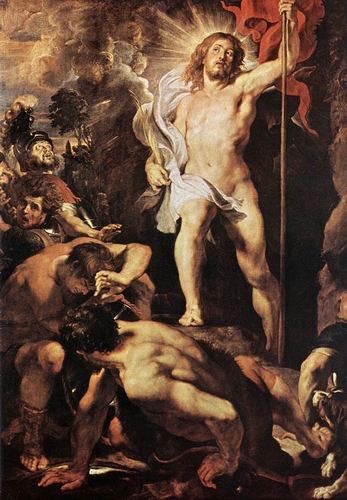
  • Easter!

    rubens_resurrection_christ.jpg

    Now, brothers, I want to remind you of the gospel I preached to you, which you received and on which you have taken your stand. By this gospel you are saved, if you hold firmly to the word I preached to you. Otherwise, you have believed in vain.
    For what I received I passed on to you as of first importance: that Christ died for our sins according to the Scriptures, that he was buried, that he was raised on the third day according to the Scriptures, and that he appeared to Peter, and then to the Twelve. After that, he appeared to more than five hundred of the brothers at the same time, most of whom are still living, though some have fallen asleep. Then he appeared to James, then to all the apostles, and last of all he appeared to me also, as to one abnormally born.

    For I am the least of the apostles and do not even deserve to be called an apostle, because I persecuted the church of God. But by the grace of God I am what I am, and his grace to me was not without effect. No, I worked harder than all of them—yet not I, but the grace of God that was with me. Whether, then, it was I or they, this is what we preach, and this is what you believed.

    But if it is preached that Christ has been raised from the dead, how can some of you say that there is no resurrection of the dead? If there is no resurrection of the dead, then not even Christ has been raised. And if Christ has not been raised, our preaching is useless and so is your faith. More than that, we are then found to be false witnesses about God, for we have testified about God that he raised Christ from the dead. But he did not raise him if in fact the dead are not raised. For if the dead are not raised, then Christ has not been raised either. And if Christ has not been raised, your faith is futile; you are still in your sins. Then those also who have fallen asleep in Christ are lost. If only for this life we have hope in Christ, we are to be pitied more than all men.

    But Christ has indeed been raised from the dead, the firstfruits of those who have fallen asleep. For since death came through a man, the resurrection of the dead comes also through a man. For as in Adam all die, so in Christ all will be made alive. But each in his own turn: Christ, the firstfruits; then, when he comes, those who belong to him. Then the end will come, when he hands over the kingdom to God the Father after he has destroyed all dominion, authority and power. For he must reign until he has put all his enemies under his feet. The last enemy to be destroyed is death. For he “has put everything under his feet.” Now when it says that “everything” has been put under him, it is clear that this does not include God himself, who put everything under Christ. When he has done this, then the Son himself will be made subject to him who put everything under him, so that God may be all in all.

    1 Corinthians, 15:1-28

  • Good Friday

    Psalm 22

    My God, my God, why have you forsaken me?
    Why are you so far from saving me, from the words of my groaning?
    O my God, I cry by day, but you do not answer,
    and by night, but I find no rest.
    Yet you are holy,
    enthroned on the praises of Israel.
    In you our fathers trusted;
    they trusted, and you delivered them.
    To you they cried and were rescued;
    in you they trusted and were not put to shame.

    But I am a worm and not a man,
    scorned by mankind and despised by the people.
    All who see me mock me;
    they make mouths at me; they wag their heads;
    “He trusts in the LORD; let him deliver him;
    let him rescue him, for he delights in him!”

    Yet you are he who took me from the womb;
    you made me trust you at my mother’s breasts.
    On you was I cast from my birth,
    and from my mother’s womb you have been my God.
    Be not far from me,
    for trouble is near,
    and there is none to help.

    Many bulls encompass me;
    strong bulls of Bashan surround me;
    they open wide their mouths at me,
    like a ravening and roaring lion.

    I am poured out like water,
    and all my bones are out of joint;
    my heart is like wax;
    it is melted within my breast;
    my strength is dried up like a potsherd,
    and my tongue sticks to my jaws;
    you lay me in the dust of death.

    For dogs encompass me;
    a company of evildoers encircles me;
    they have pierced my hands and feet–
    I can count all my bones–
    they stare and gloat over me;
    they divide my garments among them,
    and for my clothing they cast lots.

    But you, O LORD, do not be far off!
    O you my help, come quickly to my aid!
    Deliver my soul from the sword,
    my precious life from the power of the dog!
    Save me from the mouth of the lion!
    You have rescued me from the horns of the wild oxen!

    I will tell of your name to my brothers;
    in the midst of the congregation I will praise you:
    You who fear the LORD, praise him!
    All you offspring of Jacob, glorify him,
    and stand in awe of him, all you offspring of Israel!
    For he has not despised or abhorred
    the affliction of the afflicted,
    and he has not hidden his face from him,
    but has heard, when he cried to him.

    From you comes my praise in the great congregation;
    my vows I will perform before those who fear him.
    The afflicted shall eat and be satisfied;
    those who seek him shall praise the LORD!
    May your hearts live forever!

    All the ends of the earth shall remember
    and turn to the LORD,
    and all the families of the nations
    shall worship before you.
    For kingship belongs to the LORD,
    and he rules over the nations.

    All the prosperous of the earth eat and worship;
    before him shall bow all who go down to the dust,
    even the one who could not keep himself alive.
    Posterity shall serve him;
    it shall be told of the Lord to the coming generation;
    they shall come and proclaim his righteousness to a people yet unborn,
    that he has done it.

  • Notes on Anselm’s Cur Deus Homo: 6 (the brief version)

    I just lost a long post on the next couple of chapters of Cur Deus Homo, so this is the abridged version…

    The concept of God’s honor is central to Anselm’s scheme, but it has also been severely criticized and (I would argue) often misunderstood. Anselm himself may be partly responsible for some of the confusion in that he seems to say both that sin robs God of his honor and that God’s honor can’t in any way be diminished.

    In Book One, Chapter XV he addresses this directly:

    Nothing can be added to or taken from the honor of God. For this honor which belongs to him is in no way subject to injury or change. But as the individual creature preserves, naturally or by reason, the condition belonging, and, as it were, allotted to him, he is said to obey and honor God; and to this, rational nature, which possesses intelligence, is especially bound. And when the being chooses what he ought, he honors God; not by bestowing anything upon him, but because he brings himself freely under God’s will and disposal, and maintains his own condition in the universe, and the beauty of the universe itself, as far as in him lies. But when he does not choose what he ought, he dishonors God, as far as the being himself is concerned, because he does not submit himself freely to God’s disposal. And he disturbs the order and beauty of the universe, as relates to himself, although he cannot injure nor tarnish the power and majesty of God. … And so, though man or evil angel refuse to submit to the Divine will and appointment, yet he cannot escape it; for if he wishes to fly from a will that commands, he falls into the power of a will that punishes. And if you ask whither he goes, it is only under the permission of that will; and even this wayward choice or action of his becomes subservient, under infinite wisdom, to the order and beauty of the universe before spoken of. For when it is understood that God brings good out of many forms of evil, then the satisfaction for sin freely given, or if this be not given, the exaction of punishment, hold their own place and orderly beauty in the same universe. For if Divine wisdom were not to insist upon things, when wickedness tries to disturb the right appointment, there would be, in the very universe which God ought to control, an unseemliness springing from the violation of the beauty of arrangement, and God would appear to be deficient in his management. And these two things are not only unfitting, but consequently impossible; so that satisfaction or punishment must needs follow every sin.

    God’s honor is intergrally related to his creation and ordering of the universe. Considered in himself, God can’t be harmed or benefited by anything we do. This is the much-disputed doctrine of divine impassibility. Nothing can add to or take away from God’s perfection and blessedness.

    But – sin can and does deface creation. Sin is ugly in that it disrupts the order and beauty of the universe. The beauty of creation consists of each being fulfilling its purpose and contributing to the harmony of the whole. To reject that purpose is to disrupt that harmony. We might also say that sin is a lie – it speaks untruth about creation. If I sin against a fellow creature I am saying something untrue about its worth.

    So, if God were to let sin go unpunished or without satisfaction being made, he would be letting his intentions for creation be frustrated. He would be letting sin have the last word. But God can’t do this because of his goodness. Like what a feudal lord is supposed to do, God upholds the order and beauty of his realm. If he were to let his intentions for creation be frustrated by sin he would be less than fully good or less than fully powerful. To counteract sin God must do something so beautiful that it blots out the ugliness of sin. He must speak the truth about sin and about creation that contradicts the lie.

    Anselm points out that one way or another God’s will prevails. Either creatures render their due obedience to God, or make satisfaction for their sin, or are punished for their sin. But under no circumstances does sin get the last word. However, given that there is sin, Anselm thinks that there are good reasons for God to prefer satisfaction to punishment. This sets Anselm’s account of atonement apart from later views which understand Jesus as having taken our punishment on himself. In fact, he’ll go on to argue that God must make satisfaction rather than extract punishment if his purposes for creation are to be fulfilled, which, I think, has interesting implications.