Category: Uncategorized

  • The granddaddy of liberalism

    Nice article on John Stuart Mill (via Arts & Letters Daily) that argues that he was more complicated than people frequently think. He’s often reduced to a one-dimensional figure, depending on the preferences of the person discussing him (e.g. the libertarian Mill, the socialist Mill, the utilitarian Mill), but this piece shows him as a more interesting, if somewhat inconsistent, figure.
    Mill’s not my favorite philosopher by any stretch, but he’s certainly important; most of us probably take for granted any number of notions that were first clearly enunciated by him.

  • Gerald O’Collins on naming the Trinity

    Lots of good comments in the post below.

    Prior to this discussion I’d been reading Gerald O’Collins’s The Tripersonal God: Understanding and Interpreting the Trinity. He has some things to say on naming the Trinity that might be helpful:

    When the Trinity is named, God the Father functions validly if we align ourselves with the meanings communicated in that metaphor by the biblical witnesses (above all, by Jesus himself) and refuse to literalize it. It is these meanings that convey true information about the tripersonal God. Father names personally the God revealed in Israel’s history and known relationally as the Abba of Jesus’ life, death, and resurrection (together with the outpouring of the Holy Spirit). Father fixes the reference when Christians speak distinctively of the tripersonal God and what they believe the Trinity to be like. The image and language of Abba emerged from Jesus’ specific experience of God. Once we agree that language and experience, while distinguishable, belong inseparably to each other, we would misrepresent Jesus’ experience if we insisted on replacing his central language for God. Fidelity to Jesus calls on believers to name the first person of the Trinity primarily as Father, which entails acknowledging Jesus himself (though once again not exclusively) as the Son of God.

    By not arguing for an exclusive use of male names, I recognize that we do and should also use other names: Such a gender-neutral name as Creator for the first person of the Trinity and such a female name as Wisdom for the second person. Once we move beyond trinitarian formulations, many possibilities open up: well over 100 distinctive names for Jesus in the NT alone and “God” (in the form of ho Theos) as the name with which the NT often designates God the Father. The question at issue is not the use of other distinctive names but rather the primary way of naming the Trinity when we use trinitarian formulations, and–in particular–the name Father for the first person. (p. 186)

    The key points here, it seems to me, are that “Father” fixes the reference to the God of Jesus, and that language and experience are inseparable, so we can’t simply assume that we can retain the same meaning with a change of language. It’s fidelity to Jesus and his experience of God, not some vague idea we may have about “fatherhood,” that licenses the use of “Father” to address the first person of the Trinity. If anything, in the biblical tradition the character of God defines and sets the standard of fatherhood that human fathers are measured against, rather than being a projection of human qualities onto God.

    Later Fr. O’Collins writes:

    Suppressing the traditional naming of the Trinity would mean loss rather than gain. Such alternate proposals for the first person as Source and Parent sound remote, even impersonal, and nowhere near as directly relational as Father. Unquestionably, these alternatives contain or imply some personal and relational elements and are not intended to subvert Christian belief in a personal God. But if we try using (exclusively?) Source, Parent, and so forth as forms of address to God, we will perceive the superiority of Father. Some of the alternative triads (e.g., Creator, Christ, and Spirit) have a strong Arian flavor about them, as if only the first person of the Trinity were properly divine, possessed the power of creation, and had in fact freely created out of nothing Christ and the Spirit. One might object here that Hilary of Poitiers said something similar when he wrote of faith “in the Creator, the Only-Begotten, and the Gift.” Yet, he used such language immediately after recalling Jesus’ mandate to baptize “in the name of the Farther, and the Son, adn of the Holy Spirit” (De Trinitate, 2.1.33). The context for Hilary’s alternate triad removed any sense of Arian ambiguity.

    Although it may claim some kind of NT pedigree (perhaps in Acts 3:13, 26; 4:27, 30), “Child” (as in Parent, Child, and Paraclete and Father, Child, and Mother) seems to depricate the second person of the Trinity, as if the Son were not yet properly mature. Moreover, to use Father, Child, and Mother could seem a little like a rerun of a Gnostic myth summarized by Irenaeus as Father, Mother, and Son (Adversus Haereses, 1.29). Renaming the first person of the Trinity in different ways could well mean saying something different and changing basic belief. A certain crypto-modalism comes through in some of the alternate proposals I listed: Creator, Liberator, and Comforter, for instance, can readily suggest a monopersonal God who behaves toward us in creative, liberating, and comforting ways but whose inner life is not differentiated into three divine persons. Another triad, Creator, Redeemer, and Sanctifier, can claim considerable background in Christian tradition. But if used by itself, it fails to distinguish Christianity from other religions in a way that naming Father, Son, and Holy Spirit does. After all, other religions can and do profess faith in deities who create (or in some lesser way make), redeem, and sanctify human beings. The names Father, Son, and Holy Spirit tie Christian faith firmly into the revealing and saving history that culminated in the events of the first Good Friday and Easter Sunday. Once again, let me insist that I am speaking about the primary way of naming the Trinity, the three names used in the Nicene-Constantinopolitan Creed. This does not mean that such formal trinitarian language is the only way of speaking about and addressing God. In these days, we may need more than ever some alternatives to prevent our “Father” language from collapsing into crass literalism. (pp. 189-90)

    This approach seems to strike a good balance. Father, Son, and Holy Spirit remains the primary way of naming God because it keeps our faith fimly anchored in the historical particularity of the Gospel. Christianity is, after all, a historical religion, not a religion of abstract truth or speculation. But it allows for a certain flexibility in our images and forms of address to God. Theologians and mystics have frequently been quite daring in their language to and about God, and I don’t see good reason for the church to discourage that. We do need to be reminded that our language remains inadequate to its object.

  • Trinitarian hijinks

    Today our congregation started incorporating elements from the new worship book produced by the ELCA and approved at this summer’s churchwide assembly. Though the book itself won’t be in use til this fall as I understand it.

    Now, I freely admit to being resistant to change; just when I get used to a particular liturgy they go and change it on me. This forces me to focus on the liturgy when the point is to have our attention on God. The liturgy is, after all, an instrument of worship, and an instrument works best when you scarcely notice you’re using it, right?

    Nevertheless, change is sometimes necessary I suppose. But what I’ve seen so far isn’t too encouraging. There were two changes in particular that I noticed. The first was the response after the first reading. Usually, after finishing the reading, the reader says, “The Word of the Lord,” and the congregation responds, “Thanks be to God.” But today it was “Holy wisdom, holy word”/”Thanks be to God.” I’m not really sure why that change was made, but I seem to recall reading somewhere that it actually dates back to the early church.

    The other, more significant change was in the Trinitarian invocation at the end of the service. Instead of “May God, Father, Son and Holy Spirit bless you now and forever” we got “Holy Eternal Majesty, Holy Incarnate Word, Holy Abiding Spirit, one God, bless you now and forever.” While admittedly not as bad as the popular, and highly theologically dubious, “Creator, Redeemer, and Sanctifier” I admit that I don’t really think that the Trinitarian name is something we should be monkeying around with. I’m all for gender neutral or feminine images being used to balance out traditional masculine imagery, but the Christian Church has always held that the Trinitarian name is part of God’s self-revelation. It’s not something we came up with ourselves. It’s God’s proper name. As Robert Jenson put it:

    From time to time, varous concerns lead to proposed replacements of the trinitarian name, for example, “In the name of God: Creator, Redeemer, and Sanctifier” or “In the name of God the Ground, God the Logos, and God the Spirit.” All such parodies disrupt the faith’s self-identity at the level of its primal and least-reflected historicity.

    Such attempts presuppose that we first now about a triune God and then look about for a form of words to address him, when in fact it is the other way around. Moreover, “Creator, Redeemer, and Sanctifier,” for example, is, like other such phrases, not a name at all. It is rather an assemblage of after-the-fact theological abstractions, useful in their place but not here. Such assemblages cannot even be made into names, for they do not identify. Every putative deity must claim, for example, somehow to “create,” “redeem,” and “sanctify.” There are also, to be sure, numerous candidates to be “Father” or “Spirit,” but within the trinitarian name, “the Father” is not primarily our Father, but the Father of the immediately next-named Son, that is, of Jesus. The “Holy Spirit” within the name, is not merely any “spirit” claiming to be holy, but the communal spirit of the just-named Jesus and his Father. By these relations inside the phrase, “Father, Son and Holy Spirit” is historically specific and can be what liturgy and devotion–and at its base, all theology–must have, a proper name of God. (The Triune God, p. 17)

    By all means, experiment with a variety of images for God. Many of our hymns do this wonderfully. But the Trinitarian name isn’t something to be cast aside for the sake of change or for some politically correct agenda.

  • Mike D as pundit

    I’m second to no one in my love of the Beastie Boys, but I have to say, some of the rhymes on the recent To the 5 Boroughs, which I checked out from the library the other day, leave a bit to be desired. My longstanding theory has been that there is an inverse relationship in the Beastie oeuvre between the quality of the material and the degree of social consciousness they attempt to convey. To wit:

    We have a president that we didn’t elect/the Kyoto treaty he’s decided to neglect

    Sigh…

    Consider: widely regarded as their best album, Paul’s Boutique is almost entirely devoid of socially redeeming qualities. Unless you consider drug use, casual sex, throwing eggs at people, shaking your rump and gunplay socially redeeming topics.

    Actually, as a whole To the 5 Boroughs is pretty decent. But the rapping about global warming and the perfidy of George Bush I can do without.

  • Meilaender on crunchy cons

    In the new First Things, Gilbert Meilaender takes a bite out of Crunchy Cons. He’s put off, as I admit I was, by Dreher’s apparent disdain for non-crunchies:

    A strong sense of impatience runs through the pages of Crunchy Cons. Perhaps it is the impatience of the prophet, and, to the degree that it is, one must attempt to learn from it. Still, over the years I have not found the folks who sit in church with me to be as vapid as Dreher seems to think they are. I admit that, on those occasions when for one reason or another I have been at a Catholic Mass, the liturgy (let us not even mention the hymnody) has largely failed to move me.

    Still, even as a Lutheran, I would never say (as Dreher does), that “if the only contact a typical American Catholic has with Catholic teaching and thought is what he hears at Mass, he will remain a self-satisfied ignoramus.” I would not say it, in part, because I have watched ordinary bourgeois folk struggle in the different ways to take seriously what happens in the church’s worship. And I would not say it, in part, because, evidently unlike Dreher, I do not suppose they were self-satisfied ignoramuses before coming to church. Nor do I think that “traditional Christian values [make] so little apparent difference in the lives many conservative believers lead.”

    Meilaender also questions the crunchies’ idea of being “mission-minded” about raising kids: shaping their character, insulating them from mass culture, and raising “rebels with a cause” as Dreher puts it:

    There must be a way to take seriously the rearing of one’s children without focusing with such intensity on “family as mission” (probably the central concept of Dreher’s chapter on education). Doing the best we can to rear our children is a task that is both obligatory and (sometimes) satisfying, but to clothe it in the language of “mission” begins to lose something essential to the relation between parents and children: namely, the mystery of it all.

    Child-rearing is not pottery or sculpture; the materials in our hands turn out to have ideas of their own. Most of what we know about the task we learn only too late, after our mistakes have been made. Rather than a mission of rearing countercultural children, we have the task of doing the best we can, in love, to set our children on the way in life. We teach them how to behave, we try to set them on the right path and shape their character properly, but we don’t own their souls. They must for a time obey us, but they don’t have to share all our likes and dislikes.

    He worries that an excessive focus on the family (pardon the expression) can, like anything else, become idolatrous:

    The most important issue, however, lies in the way the book’s discussion of the family as mission-minded intersects with religion. I have already recounted how the women with whom Dreher’s wife Julie came to be friends in Brooklyn shared a belief “that there was something supremely important about caring for their children.” In that context Julie also comments: “All of us wanted more than anything to be a real part of our baby’s life. A baby, that’s a human being. That’s a soul. That’s a life. The baby is not an accessory. He’s not part of life. He’s everything.”

    But no, as a matter of metaphysical fact, he’s not everything. We understand, of course, how a devoted and caring mother might sometimes feel that he is. We understand how he might absorb so much of her time and energy as to seem to be everything. We understand that caring for him is her vocation in life. We understand that the tie between her and her child is so deep and intimate that nothing could entirely efface it. But her child is not everything.

    To love that child more than Jesus is, we have it on good authority, to be unworthy of Jesus. To bring that child to baptism is to hand him over to God, who must be the guarantor of his existence, and to the church, which must accept responsibility for him. There is something stiflingly possessive in this account of the parent-child bond. It is, no doubt, understandable–even admirable–in a world where so many children are left simply to fend for themselves, but it sometimes strikes a disturbing note.

    Not being a parent myself, I can’t really offer informed comments on people’s parenting style. But I do think there is a danger in making “family” the center of everything. And, as a Lutheran, I’m inclined to argee with Meilaender that the extent to which parents can shape their children’s characters has limits imposed both by human nature and the stubbornness of original sin.

    Meilaender adds that it’s curious to bemoan “alienation and a loss of community” while at the same time praising the virtues of self-sufficiency (growing your own food, living the agrarian lifestyle, etc.). Whatever its flaws, a market economy connects us by making us dependent on others for things we can’t do for ourselves.

    He concludes:

    There is much that strikes me as on-target in Crunchy Cons, along with a good bit that strikes me as misguided or ill informed, but where the book goes awry has less to do with substance than with tone. As Reinhold Niebuhr noted, if one really wants to be a prophet, one may need to be an itinerant; it is hard to hang around those who have been bludgeoned by our critique. No doubt such prophets are sometimes needed by all of us, but I wonder whether the tone of this book might not have been more successful had its author been less intent on demonstrating that those who live in ways different from his own are flawed souls–and more intent simply on depicting the goods he has found without invidious comparison with goods others enjoy.

  • Misc. links

    Brandon has a post on St. Anselm with lots of good links.

    N.T. Wright on the Resurrection, via Pastor Frontz.

    At Alternet, an interview with journalist Michael Pollan, who just publised a book called The Omnivore’s Dilemma, on “America’s Eating Disorder.” Interestingly, one of the people engaged in sustainable farming practices that Pollan talks about is also mentioned in Crunchy Cons, I think.

  • Feast of St. Anselm


    I would be remiss if I didn’t mention that today is the feast day of Archbishop of Canterbury and my favorite medieval philosopher-theologian St. Anselm. He is often referred to as the “founder of scholasticism” and is one of the great doctors of the Church. As Archbishop he was also instrumental in the struggle against lay investiture in England and settling doubts about the filioque harbored by the Greek bishops of Southern Italy.

    Not too many other people can lay claim to having come up with two of the most enduring and controversial arguments in philosophical theology. The first is his famous ontological argument for God’s existence whose shelf-life has been surprisingly long. It was criticized in his own day and St. Thomas didn’t seem to think too much of it, but it was revivied by early modern luminaries like Descartes and Leibniz. Kant was widely thought to have finally put it to rest, but recent philosophers like Alvin Plantinga and Charles Hartshorne have given it new life.

    The second, of course, is his so-called satisfaction account of the Atonement. I’ve defended it from certain misunderstandings before. It’s also recently received a respectful treatment in David Hart’s The Beauty of the Infinite, which is especially interesting considering that Anselm has often not fared well at the hands of Eastern Orthodox theologians.

    Sometimes overlooked, however, is Anselm’s contribution to piety and the devotional life. He composed many prayers and, according to some scholars was influential in forging a kind of individual piety that became very popular in the Middle Ages. His prayers and meditations served as a means for individual lectio divina, or a meditative form of reading intended to give rise to prayer.

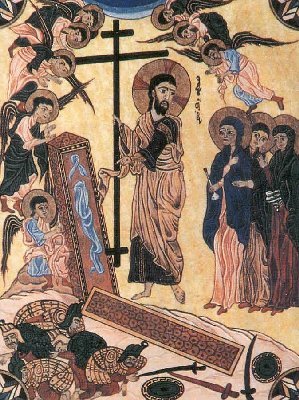
  • "He rose again on the third day…"

    This article is one of those classic pieces that proclaims the existence of a trend but then offers little more than the sparsest of anecdotal evidence that such a trend is actually occurring.

    Still, the question is a perennial one. How important to Christian belief is it that Jesus “literally” rose from the dead? The classic Christian position is that Jesus was raised bodily but that he was raised to a new kind of existence, with a “spiritual” body. In the Gospel accounts the risen Jesus is not bound by the usual constraints of the physical world; he appears in locked rooms, he is at times unrecognizable to his disciples, etc. And yet he also eats and is very tangible, as in the story of Doubting Thomas. This stands somewhere between a sheerly physcialist “resuscitation” view (which pretty much no one that I’m aware of holds) and a “spiritual” view which denies that Jesus rose bodily.

    To me the Resurrection has always been key. I could never work up much interest in a Christianity that reduced it to a metaphorical truth about Jesus’ teachings living on in his disciples or some such thing. For one thing, it’s clear that the disciples claimed that he really rose. As Pascal said, if Jesus wasn’t raised, then the disciples were either deceived or deceivers. So if the Resurrection isn’t real, then Christianity, whatever great moral insights it may offer, is based on a mistake or a fraud.

    Even when I was an agnostic investigating Christianity, I always thought it was a dishonest dodge when modernist theologians would write that it didn’t matter whether Jesus really rose from the dead, and that the Resurrection was really a metaphor for some higher, more “spiritual” truth. St. Paul’s famous hypothetical that “if Christ has not been raised, then our proclamation has been in vain and your faith has been in vain” always seemed compelling and just flat-out more honest than the revisionist view.

    I think Ian Markham, the dean of Hartford Seminary who is quoted in the Post article makes a good point:

    “We are just aware that life is much more mysterious and surprising,” Markham said. “People are less inclined to dismiss things just because they are unscientific.”

    For me, the argument that God is, after all, God, and if he wants to raise someone fromt the dead he no doubt can do so, has always been compelling. C.S. Lewis makes the point in his book Miracles that the question of God is logically prior to the question of whether miraculous events can happen. For, if there’s a Power that exists “outside” of the natural world and its nexus of cause and effect, we have no guarantee that it can’t or won’t intervene.

    Another, though maybe less rational, experience that predisposed me to not find a literal Resurrection absurd has been, I think, the fact that I grew up reading comic books and science fiction. So the ideas of parallel dimensions, supernatural powers, beings existing beyond the mundane world were already part of my mental furniture when I started to think seriously about Christian claims. I was used to thinking that the laws of nature might well apply to only a small sliver of our experience. If Jean Grey can come back from the dead umpteen times, why not Jesus? I could at least imagine the possibility, so the idea of resurrection didn’t present some kind of insuperable obstacle for me.

    More seriously, I think the Resurrection is important for Christian belief, not least because in raising Jesus from the dead God showed us what kind of God he is. That has always been the Church’s contention from day one – that in the cross and resurrection of Jesus God was at work “reconciling the world to himself.” Apart from that what basis do we have for knowing what God is like? The insights of the apostles would not be of any more intrinsic merit than any other sage or religious guru.

    Moreover, the Resurrection shows that God is at work redeeming all aspects of our existence, not just our souls or spirits. He is concerned with the physical dimension as much as the spiritual. Contra the Gnostics (and to quote Lewis) “God likes matter; he invented it.”

    (Note: Edited slightly Friday afternoon)

  • War with Iran: A Bad Idea

    I realize I’m starting to sound like a Matthew Yglesias groupie, but this article on why war with Iran is a very, very bad idea is one of the best I’ve read. Even bracketing moral considerations, there just doesn’t seem to be a feasible military option that prevents Iran from getting nukes, rather than perhaps delaying it. Aerial bombing wouldn’t guarantee anything more than a setback, regime change-plus-occupation simply isn’t doable under current conditions, and a Mark Steyn-style “decapitation” (regime change without occupation) would just be plumb foolish.

    P.S. See also this piece by Israeli military historian Martin van Creveld.

  • Musings of a crunchy con symp

    Thanks to Pastor Chip Frontz, who graciously loaned me his copy of Rod Dreher’s Crunchy Cons, I can weigh in, if somewhat belatedly, on the whole phenomenon.

    As I see it, the crunchy con ethos can be understood as an attempt to bring to bear a traditionalist religious (or philosophical) sensibility to bear on the modern world and finding that it doesn’t match up with the kinds of positions usually labeled “conservative.” Dreher himself expresses surprise at the extent to which religious commitment informs the choices of the crunchy cons he interviewed.

    In one sense, this shouldn’t be surprising. Popular American conservative ideology as we know it, rather than being an organic and coherent worldview, was in many ways a reaction against Communism. During the Cold War we seemed to need an ideology to pose against that of the godless communism of the Soviets, and this ended up being something like “God + Patriotism + Democracy + Capitalism” (not necessarily in that order). But a commitment to “democratic capitalism,” or at least actually existing democratic capitalism, is not obviously congruent with the values found in the Western religious and philosophical tradition. Any reader of the Gospels (or Plato or Aristotle for that matter) will quickly discover that the pursuit of wealth, for instance, is eyed with considerable suspicion.

    So it makes sense to me that people who are strongly committed to a fairly traditional religious worldview would grow uneasy with consumer capitalism, disregard for the integrity of the environment, and vulgar or vacuous pop culture. For the crunchy con, the good life is defined by the pursuit of virtue and fidelity to tradition, even when this conflicts with the values that prevail in American society. The “con” part is the fidelity to tradition, and the “crunchy” part is the unorthodox (from a mainstream conservative perspective) stance with respect to capitalism, the environment, consumerism, etc.

    This sensibility is given more concrete shape through Dreher’s discussion of his own family’s experience as well as through interviews with other crunchies. The organizing principle he offers for the crunchy view of the world is “sacramentalism.” In short, this is the idea that holiness or spirit is mediated through the physical.

    The best explication of this that I’ve seen is in Fr. Alexander Schmemann’s For the Life of the World. Fr. Schmemann says that there are two basic ways of looking at the religious life. One sees religion as a “spiritual” realm removed and separate from ordinary life, a sanctuary to which we retreat from the mundane physical world. The flip side of this spiritualized religion is the “activist” type which embraces the secular, focusing everything on politics, social justice, etc. and basically ignoring the spiritual aspect of existence. We work to feed the hungry but forget to tell them about the Bread of Life.

    Only in the Bible, he says, is this dichotomy overcome:

    In the Bible the food that man eats, the world of which he must partake in order to live, is given to him by God, and it is given as communion with God. The world as man’s food is not something “material” and limited to material functions, thus different from, and opposed to, the specifically “spiritual” functions by which man is related to God. All that exists is God’s gift to man, and it all exists to make God known to man, to make man’s life communion with God. It is divine love made food, made life for man. God blesses everything He creates, and, in biblical language, this means that He makes all creation the sign and means of His presence and wisdom, love and revelation: “O taste and see that the Lord is good.” (p. 14)

    For crunchy cons, this sacramental view of the world can and should carry over into areas like how we spend our money, how we prepare and consume food, how we educate our children, and our attitude toward the environment and technology. In Dreher’s view mainstream American conservatism has largely abandoned this outlook in favor of a utilitarian devotion to the free market. This is combined with a view of the material world as a sheer resource to be consumed, rather than something to be received as a gift.

    For instance, if the natural world is a gift from God with its own integrity, then practices like large-scale industrial farming and fast food suddenly come into question. This isn’t because it’s wrong for us to use nature for our own benefit, but because these practices tend to reduce to the natural world to a commodity to be exploited rather than a gift to be received in gratitude. Though Dreher doesn’t mention him, the insights of philosopher Albert Borgmann seem pertinent here. Borgmann is a critic of technology, but not a Luddite. His worry is that technological exploitation of nature threatens what he calls “focal things” and “focal practices.” At the risk of seeming pompous, I’ll quote what I wrote about Borgmann last year:

    A focal thing is something that calls forth our attention and engagement rather than being immediately available for our use. Focal things are real in their own right, rather than being commodities produced for our effortless consumption. And a focal practice is the activity whereby we engage with this reality. Paradigm instances of focal things for Borgmann are wilderness, musical instruments, the written word and the communal meal. The corresponding focal practices might be hiking, learning to play music, reading to each other and preparing the meal. These all require an active understanding and engagement with the underlying reality and the development of certain skills and virtues.

    Technology threatens focal practices because it attempts to make everything available and pliable at the push of a button or flip of a switch. It’s much easier to turn on the CD player and hear a flawless performance than to practice my own halting efforts at learning to play an instrument. But Borgmann thinks that focal practices are precisely what give life its meaning – a life reduced to an endless variety of consumption is unbearably banal.

    Crunchy cons worry that a world where everything is available as a commodity is one where we risk losing meaning and virtue for the sake of ease and convenience. Dreher writes about the family of evangelical Christians who started their own organic farm in order to raise food and animals in a way that more closely mirrors the way they believe God intended. To do this is to renounce the attitude that would turn the natural world into a commodity in favor of one that respects nature’s own integrity.

    To use Borgmann’s terminology, crunchy cons think that too many of our focal practices have been “outsourced” to corporations and the state. That’s why growing and/or preparing one’s own food, avoiding mass-produced culture, and homeschooling are central crunchy con endeavors.

    The political implications of all this are never made entirely clear. Dreher emphasizes that crunchy con-ism is more of a way of life than a political program. Though he does offer near the end of the book a tentative (and somewhat vague) crunchy con platform that includes reform of agricultural and health policies that make it easier for small farms to compete with agribusiness, zoning laws that favor historical preservation and high aesthetic standards, laws that make it easier to homeschool, and an energy policy aimed at reducing our dependence on foreign oil, along with more traditional social conservative concerns like restricting abortion and pornography, banning cloning, and tighter regulation of the biotech industry. He emphasizes, however, that not all crunchy cons would sign on to this; many, in fact, seem to have a strong libertarian streak and would be wary of using the government to instill “crunchy” virtues.

    I have to say that I’m generally sympathetic to many of the crunchies’ concerns, but there are some points of weakness. The most glaring, in my view, is that Dreher presents a lot of false dualisms. There are, on the one hand, virtuous crunchies, and on the other soulless, fast food munching, McMansion-dwelling mainstream conservatives. There are traditionalist religious believers who submit themselves to something greater than themselves, and “progressive” religious believers whose religion is little more than a projection of the needs or desires of the self. There is the wicked world of decadent American pop culture, suburban subdivisions, SUVs and consumerism versus the crunchy enclaves of quasi-monastic preservers of high culture (the last chapter is called “Waiting for Benedict”, a nod to Alasdair MacIntyre’s call for new forms of community that can uphold virtue in an increasingly barbarous world), Arts-and-Crafts urban bungalows, Volvos and bicycles, and self-sacrificing homeschoolers.

    Needless to say, there are a whole bunch of people who don’t fall into either of these stereotypes. And I can’t help but wonder if Dreher (unconsciously?) exaggerates how bad American culture is in order to validate the rebellious, “countercultural” (a word he uses with annoying frequency) self-image of the crunchy cons. Are most people in America really mindless consumerist drones driving their SUV’s to their bleak suburban subdivisions only to flop on the couch in front of the TV with their frozen pre-packaged dinners?

    After all, things like enthusiasm for organic food, environmentalism, “smart growth” and so on are hardly fringe movements anymore. Not to mention that many of the social problems that conservatives are worried about (teen pregnancy, abortion, school violence) have actually been getting better in recent years. And, personally, I think popular culture still has lots of bright spots (even TV!). Granted it’s tempting to think of oneself as part of a virtuous remnant in Babylon, but wouldn’t it make more sense for crunchy cons and their fellow travelers to encourage these positive trends by participating in and building up a common civic culture that can respond to crunchy concerns?