Category: Theology & Faith

  • “Physical” vs. “spiritual” resurrection?

    Liberal Christian icon Marcus Borg recently joined the blogosphere, and one of his first posts was an attempt to clarify his views on the resurrection of Jesus. Borg has been accused of denying the independent reality of the resurrection, reducing it to a subjective experience the disciples had after the crucifixion. But Borg maintains that he believes in a real resurrection, just not a physical one. Jesus is really alive and manifested himself to his followers following his death, but his body was not raised physically from the tomb.

    I’m not sure I find the “physical”/”spiritual” distinction particularly helpful or important. First, it presumes that we have a clear idea of what “matter” is and how it contrasts with “spirit.” Modern physics, if nothing else, has called that kind of Cartesian dichotomy into question. But more fundamentally, the New Testament stories themselves don’t seem particularly interested in answering that question. Even if we take the resurrection stories at face value, we have a Jesus who is both “physical” in the sense of being a tangible presence, who eats with his disciples and shows them the still-present wounds in his body, but who also can appear and disappear at will and whom the disciples don’t immediately recognize as being the same person. The only thing that comes through clearly here is that, for the NT writers, Jesus’ post-resurrection state involved both continuity (he was the same person, the crucified one) and discontinuity (he had been radically transformed and raised to a different state of existence).

    Keith Ward has suggested that Jesus’ resurrection involved a transformation of his body (i.e., the tomb was empty) to a “spiritual” state. But “spiritual” here doesn’t mean the opposite of “physical”; rather it means something more like a state of being fully infused with God’s Spirit. Jesus lives in the power and presence of God, but in a form that radically transcends his earthly, pre-resurrection existence. It’s not clear that asking whether this constitutes a “physical” or “spiritual” resurrection is a particularly meaningful question. The point is that the resurrection signifies God’s victory over the forces of sin, alienation, and death and promises a consummation of God’s purposes for creation.

  • La Visitacion

    Yesterday I took my daughter to the museum at Dumbarton Oaks in Georgetown. It’s privately funded and thus was not affected by the (recently concluded) government shutdown.
    The museum is small, but it features a wonderful collection from the Byzantine Empire and an impressive exhibit of pre-Columbian American artifacts. It also has, tucked away in the corner of one of the rooms, this marvelous painting by El Greco:

    Image

    What struck me was that the painting manages to convey great emotion even though both Mary’s and Elizabeth’s faces are almost totally obscured. Well worth the schlep to Georgetown if you live in or are visiting the D.C. area.

  • Christianity is not inherently right-wing

    To those of us of a more moderate or liberal disposition, the tendency of conservative Christians to identify right-wing politics with Christianity per se is a source of no small irritation. Today at Salon, Elizabeth Stoker and Matt Bruenig point out that the American Christian Right’s approach to wealth and poverty is an outlier when compared with Christian attitudes in other parts of the world:

    The notable exclusion of poverty from the Christian agenda would doubtlessly puzzle European Christians, whose support of Christian ethical approaches to family life have always been paired with a deep and vigorous concern for the poor. And, unlike their American counterparts, European Christians haven’t been willing to leave poverty up to individual charity or the market to handle. Quite the contrary: Just as public morality is an arena fit for intervention by a Christian-informed government, so too is welfare.

    The case is only bolstered if you take Catholic social teaching, Latin American liberation theology, or other non-American traditions into account. The identification of Christianity with laissez-faire economics appears to be a peculiarly American phenomenon.

    In a similar vein, in an interview with (somewhat ironically) the American Conservative, novelist and essayist Marilynne Robinson stands up for the much-derided tradition of liberal Christianity:

    Well, what is a Christian, after all? Can we say that most of us are defined by the belief that Jesus Christ made the most gracious gift of his life and death for our redemption? Then what does he deserve from us? He said we are to love our enemies, to turn the other cheek. Granted, these are difficult teachings. But does our most gracious Lord deserve to have his name associated with concealed weapons and stand-your-ground laws, things that fly in the face of his teaching and example? Does he say anywhere that we exist primarily to drive an economy and flourish in it? He says precisely the opposite. Surely we all know this. I suspect that the association of Christianity with positions that would not survive a glance at the Gospels or the Epistles is opportunistic, and that if the actual Christians raised these questions those whose real commitments are to money and hostility and potential violence would drop the pretense and walk away.

    Liberal Christianity undoubtedly has its problems. But even some of the theological critics of liberalism–like the Niebuhr brothers and Paul Tillich–were not “conservatives” in contemporary political terms. They were decidedly men of the Left, even while they critiqued liberal theology’s tendency toward sentimentality and moralism. To Tillich, for example, love and justice were inseparable, and the political expression of the Kingdom of God would be some form of democratic socialism. In fact, I have a hard time thinking of a major modern or contemporary theologian who is a full-blown right-winger.

  • Tillich: Why the “historical Jesus” is not the foundation of faith

    Paul Tillich’s discussion of historical Jesus research in volume 2 of his Systematic Theology is a minor tour de force and could still apply today without too much change. The problem of historical Jesus research, Tillich says, is that you can’t get “behind” the New Testament documents to the “real” historical Jesus of Nazareth because the records we have were shaped in very fundamental ways by the authors’ conviction that Jesus was the Christ. And any overall “portrait” of the historical Jesus is likely to be heavily dependent on which specific facts about or sayings of Jesus one takes to be historical. (For example, if one thinks that the historical Jesus applied the title “Son of Man” to himself, this will have a big effect on one’s overall picture of him.) Historical research can, at best, provide statements of greater or lesser probability. As Tillich notes bluntly, “The search for the historical Jesus was an attempt to discover a minimum of reliable facts about the man Jesus of Nazareth, in order to provide a safe foundation for the Christian faith. This attempt was a failure” (p. 105).

    One attempt to get around this was to shift the focus away from the facts about Jesus and onto his words, or teachings. This was done in one of two ways. First, they can be regarded as general moral truths or insights into human nature. “As such, they belong to law, prophecy, or Wisdom literature such as is found in the Old Testament. They may transcend all three categories in terms of depth and power; but they do not transcend them in terms of character” (pp. 105-6). The second, “more profound” approach is to focus on Jesus’ announcement of the imminent arrival of the Kingdom of God. This is not a set of general rules, but a “concrete demand,” and the proper response is to decide for the Kingdom.

    The problem with both approaches, Tillich says, is that neither one addresses the existential predicament of human beings–our estrangement from God. This isn’t something we can overcome through our own efforts. What we need is not a new law or a new set of teachings, but a new form of existence:

    But neither method can answer the question of wherein lies the power to obey the teachings of Jesus or to make the decision for the Kingdom of God. This these methods cannot do because the answer must come from a new reality, which, according to the Christian message, is the New Being in Jesus as the Christ. The Cross is the symbol of a gift before it is the symbol of a demand. But, if this is accepted, it is impossible to retreat from the being of the Christ to his words. The last avenue of the search for the historical Jesus is barred, and the failure of the attempt to give a foundation to the Christian faith through historical research becomes obvious. (p. 106)

    The only foundation for Christian faith, Tillich argues, is “the appearance of that reality which has created the faith” (p. 114).

    This reality is the New Being, who conquers existential estrangement and thereby makes faith possible. This alone faith is able to guarantee–and that because its own existence is identical with the presence of the New Being. Faith itself is the immediate (not mediated by conclusions) evidence of the New Being within and under the conditions of existence. Precisely that is guaranteed by the very nature of the Christian faith. No historical criticism can question the immediate awareness of those who find themselves transformed into the state of faith. (p. 114)

    In other words, the experience of the “New Being”–Tillich’s term for the state of overcoming the forces of sin and estrangement–is itself its own warrant. It requires no outside justification.

    But surely this has something to do with Jesus? Otherwise, what makes this specifically Christian? Tillich says that the “power which has created and preserved the community of the New Being is not an abstract statement about its appearance; it is the picture of him in whom it has appeared (p. 114). Specifically he means the picture of Jesus in the New Testament. This isn’t an “empirically factual” portrait like the one a historian might attempt. It is the record of the impact Jesus had on those who first encountered and were transformed by him. Tillich says there is an “analogy between the picture and the actual personal life from which it has arisen”:

    It was this reality, when encountered by the disciples, which created the picture. And it was, and still is, this picture which mediates the transforming power of the New Being. One can compare the analogia imaginis suggested here with the analogia entis–not as a method of knowing God but as a way (actually the only way) of speaking of God. In both cases it is impossible to push behind the analogy and to state directly what can be stated only indirectly, that is, symbolically in the knowledge of God and mediated through faith in the knowledge of Jesus. But this indirect, symbolic, and mediated character of our knowledge does not diminish its truth-value. For in both cases what is given to us as material for our indirect knowledge is dependent on the object of our knowledge. The symbolic material through which we speak about God is an expression of the divine self-manifestation, and the mediated material which is given to us in the biblical picture of the Christ is the result of the reception of the New Being and its transforming power on the part of the first witnesses. The concrete biblical material is not guaranteed by faith in respect to empirical factuality; but it is guaranteed as an adequate expression of the transforming power of the New Being in Jesus as the Christ. (p. 115)

    Just as the symbols we use about God can mediate God’s self-manifestation, the picture of Christ in the New Testament can mediate the “New Being” of which he is the bearer. The only possible validation of this is the experience of being transformed. The proof of the pudding is in the eating, as it were.

    The positions Tillich criticized live on in contemporary Christianity. More conservative Christians sometimes use historical research as a basis of apologetics, on the assumption that establishing certain historical facts about Jesus can prove, or at least provide warrant for, theological claims. On the other side of the spectrum, more liberal or progressive Christians sometimes try to identify a core set of “teachings of Jesus” that can be detached from the claims the New Testament makes about his status as the Christ. Tillich would argue that both of these approaches are doomed to failure because they try to build faith on varying degrees of historical probability.

  • Tillich: beyond naturalism and supranaturalism

    At the beginning of the second volume of his Systematic Theology, Paul Tillich provides a recap of the major themes of the first volume, in part to address criticisms he had received since its publication. In particular, Tillich discusses his doctrine of God. He characterizes the “basic intention” of his position as an attempt to go “beyond naturalism and supranaturalism.”

    Tillich identifies three ways of interpreting the meaning of “God.” The first treats God as “the highest being” who “brought the universe into being at a certain moment (five thousand or five billion years ago), governs it according to a plan, directs it toward an end, interferes with its ordinary processes in order to overcome resistance and fulfil his purpose, and will bring it to consummation in a final catastrophe” (p. 6). The problem with this view, according to Tillich, is that it “transforms the infinity of God into a finiteness which is merely an extension of the categories of finitude” (p. 6). In other words, it treats God as a being alongside other beings, one cause among many, etc. He says this view fails to adequately respect “the infinity of the infinite, and the inviolability of created structures of the finite” (p. 6). There is a qualitative difference between God and the created order.

    The second position is “naturalism,” which “identifies God with the universe, with its essence or with special powers within it” (p. 6). This is not the same as simply identifying God with the “totality of things,” which would be absurd. But its God is the “dynamic and creative center of reality”–the deus sive natura of pantheistic thinkers like Baruch Spinoza. For Tillich, however, naturalism also “denies the infinite distance between the whole of finite things and their infinite ground, with the consequence that the term ‘God’ becomes interchangeable with the term ‘universe’ and therefore is semantically superfluous” (p. 7). An essential element in human religious experience, Tillich maintains, is that the holy can be encountered as a numinous presence set over against us.

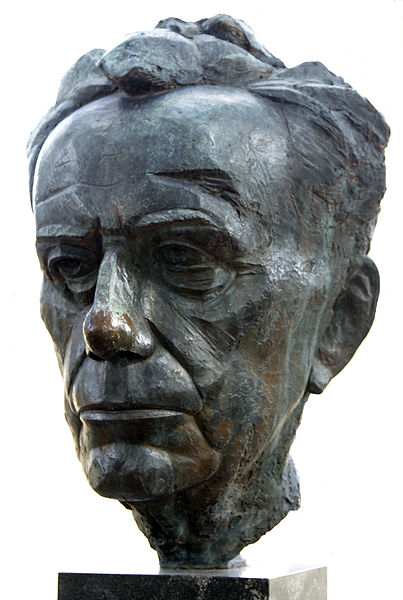
    403px-Bust_of_Paul_Johannes_Tillich_(daylight)

    Tillich proposes a “third way”–which he insists is not new, but a position found, albeit not always clearly, in the great theologians of the tradition. It emphasizes both God’s immanence and God’s transcendence. Against supranaturalism, God is not one being among others, even if the highest, but “the creative ground of everything that has being” or “the infinite and unconditional power of being.” God is “neither alongside things nor even ‘above’ them; he is nearer to them than they are to themselves” (p. 7). At the same time, parting ways with naturalism, Tillich insists that God “infinitely transcends that of which he is the ground” (p. 7). There is a certain mutual freedom between God and creation such that creatures can encounter God as something “outside” of themselves.

    Moreover, this freedom creates the possibility of creaturely alienation from God. If “God” simply named the power at the heart of the natural processes of the world, then it wouldn’t make sense to talk about human estrangement from God. Spatial imagery of God being “in” us, or “above” us can be misleading; but the concept of “finite freedom” allows us to say more precisely that created being is both “substantially independent of the divine ground” and yet “remains in substantial unity with it” (p. 8).

    Tillich’s theology has sometimes been characterized (caricatured?) as atheism dressed up in religious symbolism. But I think it’s clear here (as elsewhere) that his intention, at least, was to affirm the reality of a transcendent God, even if he was dissatisfied with certain popular formulations of theism.

  • “Living the questions” isn’t everything

    James McGrath shared a cartoon today from David Hayward that depicted the cross on a church steeple being replaced with a question mark.

    I don’t want to read too much into the cartoon, which may have just been meant to be provocative or get people thinking, but it seems to me that progressive Christians sometimes make a fetish out of “questioning.” The problem wit this is that (1) it implies that other types of Christians don’t ask questions and (2) questioning for its own sake can become a substitute for having a positive message or agenda. When I think of the great icons of liberal/progressive Christianity (e.g., Martin Luther King, Jr. or Desmond Tutu), I think of people who, yes, wrestled with doubt, but who also had a strong vision of what was true and right and were willing to fight for it. The life of perpetual questioning, with answers indefinitely deferred, can sometimes become an excuse for not taking responsibility or making a stand.

    I realize that many people who now identify as progressive Christians may come from fundamentalist and/or abusive church backgrounds where questioning received beliefs was verboten. Churches should definitely be places where people feel safe asking questions and expressing doubts (and they often fail to be such places). But a church whose highest reason for being is to ask questions sounds more like a debating society than a herald of the gospel.

  • Modern science, classical theism (3)

    One of the impulses motivating “revisionist” views of the divine nature (process theology, et al.) is not only that they can seem more consonant with modern science, but that they provide a more intimate and relational view of God. Many theologians have argued, in fact, that seeing God in responsive, relational terms such as those offered by process theology is truer to the biblical portrait of God. This view has widespread currency in recent theology. Even theologians with important differences from process theology have accepted that God is in some respects changeable and affected by what happens in the world. These included feminist, liberation, and other “contextual” theologians as well as “neo-trinitarian” thinkers like Jurgen Moltmann and Robert Jenson. Such thinkers tend to emphasize the differences between the biblical God and the Greek-inspired God of classical theism.

    In light of this, Cynthia Crysdale and Neil Ormerod (see previous posts here and here) ask “Can a transcendent God be a personal God?” That is, can a God who exists “outside” of time and space and who brings the entire history of creation into being through one timeless divine act also be related to individual human beings in a personal and responsive way?

    C&O think the answer is yes:

    [C]lassical theism presents us with a God who is infinitely responsive, who has responded so fully and so completely in the one divine act of creation that no further response is possible or needed[.] In the one infinite act of creation, past, present, and future for us , God responds to all our prayers and petitions, answers all our needs, all guided by an infinite divine loving wisdom and wise loving. . . . And while God’s response to us is itself eternal and unchanging, it unfolds for us in the fullness of time. Thus God responds to this prayer in our here and now. And if we do not pray, God does not so respond. Prayer is meaningful, it does change the situation, and God does act in response to our prayers. But this does not amount to some intervention along the lines of stirring an inactive God into action, but is part of the one creative act of God who brings into existence everything that is. (p. 128)

    God has, in effect, “already” taken into account every action, intention, prayer, and desire in the history of the universe and responded accordingly in the single, eternal creative act.

    But even on this view, there seems to be an aspect of God that is contingent, namely God’s perfect response to the world. For if God had chosen to actualize a different world from among the (presumably) many possible ones, then to the extent that the choices, prayers,etc. of the people in that world were different from ours, God’s response would have to have been different. This seems to imply that God is not wholly unchangeable, at least on the assumption that God’s actualization of other worlds than this one was a genuine possibility.

    Maybe C&O would respond that God is nevertheless not dependent on creation because it is God who chooses which possible world to make actual. This certainly distinguishes their position from those forms of process theology that deny creation ex nihilo and appear to give creation an independent ontological status. I agree with C&O in rejecting such a view. But I’m less certain how much daylight there is between their position and the more moderate “dipolar” theism espoused by someone like Christopher Southgate or Keith Ward. Both Southgate and Ward affirm creation ex nihilo and thus God’s ontological ultimacy; but both also argue that there is an aspect of God that is involved in and affected by what happens in the world.

    It’s not clear to me that C&O couldn’t accept the modified dipolar theism of Southgate and Ward while still upholding their other positions. In fact, both Southgate and Ward make arguments similar to theirs in relating theism to modern science. Alternatively, C&O could bite the bullet and say that the actual world is the only possible world. God’s creative act would give rise to this world out of necessity, rather than from God’s free choice. This seems to be essentially the view of Schleiermacher, whose views C&O’s arguments echo at several points. While this would salvage divine impassibility, it would seem to mean giving up on genuine contingency in the world. If this is right, it raises the question of whether “classical theism” is as stable a construct as it seems.

    These questions aside, I don’t want to suggest that Creator God, Evolving World is a bad book by any means. I found it incredibly stimulating (as these posts might suggest!) and also found a lot to agree with. Plus, at a time when “classical theism” has become something of a bogeyman, it’s refreshing to see it defended and brought into conversation with contemporary issues.

  • Modern science, classical theism (2)

    According to Cynthia Crysdale and Neil Ormerod’s (C&O) view, God creates in a single divine act “outside” of time and space (see the previous post). In Thomas Aquinas’ terms, God is the primary cause of the existence of everything that is, while creatures are secondary causes within the time-space framework. The implication is that God can’t be invoked to explain particular events within the world. This implies that there is no competition between scientific and theological explanations.

    But what does this imply for the problem of evil? “If God chooses this universe, in all its details from beginning to end in a single act, why does God allow there to be suffering and evil?” And how is God’s providence over history exercised?

    C&O deploy a variation of what Christopher Southgate calls the “only-way” argument. That is, this world, with its attendant suffering, is a “package deal” of sorts. You only get free personal agents like human beings through a process like the evolutionary one, “red in tooth and claw” though it may be. This is because the processes that make life possible are also the reason that suffering exists. The growth of life depends on predation, plate tectonics lead to earthquakes and volcanic eruptions, and genetic variation occasionally produces genetic disorders.

    There is no you or I apart from the total world order that confronts us in creation. It is not as if God made all the component parts of creation and stuck them together to make the universe. Rather, the universe is an intelligible whole and our existence is inseparable from the existence of that whole. (p. 86)

    We may think we can imagine a creation without suffering, but it’s not clear this is really the case:

    In the end we have no idea what it means to create a universe, or what might be possible or impossible in such a creation. While it is easy for us to imagine a world without suffering, such imaginings might not translate into a coherent and intelligible world order. If the whole is not intelligible, then such an imagined creation is a mere pipe dream, a fantasy, not realizable in fact. (p. 89)

    This line of response, assuming it works, may take some of the sting out of so-called natural evil. But what about moral evil–evil deeds intentionally chosen by free agents like us? Here C&O turn to a version of the free-will defense. They lean heavily on Augustine’s account of evil as a privation to argue that the choice of evil is a lack of purpose or meaning. “The evil act has no cause sufficient for the act, and so has no cause. It is our failure in the realm of achieving the good” (p. 97) and so “God is not the cause of this deficiency simply because it has no cause” (p. 98). God is not the cause of evil, but human freedom–which in itself is a great good–makes evil possible.

    God’s providence, in this view, consists in the superintendence of the entire created order. God does not “intervene” as a secondary cause among secondary causes, but God wills a universe into existence that includes evil as an inextricable element. This is either because, in the case of natural evil, it is an unavoidable side-effect of certain kinds of finite existence, or, as with moral evil, because it is made possible by the exercise of creaturely freedom.

    Beyond this, though, C&O suggest that there is a divinely originated response to evil on the level of practice. “[I]f evil is a lack, something that is missing that should be there, then the solution to the problem of evil is to make up for what is lacking, to repair the damage done, and turn the evil act into an opportunity for a greater good, the good of conversion, forgiveness, and mercy” (p. 99). They propose that God responds to evil by giving human beings the resources to live toward the good by taking suffering and violence as an opportunity for mercy and forgiveness. For Christians, of course, the life and death of Jesus is the ultimate expression of this response, which “has the power to change history, to shift us from decline and restore the path of genuine progress” (p. 101).

    (I have some questions about C&O’s account, but I’m going to save them for my final post in this series.)

  • Modern science, classical theism (1)

    Cynthia Crysdale and Neil Ormerod’s book Creator God, Evolving World is fighting a two-front war. On one side, they argue, against scientific atheism, that an evolutionary worldview is compatible with theism. On the other front, they uphold a form of classical theism against various revisionist views like process theology that ascribe change, passibility, becoming, and temporality to God.

    C&O offer a characterization of natural processes as an interweaving of universal laws and more probabilistic events. Nature is neither purely deterministic–with phenomena deducible from universal, invariable laws–but neither is it wholly “random” or chance-like. As revealed to us by the sciences, nature is better understood as a series of relatively stable systems of nested complexity.

    There is order and regularity–some things occur in the same way always and everywhere, all things being equal. Other things occur without a systematic pattern or a direct causality but according to probabilities. And just as the two types of inquiry intersect and are mutually creative, so those events that occur according to probabilities (by chance) and those that occur systematically (according to natural laws) interweave to make a stable world process that is nevertheless subject to conditions that change. (pp. 31-2)

    It is sometimes thought that theism is incompatible with a world of chance, but C&O argue that a certain directionality can be perceived in the world process–toward greater integration and higher levels of complexity. Subatomic elements stabilize in atoms, atoms stabilize in molecules, molecules form living organism, organisms increase in complexity and integration, and consciousness, and eventually self-consciousness, emerge from life. This process is not pre-determined; there is a genuine element of chance, as each of these levels of complexity is built on contingent events. But we can nevertheless trace a general arc toward greater complexity.

    But what role does God play in this? C&O criticize the view, popular in science and religion circles and best exemplified by process theology, that God is also to some degree subject to chance and contingency. It is sometimes maintained that the God of classical theism–characterized as impassible, eternal, omnipotent, and omniscient–is inconsistent with a dynamic, evolving world-process that includes unpredictability and chance as essential elements. To be related to a changing world, God would also have to change.

    But C&O argue that classical theism is actually more congruent with the world-picture offered by science than process theism and related views. Drawing on Thomas Aquinas’ distinction between primary and secondary causes, they contend that God is better thought of as the primary cause of all that exists–the ground of the entire world-order. The entire cosmos is contingent in the sense that it could have not existed, and God is the necessary being who actualizes this particular universe from a sea of possible universes.

    Contrary to process theology, C&O say that it is difficult to make sense of the notion that God is subject to time and change. Drawing on relativity theory, they point out that there is no non-relative “now” that God could be present in. In fact, physics indicates that time is actually an aspect of the material world, so God as creator is also the creator of time. As Augustine saw, there is no sense in asking what God was doing “before” creation, since time is an aspect of the created order itself.

    Yet, this doesn’t mean that there is no chance in the universe or that everything is determined. God actualizes this particular universe with its necessary laws and contingent events. God does not need to be invoked as an explanation for particular events (the “God of the gaps”). Rather, God is the ground of the entire series of events:

    With perfect intelligence, God grasps all possible worlds, with all possible branchings, in all possible “universes,” precisely as possibilities, in a single act. With perfect wisdom and love, God chooses one possibility in its totality from its beginning to its final consummation, from all the myriad options presented by divine intelligence, in that same creative act. In Martin Ree’s expression, God “breathes fire” into one of the many mathematically possible worlds on offer. And so with complete power God realizes that one possibility, making it the one universe that exists, the one we inhabit, in all its necessity and contingency, determinisms and chance events, again in a single divine act. God’s election of this creation eliminates none of its contingency because God knows, loves, and creates this universe with precisely this set of contingencies “built in.” We do not need to place God in time in order to preserve the contingency of the universe, nor do we need to eliminate a divine and efficacious providence. For God is the answer, not to the contingency of chance events per se but to the much more profound contingency of being. It is the contingency of the very being of the universe that requires a necessary being as its source. Once we grasp this fact of divine transcendence, transcending matter, space, and time, the divine knowledge, love, and creation of the lesser contingency of chance events is implied as an automatic consequence. (p. 55)

    C&O go on to discuss the implications of their view for providence and the problem of evil, human agency, ethics, and whether a transcendent God along the lines of classical theism can still be a “personal” God. I plan to dedicated at least one more post to their book.

  • “It gets better”–Christian style

    A group called (somewhat ham-fistedly IMO) the “Not All Like That (NALT) Christians Project” has started a campaign inspired by Dan Savage’s “It Gets Better” video series. According to the group’s website, the purpose of the campaign is to “give LGBT-affirming Christians a means of proclaiming to the world—and especially to young gay people—their belief and conviction that there is nothing anti-biblical or at all inherently sinful about being gay, lesbian, bisexual or transgender.” You can watch the videos they’ve recorded so far here.

    The group has already been written up at Religion Dispatches and Time. It’s hard to say what kind of impact it will have, but it’s good to see the “open and affirming” Christian perspective trying to go more mainstream.