Category: Theology & Faith

  • Can process theology be Christian?

    This isn’t directly related to the “classical theism vs. theistic personalism” debate, but it touches on some similar issues: evangelical theologian Roger Olson ruffled some feathers recently by declaring that process theology can’t be an authentically Christian theology. This garnered a response from Bo Sanders at Homebrewed Christianity and from theologian Philip Clayton.

    Olson’s main contention is that process theology, to the extent that it’s consistent with its own premises, denies central tenets of orthodox Christianity like creation ex nihilo, the deity of Christ, and a realist eschatology.

    I’ll let readers judge how well the defenders of process theology rebut Olson’s claims. Personally, I’m a lot less interested in process theology as such than I once was. But it does try to address some of the same issues I’ve been blogging about here recently. Issues like: What does it mean for God to be genuinely related to creation? What does it mean for God to be “personal”? And so on.

    I generally find the more “orthodox” (in terms of their fidelity to Whitehead) process theologians less helpful than the ones who use process-type concepts as flexible metaphors to illuminate Christian faith. In this group I’d include, among others, Clark Williamson and Marjorie Suchocki. Both of these theologians describe God in “process-relational” terms, but they are generally more orthodox in their theological perspective than traditional Whiteheadians and less tethered to the letter of a particular metaphysical system. For instance, Williamson defends creation ex nihilo, and both Williamson and Suchocki argue for “subjective immortality.”

    I see these as efforts to overcome, or at least mitigate, what I regard as the most glaring deficiency of traditional process theology: its reduction of God’s ultimacy. Whether this approach is fully successful, of course, is another matter.

  • Theistic personalism vs. classical theism, revisited

    Fr. Kimel at Eclectic Orthodoxy has been posting a lot of great stuff recently on concepts of God. His most recent post contrasts “theistic personalism,” which views God as, essentially, a person writ large, with “classical theism,” which has a less anthropomorphic understanding of the divine being. He comes down, with some help from Edward Feser and David B. Hart, on the side of classical theism.

    My one worry here is that the more you “de-personalize” God, the less clear it becomes how the biblical narratives can be truthful representations of who God is. The Bible clearly portrays God as acting in specific ways to bring about certain purposes, as loving us, as hearing our prayers., etc. I’m not learned enough to adjudicate this issue, but there seems to be a tension in classical theism’s efforts to combine biblical personalism with Greek-influenced metaphysics (this is hardly an original observation).

    Maybe my impression here is due to the fact that the major theologians I’ve read most recently are Schleiermacher and Tillich. Both of their systems strongly emphasize the inadequacy of applying the categories of finite being to God. But both also end up with a God whom it’s difficult to imaging acting in specific ways or answering individual prayers. This could be an idiosyncrasy of their thought, or it could be that they are more thoroughly consistent as classical theists. I’m honestly not sure. Clearly theologians have always qualified some of the Bible’s more blatantly anthropomorphic images of God, and in fact Scripture itself seems to do this in various places. But at want point does the personal nature of the biblical God die the death of a thousand qualifications?

    I’m less attracted to modern revisionist forms of theism (e.g., process theology) than I once was, but it still seems to me that they point to some genuine problems in the classical understanding of God.

    (I wrote about this issue previously here.)

  • A “greatest common denominator” approach to the Bible

    I don’t have much invested in the debate over biblical “inerrancy.” It strikes me as largely an intra-evangelical debate, one driven in large part by a very conservative, Reformed strain of evangelicalism. But I do have something invested in the inspiration and authority of the Bible. I think that a “liberal” view which regards the Bible as just one instance of great religious literature is inadequate for Christian faith.

    So it’s no surprise that I appreciated this post from Ken Schenck, who is the dean of Wesley Seminary at Indiana Wesleyan University. He argues that much evangelical hermeneutics are driven by a “most difficult common denominator” approach. That is, individual difficult passages or verses are allowed to overturn the broader trajectory of the biblical message.

    Schenck notes that in pre-modern times, “problem” verses were often interpreted in ways that were almost certainly contrary to the meaning intended by the original authors if they seemed to contradict more fundamental biblical principles.

    He thus recommends viewing the Bible in a two-level fashion: there is the original, historical meaning of the individual books, passages, and verses; and there are the overarching themes and message as Christians have commonly understood them:

    If we return to the sense of Scripture’s truthfulness before the Princeton Calvinists, we look rather to the “greatest common denominator” of Scripture.  What is the central teaching of the Bible on this topic? If there are other passages that seem to pull in another direction, you set them aside as unclear. After all, we don’t know all the history to interpret the original meaning of the Bible fully and certainly anyway.

    Chalk it up to contextual uncertainty. Reinterpret it like a good premodern or just put an “unclear” tape on it. Invoke the notion of progressive revelation or situational particularity. However your tradition deals with unclear verses, do that. But don’t let the problematic trump the central principles of Scripture.

    So, for example, the Canaanite genocide should not control our understanding of God’s nature, and an isolated verse in 1 Timothy shouldn’t determine our view about women in ministry.

    One thing that sets Schenck’s proposal apart from a more strictly pre-modern approach is that he recognizes that we can’t go back to a pre-critical consciousness. Some of the Fathers may have thought that an allegorical interpretation of a particular passage provided the “true” meaning; but we now think that the original meaning of a text is its intended meaning in its historical setting. We may reinterpet it, set it aside, or just deem it unclear or irrelevant, but we at least need to acknowledge its original meaning (to the extent we can determine it).

    It should be noted that the New Testament authors themselves often play fast and loose with the original meanings of the texts from the Hebrew scriptures that they quote or reference. It’s clear that, for them, God’s acts of salvation in Jesus provide the interpretive lens for understanding Scripture. And the Church Fathers had no apparent qualms about reinterpreting parts of the Bible if they seemed to contradict the Gospel.

    In light of this, Schenck’s position seems more consonant with the mainstream Christian tradition than some modern forms of inerrancy. Christians have always regarded some parts of the Bible as more central or authoritative than others, no matter what their theory of biblical inspiration may say. The gospels and the Pauline letters are more central than the pastoral letters or Revelation; Isaiah and the Psalms are more central than 1 and 2 Chronicles or Obadiah, etc. And this priority is determined in part by a rule of faith, such as the creed, that provides a summary of the essentials of the Christian message.

    This doesn’t mean that we can just ignore the parts of the Bible that we don’t like. But it does mean that our interpretation is shaped by the faith of the Christian community. A different rule of faith would undoubtedly result in some different interpretive choices (as modern Judaism demonstrates). But there’s really no getting around that. After all, the canon of Scripture itself was established in the light of such a rule.

  • When is schism justified (or required)?

    Emergent blogger Tony Jones calls for a “schism” regarding women in the (evangelical) church:

    That means:

    • If you attend a church that does not let women preach or hold positions of ecclesial authority, you need to leave that church.

    • If you work for a ministry that does not affirm women in ecclesial leadership, you need to leave that ministry.

    • If you write for a publishing house that also prints books by “complementarians,” you need to take your books to another publishing house.

    • If you speak at conferences, you need to withdraw from all events that do not affirm women as speakers, teachers, and leaders.

    I agree with Jones that this should be a non-negotiable position in the church. Of course, that’s easy for me to say because I belong to a church that has ordained women since 1956.*

    Some of Jones’s commenters contend that it would be more gracious and Christ-like for supporters of women’s equality to remain in fellowship with those they disagree with. While this has a certain ring of plausibility, it ignores the reality of institutional power and structural inequality. A church can contain disagreement over women’s equality, but at an institutional level it has to decide for or against it. Either you ordain women or you don’t. To advocate remaining in a church that doesn’t ordain women is not, therefore, a policy of even-handed neutrality. If one stays in such a church, it is at the cost of sacrificing the equality of women. “Let’s agree to disagree” tends to skirt the question of structural inequality and provide cover for the status quo.

    Now, mainline Protestants shouldn’t feel too smug about this, not least because true, substantive equality is still an aspiration in many of our churches. Women pastors continue to face hurdles that don’t affect their male colleagues, and we are still far from where we should be. Moreover, Christians whose churches (like the UMC) that have yet to enact policies of equality for their LGBT members face an analogous dilemma. If women’s equality is non-negotiable, is it OK to stay in fellowship with people who oppose LGBT equality under the conditions of structural inequality? If so, what is different about this case that makes it OK?

    ————————————————–

    *To be more exact, the Methodist Church, which was the largest of the bodies that merged to form the United Methodist Church in 1968, had been ordaining women since 1956.

  • Inerrancy versus sufficiency

    In a post yesterday, Daniel Silliman quoted historian Molly Worthen arguing that biblical “inerrancy” became an entrenched position among evangelical Christians only when it seemed necessary to shore up beliefs that were under attack by theological modernists. Prior to that, evangelicals held a variety of views on the inspiration of the Bible.

    He specifically mentions the Wesleyan-Holiness tradition’s emphasis on the “sufficiency” of Scripture:

    [S]ome theologians of the Wesleyan Holiness tradition, including important figures in the early history of the Church of the Nazarene, rejected inerrancy. The ultimate revelation of God, they wrote, was not the Bible. The ultimate revelation was Jesus Christ, the Word made flesh. The Bible was to be thought of not as an authority but as a guide to the revelation of Christ.

    It’s “sufficiency,” rather than inerrancy, was emphasized.

    This remains the official position of the United Methodist Church, which of course also traces its roots back to Wesley. The Methodist Articles of Religion, which were adapted by Wesley from the Church of England’s 39 Articles and are shared by a number of churches in the Wesleyan-Methodist tradition, include this statement on the “Sufficiency of the Holy Scriptures for Salvation”:

    The Holy Scripture containeth all things necessary to salvation; so that whatsoever is not read therein, nor may be proved thereby, is not to be required of any man that it should be believed as an article of faith, or be thought requisite or necessary to salvation.

    While this says that everything necessary for salvation is contained in the Bible, it does not say that everything contained in the Bible is necessary for salvation. This at least opens the door for a non-inerrantist understanding of biblical authority.

    It’s probably not wise to try to hang too much on this statement, since the origin of the 39 Articles was in Reformation-era disputes, not contemporary questions about biblical inspiration. The question for them was more about where ultimate doctrinal authority was to be found.

    Still, it’s worth keeping in mind that inerrancy is not the only–or even historically the most common–way of understanding the Bible’s authority.

  • The ACA, social insurance, and human solidarity

    Most liberals and Democrats admit that the rollout of the Affordable Care Act has been a mess. How serious this is for the long-term success of the law is a matter of debate, but no one thinks this has been anything other than a rocky start. The most visible problem, of course, has been the all-but-non-functional healthcare.gov website, which has prevented people (how many is uncertain) from signing up for insurance plans under the new federal exchange. But more recently the focus has shifted to the architecture of the law itself–specifically changes to the individual insurance market which have resulted in people having their existing policies cancelled and, in at least some cases, seeing the amount they will have to pay to get new policies go up.

    There are good wonky liberal responses to this–Jonathan Chait provides a nice overview here. The short version is that two groups–those without any insurance at all and those who purchased individual insurance–were always going to be the ones most affected by the ACA. For the former, the effects were virtually all positive: they would either be able to afford insurance on the exchanges, possibly qualifying for subsidies to help, or they might fall under expanded Medicaid eligibility. In the case of the latter group, things are a bit more mixed. Many of these people would find that they could now afford policies that were cheaper and/or better than what they had before. But at least some of these people (no one seems to know for sure how many) would end up paying more for policies comparable to what they had before. This is the much-vaunted “sticker shock” we’ve been hearing about.

    As Chait explains, the reason for this is relatively simple: the whole purpose of insurance is to put people into risk pools in order to spread risk (and hence cost) around. Thus in any risk pool, those people with lower risks (in this case, the young and healthy) are going to end up “subsidizing” those with higher risks (the old, the sick, etc.). So people who were able to get policies for less, because insurers could discriminate based on your health history, may now find themselves paying more because they are in a pool with people who previously would’ve had to pay more, or wouldn’t have been able to get insurance at all. The very same principle operates in the employer-based insurance model, which is how most Americans currently get their insurance. People whose age and health vary widely are grouped into a single risk pool, with the younger, healthier people effectively subsidizing the older and less healthy.

    From a certain point of view this all sounds horribly unfair. But only if you take an ultra-individualistic, short-term view of fairness. As David Kaib nicely explained in a post yesterday, the concept of social insurance rests on a sense of social solidarity. We spread risk around because we want everyone, within limits, to be taken care of and have a shot at a decent life. All wealthy societies have implemented forms of social insurance, including the U.S., despite our individualistic rhetoric.

    The notion of solidarity rests not only on concern for our fellow citizens, but also a more realistic understanding of our own self-interest. Social and political philosophers like Alasdair McIntyre, Martha Nussbaum, and Susan Moller Okin have pointed out that much of the Western political tradition assumes that the typical or normative human being is a healthy, independent, male individual, and this has distorted our concepts of justice. In reality, all of us find ourselves, at some point in our lives, dependent on others, whether as infants and children, or because we get sick, or because we get old and frail and lose our minds. We are “dependent rational animals,” in McIntyre’s suggestive phrase. Vulnerability and dependency are instrinsic to the human condition.

    This means that even if you are a young, healthy person, you will, inevitably, be an old or sick person. And when that happens, younger, healthier people will be caring for you. Social insurance is simply a way of institutionalizing this, making it less ad hoc and subject to chance.

    It should be obvious that these principles are congruent with Christian ethics, which enjoin care for the neighbor, respect for parents, and justice for the poor, the widow, and the orphan. Moreover, the doctrines of original sin and unmerited grace emphasize our common human lot and fact that none of us can save ourselves. Conservative Christians sometimes argue that social insurance is not a proper responsibility of government but that relief for poverty and sickness should come voluntarily from churches and other non-governmental entities. But there’s very little in the Christian ethical tradition per se to support such a restrictive role for government; this view owes more to libertarian conceptions of the “night-watchman state” than anything specifically Christian.

    Unfortunately (from my perspective), the U.S. is still caught in the debate over whether the government has a proper role in ensuring economic security for all its citizens. This distinguishes us from most European social democracies, where the debate is more about the means by which the government should do this, the precise levels of expenditure, etc. During the last election, the Democrats emphasized solidarity and interdependence to some extent (e.g., the president’s (in)famous “you didn’t build that,” and in some of the speeches at the Democratic National Convention), but American political discourse still seems largely driven by notions of individual rights and deserts. We need a stronger culture of solidarity to underwrite a commitment to social insurance, and thus the possibility of human flourishing for all.

  • Paul Tillich for Reformation Day

    On “justification by grace through faith”:

    A word must be said about the expression “Justification by grace through faith.” It is often used in the abbreviated form of “Justification by faith.” But this is extremely misleading, for it gives the impression that faith is an act of man by which he merits Justification. This is a total and disastrous distortion of the doctrine of Justification. The cause is God alone (by grace), but the faith that one is accepted is the channel through which grace is mediated to man (through faith). (Systematic Theology, vol. 2, p. 179)

    On the “Protestant principle”:

    How can a faith which has doubt as an element within itself be united with creedal statements of the community of faith? The answer can only be that creedal expressions of the ultimate concern of the community must include their own criticism. It must become obvious in all of them–be they liturgical, doctrinal or ethical expressions of the faith of the community–that they are not ultimate. Rather, their function is to point to the ultimate which is beyond all of them. This is what I call the “Protestant principle,” the critical element in the expression of the community of faith and consequently the element of doubt in the act of faith. Neither the doubt nor the critical element is always actual, but both must always be possible within the circle of faith. From the Christian point of view, one would say that the Church with all its doctrines and institutions and authorities stands under the prophetic judgment and not above it. Criticism and doubt show that the community of faith stands “under the Cross,” if the Cross is understood as the divine judgment over man’s religious life, and even over Christianity, though it has accepted the sign of the Cross. (Dynamics of Faith, p. 33)

    Needless to say, contemporary Protestant churches frequently fall short both by treating faith as a “work” we perform to earn God’s favor and by absolutizing expressions of their faith–doctrinal, moral, institutional, or whatever. But the Reformation message of God’s free and unconditional grace is meant to free us from reliance on our works–including our religious works–and our tendency to turn them into idols.

  • Keith Ward on creation and the (social) Trinity

    Keith Ward’s Religion and Creation (RC) is part of his multi-volume “comparative theology.” Its goal is to develop a contemporary Christian theology in genuine conversation with both modern science and other religious traditions.

    The focus of RC is the doctrine of God. Ward argues that recent representative figures from four major religious traditions (Judaism, Christianity, Islam, and Hinduism) all make similar moves in revising the classical understanding of God.* They have qualified the traditional insistence on God’s complete immutability and impassibility with an emphasis on the importance of the spatio-temporal creation to God. The particular moves they make differ, but they agree that the creation makes a difference to God in a way that classical forms of theism generally denied. In some cases, this means affirming that God experiences time, change, and empathy with the sufferings of creatures.

    In the book’s final chapter, Ward discusses the Christian doctrine of the Trinity in relation to creation. He suggests that creation of some kind may be necessary for God to realize the capacity for loving what is truly other. As he says elsewhere, it is “a love for what is other than God but can be united to the life of God in fellowship.”

    Ward rejects the view, proposed by some theologians, that God can be perfectly loving in Godself because of the love that exists between the three persons of the Trinity. This strongly “social” view of the Trinity sees the godhead as comprising three divine persons or centers of consciousness whose unity consists of their loving fellowship.

    According to Ward, some forms of social Trinitarianism border on polytheism, though a “rather cosy and harmonious polytheism” (p. 322). Social Trinitarians have a difficult time accounting for the necessary unity of the three persons, and attempts to do so often look like subordinationism (i.e., by making the Son and Spirit derivative from, and less than, the Father). Or they treat love as a reified, abstract principle that somehow stands “above” the three persons and binds them together.

    It’s better, he proposes, to talk about “one ultimate subject which possesses three distinct forms of action and awareness” (p. 323). The problem with social Trinitarianism, he says, is that it tends to veer into speculation about three divine individuals with intra-divine relations apart from any relation to created reality. Trinitiarian thinking should be rooted in the biblical witness, which does not speak of “three divine individuals in continuing conversation” (p. 327). Rather, “belief in the one God of monotheism, who is somehow mediated to [the apostles] through Jesus and intimately present in the power of the Spirit. The idea of the Trinity does not supersede monotheism; it interprets it, in light of a specific set of revelatory events and experiences” (p. 327).

    Threefold-ness is a real aspect of God, but it is manifested in relation to creation (p. 329). Theology shouldn’t posit some purely immanent, intra-trinitarian relation of the persons: “intra-Trinitarian being is given to us only in revelation” (p. 329). The basis of trinitarian doctrine is the apostolic experience of Jesus making God present in a new way:

    [T]he simple historical source of this doctrine is the apostolic experience of God as loving Father, Jesus as the obedient Son, the Father’s image on earth, and the Spirit as the one who makes Jesus present to every time and place, and unites ll in him. (pp. 330-1)

    While the Trinity corresponds to something real in God’s being, we only have access to the “economic” Trinity–that is, the threefold activity of God as we see it in the history of salvation. The economic Trinity is God-in-relation–responding to and affected by the actions of creatures. “This is the responsive aspect of the Divine, which interacts with created beings to check tendencies to disintegration and guide them actively toward perfection” (p. 340).

    I’ve always been a bit skeptical of social Trinitarianism, particularly when it’s combined with political theologies which suppose that human communities can and should reflect the intra-Trinitarian life (Kathryn Tanner and Karen Kilby have both powerfully criticized this view). They often seem to rest on just the sort of speculative divine metaphysics Ward is criticizing, and draw what are, to my mind, improper analogies between human communities and the divine “community.” (Obviously there’s a lot more that can be, and has been, said on this topic, both pro and con.)

    Even if we reject social Trinitarianism, though, couldn’t we say that God perfectly loves the divine self and would do so even if God had not created a world? Ward would say, however, that God would still have failed to realize the capacity for loving what is genuinely other than God, and that this form of love is a great good. In Ward’s view, it is better to have a universe with creatures who can enter into freely chosen fellowship with God, even if this also creates the possibility of their estrangement. Therefore, he thinks, creation does make a difference to God, enriching the divine life beyond what it would’ve been had God not created.

    ——————————————————–

    *The four 20th-century figures Ward focuses on are Abraham Joshua Heschel (Judaism), Karl Barth (Christianity), Mohammad Iqbal (Islam), and Aurobindo Ghose (Hinduism).

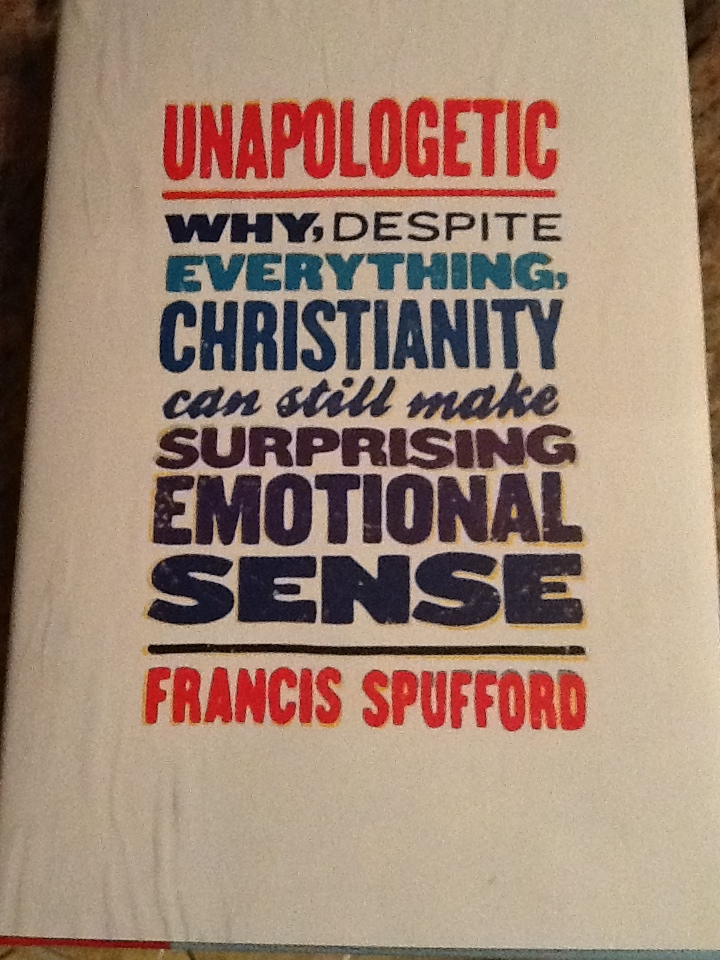
  • A non-review of Francis Spufford’s “Unapologetic”

    You should read this book.
    You should read this book.

    I’ve been having trouble thinking of something to say about Francis Spufford’s Unapologetic other than “I really, really liked it.” It’s not like any other “religious” book I can remember reading. The closest analogue I can think of are the books of Anne Lamott, who similarly writes about the life of faith with brutal honesty and without pious cant.

    The title has a double meaning: Spufford is unapologetic in the sense of not being ashamed of his belief, but he’s also not offering an “apology” in the sense of a reasoned defense of Christianity–the sort of thing you get from some of C. S. Lewis’s writings (not to mention those of many lesser lights). Spufford’s goal is to describe from the inside what being a Christian is like–specifically for an educated Englishman living in a “post-Christian” culture–and to show that it can be an emotionally authentic response to the human condition. He doesn’t shy away from the blots on Christianity’s historical record or from tough theological questions (he’s particularly unsparing of pat theological answers in his discussion of theodicy). But he is equally insistent that, at its best, it provides a compelling response to what he cheekily calls the “human propensity to fuck things up” (or “HPtFtU” as he abbreviates it).

    Spufford is a more-or-less orthodox Christian, but he considers theological propositions as secondary to a the immediate emotional experience of faith (not unlike an earlier defender of religion against its cultured despisers). This is the experience of a graceful presence underlying the messy and ambiguous world of daily life–a presence we encounter most piercingly when we have screwed things up. Christians see this presence most fully manifested in Jesus, and Spufford’s retelling of the gospel story provides the theological heart of the book. He recognizes that his faith is a wager–he doesn’t know whether or not there is a God, but “neither does Richard bloody Dawkins.”

    What I do know is that, when I am lucky, when I have paid attention, when for once I have hushed my noise for a little while, it can feel as if there is one. And so it makes emotional sense to proceed as if He’s there; to dare the conditional. And not timid death-fearing emotional sense, or cowering craven master-seeking sense, or censorious holier-than-thou sense, either. Hopeful sense. Realistic sense. Battered-about-but-still-trying sense. The sense recommended by our awkward sky fairy, who says: don’t be careful. Don’t be surprised by any human cruelty. But don’t be afraid. Far more can be mended than you know. (p. 220)

    Despite the intellectual bravado of some professional Christians, I think that this is far closer to how many of us–particularly those of us in the West–experience our faith. But nothing I can write will do justice to Spufford’s book; I encourage you to read it for yourself.

  • Francis Spufford on the “gnostic Jesus”

    The Jesus of the orthodox story treats people with deep attention even when angry. [The gnostic] Jesus zaps people with his divine superpowers if they irritate him. Orthodox Jesus says that everyone needs the love of God, and God loves everyone. Their Jesus has an inner circle you can be admitted to if you collect enough crisp packets. Orthodox Jesus likes wine, parties, and grilled fish for breakfast. Their Jesus thinks that human flesh and its appetites are icky. Orthodox Jesus is disconcertingly unbothered about sexuality, and conducts his own sexual life, if he has one, off the page. Their Jesus can generate women to have sex with out of his own ribs, in a way that suggests the author had trouble talking to girls. Orthodox Jesus says, “Don’t be afraid. I am always with you.” The Jesus of these documents says, “Advance, Blue Adept, to the 17th Jade Portal of Amazingness, and give the secret signal with your thumbs.” Read much of the rival “gospels,” and you start to think that the Church Fathers who decided what went into the New Testament had one of the easiest editorial jobs on record. It wasn’t a question of suppression or exclusion, so much as of seeing what did and didn’t belong inside the bounds of a basically coherent story.

    –Francis Spufford, Unapologetic, pp. 153-4