Category: Theology & Faith

  • The end of the world as we know it (1)

    One of the things I usually make a point of doing when we’re visiting my wife’s family in Indianapolis is to make a trip to Half Price Books. They sell both used books and remainders, and it’s rare that I can’t find some gem at low, low prices. (They also have HPB in California, but I’ve yet to find any on the East Coast.)

    Anyway, when we were there over Christmas I picked up John Polkinghorne’s The God of Hope and the End of the World. Polkinghorne, the physicist-turned-Anglican-priest, offers here a meditation on eschatology in the 21st century. His contention in that Christian theologians need to engage with the picture of the destiny of the cosmos delivered to us by modern science: cosmologists are able to predict with a high degree of certainty that the physical universe will end either in a “big crunch” — where the universe essentially collapses back in on itself — or will continue to spread out indefinitely with entropy reigning as everything decays to low grade radiation. More locally, our sun will eventually go nova and destroy any remaining life on earth (assuming we have avoided man-made or biological catastrophes).

    Even though these events are billions of years in the future, Polkinghorne says, they still call into question the ultimate significance of the universe. If the cosmos is destined to end with a bang or a whimper, it seems to threaten a kind of ultimate meaninglessness. The human prospect will long since have come to an end and all that will be left is, at best, a dead cosmos. Polkinghorne thinks that a credible eschatology has to take this rather bleak picture seriously. His book is part-apologetic, part-constructive theology as he attempts to show how sense can be made of the biblical promise that God will create a “new heaven and new earth.” In this series of posts I’ll highlight some of what I think are Polkinghorne’s more fruitful and intriguing reflections.

  • Faith and factuality

    The question of the Virgin Birth is just one example of a broader issue in the life of faith: how much of what the Bible describes as historical fact must be accurate for faith to have solid foundations? There are two extreme positions that can, and have been, taken here. One insists on literal factuality for all the details of the biblical stories; this is the position of modern Fundamentalism. The other minimizes, to the point of vanishing, any necessary historical basis for Christian faith. This approach is sometimes associated with Rudolf Bultmann and theological liberalism, but can also sometimes be seen in certain “postmodern” versions of Christian theology, such as versions of narrative theology. Liberals tend toward the position that the essential truths of faith are “existential” truths or truths of “meaning” not tied to particular historical events. Post-liberals, by contrast, are more likely to take refuge in a kind of epistemic relativism that disarms the claims of critical historical investigation, making faith immune to historical disconfirmation. (Though moderate post-liberals like William Placher tend to affirm the factuality of the key historical events of at least the New Testament, even while admitting that these can’t be shown to be factual by appealing to “neutral” historical research.)

    At the risk of taking a milquetoast middle of the road approach, I think that Christian faith has to take the results of historical investigation into account and to allow, in principle, that they can affect the content of religious belief. Christianity, maybe most of all major religions, can’t jettison its historical foundation. Its essential claim is that God enters history to share the condition of creaturely life and to redeem it. This can’t be reduced to an ahistorical truth: the Christian claim is that because of the life, death, and resurrection of Jesus our situation before God and with each other has been decisively changed. This is a variation on Paul’s dictum that “if Christ has not been raised … your faith is in vain.” Meaning can’t be separated from the question of factuality.

    This doesn’t mean that all the apparent factual claims of the Bible are essential to the faith, though. At one end of the spectrum you have apparently trivial details like where a certain conversation Jesus had took place or the particular wording of the Sermon on the Mount. At the other you have the essential facts about Jesus’ life: that he lived, had a certain character, that his preaching involved particular key themes, etc., not to mention the central mystery of his death and resurrection. In the middle, it seems to me, you have a variety of apparent historical facts whose significance isn’t immediately apparent: I would include here at least some of Jesus’ miracles, particular sayings, and so on. Is it essential to believe, for instance, that Jesus healed people and performed exorcisms? Is it essential to believe he performed all the specific healings and exorcisms mentioned in the New Testament? I’d probably put the Virgin Birth in this middle category somewhere.

    Now, as someone with a generally conservative disposition, I’m happy to give the benefit of the doubt to many of the borderline events in the Bible. And philosophically, I’m unconvinced that there’s any metaphysical barrier to God performing miracles. On the other hand, I’m pretty sure that the monologues in John’s gospel aren’t verbatim accounts of things the historical Jesus actually said (though I think John may well be more historically reliable than many critics allow). But if I became convinced that the central facts of the story of Jesus were untrue, then I would have to regard Christian faith as radically undermined.

    The resurrection, obviously, is a special case. On the one hand it is rightly regarded as the foundation of Christian faith: if there had been no resurrection, then the early Jesus movement was based on some kind of delusion. And yet, it’s impossible to simply see the resurrection as a historical event like others whose occurrence can be demonstrated by means of the canons of historical research. Some Christian apologists seem to have taken just this view, but I think they underestimate the degree to which different people’s background philosophical and theological beliefs affect their estimation of the likelihood of particular events, especially something as extraordinary as the resurrection. The resurrection is an event of history, but it isn’t “historical” in the sense of being explicable as part of a normal series of cause and effect.

    So, Christians are in a rather precarious position in that their faith is dependent on the reality of something historical which can’t be verified by historical investigation. Kierkegaard identified this dilemma as the requirement of absolute commitment in the face of objective uncertainty. It seems that we are guilty of not apportioning our beliefs and actions to the evidence. This isn’t quite the same thing as saying that faith is “belief without evidence,” as some critics of religious belief have it. But there is a degree of commitment that goes beyond the evidence. The way I think of this, which may well be defective, is that we walk in the direction that our best judgment points us, but in the hope that over time (and ultimately beyond this life) the reality that we commit ourselves to will reveal itself to us with greater clarity. Our commitment to the road of faith is a function of a confluence of influences: the historical record, but also value judgments, aesthetic considerations, and philosophical reasoning. This is a highly personal act that can’t be reduced to any kind of algorithmic process, but which presupposes a reality independent of ourselves to which we respond.
  • The Virgin Birth: does it matter?

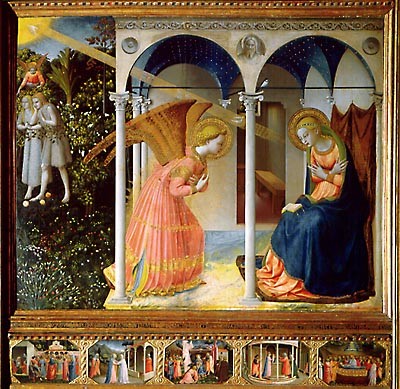
    Via Graham, here’s an article in the (UK) Spectator that asked a variety of public figures whether or not they believe in the Virgin Birth. The answers range from the thoughtful, to the flippant, to the downright idiotic (someone named Colin Wilson declaims that “you’ll have some difficulty finding any educated person who believes in it, or any other Christian dogma”). I find the idea of treating the Virgin Birth as a discrete item proposed for our belief rather strange. For starters, if you can swallow the camel of the Resurrection, why strain at the gnat of the Virgin Birth? But more importantly, the Virgin Birth only really has significance in the context of the entire Christian story.

    I think Rowan Williams is right when he says that the “recognition of the uniqueness and newness of Jesus is a recognition of the absolute freedom of God to break the chains of cause and effect that lock us into our sins and failures; the virginal conception is an outward sign of this divine freedom to make new beginnings.” That is to say, the Virgin Birth has a certain “fittingness.” On the other hand, I don’t think that the Virgin Birth is on a par with the Resurrection as an essential item of Christian belief: I think that Christians believe in the Virgin Birth because they believe in Christ’s divinity, not vice versa. And the Resurrection acts as a warrant for belief in Christ’s divinity in a way that the Virgin Birth generally doesn’t, not least because the latter wasn’t a public event in the usual sense.

    In his response, Keith Ward says that the “point of the Biblical account is to see Jesus as the start of a new creation, fulfilling the hopes of the ‘virgin Israel’.” And this doesn’t stand or fall with the literal truth of the Virgin Birth. That said, though, it is virtually the unanimous view of the tradition (I’m not aware of any significant dissenting tradition in the early church), and only a dogmatic refusal to concede the possibility of miracles can rule it out entirely. But the reasons for believing in the Virgin Birth aren’t, in my view, independent of the reasons for affirming the unique identity of Jesus.

  • Catch-all blog update post

    Sorry about the dearth of posting: a confluence of extreme busyness, travel, and computer issues has put a cramp in my blogging style. Although one perk is that I’ve been forced to detach from the various teapot-sized tempests roilling the blogosphere, which is always a benefit of time away from the computer.

    We’re in Indiana visiting the in-laws for Christmas and enjoying some much needed R&R. In my free time I’ve been reading C. S. Lewis’ The Discarded Image: An Introduction to Medieval and Renaissance Literature. This is a marvelous little book in which Lewis delineates the worldview that underlies the literature of the Middle Ages and Renaissance. Sometimes I think Lewis has (unjustly) gotten a reputation as something of a shallow thinker due to the popular nature of his apologetic works, but in this book his incredible erudition is on full display, though tempered with his lucid and homey prose.

    I’ve also been catching up on my magazine reading – that is, actual printed matter. I recommend this interesting article from Mother Jones on Ron Paul’s online following, as well as the current issue’s cover story (which doesn’t seem to be online yet), detailing the environmental consequences of China’s amazing economic growth. Also, Jason Byassee has a provocative article on pornography and “Christian eroticism” in this month’s First Things that is well worth checking out.

    Other highlights of the trip so far: hanging out with my brother-in-law and his wife, a trip to Half Price Books (yea!), and taking in a civic theatre production of Joseph and the Amazing Technocolor Dreamcoat.

    Here’s a few of the notable links I’ve come across in the last couple of days: Wayne Pacelle on Animals and Christmas, two posts on Scripture from Elizaphanian, Marvin writes about stopping global warming, Christopher on recapturing the joy of the Christmas message and Christian living and in defense of the Virgin Birth.

    I’m looking forward to the Christ Mass tonight at a local Anglo-Catholic Episcopal parish – the same one we attended last year. For a variety of reasons I’ve had a hard time getting into the spirit this Christmas, but I think this will be just what the doctor ordered.

    I hope everyone reading has a verry Merry Christmas!

  • God’s Own Party

    Harold Meyerson points out one of the problems with touting your party or candidacy as the “Christian” one: people will start to actually expect you to live up to the standards of Jesus.

    Here’s something C. S. Lewis had to say about the idea of a “Christian” political party:

    It is not reasonable to suppose that such a Christian Party will acquire new powers of leavening the infidel organization to which it is attached. Why should it? Whatever it calls itself, it will represent, not Christendom, but a part of Christendom. The principle which divides it from its brethren and unites it to its political allies will not be theological. It will have no authority to speak for Christianity; it will have no more power than the political skill of its members gives it to control the behaviour of its unbelieving allies. But there will be a real, and most disastrous, novelty. It will be not simply a part of Christendom, but a part claiming to be the whole. By the mere act of calling itself the Christian Party it implicitly accuses all Christians who do not join it of apostasy and betrayal. It will be exposed, in an aggravated degree, to that temptation which the Devil spares none of us at any time–the temptation of claiming for our favourite opinions that kind an degree of certainty and authority which really belongs only to our Faith. The danger of mistaking our merely natural, though perhaps legitimate, enthusiasms for holy zeal, is always great. Can any more fatal expedient be devised for increasing it than that of dubbing a small band of Fascists, Communists, or Democrats ‘the Christian Party’? The demon inherent in every party is at all times ready enough to disguise himself as the Holy Ghost; the formation of a Christian Party means handing over to him the most efficient make-up we can find. And when once the disguise has succeeded, his commands will presently be taken to abrogate all moral laws and to justify whatever the unbelieving allies of the ‘Christian’ Party wish to do. If ever Christian men can be brought to think treachery and murder the lawful means of establishing the régime they desire, and faked trials, religious persecution and organized hooliganism the lawful means of maintaining it, it will, surely, be by just such a process as this. The history of the late medieval pseudo-Crusader, or the Covenanters, of the Orangemen, should be remembered. On those who add ‘Thus said the Lord’ to their merely human utterances descends the doom of conscience which seems clearer and clearer the more it is loaded with sin.

    All this comes from pretending that God has spoken when He has not spoken. He will not settle the two brothers’ inheritance: ‘Who made Me a judge or a divider over you?’ By the natural light He has shown us what means are lawful: to find out which one is eficacious He has given us brains. The rest He has left to us. (from “Meditation on the Third Commandment,” in God In the Dock)

  • Illiberal atheists?

    Damon Linker – who attacked the Religious Right in his book Theoconsaccuses the “new atheists” of promoting an illiberal version of atheism that seeks to stamp out religious belief, rather than a more generous-minded skepticism that Linker thinks goes better with liberal politics.

    To the extent that atheism advocates using state power and other quasi-official channels of influence to eradicate religious belief it is being illiberal and would likely invite a similarly illiberal religious backlash. Fortunately, the prospects of, say, public schools announcing the “death” of God, as Linker claims Sam Harris wants, are nil. But to the extent that atheists simply want to convince people of the folly of their ways through appeals to reasoned argument they aren’t doing anything illiberal per se. Linker seems to think that being liberal means keeping ones deepest convictions as mere opinions in some ethereal private sphere. But this is a bad caricature of liberalism: a more robust version invites competing doctrines to duke it out in the public sphere, while creating a space where fragile individuals are protected from the excessive certainties of others.

  • “Commitment with detachment”

    I liked this article by Carol Zaleski at The Christian Century. She adivses Christians to take a political “time out,” not in abstaining from politics, but in abstaining from obsessing about politics:

    Some conservative wags like to say that liberalism is a mental disease. But the mental disease isn’t liberalism and it isn’t conservatism, it’s utopianism—and the antidote to utopianism isn’t apathy, it is faith. Faith isn’t a fix. Faith isn’t sure it knows in detail what’s wrong with the world and how to repair it. Faith doesn’t drive out doubt, but sits well with honest ignorance as to how hunger and poverty and war and prejudice and disease and ugliness and cultural degeneration are to be eliminated. Faith helps us discern the limits of what any government can do to improve our fallen human condition. Faith saves us from being seduced by totalistic schemes. Faith teaches us that politics is not the only way to serve the polis. Faith enables us to make prudential judgments with a measure of humility and realistic sangfroid. The bumper sticker says, “If you’re not outraged, you’re not paying attention,” but faith would have us pay attention to the world’s ills without outrage. Commitment with detachment—it’s a difficult road to walk, and only faith makes it possible.

  • Items of interest from the JLE

    From this month’s Journal of Lutheran Ethics:

    First, an article on the neglect of spiritual practices in the ELCA and how, if the church doesn’t offer pathways to intimacy with God, people will seek them elsewhere. I can definitely sympathize with this. As someone who (re)turned to Christian faith as a young(ish) adult I was expecting to be drilled in spiritual practices and other ways of deepening my faith. Alas, most of the ELCA congregations I’ve been associated with have scarcely mentioned, much less inculcated, intentional pracitces of prayer, fasting, spiritual reading and so on.

    That’s one of the reasons I’ll always be grateful for my year attending the Church of the Advent, an Anglo-Catholic parish in the Episcopal Diocese of Massachusetts. I was exposed to a very sacramental form of worship, the daily office, the rosary, and other spiritual practices that I’ve gotten a lot of nourishment from. Maybe as part of our full communion agreement with the Episcopal Church Lutherans will learn to be freer with borrowing form our Episcopal brothers and sisters, who seem to have preserved more of our shared heritage in this area from the undivided Western church.

    Second, a response from the former chaplain of Gustavus Adolphus College to Carl Braaten’s article from a couple of months ago (which I blogged on at some length here). This piece seeks to go beyond natural law and understand marriage, not as something that exists for purposes extrinsic to itself, but as a community that exists for its own sake as a union of two selves. I’m not sure I’d go all the way with this: doesn’t marriage, in Christian perspective, exist at least in part for the upbuilding of the community? But this in no way excludes same-sex couples, who manifestly do contribute to the upbuilding of communities of which they’re a part. If Christian marriage is partly a “school of sanctification,” then it seems to me that a Christian marriage should have an inherently “ecstatic” direction – the partners should be drawn out of themselves and give life to others. And this can have a variety of manifestations, including (but not limited to) the begetting and rearing of children.