Category: Theology & Faith

  • Fides et ratio redux

    Marvin has another post on the “faith and/versus reason” theme.

    One thing I’d want to add to the mix–in partial agreement with a comment Eric made at Marvin’s–is that there is a variety of understandings of “reason,” only some of which are inimical to faith.

    For instance, a lot of debates about faith and reason seem to employ a rather dessicated, positivist notion of reason that is more characteristic of the 19th and early 20th centuries than the high tide of Enlightenment, not to mention pre-modern notions of reason (Platonist, e.g.). Most philosophers have long abandoned such notions, which seemed to exclude God or the transcendent pretty much by definition.

  • “Truly this man was God’s son!”: A meditation on the centurion’s confession

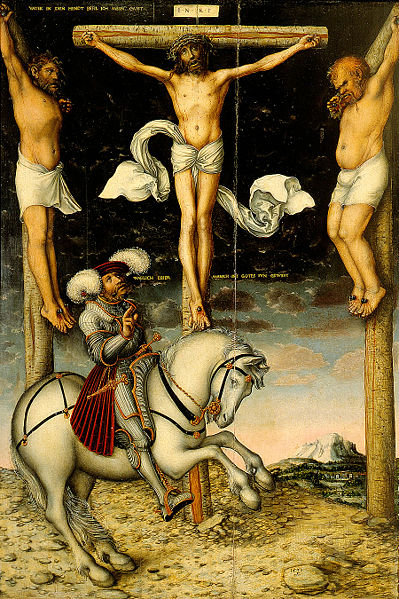
    Here’s the text of a meditation I gave at a mid-week Lenten service at our church. We were instructed to select a piece of art depicting a scene from the last week of Jesus’ life according to Mark’s gospel. I selected the confession of the centurion at the foot of the cross and used a painting by Lucas Cranach the Elder as my visual aid. I don’t know that this sort of thing is my forte, particularly, but here it is for what it’s worth:

    399px-cranach_calvary2

    This image is by Lucas Cranach the Elder, a friend of Luther and one of the most important painters of the early Lutheran movement; the scene is the centurion’s confession recorded in Mark 15:39:

    “Now when the centurion, who stood facing him, saw that in this way he breathed his last, he said, ‘Truly this man was God’s Son!’”

    This event was beloved by early Protestants because it vividly illustrates the doctrine of salvation by faith alone. But it also highlights that the object of that faith – Christ crucified – doesn’t match our expectations about the divine.

    Scholars tell us that Mark’s gospel emphasizes the “messianic secret” of Jesus’ identity. Throughout most of the gospel, supernatural powers – a heavenly voice and demons that Jesus exorcises – are the only ones who recognize who he truly is. The first human to confess Jesus’ identity is Peter (Mk. 8:27-30), but Peter “stumbles” when Jesus tries to explain to the disciples that “the Son of Man must suffer, be rejected, and killed and rise again.

    The disciples – Peter in particular – can’t accept this. They want – and expect – Jesus to restore Israel, kick out the Romans, and give them, his loyal followers, positions of power and influence in the new administration. They also, understandably, don’t want their friend and teacher – who they love – to die a cruel and painful death.

    Mark’s gospel, maybe more than any of the others, turns this expectation about what the Messiah – and what God – is like upside down. That the Messiah should be rejected and killed, dying the death of an outcast and criminal, certainly flies in the face of how we expect God’s power to show itself.

    I know that what I usually want from God is for him to engineer things in my life to go better for me.

    I pray for things to happen – for a job interview to go well, or for a medical test to turn out a certain way, or generally for things to go the way I want them to. These aren’t all self-centered prayers either; often I’m praying for others. But the sentiment is similar – I want God to do something, to make things happen (according to how I judge best).

    In this sense I guess I’m like the disciples. I have very specific expectations about how I think God should behave.

    And maybe being in the “in group,” one of the religious, upstanding citizens can blind us to a true perception of God. Certainly the gospels suggest this over and over. The “righteous” – the scribes and Pharisees – are often the ones least likely to catch on to what Jesus is about. In a similar way, we think we know what God is about, and maybe this can make us blind to surprises that God has in store.

    Which might give us a clue why the only human confession of Jesus’ status as Son of God should come from the centurion at the foot of the cross. From a gentile, a Roman soldier, part of the occupying power. Not someone we would expect to be clued in to the ultimate truth about Jesus and God.

    But this agent of the occupying power, a man who has probably inflicted both large and small cruelties on the subject population, perceived in Jesus’ suffering and death something divine. Is this, in part, because, as an “outsider” he didn’t have expectations, but was able to be open to what God was revealing?

    Mark’s passion story is un-nerving. We don’t get the serene, “in charge” Jesus of John’s gospel, or even the forgiving Jesus of Luke. Instead we get Jesus’ stark cry of terror and abandonment: “My God, my God, why have you forsaken me?”

    So why here, of all places, does the centurion – and Mark – locate something divine? Why in the cross rather than, say, the resurrection?

    Many theologians have wrestled with the meaning of the cross, but one of the most profound is the suggestion that in Jesus’ death, God himself enters into the suffering, pain, and darkness of the human condition–and the entire creation. In the cross, God reveals something about the very nature of divinity as self-giving love and presence in suffering, instead of an all-powerful king. This isn’t what we would expect God to be like at all!

    Martin Luther suggested that faith is basically a stance of receiving: only when we recognize that we don’t have anything to offer–that we’re “beggars”–can we receive the gift God wants to give us. He also believed that our knowledge of God must begin at the cross–a God revealed as humble and suffering rather than by power and glory.

    Is the centurion able to see God’s power “made perfect in weakness” as Paul would say, because as an outsider he isn’t full of expectations?

    Maybe to receive this mystery–the mystery of the crucified messiah–we need to let go of some of our expectations and let God surprise us.

    Amen.

  • God and the multiverse

    An interesting article dealing with how some religious believers are dealing with the idea, suggested from some of the more speculative corners of contemporary physics, that our universe is simply one part of a vast “multiverse” (via the First Things blog, I think).

    Among other things, the multiverse hypothesis seems to pose a challenge for certain modern arguments for God’s existence based on the so-called anthropic principle, or the appearance that the universe is fine-tuned for the existence of life. People have suggested that the fact of this apparent fine-tuning provides some kind of evidence for the existence of God (how much evidence is a matter of debate). However, if our universe is just one among many (an infinity?) of actualized universes, then the emergence of a universe fit for life would seem to be inevitalbe, or at least much more likely, without requiring an intelligent creator.

    Interestingly, Arthur Peacocke addressed this issue some time ago in his Gifford Lecutres, collected in his book Theology for a Scientific Age. He argues that you can avoid the multiverse problem by simply taking the argument up a level:

    Whatever the constraints and framework of meta-laws and supervening relations that operate in bringing about the range constituting any postulated ensemble of universes, they must be of such a kind as to enable in one of the universes (this one) the combination of parameters, fundamental constants, etc., to be such that living organisms, including ourselves, could come into existence in some corner of it. So, on this argument, it is as significant that the ensemble of universes should be of such a kind that persons have emerged as it would be if ours were the only universe. (p. 109)

    One possible problem I see with Peacocke’s argument is that it seems to depend on whether the multiverse is supposed to contain all merely physical possibilities (i.e. those universes which are possible given the fundamental “constraints and framework” of the multiverse, whatever those are) or to exhaust all logically possible universes. If the latter, then there would be no anthropic coincidence to explain, since the actually existing multiverse would be the only one that could exist. On the other hand, I’m not sure how we could establish that whatever fundamental framework governs the multiverse was the only logically possible (i.e., self-consistent) one. I also don’t have a terribly firm grasp on what motivates the entire theory, so I’m not sure how its proponents would characterize it given these options.

  • Faith and reason: a follow up

    Jeremy and Jonathan both provided some good comments and helpful pushback on this post. Here are some follow-up thoughts:

    I don’t think I was very successful at doing this, but it’s important to avoid positing a simplistic dichotomy between a monolithic reason and an equally homogeneous “faith” or “revelation.” I don’t assume that we can start from the “view from nowhere.” All our thought about the world is conditioned by our linguistic, social, historical, etc. location.

    But at the same time, it’s oversimplified to suggest that we start from within a single tradition. The truth is, we each belong to multiple overlapping traditions. Or to put it another way, multiple traditions jostle within each one of us. We don’t have a systematic framework that neatly relates and orders the various parts of our knowledge. I’m both a Christian and an heir of Enlightenment humanism and liberalism, among other things.

    What I think we need to do is bring different “truths” — or more precisely parts of the truth — into dialogue with each other. Christian theological claims can shed light on other areas of our knowledge. At the same time, knowledge gained from other sources can challenge our theology.

    I take it that within theology there are more and less central truths. If I had to summarize the Christian vision it would be something like this: A loving creator God who made all that is, who became incarnate, suffered, died and rose again to reconcile us to God, and who is leading all of creation toward fulfillment and redemption. How we come to believe in this central vision is a complex issue, but I take it that it can’t be “proven” in a strict sense, even if reasons for it can be given. (Including “modest” natural theology, various historical considerations, etc.)

    Beyond this there are various theological formulations that attempt to explicate and draw implications from this central vision. But the further you get from the “core” the more contestable your claims become. For instance, Christians have often drawn implications from their theological vision about ethics or the ordering of society which have been challenged from secular sources or from other faith traditions (as well as from dissident voices within the churches). This has led, in at least some cases, to a revision of theology but not an abandonment of the core vision.

    Our traditions or narratives never really manage to encompass all of reality. There’s always some recalcitrant material left over that resists absorption (or abstraction) into any single conceptual scheme or narrative. That’s one of the dangers I see with Lindbeck’s view – that the “biblical narrative” (which is already something of an artifiicial construct) can absorb the world. This also tends to reinforce a highly conservative view of the church, since it’s assumed that the church has the truth and merely needs to bring its light to others.

    The inevitable deficiency in any of our traditions/narratives/conceptual maps is an implication of what I take to be the key insight of a realist view of truth: that the world exists and has a determinate character independent of what we think about it. This ought to induce humility and openness to truth from other quarters.

    For this reason, we have to attend to those other narratives or traditions that people use to understand and navigate the world. Not because there’s some “neutral” ground on which to stand and from which we can dispassionately evaluate them, but because by sympathetically entering into other understandings of the world, we can widen our perspective and gain a distance on our own tradition and its flaws and blind spots. Ideally, this leads to a more complete and truer understanding of reality.

    So, I do need to backpedal somewhat on my previous post. It’s not that I think theological claims need to be tested by “reason,” understood as some context-free God’s-eye way of viewing the world, but that theological claims need to be tested by and brought into dialogue with other truth-claims: the findings of the physical, life, and social sciences, the convictions of movements for social justice, the tenets of other religions, people’s lived experiences, etc. etc. This will be a highly unsystematic process by which we try to bring these various claims into relation and see what kind of light they shed on each other.

    To take one, fairly obvious example, for most of Christian history it was thought, more or less, that the opening chapters of Genesis provided something like a literal account of the creation of the world. This didn’t stop Christians from finding all manner of spiritual value in the rich symbolism of the story, but it was probably assumed that there was a bedrock of historicity. The advent of evolutionary theory, as we well know, called this into question and prompted a re-thinking, at least in many quarters. There are now many Christians, including most of the major denominations, who think that evolutionary theory is compatible with the essentials of Christian faith. The vision was not abandoned, but some of its penumbras were revised or rejected.

    This doesn’t mean that theology will always “lose” in the sense of having its tenets overturned; sometimes we may find that theological claims hold up quite well, other times we may find that they need to be modified or are enriched by this encounter, and other times that they shed considerable new understanding on other areas of our knowledge or practice. I don’t think we can prescribe, a priori, what the outcome will be for any particular case. As Christians, though, we can be confident entering into that encounter, knowing that all truth is God’s truth.

  • Jesus Prayer rosary

    As usual, my high aspirations for improving my practice of prayer during Lent haven’t lived up to expectations. Still, I recently picked up a small book called The Jesus Prayer Rosary by the late Fr. Michael Cleary that I’ve found helpful. Although I’m wary of mix ‘n’ match approaches to spirituality, I love the Rosary and have been looking for a way to incorporate the Jesus Prayer into my practice of prayer beyond ad hoc use.

    In the introduction, Fr. Cleary says that he wrote the book precisely to bring these two traditions together. Particularly, he suggests it could be a valuable way of praying for those who are uncomfortable with the Marian prayers of the traditional Rosary.

    The Jesus Prayer Rosary differs from the traditional (Dominican) Rosary in about the ways you might expect. Here’s what the structure looks like:

    On the cross pray

    We adore you, O Christ, and we bless you.
    Because by your holy cross you have redeemed the world.

    and

    Holy God,
    Holy and strong,
    Holy and immortal,
    have mercy on us.

    On the first large bead pray the Lord’s Prayer.

    On the three small beads pray

    i. Jesus, son of David, have pity on me.
    ii. You are the Christ, the Son of the living God.
    iii. Jesus Christ is Lord,
    to the glory of God the Father.

    Pray the “Glory Be…”

    On the next large bead, announce the first “mystery” or meditation and pray the Lord’s Prayer.

    On each of the ten following beads, pray the Jesus Prayer.

    After the ten beads, pray the “Glory Be…” and the Concluding prayer for each meditation.

    Repeat this for all five decades; on the centerpiece pray one of the concluding prayers (the book offers several, including the traditional Lukan canticles).

    Pray a concluding prayer.

    The book offers a series of Bible passages and meditations that correspond roughly to the traditional mysteries of the Rosary: Meditations on the Infancy of Jesus, the Ministry of Jesus, the Passion, and “Life in Christ,” which include the Resurrection, Ascension, the Holy Spirit, the Life of Grace, and the New Jerusalem.

    For each meditation, the book also provides a clause to use when praying the Jesus Prayer that resonates with the mystery being meditated upon. For instance, the form of the Jesus Prayer given for the meditation on the Last Supper is

    Jesus, Lord and Christ,
    Son and Word of the Living God:
    you make yourself known to us
    in the breaking of bread,
    have mercy (on us).

    I’ve only used this form of the Rosary a couple of times so far, but I’ve found it to be conducive to focusing on Jesus, which, according to Fr. Cleary, is what it’s for:

    Concentrating on Jesus is what this little work is all about. It’s also a pretty good description of what Christians down the years have called ‘meditation.’ Making it possible for people to do so, in a way that changes their lives, what they have called ‘evangelization.’ At least, that’s the way St. Paul understood it: ‘For it is the God who said, “Let light shine out of darkness”, who has shone in our hearts to give the light of the knowledge of the glory of God in the face of Christ’ (2 Corinthians 4.6). And, staying focused on that face is for the apostle the secret of the spiritual life, the life of transforming grace: ‘beholding the glory of the Lord, [we] are being changed into his likeness from one degree of glory to another; for this comes from the Lord who is the Spirit’ (2 Corinthians 3.18). (pp. ix-x)

    I’m not at all uncomfortable with the traditional Marian rosary, but I do find this version’s more intensely Christological focus to be appealing.

  • The bar of reason

    Marvin reproduced an interesting quote from Gary Dorrien, who Google tells me is the Reinhold Niebuhr Professor of Social Ethics at Union Theological Seminary and Professor of Religion at Columbia University. Dorrien offers this definition of a “liberal approach” to theology:

    theology should be based on reason and critically interpreted religious experience, not external authority.

    Depending on how key terms are defined, I’d have to say that I substantially agree with this.

    A lot of 20th-century philosophy has taught us to mistrust appeals to “reason” and “experience;” we’re told that they are context-dependent, tradition-bound, and embedded in language.

    While these are all valid points, the core of what Dorrien seems to be saying here seems unaffected.

    “Reason” doesn’t need to be thought of as a kind of infallible algorithm for arriving at truth, or a means of shedding all our existing cultural, social, and linguistic baggage to adopt a “God’s-eye” view of the world (or, a “view from nowhere” as Thomas Nagel puts it).

    And “experience” is not an unmediated apprehension of the world as it is independent of any subjective elements we may bring to bear.

    I doubt Dorrien, or any critical thinker in the 21st century, would be making such claims.

    But there are understandings of reason and experience that are relevant to testing theological (or any other) truth claims.

    When some claim is presented for my belief, one thing I might do is consider whether it is reasonable and whether it comports with my experience. “Reasonable” here needn’t refer to some a priori faculty for arriving at truth; it can simply mean that it is consistent with the laws of logic and with widely-known and accepted truths about the world.

    And experience is just that: my experience and other people’s experience of the world, including their moral, aesthetic, and religious experience.

    None of this implies that reason and experience are “context independent” or “universal” in allowing an unbiased view of the world. That’s precisely why we, if we’re smart, try to widen our base of knowledge and experience by learning from other people, other cultures, traditions, religions, etc. This is a very piecemeal, fallibilist view of knowledge, but I don’t know what the alternative is.

    In deciding whether to accept a certain truth claim, then, what other procedure can we follow but to see how it fits with what we know about the world and what we’ve experienced of it?

    Thus any theological truth claim presented for our belief that 1. conflicts with the laws of logic (e.g., is self-contradictory); 2. contradicts well-established truths about the world (e.g., well-established findings of science); or 3. can’t make sense of widespread moral, aesthetic, or religious experience is, I submit and other things being equal, likely to be false.

    On the positive side, if such a claim supports or is entailed by other knowledge, or provides a more satisfying interpretation of our experience than the alternatives, or sheds new light on previously accepted truths we have good reason (again, other things being equal) to adopt it.

    Of course, as Dorrien mentions, many religions have been uncomfortable with this piecemeal sifting and testing of truth and have looked for refuge in an appeal to authority, such as the authority of an infallible church, pope, Bible, tradition or whatever.

    But as we well know, this just pushes the question back a step: How am I decide which authority is infallible? The only way I can do it is by appealing to my (fallible!) knowledge (or reason) and experience. What other way is there? Again, not an abstract, universal knowledge and experience, but the knowledge and experience I actually have, supplemented by that of others.

    I don’t know if this makes me a “liberal” or not by Dorrien’s standards; I consider the actual content of my theological beliefs to be fairly traditional. Food for thought.

    More from Dorrien on liberal theology here.

  • Rawls’ religious roots

    Try saying that three times fast! And then read this fascinating essay about philosopher John Rawls’ early writings on religion (which have only recently been published) and the continuity of the ideas expressed there with his mature (and completely secular) political philosophy. It seems that the young Rawls considered entering the priesthood of the Episcopal Church but lost his faith after his experiences in World War II. Nevertheless, based on this piece, Rawls’ earlier religious ideas–particularly a highly personalistic and communitarian understanding of Christian ethics–continued to have analogues in his later work.

  • Salvation as re-creation

    A while back I wrote about Keith Ward’s understanding of how God acts in the world, as explained in his book Divine Action. Later in the book he devotes a chapter to the incarnation and offers an interpretation of the atonement.

    Ward argues that Jesus is properly seen as the enfleshment or embodiment of God’s love in the world: “We could then say that Jesus does not only tell us about God’s love or even act out a living parable for the distinctly existing love of God. Rather, what he enacts is the very love of God itself, as embodied in this human world and for us human beings” (p. 215).

    However, the incarnation isn’t merely a lesson for us about God’s love. Or, as Ward says, “Jesus is not primarily an educator, who comes to bring salvation through knowledge, achieved in meditation and stilling of the individual mind” (p. 221). The human predicament is more radical than that; “liberal” views of the atonement sometimes suggest that we merely need to see or learn what is right in order to do it, reducing Jesus to an example:

    [God] cannot simply forgive us, while we are unable to turn from our sin — that would be to say that it does not really matter; that somehow we can love God while at the same time continuing to hate him! He cannot compel us to love him, without depriving us of the very freedom that has cost so much to give us. He cannot leave us in sin; for then his purpose in creation would be wholly frustrated. (p. 222)

    What Ward suggests instead is that the atonement is God re-creating human nature in the life of Jesus. In his life, obedience, suffering, passion, and death, Jesus re-enacts the drama of human life, but in a way that maintains its complete fidelity to God. He thus overcomes sin and the powers of evil to which we are subject. “He takes human nature through the valley of the shadow of death, and in him alone that nature is not corrupted. He is the one victor over evil; he has experienced the worst it can do, and he has overcome it” (p. 223).

    In Jesus, human nature is made anew, the way God intends for it to be. But how can this help us? Aren’t we still stuck in our sins? Ward contends that Christ can help us because he “has remade human nature in an uncorrupted form” (p. 223), and we can participate in that nature, or have it implanted in us through faith in Christ. As St. Paul puts it, “if anyone is in Christ, there is a new creation” (cf. 2 Cor. 5:17).

    The nature that we receive from God is a human nature that has triumphed over evil, that has entered into its heart and remained uncorrupted. It is not that God simply creates a new nature in us when we ask; but that he takes human nature to himself, shows what it truly is and what its destiny is and shows that it cannot be conquered by sin and death. That is the nature he places within us, making us sons by adoption, taken into the life of the Son.

    This view seems to have more affinities with the Eastern Christian emphasis on theosis than certain substitutionary or retributive models of the atonement promulgated in the West, particularly since the Reformation.

    The idea of incarnation and atonement as “new creation” also, it can be argued, fits better with an evolutionary view of the development of human nature. As I’ve argued before, evolution seems to require that we relinquish the supposition that humans existed in a state of perfect righteousness prior to a historical fall. Instead, we might propose that early human beings were immature and undeveloped and that God intended them to develop along a certain path. Instead, however, humanity has taken the wrong road, preferring self-seeking, greed, and violence to altruism, justice and peace. Atonement, then, consists of setting us back on the right road.

    A view very much like this has been developed by George L. Murphy, a physicist and Lutheran pastor, in two interesting articles: “Roads to Paradise and Perdition: Christ, Evolution, and Original Sin” and “Chiasmic Cosmology and Atonement.” Regarding atonement as re-creation, Murphy writes:

    Atonement comes about because God in Christ actually does something to change the status of people who “were dead through the trespasses and sins” (Eph. 2:1). To be effective, the work of Christ must overcome the nothingness toward which sinful humanity is headed, a nothingness which through its terror of death, guilt, and meaninglessness, it already experiences. If humanity and (as we shall note later) the rest of creation with it, is on the way to nothingness, God must re-create from nothing. Atonement parallels in a precise way the divine creatio ex nihilo.

    One benefit of this view of salvation is that it puts humanity back in its proper place as part of creation. As Lutheran “eco” theologian H. Paul Santmire says:

    The Incarnation of the Word is thus a response to the human condition of alienation from God and rebellion against God, as well as a divine cosmic unfolding intended to move the whole of cosmic history into its final stage. United with the Word made flesh, human creatures are restored to their proper place in the unfolding history of God with the cosmos. Thus united, they are free to live in peace with one another and with all other creatures, according to the imperfect canon’s of creation’s goodness. Now they may live as an exemplary human community, as a city set upon a hill, whose light cannot be hidden. (Nature Reborn: The Ecological and Cosmic Promise of Christian Theology, p. 60)

    I think this provides one fruitful way for thinking about salvation that avoids some of the pitfalls of both a forensic and merely exemplarist view and has a certain consonance with an evolutionary picture of the world.