Category: Theology & Faith

  • Supernatural mind: C.S. Lewis’s Miracles revisited

    C.S. Lewis In A Field

    I first read C.S. Lewis’s Miracles about 25 years ago, and it was pretty important in what eventually turned out to be my return to Christian faith, over a decade after I had abandoned belief in God when I was a teenager. It helped me see that Christianity–and not just a watered-down, “modernist” version–might actually be true.

    Re-reading it recently I was struck once again by Lewis’s insistence that “reason,” by which he means our faculty for logical argument, as well as for apprehending moral truth, must be “supernatural,” at least relatively speaking. That is, if our reasoning is determined by natural laws of cause and effect (the great, interlocking system of nature, as he puts it), then what justification do we have for thinking that it provides a path to truth? Only if our thinking can, at least sometimes, operate according to the laws of logic rather than the laws of cause and effect can we trust our ability to apprehend truth. Human minds–or at least this part of them–must originate outside the natural world. This is the key argument Lewis makes to show that naturalism is untenable (and a pivotal part of his argument that miracles are at least possible).

    However, Lewis’s rather stark version of dualism won’t sit well with everyone. On his view, human spirits (i.e., the part of us capable of abstract thought and moral reasoning) are “inserted” as it were at various points in the natural wold, rather than being fully integrated parts of that world. That’s his point after all–if they were fully part of the natural world we would have no grounds for trust in our reasoning capabilities. But this seems a bit inelegant and ad hoc. Wouldn’t it be better to have an account that showed human minds were fully a part of nature but didn’t undermine the trustworthiness of reason? Even from a theistic perspective, wouldn’t it be more fitting and elegant to say that God created a universe that was capable of producing reasoning creatures from within?

    These considerations are at least part of the motivation for various forms of “non-reductive” materialism or “emergentism” that have become popular among some Christian theologians and philosophers. On this kind of view, mind and consciousness develop from material organisms once they attain a certain level of complexity, but once they do, these emergent minds achieve a degree of independence.* For example, non-reductive materialists and “emergentists” maintain that causality between the mental and the physical goes both ways: our thoughts and decisions really affect the way things go, and this is not reducible to or fully explicable in terms of their physical substratum. If I get up from my desk and walk across the street to the local coffee shop, this action has to be explained (at least in part) by the contents of my thoughts. The mental has a genuine (if partial) causal independence and operates according to its own laws and principles. Another way of making the point is to say that purposive actions–doing things for a reason–are an inelminable feature of reality.

    This type of view is attractive because it allows us to see human beings as part of the natural world without sacrificing the reality and efficacy of consciousness (as so-called “reductive” or “eliminative” forms of materialism do). From a Christian point of view, it seems to offer a more holistic account of the human person which is (so it is claimed) more consistent with the way human beings are portrayed in the Bible. This contrasts with forms of dualism that characterize the soul as wholly distinct from, or even trapped in, the body–a position sometimes associated (not entirely fairly) with Plato and Descartes. It also can seem more consonant with the resurrection of the body as the main focus of our hope for life after death.

    This account isn’t without its own problems though. One is that it’s not obvious that the notion of an “emergent mind” is any clearer than full-blown dualism. It’s very hard to show how mind and consciousness could “emerge” from a particular arrangement of matter since the properties of matter and mind seem so different. This is, after all, one of the main motivations for both dualism and non-reductive materialism: thoughts have properties–they’re non-spatial, essentially private, are about something–that matter doesn’t, so they can’t be the same thing.

    It’s true that there are examples of new properties that seem to “emerge” from a particular organization of matter (e.g., the liquidity of water is not a property of hydrogen or oxygen molecules, but rather comes into existence when they are brought into a particular relation); but there aren’t other obvious examples of a non-physical property or capability emerging from the physical. This raises the question of whether “emergence” is a solution to the problem or just another way of stating it.

    There are many varieties of dualism and materialism, as well as other views like “dual-aspect monism,” and I haven’t kept up with recent philosophy of mind (not to mention other relevant fields like neuroscience!) enough to have a strong view about which one’s right (if any). I do think there are good arguments that mind and consciousness can’t be reduced to or simply identified with physical events, even though there’s obviously a strong correlation between them. What I’m less certain of is whether this means we have “souls” that are somehow independently created substances or whether our minds are functions or products of our brains and bodies that nevertheless posses a certain degree of independence.

    I still think Lewis’s argument is convincing against a strict, reductive form of naturalism. If our minds really are nothing but brain events operating according to the inexorable laws of cause and effect, then it is hard to see how we could trust them as tools for acquiring true beliefs or maintain that we (sometimes) act for reasons rather than because of blind causality. But it may be that this insight can be accommodated by a more generous form of physicalism or non-dualism.

    This might seem to undermine Lewis’s argument for theism and miracles, but a modified version of the case is possible. The fact that our universe is of the sort that can give rise to rational beings capable of moral choice could be taken to indicate that our cosmos is the result of a purposive mind. Because they are irreducible features of the world, mind, purpose and values, it could be argued, are clues to the character of the universe as a whole. They needn’t be seen as interruptions into the normal course of nature to be suggestive of nature’s origin–and of its potential openness to divine action.

    ————————————————————————–

    *Lewis focused the parts of the human mind responsible for abstract reasoning (e.g., logical inference) and the apprehension of moral truth. He allowed that the “lower” parts of our minds (sensations, emotions, etc.) were fully natural. Other philosophers and theologians focus more on the problem of consciousness itself and its irreducibility to the physical. However, one thing all parties would agree to I think is that our minds have a certain causal independence: i.e., what we think or decide can make a difference to the course of events in a way that isn’t entirely determined by or a by-product of physical causes.

  • Some good theology & religion books I read in 2018

    julian_img

    Someday–maybe next year, who knows?–I’ll get better about tracking the books I read. Heaven knows I read a bunch of stuff this year that has already slipped into the misty recesses of memory. But until I get my act together, I thought I’d note some books in theology and religion that stuck with me for various reasons:

    • Keith Ward, The Christian Idea of God (I blogged about it here.)
    • Amy Plantinga Pauw, Church in Ordinary Time (more here)
    • Ben Dueholm, Sacred Signposts (more here)
    • Elizabeth Johnson, Creation and the Cross
    • Kira Schlesinger, Pro-Choice and Christian
    • Peter Schmiechen, Saving Power 
    • Charles Marsh, Strange Glory: A Life of Dietrich Bonhoeffer (technically a biography, but rich with theological significance)
    • Julian of Norwich, Revelations of Divine Love

    While I don’t necessarily agree with all their conclusions, these were all books that made me think more deeply about various aspects of the Christian faith–the doctrine of God (Ward, Johnson), the mission of the church (Plantinga Pauw, Dueholm, Marsh), the nature of salvation (Johnson, Schmiechen) and ethics (Johnson, Schlesinger, Marsh).

    Julian is, of course, in a category all her own. Not only did I re-read her Revelations, but I got to lead a discussion of her work at my church back in February, which was well received if I do say so myself. I currently have Denys Turner’s book on Julian on my shelf, which I’m hoping to get to sometime in the new year. And I may even remember something about it by next December.


  • Church for earthlings

    keep-calm-its-ordinary-time-600x675Ecclesiology–or the doctrine of the church–is, for my money, one of the duller areas of Christian theology. And when it doesn’t engage in excessive navel-gazing and hair-splitting, it can be a source of ugly Christian triumphalism. In recent theology, the “ecclesial turn” has often upheld “the church” as the cure-all for everything that supposedly ails the modern world: excessive individualism, consumerism, hedonism, capitalism run amok, violence, racism, etc.

    This almost invariably results in an overly idealized picture of the church as an entity that is somehow immune from the sin and messiness of the world (and generally requires ignoring large swaths of Christian history). As the Lutheran theologian Gerhard Forde once wrote, “the constant temptation of the church is always to transgress, to overstep, the eschatological limit, to set itself up as a kind of ‘eschatological vestibule,’ . . . perhaps even as a sacrament itself, a diachronic extension of the incarnation in time. When that occurs, there is a blurring of the eschatological limit, a tendency to vest its purely human offices with sacramental, indeed divine, sanction” (A More Radical Gospel, p. 186).

    Reformed theologian Amy Plantinga Pauw’s recent book Church in Ordinary Time: A Wisdom Ecclesiology, offers a refreshing alternative to this eschatological inflation of the church. “Ordinary time” here has a double significance–it refers both to the parts of the church year between the great feasts where we focus on day-by-day growth in our discipleship and to living in the midst of the “ordinary” hum-drum activities of daily life. The church doesn’t exist outside of ordinary life, in some special sacred space; it exists in the flow of ordinary life and in the time between the Resurrection of Jesus and God’s consummation of all things, when it is “not yet clear what we shall become.”

    “Wisdom ecclesiology” reflects Plantinga Pauw’s reliance on the wisdom books of the Bible (particularly Ecclesiastes, Proverbs, Job, and the Psalms) to highlight God’s creative ordering of the world and the church’s status as a creature, with all that implies about its finitude and potential for sin.

    This focus on creation allows Plantinga Pauw to zoom out to see how ultimately small the church is within the grand sweep of creation. Our ever-increasing awareness of the unimaginably vast scale of creation, both in time in space, should–but largely hasn’t–result in a “Copernican revolution” in theology’s understanding of God’s purposes. It’s virtually impossible to imagine that the church is the center of God’s purpose for the universe when there are manifold other human communities and countless other living species on our planet alone (which is itself an infinitesimally small part of creation).

    Plantinga Pauw develops this theme in a trinitarian key, showing how Christians can live in the world, while recognizing that our ultimate destiny is beyond it, in the fullness of God’s kingdom. Jesus identifies fully with human life, while also being the one “in whom all things hold together.” This provides the basis for a creation-centered cosmic Christology that nonetheless is attuned to the fleshly details of everyday life. And the Spirit empowers us to live in the world rather than fleeing it, embracing the longing, giving, suffering and rejoicing that characterize the rhythms of human life and of the church calendar. We do this as finite creatures, living in a particular time and place, not as those with a God’s-eye view of creation’s purpose.

    A “wisdom ecclesiology” is about living wisely as earthlings–creatures with a limited allotment in space and time, seeking to care for those whom God has placed in front of us and for this planet we share with God’s other beloved creatures. The church doesn’t have a privileged vantage point from which it can run the world; neither is it a realm of purity where Christians can escape from the world. It is one created community among many, shaped by social, economic, political and cultural forces. But it is called to join with others in caring for God’s creation, witnessing to the self-giving love of God revealed in Israel’s story and preeminently in Jesus.

    ADDENDUM: I just wanted to add that Plantinga Pauw’s book pairs well with Ben Dueholm’s Sacred Signposts, another excellent recent book on the role of the church in our contemporary context. As Dueholm shows, the practices of the church are constituted by “brutally ordinary things” that can become, through the power of the Spirit, sites of God’s grace, even in the absence of some churchly master plan for saving the world.

  • The victory of suffering love

    I recently came across this very good talk from Metropolitan Kallistos Ware (author of several well-regarded books on Eastern Orthodox Christianity) on “Salvation in Christ.”

    Metropolitan Ware offers four questions we should ask when evaluating any proposed model of the Atonement:

    1. Does it envisage a change in God or us?
    2. Does it separate Christ from the Father?
    3. Does it isolate the Cross from the Incarnation and Resurrection?
    4. Does it presuppose an objective or subjective understanding of Christ’s work?

    The first question is intended to rule out theories that seem to imply that God’s essential nature or attitude toward us is somehow changed by the work of Christ (e.g., from wrathful to gracious), rather than changing our situation before God. The second is aimed at models that portray the wills or dispositions of Christ and God the Father as somehow at odds. The third emphasizes the importance of holding together Christ’s entire life, death and resurrection as a salvific event. And the fourth posits that the Atonement accomplishes an objective change in the human situation, not just a subjective effect on our attitudes (though the objective and subjective are both essential aspects: As St. Augustine said, “God created us without us: but he did not will to save us without us”).

    Met. Ware then considers multiple motifs/models/theories and evaluates how they stack up against these questions. These include what he calls the “exchange” model (the patristic theme that Christ became human so that we might partake of the divine nature), as well as ransom, sacrifice, Christus Victor and loving example. He has something good to say about most of them, suitably understood, although he is highly critical of variants of the sacrificial motif which imply that Jesus’ death was necessary to appease or propitiate God’s wrath. It’s scriptural to say that Christ was our substitute. The emphasis, however, should be that Christ does something for us that we could not do for ourselves. Christ dies “on our behalf” rather than “instead of us.”

    One interesting move he makes is to defend the “exemplarist” account (often associated with Peter Abelard) against the common criticism that it reduces Christ to an inspiring example we have to imitate under our own power. This seems to minimize the extent to which sin holds us in its grip and our need of a savior, threatening to lapse into Pelagianism.

    However, Ware contends that “this criticism totally misconceives the scope and dynamism of love. “Love is an objective, creative power, not just a subjective feeling. It doesn’t simply provide an example to imitate, but actually effects a change in us. “By loving others we change them. We change the world in which they live.” Thus the subjective/objective distinction collapses.

    He goes on to suggest that the example model can be fruitfully combined with a “demilitarized” version of Christus Victor. Christ’s victory is precisely the victory of suffering love. In living out his life of self-giving love, obedient to the point of death, Jesus is unbowed by the powers that would seek to turn him to hatred and violence. In the Resurrection, the power of this love is revealed as stronger than all the “dark things” in the universe and in us. This act of creative, transforming love sets us free.

    I haven’t remotely done justice here to the wisdom and warmth in this presentation. If you’re interested in this topic, it’s well worth your time.


  • Affirming Christianity is authentic Christianity

    Xtian rainbow

    Since this is pride month and since many Christian churches continue to wrestle with the full inclusion of LGBTQ people (including the denomination I’m currently affiliated with), maybe it’s worth sharing how I came to arrive at an “open and affirming” stance. Though I’m probably an atypical case in a lot of ways.

    I don’t remember ever thinking there was anything particularly wrong with same-sex relationships. I spent my teenage years and early adulthood as an atheist or agnostic (depending on the week), so I had no conscious attachment to the traditional Christian teaching on homosexuality. Plus, I had gay and bi friends in high school and college (issues of gender identity weren’t really on my radar at the time, I must say) and I generally moved in artsy, bookish “alternative” circles that were pretty accepting of gay people.

    When I returned to Christianity in my 20s, however, I wasn’t entirely sure how to reconcile this accepting stance with my new faith. In my mind, the Christians who most vocally embraced same-sex relationships were ultra-liberals of the Bishop Spong mold who seemed to water down the truth-claims of Christianity beyond recognition. The faith I had embraced was of a more traditional bent, and I wasn’t sure if it could accommodate a revisionist stance on sexuality. What if the ultra-conservatives and ultra-liberals were both right that orthodox Christianity and conservative sexual ethics were a package deal?

    Over time I was introduced to other voices who affirmed same-sex relationships and more-or-less traditional views of, say, the Incarnation and the Trinity (to name a few: Marilyn McCord Adams, Keith Ward, Gareth Moore, Rowan Williams, Eugene Rogers and James Alison, among many others). Just as important, I belonged to LGBTQ-affirming congregations and worshiped, studied and served with LGBTQ Christians whose lives unmistakably exhibited the fruits of the Spirit. These weren’t secular humanists in flimsy religious clothing, but devout Christians who saw no tension between loving Jesus and being in a committed same-sex relationship or having a non-traditional gender identity.

    At this point I’m comfortable with what I’ve learned to call “open orthodoxy”: a commitment to the gospel of God’s universal love revealed in Jesus alongside an openness to changing our understanding of the world as we acquire knowledge from multiple sources. Science, philosophy, personal experience, social movements and other religious traditions can all add to our understanding of God’s creation and what it means to live a life of love and service.

    I’m not trying to pat myself on the back for my broad-mindedness. These were largely intellectual hang-ups for me and I had very little skin in the game. I’m lucky there were LGBTQ Christians in my life who patiently pointed me to resources for a better understanding and who also lived out their own faith so authentically. (Some of them were regular commenters on this blog back in the day.) My experience has taught me that LGBTQ-affirming Christianity isn’t some counterfeit or watered-down version of the faith. I’ve come to view the affirming stance as not just permitted but mandated by an authentic understanding of the gospel of Jesus.

  • The Luther Option

    If instead, we renew our focus on those Christian possessions shared by all, perhaps we can understand both our faith and each other better. If we turn away from an ideal Christianity to be preserved from the past or built in the future, perhaps we can see better what Christians already do and already are. Because despite our apparent marginalization, our differences and manifest failures, what happens among Christians can still astonish. (Ben Dueholm, Sacred Signposts, p. 8)

    It’s widely recognized that we (that is, we in Europe and North America) live in a “post-Christian” culture. Whether this is a cause for celebration or despair varies from person to person, but few deny that the social and cultural hegemony once enjoyed by Christianity has waned in the last several decades (or centuries). Religious ideas and ways of interpreting the world no longer guide how increasing numbers of people go about their lives.

    This situation has called forth a variety of proposed responses. The Christian right, or parts of it, wants to reestablish a form of Christian hegemony. Failed Alabama Senate candidate and notorious creep Roy Moore is a particularly egregious example of this. Some Catholic thinkers broadly grouped under the label “integralism” and the “Radical Orthodoxy” school of John Milbank seem to pine for a resurrected Christendom, with the church wielding a form of secular authority. Meanwhile, the “Benedict Option” advocated by conservative writer Rod Dreher and others envisions small, self-enclosed communities adhering to a strict doctrinal and moral orthodoxy—arks where the faithful can weather the flood of secular nihilism and the supposed impending collapse of liberal institutions.

    More moderate and progressive Christians seem to be less certain how to respond to this situation. Some welcome the decline of Christian-tinged civil religion, embracing pluralism and hoping that it will make space for a more authentic form of Christian discipleship. On the other hand, the evacuation of shared religious values from the public square can allow the brutal values of nationalism, self-interest, and greed to run rampant.

    In this kind of fractured environment, with Christians splintered into various theo-political tribes, is there anything that unites us, much less allows us to make a coherent public witness?

    Ben Dueholm, Lutheran pastor and writer, thinks that the Christian churches already have much of what they need in the form of the historic practices that have shaped them for centuries. In his new book* Sacred Signposts he describes how these historic Christian practices can speak to our post-Christian world. They do this by subverting the rules of the workaday world and constituting sites of grace where we glimpse God’s kingdom.

    He organizes these practices around Martin Luther’s seven “marks” of the church: the Holy Scriptures, baptism, the Lord’s Supper, forgiveness of sins, the ordained ministry, prayer and worship, and “the cross.” Dueholm says that these practices are in a sense more fundamental than our beliefs or theology; if anything, theology often arises to rationalize the practices. One can hold fast to a practice without necessarily have a firm grip on one’s beliefs or theology.

    He dedicates a chapter to each practice, showing how they can interrupt the world’s rules and expectations and create new possibilities for graced living. In baptism, for example, people of all races and classes are adopted into a single family (“neither Greek nor Jew, male nor female, slave nor free . . . “). This challenges the prevalent human tendency to erect and maintain, often violently, barriers between groups of people. This takes on a particular urgency in this era of populist nationalism with its walls and bans.

    The Lord’s Supper enacts the permeability of our selves and our bodies as we receive Jesus in the humble elements of bread and wine and join with others in this holy communion. In prayer and worship we offer our time and ourselves to God in a way that challenges both the cult of work and the commodified “leisure” of an uber-capitalist economy.

    In each case, the order of grace interrupts, subverts, and resists the order of cause and effect, reward and merit, mine and thine:

    In these brutally ordinary things, we encounter grace as the fundamental fact of existence. They are not mysterious additions to a clear and visible universe, but a hard-as-nails foundation for experiencing the universe’s fathomless mysteries. (pp. 168-9)

    Following Luther, Dueholm sees suffering and the cross not just as one piece of the church’s theology, but as the through-line of its entire existence. This is Luther’s “theology of the cross,” which is not a theory of atonement, but an entire approach to theology and the Christian life. The Christian God is revealed most definitively in a despised man hanging on a cross. This means that God is not revealed in worldly success or power, but in suffering, both the suffering of Jesus and with all those who suffer.

    Unfortunately, our culture is obsessed with avoiding suffering, and we’re all-too willing to inflict it on others if that’s what it seems to take to preserve our way of life. And Christians are no exception: white, Western Christians in particular have inflicted massive suffering under the very sign that should call us to solidarity with those who suffer. This is nothing short of a betrayal of the revelation of God’s solidarity and empathy with creaturely suffering.

    Whether we want it or not, whether we embrace it, flee it, or try somehow to do both, the cross is at the heart of the church’s presence in the world, and at the heart of its politics. . . . It asks, ‘Does this embrace the God revealed in suffering in shame, or does it deny that God for the sake of something else?’ (pp. 159-60)

    Following its Lord, the church lives under a sign of weakness. Its stakes its life not on its power or prestige, its patronage of the arts or the refined aesthetics of its worship, its dazzling intellectual accomplishments, or the impeccable morality of its members. It lives instead by these holy possessions, these very ordinary things, where grace is both hidden and revealed, like God on a cross. To embrace these possessions doesn’t require “a systematic program of reform, a transcendence of Christian divisions, or a perfect rejoinder to the criticisms leveled by the ideologues of a secular age. . . . They are simply there, as gifts for the whole church, and through the church to the whole world” (p. 167).

    Because Dueholm focuses on things that Christians already have in common, it might be easy to miss the radicalism of what he’s proposing. Christians have tried different ways to shore up our position in this post-Christian age. We’ve tried slick management techniques, cultural isolationism, cultural capitulation, moral and theological polemics, and enlisting the coercive arm of the state. Dueholm is asking Christians to trust in the grace of the Holy Spirit and the gifts she’s already given to the church. This isn’t exactly a recipe, in worldly terms, for institutional success!  But Dueholm (and Luther) would be the first to point out that, in this case, faithfulness matters more than success. Ultimately, the word and practices of grace are all the church has, but they might be the one thing the world really needs.


    *Ben is a Twitter friend and all-around mensch, and the good people at Eerdmans kindly sent me an advanced reading copy of the book at his request. In this post I will refer to Ben as “Dueholm” even though that seems weirdly formal.

  • Will Marcion win after all?

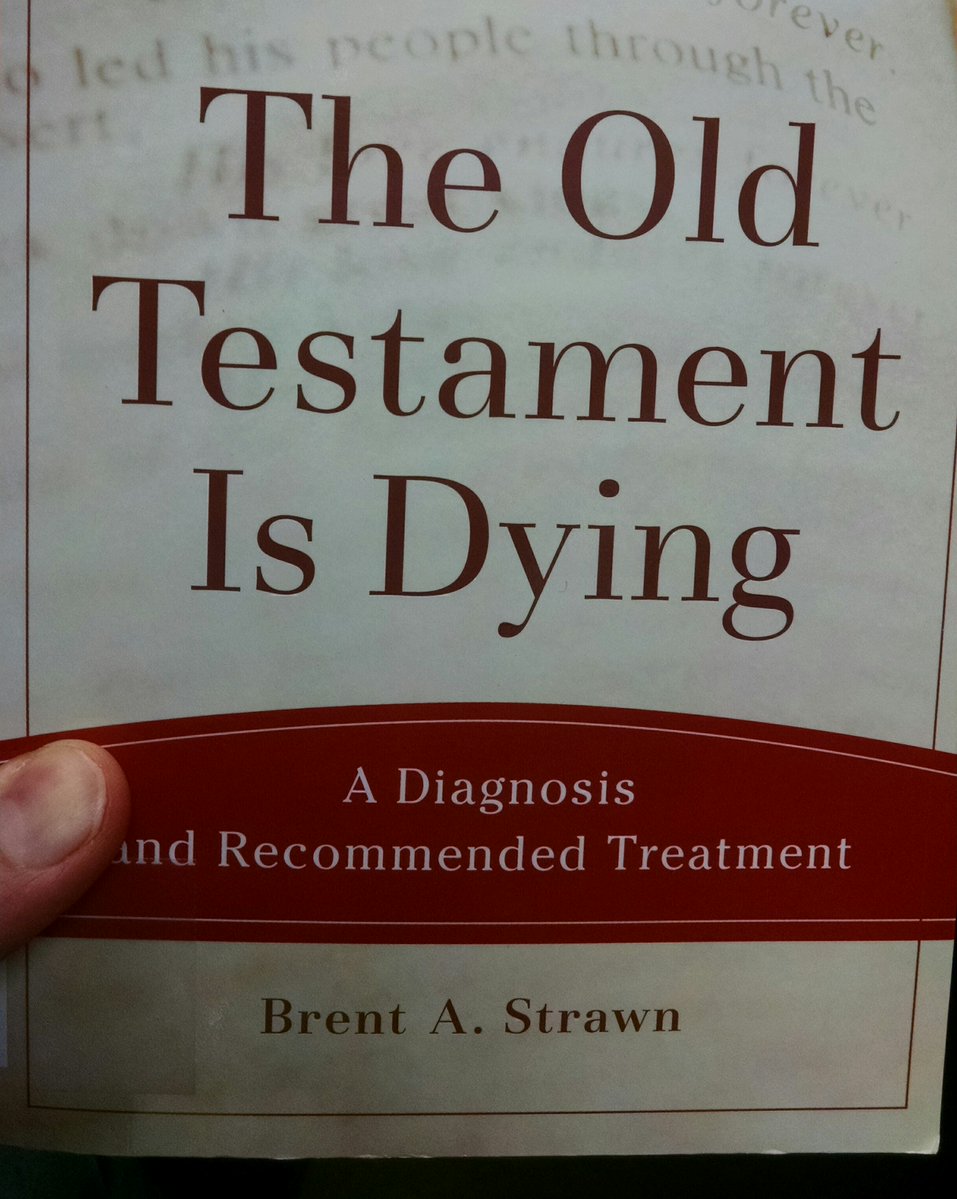
    In his recent book, Princeton Theological Seminary professor Brent Strawn makes a provocative case that American Christians are in imminent danger of losing the Old Testament—and with it much of the substance of Christian faith.

    DCIVX5cVYAA_IAA

    Drawing on a variety of evidence, Strawn argues that we are losing our grip on the OT, making it comparable to a dying language. He bases this assessment on a survey of religious knowledge among Americans, an analysis of the content of sermons, the way the OT is used (or not used) in hymns, and the highly selective use of the OT in the Revised Common Lectionary. He concludes that American Christians’ faith is subsisting on a drastically reduced diet of Old Testament.

    Pursuing the linguistic analogy, Strawn looks at how the use of the OT has become “pidginized”—its use reduced to a very basic, almost childlike “vocabulary”—and “creolized”—combined with other non- or sub-biblical thought-and-language systems. In the first category, he places the New Atheists, who often deploy a radically simplistic understanding of the OT in their anti-religious polemics. They latch on to a few verses supposedly demonstrating the barbarism and immorality of the OT and its God, without bothering to understand the Bible in all its complexity. The problem is that many Christians are themselves so devoid of OT knowledge that they can’t muster effective counterarguments.

    Strawn sees this “pidginized” understanding of the OT at the root of the church’s recurrent temptation toward the arch-heresy of Marcionism. This is what’s going on, for example, whenever the “mean,” “violent,” “judgmental” God of the OT is contrasted with the “tolerant,” “peaceful,” “forgiving” God of the New Testament/Jesus. The historical Marcion took this to an extreme in seeking to explicitly excise the OT (and large swaths of the NT) from the Christian canon, but neo-Mariconite tendencies are at work whenever (often well meaning) preachers, teachers, liturgists, etc. elide or omit large portions of the OT (especially certain “troubling” passages) from Christian worship, prayer, and education.

    Like nature, theology abhors a vacuum, and the void left by the OT is often filled by sub-biblical and sub-Christian discourse. This is what Strawn compares to linguistic creolization—snippets of biblical language are grafted on to another belief-system, resulting in new hybrid that loses much of the biblical substance. The clearest example of this is the prosperity gospel, where quasi-biblical language and concepts are combined with a debased form of American civil religion/capitalist ideology.

    Languages can die, and once they do, it’s extremely difficult to resurrect them. As with a dying language, American churches suffer from too few competent “speakers” of the OT, and based on the available evidence they aren’t doing a great job of making new ones. If use of the OT continues to trail off, it may soon be too late to bring it back.

    Strawn’s key point of emphasis is that Christianity without the Old Testament front and center isn’t actually Christianity at all, at least not in any sense continuous with the earliest Christians. Many Christians have too long treated the OT as, at best, a kind of preface to the NT. Strawn maintains, on the contrary, that it has its own integrity for preaching, teaching and worship, and–considering that it makes up the vast majority of Christian scripture–that it should have a much more prominent place than it currently does. (To show how this can be done, he highlights Walter Brueggemann as one of the few prominent Christian theologian/preachers who draws primarily on the OT.)

    As a course of treatment for this perhaps fatally ill patient, Strawn offers several recommendations: lectionaries that make fuller use of the OT in worship; sermons that preach primarily, if not exclusively, from the OT readings; hymns that reflect a more biblically-based theology, as well as more use of the psalms in corporate worship; and Christian education that teaches people to wrestle with the full scope of scripture.

    One may wonder if even these steps would be enough if the problem is as deep and pervasive as Strawn has suggested. Of course, even these actions are unlikely to be taken if church leaders aren’t facing up to the problem. Getting Strawn’s book into as many of their hands as possible would be a good start. The Old Testament may be dying, but we have it on good authority that God is in the resurrection business.

  • Tom Paine, the Bible and wealth redistribution

    I enjoyed this interview with University of Michigan philosopher Elizabeth Anderson on how workplaces effectively function as “private governments” and often act in oppressive ways toward their employees.

    That lead me to this piece by Anderson on Tom Paine as an early theorist of social insurance. In Anderson’s telling, Paine was responding to revolutionary communist tendencies among some thinkers during the French Revolution.

    thomas_paine2
    The other Tom of the American (and French) Revolutions

    He wanted to save private property and freedom while also solving the problem of poverty–the very problem that led some to embrace extreme, communist-like solutions.

    Paine called for an unconditional grant of money to every citizen funded by a tax on inherited wealth. For him, this was not a matter of charity, but of justice. The earth belongs to everyone, so others are owed some recompense when property is appropriated to private ownership. Moreover, the value of any property depends in part on the social context in which it exists.

    As Paine says in his essay Agrarian Justice:

    I have made the calculations stated in this plan, upon what is called personal, as well as upon landed property. The reason for making it upon land is already explained; and the reason for taking personal property into the calculation is equally well founded though on a different principle. Land, as before said, is the free gift of the Creator in common to the human race. Personal property is the effect of society; and it is as impossible for an individual to acquire personal property without the aid of society, as it is for him to make land originally.

    Separate an individual from society, and give him an island or a continent to possess, and he cannot acquire personal property. He cannot be rich. So inseparably are the means connected with the end, in all cases, that where the former do not exist the latter cannot be obtained. All accumulation, therefore, of personal property, beyond what a man’s own hands produce, is derived to him by living in society; and he owes on every principle of justice, of gratitude, and of civilization, a part of that accumulation back again to society from whence the whole came.

    What’s striking about Paine’s arguments is that they anticipate later views about the common origin of property, the social construction of property rights and the duties that property owners have to society. (Recall President Obama’s (in)famous “You didn’t build that” line.)

    I’d add that, although Paine was a Quaker-turned-Deist, this general viewpoint is consonant with Christian thinking. The earth does not belong to any human being; rather we hold it in trust as a gift of the creator. The Old Testament sets explicit limits on property rights, calling for fields and vineyards to be left fallow for the poor (and animals!) to eat from every seventh year (see Exodus 23). There is no absolute right of private property in the Bible, and any scheme of property rights that leaves some in destitution is unjustifiable and wicked.

    With the Fourth of July upon us, remember that Paine is at the very least an honorary founding father, so wealth redistribution turns out to be as American as apple pie. 😉


  • Is penal substitutionary atonement the “core of Christian faith”?

    According to this story, the Southern Baptist Convention just adopted a resolution at its annual meeting that re-affirms the “penal substitutionary” view of Christ’s atonement. This was passed in the face of what were described as efforts to “weaken” the doctrine.

    Proponents of PSA (penal substitutionary atonement)–the view that on the cross God was punishing Jesus for the sins of humanity–often treat it as a non-negotiable part of Christian orthodoxy, or even the very essence of the gospel. In the article linked above, Southern Baptists seminary professor Owen Strachan is quoted as saying the following:

    “there is no doctrine in Scripture more beautiful than penal substitutionary atonement,” yet at the same time “there may be no doctrine that is more hated.”

    “In truth, the biblical precept that the righteous must die for the wicked is the very core of Christian faith,” Strachan said. “Here is the burning heart of divine love: Christ crucified for us.”

    By contrast, many other Christians will concede that PSA, properly interpreted, is one legitimate way of understanding the cross, but they insist that it be balanced with other images and motifs from Scripture, such as Christus Victor or moral exemplar.

    What strikes me about the pro-PSA side of the argument is that, considering it’s supposed to constitute the essence of the gospel, it actually takes a lot of work to make the case for it from the Bible. Nowhere does Scripture unambiguously say in so many words that God was punishing Jesus on the cross. (And there’s a lot of biblical data that would tell against such an interpretation.) The case for PSA draws primarily on certain passages in Paul, Isaiah, and a few other books, and these passages admit of various interpretations. One has to stretch, to say the least, to find PSA in the gospels and much of the rest of the NT. Even Paul himself draws on a variety of images for understanding what happened on the cross, not all of them obviously consistent with PSA. It seems to me that the death-and-resurrection of Jesus is, for the NT authors, a cosmic event that eludes neat and tidy explanations in the form of any particular theory.

    You’d think that if the atonement, understood specifically in a penal, substitutionary sense, really was the “core of Christian faith” it would be presented a bit more unambiguously in the Bible. Given that it isn’t, it seems a sin against Christian liberty to require people to believe in PSA. As the Anglican articles of religion put it,

    HOLY Scripture containeth all things necessary to salvation: whatsoever is not read therein, nor may be proved thereby, is not to be required of any man, that it should be believed as an article of the Faith, or be thought requisite or necessary to salvation. (Article VI)

    It’s a little ironic that a free-church tradition like the SBC would try to impose more restrictions on Christian consciences than the church of Queen Elizabeth.

  • The cross as sacrifice and gift

    In chapter two of his small book on the cross and resurrection (see previous post), Rowan Williams turns to the important but controversial motif of sacrifice. He reminds us that “there is no pre-cross Christianity”: that is, as far as we can tell, there was no early Christianity that regarded Jesus only as a charismatic teacher or preacher. “[N]ot only is the first stratum, the base level, of Christianity preoccupied with the cross: it seems to take it for granted that the cross is for something, that it is an event whose effect is liberation given to us from beyond ourselves” (p. 21).

    When the New Testament writers (and other early Christians) looked for ways to understand the death of Jesus, they reached, almost instinctively it seems, for the language of sacrifice. “If a first-century Jew had heard the statement that Jesus died ‘for many’, for the forgiveness of sins, his or her first thought would probably have been to connect it with the system of sacrifice: when blood is shed in God’s presence, for the sake of God’s people, for the avoiding of disaster, that is sacrifice” (p. 22). It is sacrifice—moreso than the image of the law court—that provides the controlling metaphor for much of the NT’s reflection on Jesus’ crucifixion.

    Williams briefly reviews the multiple forms and purposes of sacrifice in the Old Testament, including peace offerings, guilt sacrifices, the great Day of Atonement where the sins of the whole people are laid on the scapegoat, and the daily offering of the lamb in the Temple sanctuary. There is no one, simple understanding of sacrifice that we can put into a “tidy system,” but

    in the middle of it all is one great governing idea: a sacrifice is something given over into the hands of God, most dramatically when it is a life given over with the shedding of blood. That gift of life or blood somehow casts a veil over the sin or sickness or disorder of an individual or of a whole people. (p. 24)

    The sacrifice, on this understanding, both turns away God’s anger and establishes (or re-establishes) a covenant between God and God’s people. “The gift is given, and in response God not only covers over sin but promises actively to be there for his people” (p. 25).

    Turning to the NT, Williams highlights several key passages that use sacrificial language referring back to the OT. Paul uses language of “propitiation,” as well as the metaphors of the scapegoat and the covenant established in blood, when writing about what God has accomplished in Jesus. The Letter to the Hebrews sees Jesus’ sacrifice as analogous to, but surpassing, the Day of Atonement ritual, while both 1 Peter and Revelation reflect on Jesus as the sacrificial lamb.

    This does not, Williams notes, add up to a “precise theory of Christ’s death as a sacrifice,” but we can identify at least three ways it has a sacrificial effect. First, it “breaks the chain between evil actions and consequences”; second, it deals with the failures not just of individuals, but of the people taken collectively; third, it establishes and reinforces the covenant—the “peace treaty” between God and humanity.

    Granted that sacrifice is a powerful symbol or metaphor, can we say what it is a metaphor for? After all, Jesus was not literally sacrificed as a ritual victim in a cultic setting. He was executed by the Roman state as a rebel on a desolate hill, far outside the Temple.

    To understand this, Williams turns to developments in the OT and intertestamental Jewish thought that seem to move away from a literal understanding of sacrifice and toward a more “spiritual” view. Specifically, “the real heart of sacrifice was obedience . . . to perform the law, to do God’s will, is to give the gift that pleases him most” (pp. 29-30). And it was recognized that fully giving the gift of one’s heart, will, and decisions could lead, under certain circumstances, to death: “obedience to the law could mean death at the hands of a ruthless occupying power.” Such a death, it came to be thought, could “cover over” the sins of others.

    It’s a short step from here to understanding Jesus’ life and death as a sacrifice for others:

    At every moment of his life he has given his heart to God in such a way that God is able to work through him with no interruption, with no diversion. At every moment Jesus has fulfilled the law; not by ticking off at the end of every day a series of acts performed; not by obeying God like a reluctant corporal with a sergeant major ordering him around; but at every moment Jesus has done what God wants. […]

    But as with those martyrs in the period between the Testaments, it was an obedience that led to death. Jesus’ single-minded gift of his heart to the Father leads him to the shedding of his blood, because obedience to God in this world of sin, oppression and violence puts you lethally at risk. This is a world in which if you try to give your heart to God you may find your blood shed; it’s that kind of world. That’s why the New Testament speaks of the cost of Jesus’ obedience, and of Jesus paying a price on our behalf; he buys us back. (p. 31)

    The uniquely Christian twist on this idea, however, is that Jesus is more than a perfectly obedient human being whose self-sacrifice covers the sins of others and restores relationship with God. He is, as the doctrine of the Trinity says, God enfleshed.

    The obedience that Jesus offers to his Father is not just that of a very pious Jew: it goes deeper. It’s a loving gift which directly and uninterruptedly and perfectly reflects God’s own loving gift. It’s the Son watching what the Father does and ‘playing it back’ to him. (p. 33)

    In other words, sacrifice is here not understood as something humanity offers God to assuage his anger, but as a gift that God himself gives: the loving response of the Son to the Father in the Spirit. Human beings are “caught up in” this loving relationship, enabled by the Spirit to share in the Son’s loving response to the Father.

    This is, Williams says, what the often-misunderstood St. Anselm of Canterbury was trying to get at, in part, in his treatise on the Incarnation.

    At the heart of [Anselm’s] argument is the idea of giving a gift to God that is worthy of God. What gift could be worthy of God except God’s own love? Jesus, perfectly human, perfectly diving, gives it to God as we cannot because of our ingrained sin. So the life and death of Jesus are the translation into human terms of the eternal truth of God the Father, the Son and the Spirit. And when that divine life becomes active and local and immediate in the world, it changes the definition of what human beings are. It interposes between God and human failure, a new face for humanity.

    ‘Look Father, look on his anointed face, and only look on us as found in him,’ says the great eucharistic hymn. We are able to say to God: ‘Don’t look at our failures. You know, Lord God, that humanity is more than this because you have made it more than this. You know that humanity is more than me and my miserable and wretched and incompetent struggles to be human, because you have given to the world perfect humanity: Jesus’ humanity. And in association with that new human nature I can be at peace with you, my sins forgiven, my injuries healed, a new creation.’ (pp. 34-5)

    Williams admits that we can’t quite get a satisfying intellectual grip on this “immense metaphor of sacrifice.” But at its heart it’s saying that “what Jesus does, who Jesus is, is a gift offered to God, offered from the earth, from humanity, and yet offered with divine liberty and divine love. That gift – so costly, so painful in a world of injustice and violence – ‘covers over’ the world’s failure, makes the face of the world new, makes peace” (p. 36).

    Thus we are driven beyond the idea that the cross is (just) a revelation or sign of God’s love—it accomplishes something for us that we could never have done for ourselves. We can say that Jesus suffered “for us” or “in our place”–though not primarily in the penal-substitutionary sense favored by some evangelical Protestants. As David B. Hart described it in an article on Anselm, it is a “gift exceeding every debt.”