As longtime readers are aware (if there are any of you left!), Anglican philosopher-theologian Keith Ward has been a big influence here at ATR. I think the first book of his I read was What the Bible Really Teaches, which at the time was extremely helpful to me by articulating a theology that was open to change but also still broadly orthodox and metaphysically robust. I had been put off by the kind of reductionistic liberalism espoused by figures like John Shelby Spong but was also uncomfortable with much conservative theology. (This also happened to be a time when the acceptance of same-sex relationships in the church was probably the issue roiling mainline Protestantism.) Ward showed that one could be “liberal” while still adhering to the reality of God and the unique significance of Jesus as savior and revealer.
Since then, Ward has continued to publish at a steady clip, largely in the areas of philosophical theology, the science and religion dialogue, and issues of religious pluralism. In particular, he published three volumes comprising a more-or-less systematic theology in the last decade or so that spell out his version of a broadly orthodox-yet-liberal Christian theology.*
Ward, now in his 80s, has slowed down more recently, but has still managed to publish several worthy volumes in the last few years. In 2022, he published a very short work (less than 100 pages) as part of Fortress Press’ ‘My theology’ series. The series consists of short summary statements of theological perspective by several contemporary luminaries such as Ilia Delio, Cynthia Bourgeault, Grace Ji-Sun Kim, and Scot McKnight, among others.
Ward’s contribution is titled Personal Idealism, which is how he characterizes his particular philosophical-theological perspective.
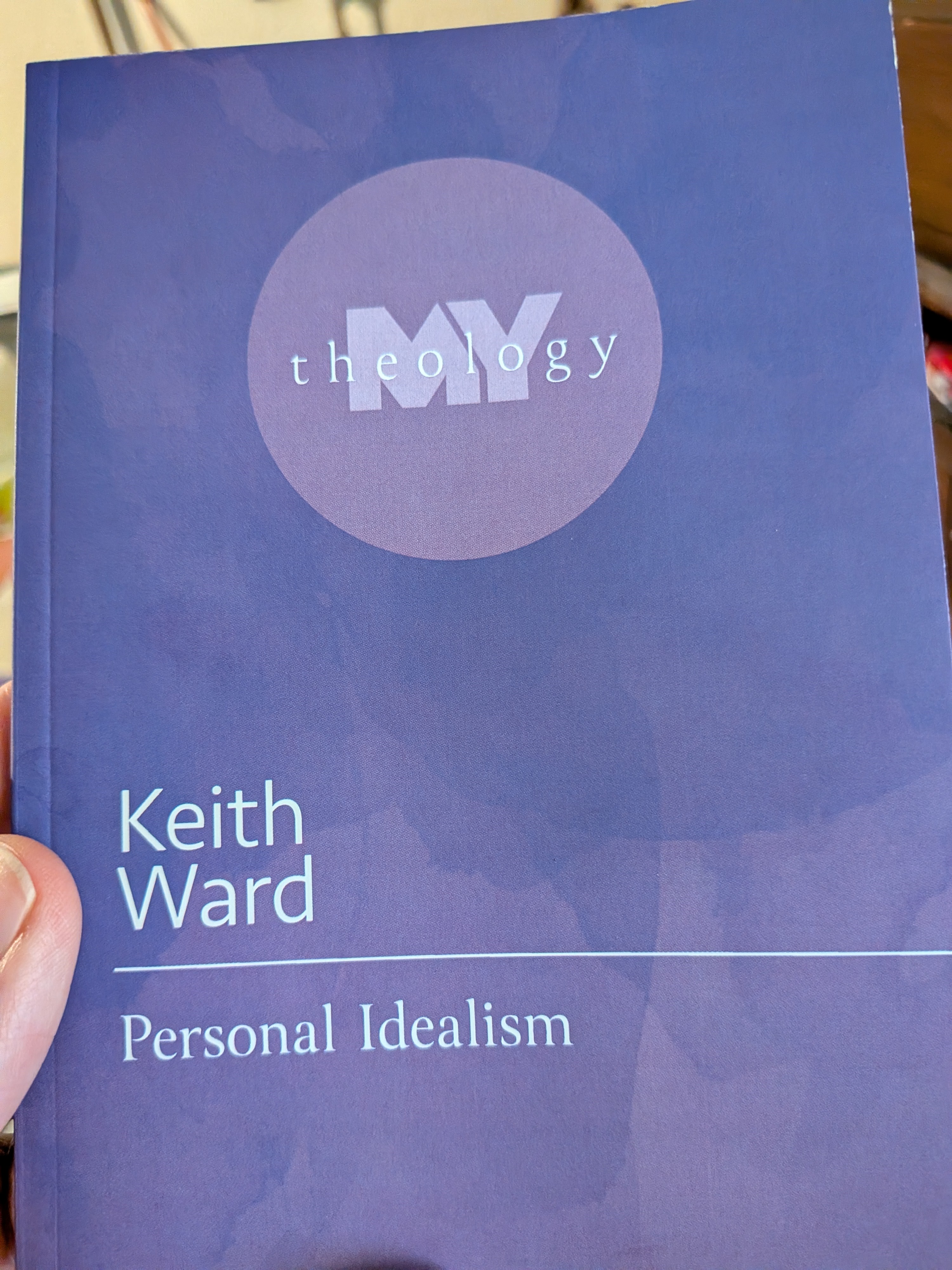
In short, as an idealist, Ward holds that mind is more fundamental than matter and provides the explanatory principle for the existence of the cosmos. This may sound highly counterintuitive, but Ward argues that consciousness — including feelings, thoughts, and sense-impressions — is actually prior to matter in the order of knowledge. We are more certain that these things exist than that “matter” exists, because they are the medium through which we know anything. Moreover, it’s highly implausible, Ward thinks, that mental events or properties, broadly speaking, are identical or can be reduced to material properties or events. In fact, the world as contemporary physics describes it is highly remote from our experience, consisting of wave/particle dualities, vibrating 11-dimensional stings, and probability waves. Ward thinks that the world of physics is an abstraction from experience — a framework for explaining and predicting events insofar as they are measurable and quantifiable and thus susceptible to the methods of physical science. This unavoidably leaves out a lot.
But what, you may ask, does this have to do with God? According to Ward, a fully satisfying explanation of the existence of the universe would answer the question of why this universe exists rather than some other. It’s intuitively plausible to think that there are many possible universes, so why this one? Ward suggests that there is an infinite “ocean of possibilities” out of which one set of possibilities has been actualized — namely our universe. But possibilities in themselves are just abstractions — how can they subsist independently, much less have any causal power?
Ward argues that it makes the most sense to think of the set of all possibilities as residing in an infinite and eternal Mind. This Mind then actualizes the set of possibilities that will contain certain goods — states that are worthwhile for their own sake. This is a personal, axiological explanation for the existence of the cosmos. The universe exists because the Eternal Mind wanted to bring into existence certain worthwhile states such as beauty, creativity, and friendship. These are states that are best actualized by free, rational beings.
Idealism, in Ward’s sense, is the view that everything that exists either consists of mind (a strong version) or depends on mind (a weaker version). All theists are idealists in the weaker version, since they hold that everything which exists depends on God. According to Ward, the universe can be seen as an environment brought into being by the Eternal Mind so that created agents can further realize new forms of value through interactions with each other and the wider world.
Now, one might at this point ask what all this has to do specifically with Christianity. Ward suggests that an Eternal Mind (let’s just call it “God” from now on) seeking to realize certain values would have good reason to make rational, intelligent creatures aware of its existence and purposes. Thus we have revelation – the disclosure of the Divine Spirit to people through various mediums such as inspired holy people.
Ward is clear that he doesn’t think Christianity has a monopoly on divine revelation. Moreover, he argues that no tradition is a monolith: each one changes and evolves over time, so it’s very difficult to say what the Christian (or Buddhist, Hindu, Muslim…) view on a given topic is. Moreover, whether they like to admit it or not, traditions interact and learn from each other, often correcting their own limitations with insights from others. Ward calls his view “expansivism” to contrast it with the usual typology of exclusivism/inclusivism/pluralism. By this he means a view that is committed to a particular tradition, but is open to learning and correction from others.
The Bible, on this view, is the record of the Jewish people’s wrestling with God and its developing idea of God and sense of universal morality. The New Testament in particular is the witness to Jesus, who Christians believe, discloses the divine as a God of unlimited love who wills the salvation of all. Ward goes on to sketch his views on key doctrines such as the Incarnation, Atonement, and Trinity. As is usually the case, he embraces the intent of the orthodox doctrine while departing from some of the traditional formulations. (For example, he develops the “two natures” theology of Chalcedon in ways that might make some traditionalists nervous, and he rejects forensic “penal substitution” models of the Atonement, preferring to say that God participates in human suffering and unites humanity to Godself.)
The capstone of Ward’s theology is the union of all created being with God. The Eternal Word, or Logos, unites itself to a particular human being in order to overcome the estrangement between God and humanity that has resulted from our pride, hatred, and greed. In Jesus, the divine and human are united in the closest possible way, which provides the archetype of the new humanity. With the resurrection, new possibilities are created, and God sends the Holy Spirit into the hearts of people so that they can be refashioned according to the pattern of Christ. And our ultimate destiny is to be “partakers of the divine nature” as we are united with the Eternal Christ along with “all things.” As Ward sums up:
The Trinitarian God — transcendent, finitely expressed in Jesus, and present within all created persons throughout the universe — is the Christian vision of the supreme mind of the cosmos, who calls all creation out of estrangement and suffering into a joyful communion of love. As the New Testament puts it: “God was in Christ, reconciling the world [and I think we need to make clear that, with our expanded knowledge of the universe, this means the whole cosmos] to himself” (1 Corinthians 5:19). (p. 93)
As I noted at the beginning of this post, Ward has had a significant influence on my thinking (check the archives if you doubt it!). Maybe it’s because I have a background in philosophy, but I appreciate his willingness to bring philosophical tools to bear on theological questions. There has been a trend in theology over the last several decades (though maybe this is waning?) to treat theology as fully autonomous either because it’s supposedly based entirely on revelation or because it constitutes its own thought-world (or “language game”) and thus can’t be critiqued by norms outside itself.
I’ve always thought this was a dead end. In my view, theology has to make sense in relation to other domains of human knowledge, whether that be science, philosophy, history, or other religious traditions. That doesn’t mean that it should uncritically accept the findings of these other disciplines (which would be impossible in any event, since there are disagreements among practitioners of all those disciplines!). But I do think theology needs an account of how, at least in principle, it relates to truths revealed by other areas of human knowledge. After all, they are all trying to tell us something about the same world — a world that we believe was created by God and is at least in part able to be understood through patient inquiry.
To take a specific example, it’s all well and good to derive an idea of God from the Bible. But questions will inevitably arise about how that idea relates to what we know about, e.g. how natural processes work or the occurrence of certain historical events. As we bring these domains of discourse into contact, there will likely (inevitably?) be adjustments in our idea of God. Ward is trying to do this in a principled, rather than an ad hoc way. Though, as he readily admits, many (most?) philosophers don’t agree with him about many of these issues.
Further, Ward is able to give an account of why some doctrinal or theological positions are open to revision without giving the store away, so to speak. He can articulate a robust incarnational faith while rejecting literalism and fundamentalism. Again, many people may disagree on particular points, but surely this is the most viable approach for a theology that wants to remain faithful to the central Christian truths while accepting that the world has changed in myriad ways since the 1st century. (I’d argue that it’s the approach that much Christian theology has historically taken, even when it denies that it’s doing so.)
One might also complain that Ward’s theology is too abstract and intellectual and therefore doesn’t motivate moral commitment or experiential spirituality. While his writing is generally not warm and fuzzy, his commitment to the ethical upshot of Christianity is clear from a number of works, and he has even written a book of meditations and prayers (which to be fair is still pretty darn intellectual!). What I think is fair is that some Christians aren’t necessarily preoccupied with the issues Ward focuses on and would rather get on with the business of following Jesus. That’s certainly a reasonable stance! But for those who, as Ward says about himself, are interested in these “big questions,” he has provided a rich body of work that helps us to grapple with them.
*For more, see the following posts: God as Ultimate Mind: Keith Ward’s “Christian Idea of God” and And yet they are not three gods but one God; somehow I never got around to writing about the third volume in this loose trilogy: Sharing in the Divine Nature.

 A Thinking Reed