Category: Politics

  • The “Progs for Paul” myth redux

    I’ve never bought into the “Progressives for Paul” myth – the idea that there was a burgeoning groundswell of support on the anti-war Left for maverick GOP congressman Ron Paul.

    Gaius links to this rather silly piece saying that Paul’s “support” on the Left may be shot now that he’s “revealed” his radical small-government views.

    Look, Ron Paul is a staunch decentralist, small-government libertarian (paleo division). He hasn’t exactly kept that a secret and talks about his desire to drastically reduce the size and scope of the federal government at pretty much every available opportunity.

    Now, sure, some anti-war writers on the Left have given Paul some good press. And for good reason: he’s a voice of sanity in the la-la land inhabited by the rest of the GOP field. Progressives and other anti-war types ought to be glad whenever Paul gets some attention paid to his “extremist” views on foreign policy (extreme outside of the DC “bipartisan consensus” that is).

    But how likely was it that lefties were ever going to vote en masse for Paul? There is a perfectly good progressive anti-war candidate running for the Democratic ticket. His name’s Dennis Kucinich. Though not exactly a progressive myself, or a registered Democrat for that matter, I think there’s a lot to like about him. And, there’s also the curmudgeonly Mike Gravel and Bill Richardson as options for the liberal anti-war voter.

    Ron Paul is against the war in Iraq and our imperialist foreign policy more generally. And he’s also shares certain other positions with liberals: he’s against the drug war, for instance. And the post-9/11 expansion of the national security state. But he’s not a liberal or a progressive, and I imagine folks on the Left are smart enough to know that.

  • Yuengling vs. the union

    This story, if accurate, is a bummer. The writer is absolutely correct about its ubiquity in the greater Philadelphia area. And now that we’re back in the world of Yuengling distribution it’s been my go to beer.

    Which makes this all the more unfortunate:

    Earlier this year, the employees at Yuengling’s Pottsville brewery decertified — i.e. got rid of — their local Teamsters union after ownership stopped negotiating with the union. Anonymous workers told the Associated Press that brewery owner Dick Yuengling promised the employees he would close the place down if they didn’t boot the Teamsters. After losing the legal battle because terrified employees wouldn’t come forward to testify, the union fired back in May with a request for drinkers to boycott Yuengling.

    (via the Young Fogey)

  • Evangelicals for Palestine

    This seems like a heartening sign: Coalition of Evangelicals Voices Support for Palestinian State. Of course, most of the signatories to the letter to the President mentioned in the article are the usual suspects of the evangelical left (Tony Campolo, Ron Sider), but others like Richard Mouw and David Neff of Christianity Today seem indicitave of a broader spectrum of support.

    On a side note, I caught a few minutes of a broadcast of some far-out Christian Zionist guy the other day and he referred to God “smiting the Muslim hordes” in Ezekiel! Now I’m no biblical scholar, but I think his chronology’s off by a thousand years or so, give or take a few centuries.

  • Humans as GMOs

    This article at The Nation makes the case that even progressives who take the ultra anti-restrictionist line on abortion should support regulation of new reproductive technologies. These technologies have the potential for very serious unintended social consequences and therefore shouldn’t be left solely to individual choice. This seems like a place where progressives and cultural conservatives could make common cause if they can put aside mutual suspicion over abortion politics.

    I think this is a place where a Murray Jardine-style analysis is illuminating: we have a very hard time as a society limiting things that appear on their face to be simply matters of individual preference. But the author of this piece shows that the consequences of those choices have the potential to create social patterns that will have consequences for other individuals who had no part in making that choice. This requires us to deliberate about what kind of a society we want to live in. For instance: do we want to live in a society where access to new technologies results in an extreme genetic stratification between rich and poor?

  • “Green consumerism” vs. consuming less

    A couple of weeks ago the New York Times ran a story on the new “green consumerism.” Today George Monbiot writes that it’s not good enough to “buy green”; we have to buy less. His contention is that “green” consumption is at this point a supplement to rather than a replacement of conventional consumption and that people have started to by flashy “green” items more as a sign of social status than as concrete contributions to the problem. The result is that individual consumption ends up being seen as a replacement for political action.

    Ethical shopping is in danger of becoming another signifier of social status. I have met people who have bought solar panels and mini-wind turbines before they have insulated their lofts: partly because they love gadgets, but partly, I suspect, because everyone can then see how conscientious (and how rich) they are. We are often told that buying such products encourages us to think more widely about environmental challenges, but it is just as likely to be depoliticising. Green consumerism is another form of atomisation – a substitute for collective action. No political challenge can be met by shopping.

    […]

    Challenge the new green consumerism and you become a prig and a party pooper, the spectre at the feast, the ghost of Christmas yet to come. Against the shiny new world of organic aspirations you are forced to raise drab and boringly equitable restraints: carbon rationing, contraction and convergence, tougher building regulations, coach lanes on motorways. No colour supplement will carry an article about that. No rock star could live comfortably within his carbon ration.

    It does make you start to wonder if consumption is the only response we know how to make to any social problem. Hip articles associated with a particular cause become status signifiers, especially when they’re expensive. You can’t ostentatiously show off buying less stuff.

    In theory Christianity should be able to provide resources for dealing with this. Theologically we deny that our identity is grounded in what we buy and consume. And the tradition of living simply as part of the path of virtue goes back at least to the Desert Fathers. But how many churches have addressed this? And how many have encouraged being virtuous consumers instead?

    Not that the two should be seen as inevitably opposed. After all, we need to consume things! Things are good! And it’s probably better to drink organic fair trade coffee than conventional coffee. A lot of churches have been good at promoting things like that. But we’re probably less good at evaluating whether we really need the things we find ourselves wanting (I know I am!). What kinds of practices and resources do we have for making those distinctions? (By the way, yes I do need coffee, so don’t ask.)

  • NYT: Public doesn’t want to hear ideas for universal health care or getting out of Iraq

    A friend of mine sent a link to this excellent post at the American Prospect’s Beat the Press blog, tearing a NY Times op-ed for pronouncing, seemingly without evidence, that “minor” candidates like Rep. Dennis Kucinich should be barred from the presidential debates since no one cares what they have to say.

    On the contrary, as Dean Baker points out, polls indiciate significant support for Kucinich’s positions on the Iraq war and a universal Medicare system. He’s deemed a “minor” candidate largely by press fiat, not by the amount of support the positions he gives voice to actually have.

    Like Ron Paul who’s keeping the other GOPsters on their toes, Kucinich’s voice is sorely needed in a Democratic field where the leading contenders are at best lukewarm on the idea of actually bringing the troops home from Iraq. And I don’t know if a universal Medicare system is the best solution to our national health care woes, but I’d certainly like to be able to hear more about it.

    Why is the press so intent on narrowing the debate to a pre-selected roster of “serious” candidates and for keeping it within the relatively narrow bounds they represent?

  • Paging Dr. No

    Here’s a pretty sympathetic if not uncritical profile of Ron Paul in the New York Times Magazine by Christopher Caldwell.

    One of the things I took away from this piece is that Paul’s ability to attract a broad spectrum of support from people who are alienated from the political status quo is the flip side of his tendency to attract people from the political fringes (money cranks, 9/11 conspiracy theorists, etc.).

    Still, I’ll give him this: on some really important stuff where all the “sensible” and “serious” people went badly wrong (the Iraq war, civil liberties in the post-9/11 national security state) Paul got it right. Sometimes it pays to stand outside the bipartisan consensus.

  • The Making and Unmaking of Technological Society 3: The Christian revolution

    (See previous posts here and here.)

    In chapter 8 Jardine discusses what he calls the cosmological and anthropological revolution wrought by Christianity and why it holds the key to facing the dilemma of the technological society. That dilemma, recall, is that we human beings have found ourselves with the capacity to radically alter our environment but without a moral understanding adequate to direct us in using that power. Traditional moral theories, such as those inherited from Greek philosophy, have assumed a static order both in the natural world and in human nature. Consequently, natural law theories don’t provide guidance in how we should use our ability to alter what was previously thought to be an unchanging order.

    Furthermore, Jardine thinks, liberalism doesn’t provide an answer to this dilemma either. This is because of its inbuilt tendency toward nihilism. While liberalism recognizes the human capacity for altering the environment, in seeking a “neutral” ethic that prescinds from making judgments about the good it fails to set direction or limits to that capacity. Thus, he thinks, individual preference becomes the sole source of value in a liberal society.

    Despite the fact that Christianity would seem to be one of the main foundations of Western civilization, Jardine thinks that we haven’t sufficiently assimilated its cosmological and anthropoligical outlook. Unlike either ancient paganism or Greek rationalism, Christianity is characterized by two distinct tenets that can help re-orient our technological society. First, Christianity recognizes that human beings, while creatures, have a share in God’s creative power. We are co-creators in a sense. Secondly, the Bible views the universe as a dynamic expression of the divine being. In “the word” we find the key metaphor for understanding the biblical view of the universe.

    God, Genesis tells us, speaks the world into existence. Unlike ancient paganism which viewed the gods as capricious, the biblical God is trustworthy and faithful. Thus his creation will display a certain order and reliability. But unlike Greek rationalism, which saw the world’s order as unchanging, the biblical God is dynamic and involved in history. History becomes a key concept for understanding the creation: it is more like an ongoing process with new potentialities unfolding over time. This dual view of humans as co-creators and the universe as an orderly but dynamic process, Jardine thinks, is much more in tune with the world revealed by our technological capcities and scientific knowledge.

    And this view provides the foundation for an ethic that can grapple with the problems of being co-creators in such a world. Just as God speaks the world into being, humans can think of themselves as speakers before God. Speech is key because, in a sense, speech is what allows us to create new worlds of possibility and thus is at the root of our creative capacities. “Using language in certain ways creates human capacities that could not exist otherwise” (p. 175). Our creative powers are real, though limited.

    The proper response of such creatures, living in a dynamically ordered world created by a good God, is to try to be “faithful speakers before God.” Jardine provides an illuminating interpretation of the story of the Fall. The human situation is that we seek to transgress the limits of our knowledge and creative powers in order to be like God:

    We are creators, but we are also creatures. As such, there are limits to our creative capacities, and limits to our knowledge. But because we are creators, we will have a powerful tendency to forget, or willfull ignore, the fact that we are creatures, and we will frequently try to be only creators–that is, to be God. This behavior is what is meant by the term sin, and its paradigm is attempting to claim absolute knowledge, which of course only God can have.

    The reason people sin is precisely because of our ambiguous situation as creators and creatures. As creatures we are limited beings, but as creators we can imagine ourselves as unlimited beings, and thus we will tend to attempt to cast off all limitations–or, in theological terms, we will be tempted to be like God. Or, putting this in terms of our model of creating a world through speech, sin is the attempt to become creators only, instead of cocreators, and to create our own little world. This is precisely what one does when one lies; one attempts to replace the world created by God and the speech of other humans with a world created only by oneself. More generally, all attempts to dominate other people are cases of trying to create one’s own world by force. Similarly, the delight that humans sometimes–indeed, rather often–take in acts of destruction can be understood as another attempt to create one’s own world by force. Stating the idea of sin in these terms makes it clear that fundamentally, sin comes from a lack of faith, that is, a lack of trust, in God and his created world; it is an attempt to replace God’s creation with our own. Sin means essentially unfaithful human acts.(pp. 186-7)

    If sin is essentially unfaithfulness, then faithfulness will be embodied in an ethic of unconditional love. Since human beings are co-creators with the capacity to create their own “worlds” plurality is an essential feature of the human condition. You and I may well disagree about how we should live together, or how our powers of creativity should be used. Jardine defines unconditional love as the persistent attempt to understand and empathize with those whose perspective differs from our own. Concretely, this means practicing forgiveness and mutual correction. These balance each other because while we must stop the person who is sinning, a recognition of the limits of our knowledge highlights the importance of forgiveness.

    Jardine goes on to distinguish this Christian ethic from that of liberalism. Unconditional love is not the same thing as liberal tolerance. Tolerance implies a kind of indifference to what others are doing so long as they harm no one but themselves. But unconditional love corrects and forgives out of a concern for the well-being of the other. “From the standpoint of an ethic of unconditoinal love, liberal tolerance is, for the most part, indifference, and fails to help or correct people unless their actions affect others in a direct, blatant way” (p. 189).

    Indeed, Jardine goes on to argue that “[g]enerally speaking, liberalism is best understood as a distortion of–or better yet, a reductionisitc version of–Christiainity, or more specifically of the Christian ethic of unconditional love” (p. 189). Liberalism enjoins toelrance and avoiding persecution rather than the deeply involved personal love commanded by the Christian ethic. Christianity may have inspired the idea that all people are fundamentally equal and thus one could engage in productive exchanges with those outside of one’s family, clan, or culture, but liberalism goes too far in reducing all social relationships to market exchanges. The Christian ethic of unconditional love provides the foundation for faithful speaking before God and communal deliberation about the good.

    I think this would be a good point to ask some critical questions. Jardine has argued that liberalism leads to nihilism and that only Christianity can provide the means for a fruitful deliberation about the good, providing some guidance in the use of our powers as cocreators in a dynamic and creative, but ordered and reliable universe. He maintains that liberalism is a reduction of the Christian idea of equality and unconditional love to a bland tolerance. However, does he grapple sufficiently with what gave rise to liberal tolerance in the first place? As good as mutual correction and forgiveness sounds, it’s very difficult to see how this would apply to society as a whole, rather than to close-knit Christian communities. Liberalism flourished initially in part because the churches were being rather too zealous in the cause of fraternal correction. In other words, “mere” tolerance is no mean accomplishment and not something to be dismissed lightly. In a vast society tolerance may be the best thing we can give to a lot of our fellow citizens. Mutual correction requires a degree of intimacy and trust that isn’t easily attained. As Alasdair MacIntyre has argued, the modern nation-state may well be incapable of being a genuine community in the sense of providing an arena for communal deliberation about the good.

    Secondly, Jardine seems to conflate political liberalism, understood as a regime that refrains from enforcing a particular vision of the good, with liberalism as a way of life. The latter takes human autonomy as the highest good and is in that sense itself a comprehensive philosophy of life. But not all political liberals are liberals in this sense. In his book Two Faces of Liberalism the political philosopher John Gray distinguishes between liberalism understood as a way of life and liberalism understood as a kind of modus vivendi that allows different ways of life to peacefully co-exist. A modus vivendi liberalism isn’t necessarily committed to enforcing liberalism as a way of life, the kind of philosophy of life that may well lead to nihilism as Jardine fears.

    It might be worth pointing out that most people in modern Western liberal societies are not in fact nihilists. And this may be because they have adopted more of a modus vivendi style of liberalism that allows different ways of life to co-exist. This doesn’t mean that every person in a liberal society suddenly becomes an atomized individual unattached to any larger context for making sense of her life. Granted that liberalism as a way of life has certainly made inroads in these societies, it doesn’t seem to follow, either empirically or as a matter of logic, that it must overwhelm all more communitarian or traditional ways of life.

    And this brings me to one more point. Jardine, like some writers in the Radical Orthodoxy school of thought, holds that liberalism necessarily leads to nihilism and that only Christianity provides a viable alternative to liberalism. But I think we’re well beyond the point where Christian thinkers can ignore the plurality of other points of view in the world and treat secular liberalism as though it were the only serious rival to Christianity. The irreducible fact of pluralism – of a diverse array of religious and philosophical ways of life – is, in my view, precisely the best argument for some variety of modus vivendi liberalism. This would be an order that allows people to live in relative peace without denuding themselves of their particular religious, cultural, and other kinds of identity.

    That said, Jardine’s re-interpretation of the story of the fall and its relation to our technological capacities is suggestive, and something I think Christians would do well to bring to the debate on how those capacities should be used. They might well find common ground here with believers from other traditions. In the next (and probably final) post in this series I’ll talk a little about Jardine’s concrete proposals for social change in light of the discussion so far.
  • Does God want us to be free?

    (Switching gears here; we’re talking about political freedom now, not the metaphysical variety.)

    There’s been an interesting debate recently, swirling around some of President Bush’s more exuberant comments about political freedom being a “gift from the Almighty.” The reference comes from a recent David Brooks column (not accessible to us proles who don’t subscribe to the Times), the implication being that Bush’s confidence in the policies he’s pursued is rooted in a conviction that a providentially-ordered history is on his side.

    This belief has met with a storm of criticism from some of the more thoughtful conservative pundits and bloggers (Andrew Sullivan, Ross Douthat, Daniel Larison, Rod Dreher), with Ramesh Ponnuru offering something of a defense.

    The issue I take it has two parts. Bush, allegedly, believes that there is something of an innate telos toward freedom in the created order in virtue of God’s creative and providential care. The second part is that his policies have a good long-run chance of success precisely because they are aligned with the “grain of the universe” so to speak. It might be helpful to point out that these two claims are detachable. Even if there is an inherent tendency toward freedom in human nature, it doesn’t follow that the best way to promote that tendency is the way Bush has chosen. In fact, it seems to me that there are good reasons to think otherwise, since going to war with and invading other countries requires coercion on a massive scale.

    But regarding the first claim – whether political liberty is part of what God wills for his creatures – I come at this from a slightly different angle. My take is that political liberty follows from human fallenness. Precisely because human beings are frail, selfish, limited in knowledge, prone to self-assertion, and vulnerable, liberty is necessary to create a sphere within which people are protected from the impositions of others. As fallen creatures we are prone to mistake our partial visions of the good with the Good itself and to be insufficiently modest in trying to get our fellow creatures to go along with them. If people weren’t sinners, political liberty as we know it would be superfluous because everybody would spontaneously do the right thing. Because our own knowledge is limited and our motives are suspect, the political order should limit the extent to which we can enforce our preferences on others. So, I guess I’m something of a post-lapsarian about freedom.

    It should be obvious that this is a more modest version of liberalism than the kind of progressive optimistic Whiggery criticized by some of the conservatives cited above. In fact, Christopher Insole, whose book on theology and political liberalism helped me clarify some of these ideas, expressly distinguishes a liberalism of human frailty from what he calls “crusading liberalism.” This is Whiggish liberalism that identifies the triumph of freedom with a single kind of political and economic order that will spread by means of inevitable historical progress.

    So you might say that the institutions that foster political liberty are a means of protecting vulnerable human selves from each other. This view doesn’t identify liberalism with any kind of utopia or “end of history,” and it recognizes that liberty can be embodied in a diversity of forms. It is also respectful of historically developed institutions that have acheived a measure of freedom and stability and would be wary of rashly overturning them in the name of some revolutionary project. Certainly I think any Christian would say that God wills the flourishing of human beings in this good but fallen world, and to the extent that the institutions of liberty contribute to that by creating spaces for human flourishing we can indeed say that God wants us to be free.

  • Disfranchised

    I see the signs for DC Vote all over the place.

    Is there a compelling reason why residents of the District shouldn’t have congressional representation?

    For those of a more radical bent there’s also the DC Statehood Party (which merged with the Greens).

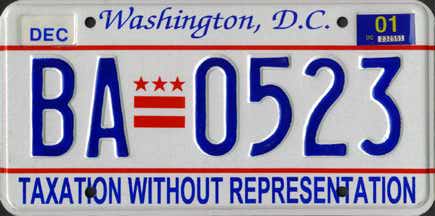
    You can also get yourself the (quite popular) “Taxation without Representation” license plate.

    dc01.jpg