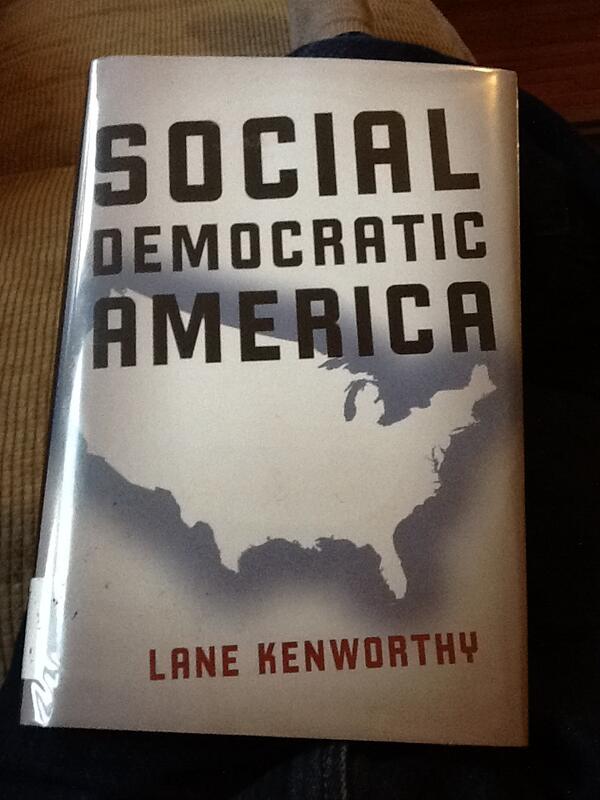
Over the weekend I finished reading Lane Kenworthy’s Social Democratic America. Kenworthy, a professor of sociology and political science at the University of Arizona, offers a clear, concise, and well-argued case for expanding the role of government in ensuring economic fairness and opportunity for all.
Kenworthy’s book is divided into four main sections: describing the problem, making the case for his preferred solutions, dealing with objections and alternative proposals, and arguing that the changes we need are not only politically feasible, but likely. In this post, I’m going to focus on the problem and Kenworthy’s proposed solutions. In future posts, I’ll look at some objections and alternatives he considers, how he thinks we can move forward politically, and finally some of my own thoughts on the book.
The problem
There won’t be much new here for anyone who has followed these debates in recent years, but Kenworthy compellingly lays out the data showing that since the 1970s the U.S. has been moving in the wrong direction. He breaks the problem into three components: economic security, opportunity, and shared prosperity.
—Security means “having sufficient resources to cover our expenses” (p. 17); lack of security is indicated by low incomes, declining incomes, and large unanticipated expenses, such as a major health event. Income insecurity has risen in the last few decades largely because of changes in the economy: increased competitive pressures arising from globalization and more demand from shareholders for constantly increasing profits chief among them.
—Opportunity does not, for Kenworthy, mean equal opportunity, which would require everyone to have the same “skills, abilities, knowledge, and noncognitive traits.” Instead, he proposes, following economist Amartya Sen and others, that we focus on maximizing people’s capacities “to choose, act, and accomplish” (p. 30). In post-1970s America, he shows, opportunity, as measured by the ability of someone from a poorer-than-average family to move up the economic ladder, has declined.
—Shared prosperity means that the economy benefits everyone, even if unequally. Most Americans probably don’t object to inequality per se, but recent decades have seen the benefits of economic growth going primarily to the top 1 percent. “The income pie has gotten bigger, and everyone’s slice has increased in size, but the slice of the richest has expanded massively while that of the middle and below has gotten only a little bigger” (p. 36).
The solution
One distinctive feature of Kenworthy’s book is that, unlike many on the left, he doesn’t necessarily think we need radical new policy proposals to address the problems he has outlined. Rather, we mainly need to build on and expand existing programs and borrow some ideas from other countries, particularly the Nordic “social democratic” ones (hence the title).*
Economic security can be enhanced by implementing or expanding programs that address low incomes, declining incomes, and large unanticipated expenses. These include the Earned Income Tax Credit, Temporary Assistance to Needy Families, unemployment and wage insurance, paid parental leave, and universal health insurance. All of these policies help compensate for fluctuations in people’s income.
To expand opportunity, Kenworthy proposes various improvements to our educational system on the grounds that “schools . . . are our principal lever for enhancing opportunity” (p. 62). These include things like free public colleges, more investment in high-quality K-12 teachers, and universal pre-K education. In addition to educational improvements, he also suggests a cash grant to low-income families in the form of a “child allowance,” reducing incarceration for minor criminal offenses, and instituting family-background-based affirmative action programs.
Ensuring shared prosperity may be the hardest problem to tackle. This is because the forces that have contributed to unequal growth are not easily reversed: globalization, mechanization, immigration, etc. Moreover, it’s not clear that it would be good to reverse these trends even if we could. Kenworthy does think the government can do more to encourage higher-wage employment by, for example, providing personalized job search and (re)training support, subsidizing private-sector jobs, and creating public-sector jobs.
But ultimately he thinks we need to accept that many of the jobs of the future will be relatively low-wage service jobs. Rather than fight this, we should ameliorate it through things like a higher minimum wage and an expanded EITC. We can also provide more public goods, including public spaces and more paid holidays and vacation time, which can improve people’s standard of living even if they don’t increase their income as such.
Kenworthy even provides his favored proposals in handy bullet-list form:
–Universal health insurance
–One year of paid parental leave
— Universal early education
— Increased Child Tax Credit
— Sickness insurance
— Eased eligibility criteria for unemployment insurance
— Wage insurance
— Supplemental defined-contribution pension plans with automatic enrollment
— Extensive, personalized job search and (re)training support
— Government as employer of last resort
— Minimum wage increased modestly and indexed to prices
— EITC extended farther up the income ladder and indexed to average compensation or GDP per capita
— Social assistance with a higher benefit level and more support for employment
— Reduced incarceration of low-level drug offenders
— Affirmative action shifted to focus on family background rather than race
— Expanded government investment in infrastructure and public spaces
— More paid holidays and vacation time
Lane Kenworthy thinks we need more public goods–like the library where I got this copy of his book.
*A note on usage: by “social democracy” Kenworthy largely means the model favored in the Nordic countries, which combines relatively free markets with robust welfare states and provision of public goods. This differs from some other uses of the term, which take “social democracy” to be virtually synonymous with “democratic socialism.” As Kenworthy uses it, though, social democracy is not wholly distinct from, but rather exists on a continuum with, what Americans typically call “liberalism.”
Politico ran a story today from conservative writer Kevin Williamson on why Senator Rand Paul’s brand of libertarian-inflected conservatism will have trouble appealing to voters.
I don’t know about the politics, but Williamson makes an interesting point about the difference between libertarians and social liberals. Libertarians are sometimes described as “fiscally conservative and socially liberal,” but Williamson says that liberals actually don’t like Paul’s brand of leave-us-alone social libertarianism:
If the fair-weather fiscal conservatives don’t like Rand Paul, the phony social liberals are going to loathe him. Here’s where the English language fails us: “Liberal” and “libertarian” come from the same linguistic root, meaning “liberty,” and many libertarians will describe themselves among friends as “classical liberals”—political heirs to the Whigs and the Manchester free-traders. But “socially liberal” and “socially libertarian” today mean almost precisely opposite things. If there is one thing our “social liberals” hate, it is liberty. In their view, you’re free to do as they please.
Take the case of the Christian bakers and photographers who do not wish to participate in same-sex weddings because of their religious and moral views. Paul takes the classical liberal view, which is that people should be allowed to make their own decisions based on their own values, and that if a baker’s belief offends you, then you can criticize him, boycott him, give him the full Duck Dynasty treatment—but you cannot use the strong arm of the state to compel him to put two tuxedoed gentlemen on top of a cake.
America’s so-called social liberals think that amounts to Jim Crow for gay people. Paul’s instinct is to get marriage entirely out of the federal tax code and to let the states define marriage for themselves. For social liberals, that is, at best, a punt. On the subject of gay marriage, they do not want a skeptical federalist—they want a president who is categorically in favor of gay marriage. They do not want somebody tolerant, but somebody committed, and willing to use the federal government to make their own preferences national policy. They don’t want marriage written out of the federal tax code—they want gay marriage written into it. They demand a pro-gay president even if, like Barack Obama in 2008 and 2010 and half of 2012, he claims to be against gay marriage for reasons of cynical political self-interest. Liberalism is a subculture; they know their own. Rand Paul isn’t one of them—and probably won’t get their votes. In fact, whether it is abortion, guns, public-school curricula or the all-important issue of dropping the federal civil-rights hammer on noncomformist bakers, Paul can count on bitter, unified opposition from liberal social-issue voters.
Minus the tendentious characterization of liberalism, I actually think Williamson is on to something here. Broadly speaking, liberals care about social equality, while libertarians care about non-interference from the government. This is why, for example, you get liberals arguing that business owners shouldn’t be allowed to discriminate on the basis of race or sexual orientation, while libertarians say that property owners should be free to discriminate in whom they serve (or hire).
Sometimes these views overlap in their policy recommendations–for example, both liberals and libertarians generally oppose locking up nonviolent drug users. But it’s worth understanding that these are based in different philosophical viewpoints. Liberals do not see non-interference by the government as the highest political good. In fact, they think that government action is often warranted to ameliorate social inequalities. From a liberal point of view, libertarian “non-interference” leaves people, particularly less powerful people, at the mercy of private concentrations of power–corporations, bosses, intolerant religious and social majorities, etc. Certainly liberals think liberty is an important good, but they don’t see government as the only, or even necessarily the main, threat to liberty.*
Incidentally, this is why I think the “fiscally conservative, socially liberal” formula is ultimately incoherent. If social liberalism is about social equality, then you can’t be a social liberal without supporting the material conditions of equality. This means not only that government may need to step in to thwart discrimination, but also that it should ensure access to the basic material conditions of participating in society on an equal footing. This includes such essential goods as education, health care, and a minimum level of income (though liberals disagree on the ideal mechanisms to provide access to these goods). Liberals and libertarians may share some philosophical forbears, but at this point they’re really different species.
—————————————————-
*It’s worth noting that J.S. Mill’s classic liberal manifesto On Liberty was in large part concerned with non-governmental forms of coercion.
Buzzfeed(!) profiles pioneering Catholic feminist theologian Elizabeth Johnson. I blogged about Johnson’s book She Who Is back in 2009–see here, here, here, and here.
Rep. Paul Ryan thinks free school lunches are bad for kids’ souls. I take this a bit personally since I got free lunches when I was a kid and don’t think my soul is particularly worse off for it. You know what is bad for your spiritual and moral development? Being too poor to eat.
A wonderful essay from the New York Review of Books on the “secret life” of W. H. Auden. Apparently the great poet–who was also Christian, if a somewhat idiosyncratic one–did a lot of surreptitious charitable works, even when it made him look like a jerk in public.
The impending publication of some of his journals reignite the debate about whether philosopher Martin Heidegger was an anti-Semite.
The Democratic primary for D.C. mayor is next month, and the Washington Post has put together a helpful guide on where the candidates stand on various issues. I’m still undecided on this.
Political scientist Adolph Reed Jr. published an essay in Harper’s (not available online) about what he says (apparently; I haven’t actually read the essay) is the long decline of the American Left and its over-investment in the electoral fortunes of the Democratic Party. This garnered some push-back from various quarters (see here, here, and here, among others); Reed replied to some of these criticisms here. I’m probably less left-wing than most of the participants to this argument, but it’s hard to deny that conservatives have been more successful than the Left in recent decades in building a grass-roots movement that can drive policy changes. The GOP is far more beholden to the conservative movement than the Dems are to the Left. I don’t think, however, that investing in such a movement should prevent anyone from supporting the superior alternative (or lesser evil if you prefer) in a given election. And for left-of-center folks this will almost invariably be the Democrat.
On the situation in Ukraine, and the persistent demands that the U.S. “do something,” I found this helpful.
Music-wise, I’m still on a St. Vincent kick. Here’s a great live session from a couple of years ago.
At this point in my life I have probably had a broader experience of the American population than is usual. I have been to divinity schools, and I have been to prisons. In the First Epistle of Peter we are told to honor everyone, and I have never been in a situation where I felt this injunction was inappropriate. When we accept dismissive judgments of our community we stop having generous hopes for it. We cease to be capable of serving its best interests. The cultural disaster called “dumbing down,” which swept through every significant American institution and grossly impoverished civic and religious life, was and is the result of the obsessive devaluing of the lives that happen to pass on this swath of continent. On average, in the main, we are Christian people, if the polls are to be believed. How is Christianity consistent with the generalized contempt that seems to lie behind so much so-called public discourse? Why the judgmentalism, among people who are supposed to believe we are, and we live among, souls precious to God–three hundred million of them on this plot of ground, a population large and various enough to hint broadly at the folly of generalization? It is simply not possible to act in good faith toward people one does not respect, or to entertain hopes for them that are appropriate to their gifts. As we withdraw from one another we withdraw from the world, except as we increasingly insist that foreign groups and populations are our irreconcilable enemies. The shrinking of imaginative identification which allows such things as shared humanity to be forgotten always begins at home.
–Marilynne Robinson, “Imagination and Community,” When I Was a Child I Read Books, pp. 30-31
To me, the most interesting part of this Dahlia Lithwick article on the recent wave of left-of-center protests in North Carolina is this:
One of the first speakers of the morning opened with a booming, Southern, “Shabbat Shalom, y’all.” An imam spoke eloquently of civil rights. An astute 11-year-old friend observed that when so many religious leaders can agree so much about moral truths, “The speeches can be much shorter.” And when Barber spoke, he toggled almost imperceptibly between quoting the Constitution and the Bible. “Kicking hardworking people when they are down is not just bad policy. It is against the common good,” he preached, pleading, “Lord, Lord, plant our minds on higher ground.”
Progressives are not used to so much religion in their politics. I met someone who planned to avoid Saturday’s protest because of the God talk, and it’s clear that for many liberals, it’s easier to speak openly about one’s relationship with a sexual partner than a relationship with God or spirituality. But there are a lot of liberals who live on the seam between faith and politics. And one of the core messages of Moral Mondays is that ceding all talk of faith and morality to the political right in this country has been disastrous for the left. Or as Barber put it when he spoke, those who dismiss these protesters as “violent, and losers, and leftists, and socialists” fail to understand that the great prophets of the Bible and the founders of American constitutional democracy were “violent, and losers, and leftists, and socialists,” too.
As discomfiting as it may be to hear the Bible quoted alongside the Federalist Papers, the truth remains that for most people of most faiths, kicking the poorest and most vulnerable citizens when they are down is sinful. Stealing food and medical care from the weakest Americans is ethically corrupt. And the decades long political wisdom that only Republicans get to define sin and morality is not just tactically wrong for Democrats. It’s also just wrong. This is a lesson progressives are slowly learning from nuns and the new pope. When we talk of cutting food stamps or gutting education for our poorest citizens, we shouldn’t just call it greed. We should call it what it is: a sin.
Liberals have long been skittish about mixing politics and religion, and often with good reason. After all, one of the fundamental tenets of a liberal society is an embrace of religious pluralism. This has led many academic liberal theorists to take their cue from philosopher John Rawls’ admonition that a liberal society must be “neutral” between competing conceptions of the human good.
But the uncomfortable truth is that this is at odds with much of the history of progressive social movements. Arguably, the two most important movements for social justice in U.S. history–abolitionism and the Civil Rights movement–succeeded in no small part because they appealed to Americans’ religious sentiments. Lithwick’s article suggests that forging any broad-based political coalition in America still requires such an appeal.
Personally, I’m skeptical that any society can maintain a strict Rawlsian neutrality among conceptions of the good life. Public policy will, I suspect, inevitably reflect prevalent views on what kinds of life are worth pursuing, which for many Americans includes a religious component. In the realm of real-world politics, refraining from taking a position on the good is likely to cede the public arena to the influence of wealth or naked self-interest. This constitutes a de facto endorsement of a certain vision of the good.
The question is whether we can affirm certain goods as worthy of public endorsement while maintaining our commitment to a reasonable form pluralism. I think we can, but I can also see why it might make some liberals uncomfortable.
I end up sharing a lot of links on Twitter, so I thought it might be worth collecting what I think were the stand-out pieces of the week. (“Stand-out” doesn’t necessarily mean I agree with every word, just that these were the most interesting or thought-provoking items I came across).
Say what you will about conservative New York Times columnist Ross Douthat, he certainly knows how to troll liberals.
Yesterday, the Times published a column in which Douthat offers an explanation of why, as some research has apparently shown, parents who have daughters are more likely to vote Republican. Douthat sketched a post-60s sexual landscape in which men hound women for commitment-free sex, and women spend their prime child-bearing years without landing a husband. This situation, he theorized, can increase the appeal of social conservatism to parents who worry about such a fate for their daughters.
This set off a round of the usual Twitter outrage among liberals. And much of it was well justified–Douthat’s column could be read as endorsing the retrograde sexual ethic or a bygone (and in many ways mythical) era. Virtually all liberals–and many conservatives–think we’re on balance much better off living in a world where premarital sex and previously taboo forms of sexual behavior like homosexuality don’t invite the full force of social disapproval (not to mention legal sanction). Moreover, the findings that Douthat’s argument leans on can be given a much more unpleasant interpretation.
But in fairness, Douthat’s conclusion was actually pretty modest. You don’t have to be crazy to think that contemporary sexual norms have drawbacks as well as advantages. Or that those drawbacks might disproportionately affect women. Certainly Christians, whatever their political views, can’t sign on to a regime of anything-goes sexuality.
All this notwithstanding, as (yes) the father of a daughter (and of a son for that matter), I’m glad my kids aren’t going to grow up under the sexual norms that prevailed when I was young, much less those of the 1950s. If for no other reason, this is because (1) girls and women today aren’t held to quite as rigid a double standard and (2) being gay is much less stigmatized. I don’t want my daughter to live in a world that tells her she’s a slut for expressing her sexuality, and I don’t want either of my kids to think there’s anything wrong with being gay.
Having kids has made me more conservative in some ways (and more liberal in others). Yet this hasn’t translated into increased support for the policy objectives of the organized conservative movement. As far as I can tell, these have very little to do with addressing the real problems facing people today, including young people. A policy that actually supported commitment and family formation, for example, would include paid parental leave, something that is largely anathema to the Right. Contemporary social conservatism seems driven largely by a tribalistic opposition to anyone who doesn’t fit a very narrow definition of “real” American. And it’s far from clear to me how a platform of cutting taxes on the rich, gutting the welfare state, and opposing gay marriage will make life better for my daughter (or my son) as she grows up.
If there’s a problem with contemporary sexual mores, it’s not clear there’s a policy fix for it. But to the extent there is, I don’t see any reason to think conservatism provides it.
This is not based on any kind of rigorous methodology; these are just the books I enjoyed and/or that “stuck with me” the most throughout the year. As should be obvious, these were not necessarily books published in 2013.
Fiction:
Anna Karenina, Leo Tolstoy
I decided to start reading this late last year after seeing the film version starring Keira Knightley. I’m frankly in awe of it, and nothing I can say will do it justice. But the thing that probably struck me the most was Tolstoy’s ability to draw fully realized characters and make the reader truly view the world from their perspective (including, in one case, a dog!). I can see why some people have compared Tolstoy to God: he intimately knows and truly loves each of his characters (sometimes, one senses, in spite of himself). And I haven’t even mentioned the delicately intertwining stories, the astonishingly clear and beautiful scenes Tolstoy draws, the social commentary, and the philosophical and religious musings. Basically, this book deserves every bit of its reputation as one of the greatest novels ever written.
True Grit, Charles Portis
I’d seen both movie versions, but had never read the book. Portis’s unforgettable characters, deadpan dialogue, and tightly constructed plot made this a hugely enjoyable read.
Non-fiction:
The Radical and the Republican: Frederick Douglass, Abraham Lincoln, and the Triumph of Antislavery Politics, James Oakes
Oakes’ recounting of how the radical abolitionist Douglass and the temperamental conservative Lincoln converged around a particular brand of antislavery politics isn’t just a fascinating story about two important figures at a pivotal point in American history (it is that, though!). It also serves as a rebuttal of sorts to radicals of every stripe who think they’re too pure for the grubby business of electoral politics.
Systematic Theology, vols. 1 and 2, Paul Tillich
I disagree profoundly with some of Tillich’s basic theological positions, but his thought remains, nearly 20 years after I first read him, a source of stimulation and insight.
Lincoln at Gettysburg: The Words that Remade America, Garry Wills
I’m not sure Wills persuaded me of his main thesis, namely, that Lincoln’s address at Gettysburg was, in effect, an ideological re-founding of the Republic. But his erudition is undeniable, and his analysis of the address in light of classical and contemporary examples of funeral oratory is extremely illuminating. He also writes like a dream.
Unapologetic: Why, Despite Everything, Christianity Can Still Make Surprising Emotional Sense, Francis Spufford
Spufford avoids nearly every cliche of contemporary religion writing and provides the freshest take on Christian faith I’ve read in ages. Sharp, funny, and heartfelt without being sappy. As I said in my “non-review,” I think Spufford captures how many of us in the “post-Christian” West experience our faith.
How Much Is Enough?: Money and the Good Life, Robert Skidelsky and Edward Skidelsky
This father-and-son team (an economist and philosopher, respectively) ask why the richest societies in history have so much inequality and so little genuine leisure. They blame a combination of political and philosophical failures, and argue for recovering a broadly Aristotelian concept of the good life than can help us get off the production-and-consumption treadmill. Their skewering of trendy “happiness” research and its associated policy prescriptions alone is worth the price of admission. Also worth noting is their critique of liberal “neutrality” regarding the good life.
I’ve got a couple of books going now, and if any finish any before December 31st that blow me away, maybe I’ll update this. Also, looking this over, I realize that I really need to read more books not written by white men.
This was the perfect medium for changing the way most Americans thought about the nation’s founding acts. Lincoln does not argue law or history, as Daniel Webster did. He makes history. He does not come to present a theory, but to impose a symbol, one tested in experience and appealing to national values, with an emotional urgency entirely expressed in calm abstractions (fire in ice). He came to change the world, to effect an intellectual revolution. No other words could have done it. The miracle is that these words did. In his brief time before the crowd at Gettysburg he wove a spell that has not, yet, been broken–he called up a new nation out of the blood and trauma.
Most liberals and Democrats admit that the rollout of the Affordable Care Act has been a mess. How serious this is for the long-term success of the law is a matter of debate, but no one thinks this has been anything other than a rocky start. The most visible problem, of course, has been the all-but-non-functional healthcare.gov website, which has prevented people (how many is uncertain) from signing up for insurance plans under the new federal exchange. But more recently the focus has shifted to the architecture of the law itself–specifically changes to the individual insurance market which have resulted in people having their existing policies cancelled and, in at least some cases, seeing the amount they will have to pay to get new policies go up.
There are good wonky liberal responses to this–Jonathan Chait provides a nice overview here. The short version is that two groups–those without any insurance at all and those who purchased individual insurance–were always going to be the ones most affected by the ACA. For the former, the effects were virtually all positive: they would either be able to afford insurance on the exchanges, possibly qualifying for subsidies to help, or they might fall under expanded Medicaid eligibility. In the case of the latter group, things are a bit more mixed. Many of these people would find that they could now afford policies that were cheaper and/or better than what they had before. But at least some of these people (no one seems to know for sure how many) would end up paying more for policies comparable to what they had before. This is the much-vaunted “sticker shock” we’ve been hearing about.
As Chait explains, the reason for this is relatively simple: the whole purpose of insurance is to put people into risk pools in order to spread risk (and hence cost) around. Thus in any risk pool, those people with lower risks (in this case, the young and healthy) are going to end up “subsidizing” those with higher risks (the old, the sick, etc.). So people who were able to get policies for less, because insurers could discriminate based on your health history, may now find themselves paying more because they are in a pool with people who previously would’ve had to pay more, or wouldn’t have been able to get insurance at all. The very same principle operates in the employer-based insurance model, which is how most Americans currently get their insurance. People whose age and health vary widely are grouped into a single risk pool, with the younger, healthier people effectively subsidizing the older and less healthy.
From a certain point of view this all sounds horribly unfair. But only if you take an ultra-individualistic, short-term view of fairness. As David Kaib nicely explained in a post yesterday, the concept of social insurance rests on a sense of social solidarity. We spread risk around because we want everyone, within limits, to be taken care of and have a shot at a decent life. All wealthy societies have implemented forms of social insurance, including the U.S., despite our individualistic rhetoric.
The notion of solidarity rests not only on concern for our fellow citizens, but also a more realistic understanding of our own self-interest. Social and political philosophers like Alasdair McIntyre, Martha Nussbaum, and Susan Moller Okin have pointed out that much of the Western political tradition assumes that the typical or normative human being is a healthy, independent, male individual, and this has distorted our concepts of justice. In reality, all of us find ourselves, at some point in our lives, dependent on others, whether as infants and children, or because we get sick, or because we get old and frail and lose our minds. We are “dependent rational animals,” in McIntyre’s suggestive phrase. Vulnerability and dependency are instrinsic to the human condition.
This means that even if you are a young, healthy person, you will, inevitably, be an old or sick person. And when that happens, younger, healthier people will be caring for you. Social insurance is simply a way of institutionalizing this, making it less ad hoc and subject to chance.
It should be obvious that these principles are congruent with Christian ethics, which enjoin care for the neighbor, respect for parents, and justice for the poor, the widow, and the orphan. Moreover, the doctrines of original sin and unmerited grace emphasize our common human lot and fact that none of us can save ourselves. Conservative Christians sometimes argue that social insurance is not a proper responsibility of government but that relief for poverty and sickness should come voluntarily from churches and other non-governmental entities. But there’s very little in the Christian ethical tradition per se to support such a restrictive role for government; this view owes more to libertarian conceptions of the “night-watchman state” than anything specifically Christian.
Unfortunately (from my perspective), the U.S. is still caught in the debate over whether the government has a proper role in ensuring economic security for all its citizens. This distinguishes us from most European social democracies, where the debate is more about the means by which the government should do this, the precise levels of expenditure, etc. During the last election, the Democrats emphasized solidarity and interdependence to some extent (e.g., the president’s (in)famous “you didn’t build that,” and in some of the speeches at the Democratic National Convention), but American political discourse still seems largely driven by notions of individual rights and deserts. We need a stronger culture of solidarity to underwrite a commitment to social insurance, and thus the possibility of human flourishing for all.
 A Thinking Reed