In a couple of posts I’ve tried to explain why I’m not #feelingthebern, at least not to the extent that some of my friends and online acquaintances are. So does that make me a Hillary Clinton supporter only by default? Or is there a positive case to be made for the former first lady, senator and secretary of state?
Yes, I think there is, and for me it boils down to four things:
(1) She’s experienced, smart and realistic. Clinton is arguably more prepared to be president than anyone else in the country (except, that is, for the current president). She has a wide range of experience at the highest levels of government. Her mastery of issues and policy is unmatched by anyone running in either party. And she has a tough-minded and realistic understanding of what a president can accomplish in our current polarized environment.
(2) She’s liberal (enough). Though Clinton has supported some policies that liberals dislike, the overall arc of her career shows her to be a mainstream liberal Democrat. Yes, she’s a moderate in some respects, but contrary to what Bernie Sanders says, it is possible to be a moderate progressive. Though I don’t agree with her on everything, I’m closer to Clinton ideologically than I am to Sanders.
(3) She’s a woman. This matters, both substantively and symbolically. Issues affecting women would probably be more central to a Clinton presidency, and electing a woman as president of the United States would be a major feminist victory in itself. I want my daughter (and my son for that matter) to see that a woman can hold the highest office in the land.
(4) She can win. Some recent polls notwithstanding, I’m still convinced that Hillary has a better shot than Bernie at keeping the White House out of Republican hands. Clinton’s performance in front of the House committee investigating the Benghazi pseudo-scandal is just one of many examples of her unflappability in the face of nasty attacks. Bernie, by contrast, is still an unknown quantity in a really tough election fight. This isn’t dispositive for me, but it’s definitely a consideration.
Clinton has been fairly criticized for being too close to big business in general and Wall Street in particular, for being too hawkish on foreign policy and for some questionable decisions that create at least the appearance of ethical shadiness. These things worry me.
But there are no perfect choices in politics. Who you prefer will depend a lot on how much weight you give to particular strengths and weaknesses. For me, Clinton’s experience and pragmatism outweigh Bernie’s zeal and idealism. Many of my fellow Democratic voters have decided otherwise. Reasonable people can disagree here.
And like I said before, I’ll happily pull the lever for Bernie in November if he manages an upset. But this April, when the Maryland primary rolls around, I’ll be ready for Hillary.
(I’ll try to post on something non-political soon–I promise! :))
Democrats should be wary of embracing Sen. Bernie Sanders’ democratic socialism, argues Princeton sociologist Paul Starr.* “Socialism” isn’t just another term for New Deal liberalism, he says, but a distinctive political and ideological outlook that is at odds both with the liberal tradition and economic and political reality.
Sanders’ own political journey recapitulates the evolution of socialism itself: communal living on an Israeli kibbutz, touting the state socialism of Eugene Debs, affiliations with the Socialist Workers Party, and now advocating a program of extensive redistribution and regulation as a nominal Democrat.
Starr argues, however, that Sanders’ proposals, such as his tax and health plans, are outside of the mainstream even when compared with the European social democracies he upholds as models. For instance, Scandinavian governments have largely made peace with capitalism, financing generous welfare states with wealth produced by a relatively low-regulation market economy. (This point has also been made by libertarian writer Will Wilkinson.) But Sanders doesn’t talk as though he recognizes any external constraints on the feasibility of his plans–other than those that stem from the greed of the rich or the venality of establishment politicians.
Sanders’ causal attitude toward the real-world obstacles to implementing his policies has caused considerable consternation among some high-profile left-of-center economists and policy writers. But it reflects the moral fervor that animates his campaign. That is, Sanders’ socialism is not first and foremost an economic plan to be evaluated according to the canons of technocratic rationality; it’s a moral vision based on the value of economic equality. The revolution trumps (pardon the expression) the petty bean-counting of wonks.
But this single-minded focus on equality distinguishes socialism (democratic or otherwise) from liberalism, according to Starr:
At its core, liberalism has a concern for liberty. While liberals have expanded public programs, they also have sought to strengthen rights that limit arbitrary power, both governmental and private. Liberals do not sanctify the free market, but they care about preserving the incentives that stimulate innovation and investment and make possible a flourishing economy.
While I think Starr may overstate his case a bit here (a passion for equality is not necessarily at odds with a commitment to liberty), Sanders does seem to operate on a different set of assumptions than mainstream liberals. Do current business practices require stronger oversight are are they fundamentally illegitimate? Is there any limit, in principle, to the scope of authority the government should have to manage economic outcomes? Can capitalism be harnessed for more equitable growth, or is it essentially immoral? This is an long-running debate between liberals and socialists, reformers and radicals.
My own inclinations are toward the incremental progress and messy compromises of reformist liberalism. Pure socialism, in any of its forms, has little appeal to me, and I’m a moderate by both temperament and conviction. I also share the concerns about the feasibility of Sanders’ proposals, not to mention his appeal to a chimerical “political revolution.” (There’s also his evident lack of interest in foreign affairs and other aspects of the actual job of being president.)
But at the same time, liberals should listen to and benefit from more radical critiques and ideas. The New Deal wasn’t socialism (and neither was the Great Society or Obamacare), but progressive reform in the U.S. has often been influenced by more radical movements, with liberals in many cases co-opting (and moderating) ideas advocated by socialists and other more radical leftists. Abraham Lincoln, in some ways the pragmatic liberal reformer par excellence, was pushed in a more progressive direction in part by radicals in his own party as well as by activists like Frederick Douglass** (the course of the war had something to do with it too). Without this pressure, Lincoln might’ve pursued a restoration of the pre-war status quo instead of making the abolition of slavery a reality.
I don’t plan to vote for Sanders (unless he wins the nomination, which currently appears unlikely). But I’m glad he’s injected some more radical ideas into the race. The vast wealth disparities that characterize our new Gilded Age threaten values that everyone on the left side of the political spectrum holds dear. By putting the issue of inequality front and center, Sanders has done liberalism–and the country–an important service.
————
*Starr is the author of Freedom’s Power, a very good book on the history and ideas of liberalism.
**Douglass also came to value Lincoln’s pragmatism, however. A good book on the Lincoln-Douglass relationship and their different approaches to political change is James Oakes’ The Radical and the Republican.
There’s a lot going on in Douglas Ottati’s Theology for Liberal Protestants–much more than I’m going to be able to cover in a blog post (or several). But as I’m nearing the end of the book, I think what will stick with me most is Ottati’s insistence on a cosmic theocentric piety.*
What does this mean? Mainly it’s about adjusting our theology and piety to the size and scope of the universe as modern science has revealed it. Christians often pay lip service to this, have we really adjusted our worldview accordingly? Many of us still think of humanity as the crowning achievement of creation, if not indeed the very reason for the creation of the entire cosmos. And we think of God’s activity as centered on the human race.
But this just isn’t realistic given what we know about the universe and our place in it. The universe is billions of years old and contains probably hundreds of billions of galaxies, themselves containing countless trillions of stars (the Milky Way alone contains something on the order of 400 billion stars) and, potentially, life-bearing planets. Add to this the fact that in all likelihood the human race will go extinct (quite possibly as the result of a self-inflicted wound) long before the universe itself winds down into a heat death or some other unimaginable final state. Taking these facts into account, it’s very heard to see humanity as particularly important to the cosmic drama. As Ottati puts it:
If all the cosmos is a stage, then it is far too vast and complex for us to plausibly consider it the stage for human history alone. Indeed, given the vast expanse of the cosmos, the staggering cosmic time frames, the astounding number of stars, planets, and meteors, the gases, chemicals, ice, and dust scattered through space, and so forth, perhaps the appropriate analogy is not a single stage but a world with many different venues, theaters, stages, and shows in many regions, cities, hamlets, and towns. (p. 227)
For Ottati, God is both the ground of the universe’s existence and the source of the processes that give it structure and coherence. And within this cosmos, humanity may be one of many “players,” and not a particularly central one. What we should hope for, he says, is a “good run”–we have our “place and time” to live out as participants in a vast, complex, cosmic ecology.
This prompts the shift from an anthropocentric to a theocentric perspective. If humans are displaced from the center of the cosmic drama, the cosmic ecology as a whole can nonetheless be seen as having value for God and as being a product of the divine creativity. This doesn’t mean that human beings don’t have a special value, but it’s as “good creatures with distinctive capacities,” not the “fulcrum . . . of all creation.” The proper religious response to this is to understand ourselves as participants in the cosmic ecology and ultimately as dependent on God as its mysterious ground and source. As Ottati summarizes it, the “chief end and vocation of human life” is “to participate in true communion with God in community with others” (p. 306).
The second, yet-to-be-published volume of Ottati’s theology will cover the traditional topics of sin, redemption, and eschatology. I’m intrigued to see how he reconciles these more down-to-earth (so to speak) topics with the wider, cosmic perspective he develops here.
———————————————–
*By “piety” Ottati means a pattern of sensibility or a general orientation toward God, self, and world.
I like that Presbyterian theologian Douglas Ottati is willing to go to bat for the much-maligned tradition of liberal Protestantism in his recent book (which I’ve just started reading). Liberal Protestantism is pretty unfashionable in theological circles these days. From what I can tell, it’s much cooler to be “post-liberal,” “post-conservative,” “postmodern,” “Barthian,” “Radical Orthodox,” or even just “progressive.”
But Ottati thinks that liberal Protestantism–while probably never destined to be a majority view within Christianity–provides a vital minority position that’s still worth defending. He says that liberal Protestants often know what they stand for in social and ethical debates, but that they currently lack solid theological underpinnings. That’s what he’s trying to provide in this book.
Ottati points out that there’s no such thing as a “generic” liberal theology: it has to be rooted in a specific tradition. He describes the tradition he’s working in as “Augustinian-Protestant-liberal.” It’s Augustinian in emphasizing the priority of grace and the profundity of human sin; Protestant in denying the infallibility of church or tradition; and liberal in making engagement with contemporary modes of thought and social reform central.
I’m only about 50 pages into the book, but I’ve found it really engaging so far. (It helps that Ottati is a wonderfully clear writer.) I’ve long resisted identifying as a liberal Protestant, but if I’m being honest, it’s probably the tradition within Christianity that I stand closest to.
UPDATE: I originally wrote that Ottati characterizes his theology as “Augustinian, Reformed, and Liberal.” It should be “Protestant,” not “Reformed.” I’ve corrected the post.
There’s been some back-and-forth in the comments to this post about whether Christianity is really compatible with social democracy (or we might just as accurately say welfare-state liberalism). Does Christian ethics require provision for the poor to take place at the local level and/or through private organizations rather than being carried out by the federal government?
This article from Elizabeth Stoker provides a timely response. She says that there are good reasons for Christians to support state-based welfare, not instead of private charity, but in addition to it.
So what is the Christian argument, then, for supporting a compound structure of state welfare programs and private charity when it comes to addressing the stresses of life, which range from poverty to illness and old age? Foremost is the idea that human dignity entitles people to an “existence minimum” which guarantees their basic needs will be reliably met without discrimination based on caprice, race, gender, creed, orientation, or any other marker. Since the guarantee of stability promised by an existence minimum is the foundation upon which lives can be built — and because voluntary private charity is by nature not a guarantee — the state is the best mechanism to deliver a baseline standard of living.
She goes on to point out that, as Reinhold Niebuhr argued, relying on private charity leaves existing power structures in place because the wealthy are still calling the tune.
I think it’s important not to be dogmatic here. Programs should be evaluated on a case-by-case basis and and by the results they produce. Some programs–Social Security and Medicare, for instance–have been very successful. Others–the old Aid to Families with Dependent Children program comes to mind–had, by general consensus, serious problems, even if there was less agreement about what should replace them. (My view is that the program which replaced AFDC–Temporary Assistance to Needy Families–is also seriously flawed.) The point is that the specific programs should be subordinate to the results we’re trying to achieve. If you’re clear on those, you can be flexible on program design. The state can commit to ensuring a “social minimum” while using a trial-and-error approach to bringing it about. In theory, this should allow for at least some cooperation and give-and-take between liberals and conservatives.
It’s kind of strange that the “private charity only” position has come to be so closely associated with Christianity. Not only is it at odds with the practice elsewhere in the world, but it tends to ignore much of the history of Christian social reform in America. As Christians (and others) have worked to ameliorate poverty and other social ills, they have often found that this requires large-scale structural or institutional changes that can best (or only) be carried out by the national government. Individual conversion, local efforts, and private charity–while essential–aren’t sufficient.
My summary can’t do justice to Kenworthy’s book, largely because it leaves out the impressive array of data he uses to buttress his arguments. I’m hardly a data-wonk, but in most cases the evidence he presents is clear and fairly persuasive in showing how the policies he favors can ameliorate the problems of economic stagnation and inequality. He’s also fair and level-headed in addressing objections, and generally un-dogmatic about his conclusions.
There are still things to argue with in this book, though. One of the more interesting arguments, to me anyway, is whether liberals/leftists/social democrats should agree with Kenworthy in accepting a future consisting in large part of relatively low-wage service jobs “cushioned” by generous government spending and services, or whether they should work toward reestablishing, in some form, the high-wage industrial model of the mid-20th century. I don’t know the answer to this, but in support of Kenworthy’s position, I think it’s fair to say that no one has yet come up with a way of recreating that model, despite it being the object of a lot of nostalgia on the center-left.
I’d also liked to have seen more discussion of the “intangible” aspects of work–its meaning, the extent to which it engages our capacities and creativity, whether it allows for some degree of autonomy and self-direction, etc. Making sure everyone has sufficient material resources is absolutely a prerequisite for a decent society, but a good society should also allow for everyone, to the extent possible, to exercise their distinctively human capabilities. That doesn’t have happen through paid labor, but given that many people spend a large chunk of their waking hours at work, making it more fulfilling should be on the agenda.
All that said, however, I’m inclined to support most if not all of Kenworthy’s policy prescriptions. Most of them are good ideas on their own merits, even if they may not be sufficient to solve the problems he identifies. I also consider it a mark in this agenda’s favor that it wouldn’t require an unlikely and radical break with past progress, but its natural continuation. If nothing else, it certainly gives the center-left plenty to do in the years to come.
Observers of 21st-century American politics might be forgiven for thinking that the policies Kenworthy proposes are so much pie-in-the-sky dreaming. After all, the resurgent radical right bitterly opposes much of the existing welfare state, much less new programs. And haven’t the Democrats largely embraced corporate centrism and deficit-fetishism?
Surprisingly, perhaps, Kenworthy thinks the long-term trend of American social policy is toward providing more services, and once programs are adopted, they are very hard to undo. Simply put, the economic trends producing insecurity, lack of opportunity, and uneven economic gains are likely to continue, if not worsen. Policy makers will try to solve these problems, and the kinds of programs that exist here and abroad have a proven track record of helping. So, at least sometimes, they will succeed in expanding or implementing these programs.
He’s not unaware of the obstacles to these kinds of reforms, but argues that, on balance and over time (the next 50 years or so), many of these policies are likely to be enacted. He points out, for instance, that although many polls show that Americans are opposed to “big government” in theory, they largely support individual programs like Social Security and Medicare. And once a policy is adopted and has been in effect, support tends to go up.
Given yesterday’s Supreme Court ruling, it might be worth focusing on the role of money in politics. This ruling lifted a cap on the total amount someone could contribute during a particular period, while leaving intact limits on contributions to individual candidates. It’s another step down the same path as the controversial 2010 Citizens United ruling, which prohibited limits on independent spending by corporations and unions.
For many folks on the left, the ever-expanding role of money in politics is one of the most powerful obstacles to progressive reform, if not the most powerful. Kenworthy is aware of this, but argues that the role of money in determining political outcomes is overstated:
Even if money totals continue to favor Republicans, it’s unclear how much that will matter. There are diminishing returns to money in influencing election outcomes: when a lot is already being spent, additional amounts have limited impact. The Democrats had less money in 2012, yet they were competitive in the presidential, House, and Senate elections. (p. 163)
In general, he says, the “history of campaign finance in national elections in the past four decades is one of each party and its backers seeking new ways to raise and spend large amounts of money in spite of existing regulations” (p. 163). If this pattern continues, Democrats will find new ways to offset Republicans’ advantages arising from a changed legal and regulatory landscape.
But to many on the left this misses the point: even if Democrats can continue to be electorally competitive, hasn’t the influence of big money pushed them to the right and led them to promote policies that favor the rich? A common story is that over the last several decades the influence of liberals in the party has waned, while corporatist, “third-way” Democrats have triumphed.
Kenworthy considers this objection and responds by showing that, in fact, patterns of voting on economic issues by Democratic legislators at the federal level do not show a shift to the center. If anything, the pattern since 1950 shows a slight shift to the left (see p. 164). (This is partly due to the exodus of conservative southern lawmakers from the party in the wake of civil rights, but even if you factor them out, the pattern holds.) He concedes, however, that focusing exclusively on voting could be misleading since many important policy-shaping decisions are made before a proposal even comes up for a vote. It’s possible that if we could measure this we’d see that the influence of campaign contributions has successfully moved policy to the right. (This strikes me as a fairly significant caveat.)
Nonetheless, the Democrats, while historically more of a centrist than a true leftist party, remain electorally competitive, and the Democratic Party has historically been the main vehicle for implementing progressive economic policies. It’s also worth noting, anecdotally, that in the last few years there seems to have been at least a slight shift toward a more “populist” economic posture among Democrats, which isn’t what you’d expect if big-moneyed interests were all-powerful.
Another major obstacle that many liberals and Democrats would highlight is influence of a more radical and intransigent faction of the right on the GOP (i.e. the tea party). Kenworthy admits that the current GOP and its anti-government rhetoric pose a problem for a social democratic program like his. But he we can expect that the party will move back to the center. Reasons for this would be if the GOP loses an otherwise winnable election and the increasing importance of working-class whites as a Republican constituency. (In fact, last year’s government shutdown fiasco seems to already have provided something of a moderating influence.) Over time, he thinks, the GOP will find its way back to the middle and come to more closely resemble center-right parties in Western Europe. Its focus will then be not so much on how much the government does, but how it does it.
These claims will probably strike different readers as having varying degrees of probability, and some of the discussion does strike me as a bit Pollyanna-ish. But Kenworthy goes on to point out that, even since the 70s, headway has been made on a number of fronts (e.g., expansions in the EITC, expansions in unemployment insurance, expanded Medicaid access, the Medicare prescription drug benefit, and others). Indeed, the Affordable Care Act, for all its problems, is probably the single largest expansion of the welfare state since LBJ’s Great Society and shows that significant progress is still possible.
After discussing the problems he’s concerned with and his proposed solutions, Kenworthy considers a number of objections to his program, both from the “right” and the “left” (broadly speaking).
For instance, one of the most obvious objections is: how are we going to pay for all this? Kenworthy estimates that the policies he’s outlined would require an additional 10 percent of GDP in expenditures. He thinks this can be accomplished through a combination of tax measures–most significantly a national consumption tax, or value-added tax, similar to those of many European countries, along with modest increases in the income tax rate for high earners, an end to the mortgage interest deduction, a carbon tax, and a few other measures.
He argues that American liberals have been overly focused on making the income tax more progressive, whereas what should really matter to the left is that the post-tax-and-transfer distribution is progressive. This requires a tax base broad enough to finance the programs he’s identified.
He goes on to rebut claims that big government is bad for economic growth, innovation, and employment, marshaling data showing that these are all compatible with the kind of robust social-welfare state he’s advocating. He also argues that such a state is consistent with economic freedom, as conservatives often define it, noting that some social democratic countries have relatively light regulation (including of the labor market). He calls this “competition with cushions”–in essence, you want a dynamic market economy to generate wealth and jobs, but one whose rough edges are smoothed by redistribution and the provision of public goods. The Nordic model shows that this is possible in the real world.
These are mostly objections from the right. Alternative proposals from the left that Kenworthy considers include putting the brakes on globalization, re-industrializing the economy, and revitalizing unions. As I’ve already mentioned, Kenworthy doesn’t think these are, for the most part, either plausible or desirable goals. For instance, globalization (which means both liberalized trade and increased immigration) has arguably helped lift hundreds of millions of the world’s poorest people out of poverty. It would be ironic, to say the least, if the American left made policies that would prevent this the centerpiece of its domestic social justice platform. Regarding industrialism and unions, given recent trends, Kenworthy sees little prospect for returning to the mid-20th-century model of high levels of industrial employment and strong private-sector unions.
He goes on to consider other “left” alternatives to his proposals, such as ensuring a high wage floor (vs. a lower wage floor with after-the-fact redistribution) and a basic universal income grant. As far as wages go, as noted earlier, he thinks the minimum wage should certainly be higher, but increasing it enough to make it a primary means of increasing incomes at the lower end would likely reduce employment. He goes on to emphasize that public goods and services can be a means of increasing people’s standard of living, even with relatively low wages. Similarly, he worries that a UBI would reduce employment and weaken support for other social programs.
To summarize, Kenworthy thinks that the Nordic model shows that we can have the dynamic, high-growth economy favored by the right and still ensure economic fairness via the redistributionist policies favored by the left. This puts him at odds, at least to some extent, with both sides of the spectrum. Though I suspect he’d find much more opposition from the right than the left to most of his proposals.
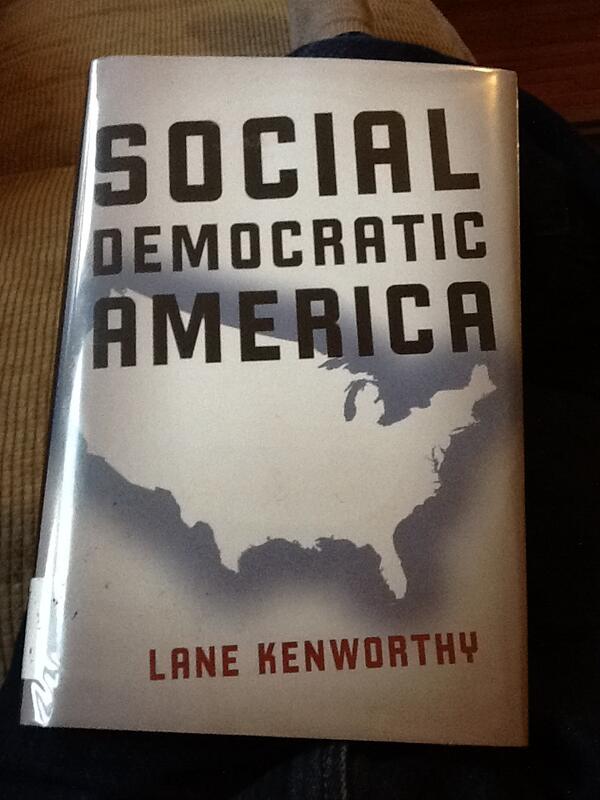
Over the weekend I finished reading Lane Kenworthy’s Social Democratic America. Kenworthy, a professor of sociology and political science at the University of Arizona, offers a clear, concise, and well-argued case for expanding the role of government in ensuring economic fairness and opportunity for all.
Kenworthy’s book is divided into four main sections: describing the problem, making the case for his preferred solutions, dealing with objections and alternative proposals, and arguing that the changes we need are not only politically feasible, but likely. In this post, I’m going to focus on the problem and Kenworthy’s proposed solutions. In future posts, I’ll look at some objections and alternatives he considers, how he thinks we can move forward politically, and finally some of my own thoughts on the book.
The problem
There won’t be much new here for anyone who has followed these debates in recent years, but Kenworthy compellingly lays out the data showing that since the 1970s the U.S. has been moving in the wrong direction. He breaks the problem into three components: economic security, opportunity, and shared prosperity.
—Security means “having sufficient resources to cover our expenses” (p. 17); lack of security is indicated by low incomes, declining incomes, and large unanticipated expenses, such as a major health event. Income insecurity has risen in the last few decades largely because of changes in the economy: increased competitive pressures arising from globalization and more demand from shareholders for constantly increasing profits chief among them.
—Opportunity does not, for Kenworthy, mean equal opportunity, which would require everyone to have the same “skills, abilities, knowledge, and noncognitive traits.” Instead, he proposes, following economist Amartya Sen and others, that we focus on maximizing people’s capacities “to choose, act, and accomplish” (p. 30). In post-1970s America, he shows, opportunity, as measured by the ability of someone from a poorer-than-average family to move up the economic ladder, has declined.
—Shared prosperity means that the economy benefits everyone, even if unequally. Most Americans probably don’t object to inequality per se, but recent decades have seen the benefits of economic growth going primarily to the top 1 percent. “The income pie has gotten bigger, and everyone’s slice has increased in size, but the slice of the richest has expanded massively while that of the middle and below has gotten only a little bigger” (p. 36).
The solution
One distinctive feature of Kenworthy’s book is that, unlike many on the left, he doesn’t necessarily think we need radical new policy proposals to address the problems he has outlined. Rather, we mainly need to build on and expand existing programs and borrow some ideas from other countries, particularly the Nordic “social democratic” ones (hence the title).*
Economic security can be enhanced by implementing or expanding programs that address low incomes, declining incomes, and large unanticipated expenses. These include the Earned Income Tax Credit, Temporary Assistance to Needy Families, unemployment and wage insurance, paid parental leave, and universal health insurance. All of these policies help compensate for fluctuations in people’s income.
To expand opportunity, Kenworthy proposes various improvements to our educational system on the grounds that “schools . . . are our principal lever for enhancing opportunity” (p. 62). These include things like free public colleges, more investment in high-quality K-12 teachers, and universal pre-K education. In addition to educational improvements, he also suggests a cash grant to low-income families in the form of a “child allowance,” reducing incarceration for minor criminal offenses, and instituting family-background-based affirmative action programs.
Ensuring shared prosperity may be the hardest problem to tackle. This is because the forces that have contributed to unequal growth are not easily reversed: globalization, mechanization, immigration, etc. Moreover, it’s not clear that it would be good to reverse these trends even if we could. Kenworthy does think the government can do more to encourage higher-wage employment by, for example, providing personalized job search and (re)training support, subsidizing private-sector jobs, and creating public-sector jobs.
But ultimately he thinks we need to accept that many of the jobs of the future will be relatively low-wage service jobs. Rather than fight this, we should ameliorate it through things like a higher minimum wage and an expanded EITC. We can also provide more public goods, including public spaces and more paid holidays and vacation time, which can improve people’s standard of living even if they don’t increase their income as such.
Kenworthy even provides his favored proposals in handy bullet-list form:
–Universal health insurance
–One year of paid parental leave
— Universal early education
— Increased Child Tax Credit
— Sickness insurance
— Eased eligibility criteria for unemployment insurance
— Wage insurance
— Supplemental defined-contribution pension plans with automatic enrollment
— Extensive, personalized job search and (re)training support
— Government as employer of last resort
— Minimum wage increased modestly and indexed to prices
— EITC extended farther up the income ladder and indexed to average compensation or GDP per capita
— Social assistance with a higher benefit level and more support for employment
— Reduced incarceration of low-level drug offenders
— Affirmative action shifted to focus on family background rather than race
— Expanded government investment in infrastructure and public spaces
— More paid holidays and vacation time
Lane Kenworthy thinks we need more public goods–like the library where I got this copy of his book.
*A note on usage: by “social democracy” Kenworthy largely means the model favored in the Nordic countries, which combines relatively free markets with robust welfare states and provision of public goods. This differs from some other uses of the term, which take “social democracy” to be virtually synonymous with “democratic socialism.” As Kenworthy uses it, though, social democracy is not wholly distinct from, but rather exists on a continuum with, what Americans typically call “liberalism.”
Politico ran a story today from conservative writer Kevin Williamson on why Senator Rand Paul’s brand of libertarian-inflected conservatism will have trouble appealing to voters.
I don’t know about the politics, but Williamson makes an interesting point about the difference between libertarians and social liberals. Libertarians are sometimes described as “fiscally conservative and socially liberal,” but Williamson says that liberals actually don’t like Paul’s brand of leave-us-alone social libertarianism:
If the fair-weather fiscal conservatives don’t like Rand Paul, the phony social liberals are going to loathe him. Here’s where the English language fails us: “Liberal” and “libertarian” come from the same linguistic root, meaning “liberty,” and many libertarians will describe themselves among friends as “classical liberals”—political heirs to the Whigs and the Manchester free-traders. But “socially liberal” and “socially libertarian” today mean almost precisely opposite things. If there is one thing our “social liberals” hate, it is liberty. In their view, you’re free to do as they please.
Take the case of the Christian bakers and photographers who do not wish to participate in same-sex weddings because of their religious and moral views. Paul takes the classical liberal view, which is that people should be allowed to make their own decisions based on their own values, and that if a baker’s belief offends you, then you can criticize him, boycott him, give him the full Duck Dynasty treatment—but you cannot use the strong arm of the state to compel him to put two tuxedoed gentlemen on top of a cake.
America’s so-called social liberals think that amounts to Jim Crow for gay people. Paul’s instinct is to get marriage entirely out of the federal tax code and to let the states define marriage for themselves. For social liberals, that is, at best, a punt. On the subject of gay marriage, they do not want a skeptical federalist—they want a president who is categorically in favor of gay marriage. They do not want somebody tolerant, but somebody committed, and willing to use the federal government to make their own preferences national policy. They don’t want marriage written out of the federal tax code—they want gay marriage written into it. They demand a pro-gay president even if, like Barack Obama in 2008 and 2010 and half of 2012, he claims to be against gay marriage for reasons of cynical political self-interest. Liberalism is a subculture; they know their own. Rand Paul isn’t one of them—and probably won’t get their votes. In fact, whether it is abortion, guns, public-school curricula or the all-important issue of dropping the federal civil-rights hammer on noncomformist bakers, Paul can count on bitter, unified opposition from liberal social-issue voters.
Minus the tendentious characterization of liberalism, I actually think Williamson is on to something here. Broadly speaking, liberals care about social equality, while libertarians care about non-interference from the government. This is why, for example, you get liberals arguing that business owners shouldn’t be allowed to discriminate on the basis of race or sexual orientation, while libertarians say that property owners should be free to discriminate in whom they serve (or hire).
Sometimes these views overlap in their policy recommendations–for example, both liberals and libertarians generally oppose locking up nonviolent drug users. But it’s worth understanding that these are based in different philosophical viewpoints. Liberals do not see non-interference by the government as the highest political good. In fact, they think that government action is often warranted to ameliorate social inequalities. From a liberal point of view, libertarian “non-interference” leaves people, particularly less powerful people, at the mercy of private concentrations of power–corporations, bosses, intolerant religious and social majorities, etc. Certainly liberals think liberty is an important good, but they don’t see government as the only, or even necessarily the main, threat to liberty.*
Incidentally, this is why I think the “fiscally conservative, socially liberal” formula is ultimately incoherent. If social liberalism is about social equality, then you can’t be a social liberal without supporting the material conditions of equality. This means not only that government may need to step in to thwart discrimination, but also that it should ensure access to the basic material conditions of participating in society on an equal footing. This includes such essential goods as education, health care, and a minimum level of income (though liberals disagree on the ideal mechanisms to provide access to these goods). Liberals and libertarians may share some philosophical forbears, but at this point they’re really different species.
—————————————————-
*It’s worth noting that J.S. Mill’s classic liberal manifesto On Liberty was in large part concerned with non-governmental forms of coercion.
 A Thinking Reed