Category: Interfaith

  • Religious pluralism revisited

    One common criticism of the pluralistic view of religions–and one that I have found persuasive–is that it presupposes a “god’s eye” vantage point that seems to be ruled out by the theory itself. That is, asserting that all religions provide a partial perspective on the divine, seems to imply that the pluralist can discern clearly the Reality that the various religious traditions perceive only dimly.

    John Hick, who probably has as large a claim as anyone to putting religious pluralism on the agenda of (Anglo-American) philosophy of religion, has a response to this objection. The pluralist hypothesis, he says, is an inductive hypothesis, founded in part on the assumption that religious experience is not illusory:

    The advocate of the pluralist understanding cannot pretend to any such cosmic vision. How then does he profess to know that the situation is indeed as he depicts it? The answer is that he does not profess to know this, if by knowledge we mean infallible cognition. Nor indeed can anyone else claim to have knowledge, in this sense, of either the exclusivist or inclusivist picture. All of them are, strictly speaking, hypotheses. The pluralist hypothesis is arrived at inductively. One starts from the fact that many human beings experience life in relation to a limitlessly greater transcendent Reality–whether the direction of transcendence be beyond our present existence or within its hidden depths. […] Treating one’s own form of religious experience, then, as veridical–as an experience (however dim, like “seeing through a glass darkly”) of transcendent divine Reality–one then has to take account of the fact that there are other great streams of religious experience which take different forms, are shaped by different conceptualities, and embodied in different institutions, art forms, and life-styles. In other words, besides one’s own religion, sustained by its distinctive form of religious experience, there are also other religions, through each of which flows the life blood of a different form of religious experience. What account is one to give of this plurality? (Problems of Religious Pluralism, pp. 37-38)

    Assuming that religious experience is to some extent veridical, Hick asks, is it more reasonable to think that one (and only one) tradition has discerned the truth about the divine, or that all the major traditions contain some truthful perception of that Reality? Hick’s argument is that the pluralistic hypothesis is the most reasonable.

    Most mainline Christians (Protestant and Catholic) no longer take the hard-line exclusivist stance that Christianity is true and other religions simply false. They also generally affirm that adherents of other religions can find salvation (though there’s a variety of accounts about how that’s supposed to work). But mainline theology has generally moved in the direction of “inclusivism.” What Hick contends, though, is that inclusivism is a logically unstable half-way house between exclusivism and a more thorough-going pluralism. His argument hinges on his understanding of the nature of salvation.

    For Hick, salvation is the process whereby we move from being self-centered to “Reality-centered.” That is, we become less preoccupied with our selves and move toward a universal compassion. Religion, then, is a vehicle for attaining salvation/liberation. And since, as seems evident, no one religion has a monopoly on this form of liberation, it seems reasonable to conclude that all religions with such spiritual and moral fruits are rooted in some kind of authentic experience of ultimate Reality. And it further seems to follow that no one religion can, on these grounds at any rate, claim to be the one unsurpassable truth.

    Religions–with their complex systems of symbol, myth, metaphysics, ritual, devotional practices, ethical principles, art, and social organization–are culturally conditioned responses to an encounter with “the Real”–an encounter often mediated through charismatic leaders and founders. What accounts the differences among religions is the diversity among human beings: their cultures, their histories, and other factors that shape their response to ultimate Reality. The Real as it appears in forms of religion must be distinguished from the Real as it is in itself. Different religions may reflect different aspects of the Real, but, as far as we can observe their effects, it would be presumptuous to assert that one is superior to the rest.

    Hick to some extent offers a pragmatic criterion of religious truth. Various culturally conditioned manifestations of the Real are true and good to the extent that they enable their adherents to move from self-centeredness to Reality-centeredness. “These many different perceptions of the Real, both theistic and non-theistic, can only establish themselves as authentic by their soteriological efficacy” (p. 44). This doesn’t mean that religions don’t make truth-claims, but that their ultimate claims–in this life at any rate–can only be evaluated by their efficacy in making salvation possible.

    I think this version of pluralism is stronger than it’s often given credit for, and Hick has responses to some of the most common objections. But one question that occurs to me is whether the “soteriological efficacy” of a particular religion depends, at least in part, on its being believed in a non-pluralistic fashion. In other words, many of the great saints of the Christian tradition seem to be those who believed most wholeheartedly in Christianity’s truth claims. By contrast, if I come to see Christianity as one among many culturally conditioned responses to the Real, might it not be harder for the Christian narrative, symbols, practices, etc. to form me in a way that makes salvation/liberation possible? Won’t I be tempted to hold them at arm’s length, having seen them as the product of human minds as much as the divine mind?

    Of course, Hick might well respond that this is simply the position that all moderately critical religious believers find themselves in. Anyone who has rejected the inerrancy of the Bible and the infallibility of church and tradition must reckon with the fact that, to some extent, their religion is man-made. It may be a response to a divine revelation, but that revelation is mediated through human language, symbols, and concepts. Wholehearted, uncritical belief just isn’t an option.
  • Priorities

    I like this, from Brandon:

    Here and there over the past few years I’ve seen a great many Christians who are of the opinion that argument with the so-called New Atheists should be a major priority among Christians, and I recently saw another instance of this. They don’t generally ask my advice, but whenever people do, I always suggest that this is exactly the wrong way to go. The fact of the matter is, however important they may seem to themselves, and however visible they may be, they are of extraordinarily minute importance in the vast concerns of the Church. Our relations with Jews, Muslims, Sikhs, Hindus, and Buddhists are all vastly more important, and our relations with our fellow Christians more important still. And of all the foes we fight in our fight against the World, the darkness of the Zeitgeist, the New Atheists are puppy dogs; it is foolish to spend our time focusing so much on the little pups that we ignore the wolves. And of all the problems we face, we ourselves are more of a problem for us than they are; particularly the absurd ease with which we all are distracted from what is truly important by the fact of who happens to have made it to the bestseller list recently, or by some other utterly frivolous thing. And what is truly important, of course, is clear: Love God and neighbor, and when we somehow fail to do so, set out again and again until with God’s grace we succeed. Everything else is hobby.

    When’s the last time you saw a serious Christian engagement with Sikhism?

  • Distinctivism in practice

    I spent the weekend in Boston attending the wedding of some good friends. The ceremony itself was a Hindu-Christian fusion, certainly a first for me–Hindu and Christian prayers, blessings, readings, and rituals were interspersed throughout. There was also a joyfulness in parts of the service that seems all too absent from much mainstream Christian worship, though I can hardly say whether or not that’s typical of Hindu worship.

    While the service was beautiful and moving, I’m not entirely sure what to make of it theologically. On the face of things, Hinduism can probably incorporate elements of Christianity more comfortably than the reverse. It seems to me anyway that Jesus could be absorbed into the Hindu pantheon more readily than Christianity can make peace with, say, prayers to Ganesh.

    On the other hand, at least as I understand it, some schools of Hinduism see the various deities as manifestations of an underlying divine reality. Could Christianity affirm the same? Parts of the Bible do portray angels as intermediaries of sorts between God and humanity, and the saints have often functioned kind of like demigods who mediate divine power (in practice if not theory).

    So, is there room in Christian cosmology for seeing Hindu deities as manifestations of the divine to a particular people, alongside God’s self-manifestation to Israel? Or maybe they could be viewed as archetypal imaginative responses to divine revelation, and not necessarily entities with an independent existence. I certainly can’t dismiss a tradition as wide and deep and ancient as Hinduism. But how does that fit with the belief that God’s definitive revelation was in Jesus?

    I think, as Christians, the best approach is not to start out assuming we know how other religions fit into God’s will for the world, but to be willing to learn from them, and even open to the possibility of being by transformed by them.

  • Pre-Christmas odds and ends

    The ATR household is off to visit family for the better part of the next week, so blogging will be light–well, even lighter than usual.

    Here’s a sampling of what I’ve been reading ’round the Web lately:

    Christopher has several posts on l’affaire Rick Warren that are, as usual, very much worth your time. (See here, here, and here.)

    Congrats to John Schwenkler, whose blog Upturned Earth has been absorbed into the ever-expanding conservative media empire that is Culture 11.

    Lynn reflects on the movie Milk and how different the atmosphere for gay rights in California has changed since the 70’s (n.b.: a couple of f-bombs).

    I thought this article on St. Joseph at Slate was neat.

    Jennifer reminds us that it’s T-minus one month till the Lost season premiere! (And don’t forget Battlestar Galactica on January 18th!)

    Alan Jacobs and Noah Millman discuss intereligious dialogue at the American Scene. This is something I haven’t given as much thought to as I’d like. (See here, here, and here.)

    Tom Engelhardt writes on publishing and reading during a downturn. Also see this: “The Tyranny of the ‘To-Read’ Pile”

    George Monbiot on peak oil.

    This is interesting: Meat Consumption and CO2 Emissions

    Not surprisingly, beef has the highest CO2 emissions per pound, but surprisingly high also are cheese and shrimp. I wonder if transportation was included in the figuring.

    This talk
    from the E.F. Schumahcer Institute was delivered in May, but it still seems entirely relevant to our current predicament.

    Finally, I’d be remiss if I didn’t bring you Christmas wishes from Ronnie James Dio (along with the rest of the Dio-era Black Sabbath line-up).

    Merry Christmas to all and to all a good night!

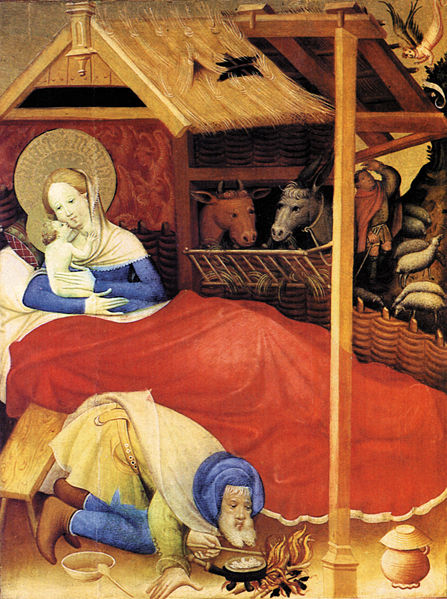
     Conrad von Soest, Nativity (1404)
    Conrad von Soest, Nativity (1404)
  • Thoughts about the Ascension and other faiths

    Today at church we observed the feast of the Ascension and our pastor preached what I thought was a fine sermon. His message, in essence, was that the Ascension is important because it shows that the love that was revealed in the life, death, and resurrection of Jesus is affirmed to be the sovereign force over all of creation. Because Jesus, as Paul says in the reading from Ephesians is now seated “above all rule and authority, power and dominion, and every title that can be given, not only in the present age but also in the one to come,” we know that the self-giving love that characterized his life and ministry also characterizes reality at its deepest level.

    Though it didn’t come up in the sermon, this got me to thinking that the Ascension (and the related feast of Christ the King) presents a stumbling block to any thoroughgoing religious pluralism. It’s one thing to affirm that Jesus is our way to the divine, a way that we have found helpful. It’s another to affirm that Jesus – the crucified and risen one – is the sovereign lord of all creation. This implies that those who don’t affirm this are wrong about a fundamental fact of reality.

    This doesn’t mean, though, that adherents of other faiths can’t perceive the power of the kind of love that Jesus embodied and, seeing it, give their allegiance to it. In fact, if they do that, they’re acting in alignment with what Christians believe to be the deepest truth about reality. Just as many theologians, including early church fathers like Justin Martyr, believed that non-Christians could have access to the logos that Christians believe was incarnate in Jesus, we can say that those who follow this path of love are in touch with the same reality that we believe was manifested in Jesus’ life and which reigns supreme over all lesser powers.

  • More on +Rowan’s lecture

    Via Fr. Chris, an in-depth analysis and defense of the now-infamous Rowan Williams “sharia lecture” by Mike Higton, a theologian and scholar of Williams’ work. As Higton says in his brief summary:

    Despite everything you’ve heard and read, the most striking thing about Rowan Williams’ lecture is that he mounts a serious and impassioned defence of ‘Enlightenment values’.

    Fr. Chris also makes the following point that’s well worth considering:

    It is always interesting — frustrating, too — to observe how Muslims are criticized illegitimately for doing things that Christians seem to be called to in some ways as well. 1 Cor 6 seems to suggest that we Christians should also avoid bringing our legal disputes into the secular realm, solving them within the Church wherever possible. The Muslim system goes further than this, so the situations are not identical. But on the face of it, I don’t see the desire to adjudicate some claims within one’s faith community — especially where there are safeguards so no one is coerced to give up their basic human rights, an important caveat in Williams’ proposal — is illegitimate.

    P.S. See also Ross Douthat and Alan Jacobs for somewhat more critical, but still intelligent takes.

  • Making room for religious law?

    There’s been a lot of blogospheric hubabaloo about this rather dry and academic lecture given by Rowan Williams on the possibility of recognizing, in some official fashion, religious legal jurisdictions within a pluralistic society. What was reported as the Archbishop appeasing Islamic extremists is, in reality, a nuanced exploration of some significant issues in the philosophy and theology of law.

    In fact, Williams’ lecture is an interesting discussion of some of the issues we’ve been batting around here, specifically the question of how particular religious identities can be expressed within a pluralistic and secular state. What Williams is exploring is the possibility that, for certain specified matters, religious believers could choose to “opt-in” to legal (or quasi-legal) arrangements based in religious principle. Which sounds to me like a form of religiously-based arbitration.

    The emphasis here is on the need to recognize that society is composed not just of individuals, but of a plurality of groups, each with their own particular identity. And that each person has plural identities in being both a citizen of the state and a member of one or more group within society. To allow people to opt-in to certain particular legal or quasi-legal frameworks is part of recognizing the reality of religious and other identities and the claims they make upon their adherents. So, a Muslim might choose to have certain issues relating to marriage or finances adjudicated by an Islamic “court” within the broader framework of the law of the state.

    Rowan is careful to note that there are potential pitfalls in making sure that all people have their rights as citizens secured and that coercion and abuse are avoided. He is insistent that there be a prior guarantee of equality before the law and a baseline morality for all citizens. And this is where his lecture seems most germane to the issues we’ve been hashing out. He sees the role of the law as “a mechanism whereby any human participant in a society is protected against the loss of certain elementary liberties of self-determination and guaranteed the freedom to demand reasons for any actions on the part of others for actions and policies that infringe self-determination.” In other words, the authority of particular communities over their members is limited by recognition of an essential shared human dignity.

    It is not to claim that specific community understandings are ‘superseded’ by this universal principle, rather to claim that they all need to be undergirded by it. The rule of law is – and this may sound rather counterintuitive – a way of honouring what in the human constitution is not captured by any one form of corporate belonging or any particular history, even though the human constitution never exists without those other determinations. Our need, as Raymond Plant has well expressed it, is for the construction of ‘a moral framework which could expand outside the boundaries of particular narratives while, at the same time, respecting the narratives as the cultural contexts in which the language [of common dignity and mutually intelligible commitments to work for certain common moral priorities] is learned and taught’ (Politics, Theology and History, 2001, pp.357-8).

    This is similar to what I’ve been calling “chastened” liberalism: it upholds the irreducible importance of self-determination and the need for a sphere of free action for the individual, but it also respects the reality of “thick” communities. It refrains from trying to loosen their bonds more than is necessary to ensure an essential measure of justice and freedom for each person as well as a kind of modus vivendi or negotiated peace between different communities within a society. This would be in contrast to a more universalizing or “crusading” liberalism that upholds a single form of life as the best for every person: the free-wheeling, unattached, cosmopolitan individual.

    Now, It’s not entirely clear to me how much freedom Rowan envisions people having “over against any and every actual system of social life.” For instance, if I can opt-in to a more restrictive religious law, can I also opt-out again? In other words, exactly how much authority does he envision ceding to religious communities? Is it possible to give communities a significant degree of autonomy while still upholding the principle that whether or not to belong to such a community is a matter of individual choice? This is, I think, the more reasonable version of the concern raised, somewhat hysterically, in some quarters by Rowan’s speech. I recommend reading the whole thing, though it is a bit dense in places.

  • The Buddha and the Christ

    Here’s an interesting piece by a lapsed Catholic who studied Tibetan Buddhism and eventually found his way back to the Catholic Church. He discusses Tibet, and the many misconceptions Westerners have about it, as well as the differences between Buddhism and Christianity.

    Partly for personal reasons and partly out of curiosity I’ve been delving into the world of Buddhism a bit myself. Here are some books I’ve read over the last few weeks that I liked:

    Sitting: A Guide to Buddhist Meditation, by Diana St. Ruth

    Zen for Christians, by Kim Boykin

    Buddhism Plain and Simple, by Steve Hagen

    I’m not sure exactly where I’m going with this, but trying to practice meditation daily has been a good discipline. And at the risk of becoming some kind of cheesy Western dilettante, cultivating an awareness in and of the present moment strikes me as a good thing to do, regardless of your religious beliefs.

  • Another view

    I don’t have anything interesting to say about Mitt Romney’s religion speech, but, as it happens, yesterday I was hanging out with an out-of-town Mormon friend. I asked him what he thought of Romney’s speech. He didn’t like it because he doesn’t think Mormonism should strive to be mainstream. He said he has never thought of himself as a Christian and doesn’t like the idea of Mormonism being subsumed under a generic quasi-evangelical Christianity. He prefers, he said, that Mormonism remain on the margins. Also, he’s a liberal Democrat who is torn between supporting Clinton and Obama and complained that Romney is betraying Mormon values with his support of “enhanced interrogation,” Gitmo, etc. Though he readily concedes that his aren’t typical views among his co-religionists.