The Chicago Tribune reports on the various–and very appetizing–ways meat is treated to make it safe.
(Via.)
I’m in the process of making this recipe for crispy tofu with bourbon BBQ sauce, and it promises to be delicious.
I found a helpful tutorial on frying tofu here.
And I’m using Bulleit Bourbon for the sauce, a spicy bourbon with a fairly high rye content.
Yum!
Interesting article from Tom Philpott at Grist on the connections between cheap food and cheap labor, and the need for the sustainable food movement to address issues of class. Key paragraph:
In short, an economy hinged on cheap labor needs cheap food. And that’s the structural problem faced by Slow Food and other would-be reformers of the food system. The challenge of food reformers isn’t just to reform the food system; it’s to reshape the entire economy—to create new economic models that revalue labor along with food, so that people can afford the revalued food.
The increased availability of cheap consumer goods has long been the justification offered by apologists for free trade, corporate globalization, and the rest of the bi-partisan economic agenda. But if, as Philpott argues, “cheap” food is not sustainable, then we need to re-think the entire premise of a cheap-goods/cheap-labor economy.
I’m obviously sympathetic to a lot of the proposals of Michael Pollan, et al., but some of what passes for criticism of our system of food production can come across as simplistic, naive, or nostalgic.
That’s why I was happy to discover the blog of historian and author Maureen Ogle who, among other things, subjects “Pollanism” and allied movements to a healthy dose of sympathetically critical scrutiny.
See here and here for two interesting series she’s written.
Ogle is also the author of the book Ambitious Brew, an unabashedly celebratory history of the big American beer makers–the sort of thing that drives beer snobs up a wall.
Ohioans will vote Tuesday on a measure to amend the state constitution and create a board of political appointees that will set standards for the treatment of farm animals. The problem, as this Mother Jones article spells out, is that any such board would be outside the normal rule-making process, immune from public comment, and is bound to be dominated by big agriculture interests, who have been the prime movers in getting this measure on the ballot.
The opposition–a loose coalition of small farmers, animal welfare groups, and even some small-government conservatives–argues that the measure would create a permanent place for special interests in the state constitution. Moreover, any measures to improve the conditions of farmed animals (like last year’s Proposition 2 in California) would have to amend the state constitution. Here’s a summary of their arguments. It’s very difficult to see this measure as anything but an attempt by a powerful and influential industry to insulate itself from pressure for reform.
California beef producer Harris Ranch Beef Co. put the screws to Cal Poly San Luis Obispo when they found out Michael Pollan was scheduled to speak there, with the company chairman essentially threatening to withhold financial support in a letter to the university’s president. The result? Instead of a speech by Pollan, the university put on a panel discussion with Pollan, a pro-industrial-ranching professor from Colorado State, and organic farmer Myra Goodman. As this editorial from the L.A. Times puts it,
Agribusiness gets plenty of opportunities to preach its point of view at agriculture schools such as Cal Poly, where the likes of Monsanto and Cargill fund research and most professors are trained in modern practices. Students seldom get to hear voices like Pollan’s, though. The university’s attempt to dilute his message in order to placate a donor is a shameful breach of academic freedom.
The vast influence that agri-business wields over agricultural schools and programs is a greatly under-reported story and a significant obstacle to meaningful reform.
A while back, the American–the magazine of the American Enterprise Institute–published an article by farmer Blake Hurst called “The Omnivore’s Delusion,” taking to task “agri-intellectuals” like Michael Pollan who have criticized industrial farming.
Here Tom Philpott points out some of the holes and omissions in Hurst’s argument. Philpott acknowledges that the sustainable food movement hasn’t grappled with some of the big, hard questions about transitioning to a different system of food production, but also points out that Hurst doesn’t address the many serious environmental impacts of industrial farming that call into question its long-term future.
I lean somewhat toward the more middle-of-the-road views espoused by folks like Paul Roberts and James McWilliams: some kind of “industrial” (i.e., large-scale, mechanized) food production is probably inevitable simply to feed people, but distinctions need to be made between sustainable and un-sustainable varieties. (For instance, a modified form of industrial grain production vs. industrial animal farming.) In other words, neither Roberts nor McWilliams sees the solution as a return to an idyllic agrarian past.
But mostly because of the prices and intolerable smugness.
Link via JL Wall at Upturned Earth.
This piece from the Boston Globe looks at the tensions between an increasing sense of idealism among zoo officials–they want to treat their animals better and raise awareness of wildlife conservation–and the undeniable need to entertain zoos’ human visitors.
James McWilliams writes on the recent report out of the UK which found that organic foods are not necessarily more nutritious than their conventionally grown counterparts. McWilliams says that this debate misses the point: organic consumers make up a tiny percentage of the population, and the categories of conventional and organic are themselves too heterogeneous for comparisons to be useful. We should focus instead, he says, on things that we know will improve our health and benefit the environment. Like eating less meat.
Derek wrote a good piece for Episcopal Cafe on what beets (and seasonal food generally) can teach us about God’s gifts.
It’s been uncharacteristically pleasant weather here for July. Today we drove to Homestead Farm in Maryland for some pick-your-own produce (blackberries and some peaches).
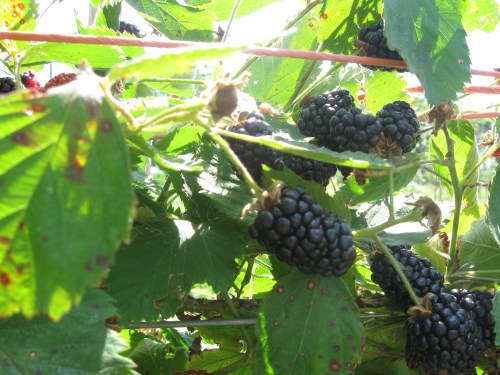
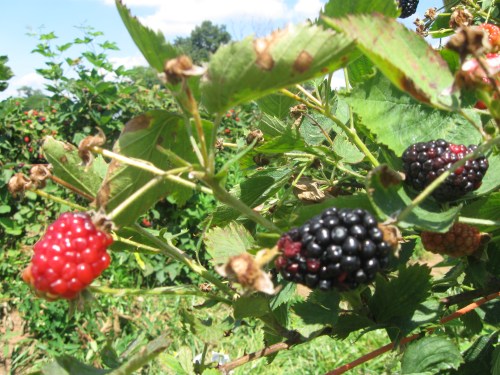
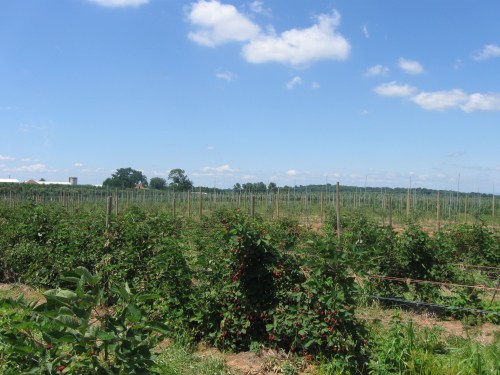

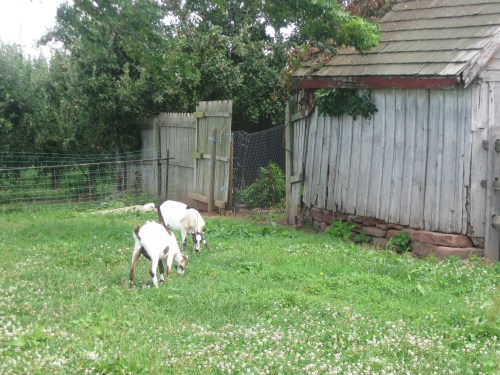
I commented on Facebook on the irony of doing something for leisure that others do as backbreaking labor. Seems a bit decadent. On the other hand, blackberries are actually pretty easy to pick, if you can avoid the thorns (which I managed to do for the most part).
 A Thinking Reed