I have always had a small-c conservative streak that makes me skeptical of utopian politics. The idea that human beings could, through their own efforts, abolish suffering, strife and injustice once and for all has always struck me as dangerously wrongheaded. Both history and my own religious tradition seem to tell pretty decisively against this kind of hubris. 20th-century communism is probably the most towering example of utopian aspirations leading to widespread human misery. Human nature is not nearly as malleable as various utopian thinkers have supposed, which tends to undercut ambitious programs of remaking society from whole cloth.
But there’s an opposite danger to utopianism, which is to become complacent about the status quo. Just because utopia in the strict sense is impossible doesn’t mean that things couldn’t be a lot better than they are. Complacency is a particular temptation for the privileged–those of us who are relatively well off materially and insulated from the more obvious forms of injustice.
On a more prosaic level, it’s increasingly evident that the fortunes of center-left political parties across the developed world have suffered in part because they no longer offer a compelling vision of the future that can inspire hope among the electorate. This dynamic played out in last year’s presidential election, where Hillary Clinton was perceived (fairly or not) as lacking the “vision thing” (as George H.W. Bush memorably called it). Her realism was ill equipped to fend off Donald Trump’s fear-mongering and grandiose promises to make America “great” again, however untethered from reality those promises were. And it’s no secret that the enthusiasm Bernie Sanders generated was due in part to his willingness to “go big” in his proposals (free college, universal health care, etc.). Again, it’s debatable whether a President Sanders would’ve been able to deliver on those promises, but he provided something like a vision of a better society and not just a series of incremental tweaks to the status quo.
There’s no easy solution to the dilemma between offering big change and staying within the bounds of political realism. Even our most transformative presidents, like Lincoln and FDR, were keenly aware of the limits placed on them by the powers of their office and the political situations they found themselves in. Nevertheless, it seems clear that without some animating vision of a good society, a political party or movement risks losing its reason for being. Maybe there is room for “utopian” dreaming about the society we want to see.
Toward that end, I really liked this article from Australian economist John Quiggin that I came across recently. Appealing to the thought of the great economist John Maynard Keynes, Quiggin argues that the left, broadly speaking, needs to reclaim a utopian vision of human beings freed from extreme material want; such freedom will allow us to enjoy ever-greater amounts of leisure and develop our distinctive capabilities.
In his 1930 essay “‘Economic Possibilities for our Grandchildren,” Keynes argued that steady economic growth would eventually solve the problem of scarcity and essentially abolish the need to work to survive. Once the age-old struggle for subsistence was solved, humans could use their newfound leisure for other, more humane pursuits.
Quiggin argues that the end to scarcity Keynes envisioned is actually achievable within the relatively near future through a combination of productivity-enhancing technological progress and social-democratic policies. This would require a shift away from the obsession with maximizing wealth and consumption that characterize what Quiggin calls “market liberalism” (and what others call “neoliberalism,” Reaganism, Thatcherism, etc.).
Under market liberalism, the gains of economic output have increasingly accrued to the very rich, while the rest of the population has seen little benefit, and certainly not the freedom from material scarcity that Keynes envisioned.
This could change with a correction in policy, Quiggin thinks:
The first step would be to go back to the social democratic agenda associated with postwar Keynesianism. Although that agenda has largely been on hold during the decades of market-liberal dominance, the key institutions of the welfare state have remained both popular and resilient, as shown by the wave of popular resistance to cuts imposed in the name of austerity.
Key elements of the social democratic agenda include a guaranteed minimum income, more generous parental leave, and expanded provision of health, education and other social services. The gradual implementation of this agenda would not bring us to the utopia envisaged by Keynes — among other things, those services would require the labour of teachers, doctors, nurses, and other workers. But it would produce a society in which even those who did not work, whether by choice or incapacity, could enjoy a decent, if modest, lifestyle, and where the benefits of technological progress were devoted to improving the quality of life rather than providing more material goods and services. A society with these priorities would allocate most investment according to judgments of social need rather than market signals of price and profit. That in turn would reduce the need for a large and highly rewarded financial sector, even in relation to private investment.
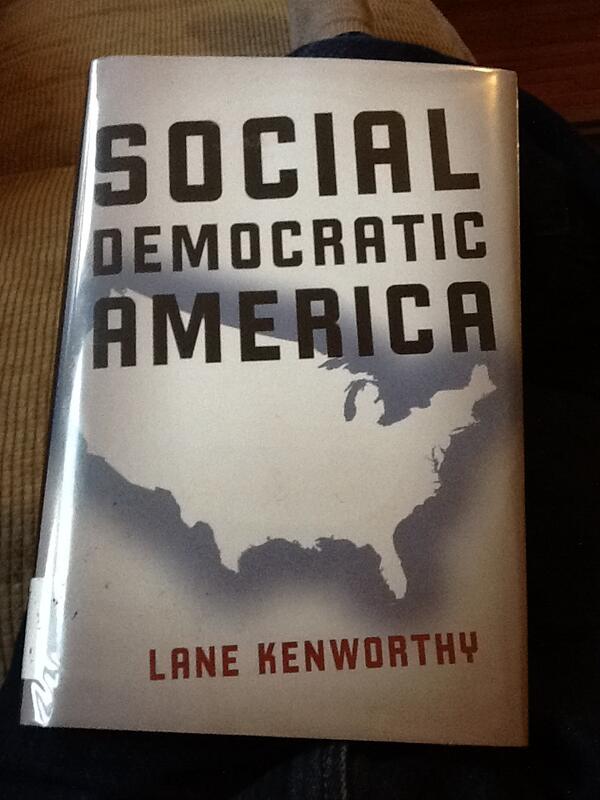
This is essentially the program of the leftward-edge of social democracy (or left-liberalism in American terms), and a kissing cousin of “democratic socialism,” depending on how one understands those terms. But it would be in the service of a particular vision–of moving beyond the “money-driven” society toward one in which human beings are free not to work and accumulate, or at least work and accumulate less. And though Quiggin doesn’t mention this in his essay, the environmental crisis calls into serious question whether a world of ever-increasing consumption and accumulation is even compatible with the continued existence of human civilization.
Yet our mainstream politics is usually afraid to step outside the terms of debate offered by market liberalism. Even left-of-center politicians (in the U.S. anyway) typically talk about citizens as workers and consumers first and foremost and tend to valorize the ulta-rich (particularly if they happen to be their donors).
But the great philosophers and religious traditions are virtually unanimous in saying that the good life for human beings consists of something other than endless work, accumulation and consumption. I’m optimistic enough to believe that many people would, if given the choice, prefer to have less “stuff” if their essential needs were taken care of and if it meant they could spend more time with their friends and family, enjoy artistic and creative pursuits, travel, appreciate nature, etc. This is hardly utopian in the sense of bringing and end to human suffering, nor does it require a revolution to tear down existing society and start from scratch (with the rivers of blood that usually entails). But it points to a dramatically different society organized around virtues that our current arrangements tend to stifle. As Keynes himself put it:
I see us free, therefore, to return to some of the most sure and certain principles of religion and traditional virtue – that avarice is a vice, that the exaction of usury is a misdemeanour, and the love of money is detestable, that those walk most truly in the paths of virtue and sane wisdom who take least thought for the morrow. We shall once more value ends above means and prefer the good to the useful. We shall honour those who can teach us how to pluck the hour and the day virtuously and well, the delightful people who are capable of taking direct enjoyment in things, the lilies of the field who toil not, neither do they spin.
Given the current state of things, even thinking about utopia seems utopian! But as the Scriptures say, “where there is no vision, the people perish.”
 A Thinking Reed