Continuing the experiment of dusting off this creaky old blog, here are the best theology books I read this year (not necessarily published this year!):
Teresa Morgan, Trust in Atonement:Teresa Morgan is a scholar of classical antiquity as well as New Testament and early Christianity, and she brings this perspective to bear in developing a new model of the atonement in this stimulating book. Taking the Greek pistis, with its connotations of “trust” and “trustworthiness,” Prof. Morgan argues that Christ is the one who God entrusts to create trust in human beings. In order to reconcile God and human beings, Jesus creates a “space” where trust can be (re-)established. God entrusts Jesus to us, even at our worst, in order to demonstrate that we can put our trust in God. This is an intriguing work that offers a genuinely fresh alternative to the typically rehearsed atonement models.
St. Athanasius, On the Incarnation: I decided to revisit Athanasius’ classic treatise this year, which remains one of the touchstones of classic Christian theology. One thing that struck me this time around was that, although Athanasius is sometimes presented as an alternative to “forensic,” “juridical” satisfaction theories of the atonement, there are elements of such accounts in his argument. For example, Athanasius says that in dying for us, Christ discharges a “debt” to God, which sounds positively Anselmian. Though it should be said that the emphasis remains on the ontological change effected through the incarnation. There are certainly arguments one could pick with Athanasius’ treatise (e.g. it says very little about Jesus’ earthly ministry and it’s not clear he has completely absorbed the point that Jesus is fully human), but it remains a lucid presentation of one of the essential truths of Christianity.
Nijay Gupta, The Affections of Christ Jesus:When there is so much niche scholarship being published on Paul, it’s nice to see someone offer an original interpretation of his thought as a whole. Gupta, professor of New Testament at Northern Seminary, argues that, as the book’s subtitle has it, love is at the heart of Paul’s theology. He applies this insight to Paul’s gospel, his understanding of Christian community, and his ethics, among other topics. “Christianity is about love” may sound trite, but Gupta’s work throws fresh light on Paul’s theology and its relevance for us.
Mildred Bangs Wynkoop, A Theology of Love: I read and discussed this book a chapter at a time with one of my good friends, who is also a deacon in the United Methodist Church. Wynkoop was a Church of the Nazarene theologian in the Wesleyan-Holiness tradition who tried to interpret the language of her tradition (“sanctification,” “perfection,” etc.) in ways that would make sense for contemporary people. One of her key insights is that doctrine has to connect with life in a meaningful way – too often theological terms become shibboleths that don’t find purchase in our actual experience. For Wynkoop, “holiness” is fundamentally about the flowering of love in our relationship with God and others. It is never a sub-personal, mechanical, or quasi-magical process; rather, it is an intensely personal relationship with the God of love.
Samuel Wells, Constructing an Incarnational Theology:This is an ambitious work that tries to reframe Christian theology around a “supra-lapsarian” understanding of the incarnation. Wells, a pastor of St. Martin-in-the-Fields in London, former Dean of the Chapel at Duke University, and author of numerous other works, applies his concept of “being-with” to some of the classic loci in Christian theology. Wells argues that, most fundamentally, God desires to be with God’s creatures and all of creation exists for this purpose. Rather than the incarnation being a “plan B” in response to sin, it is the manifestation of God’s desire to be with God’s creation. This is a provocative and original work, though I’m not 100% sold on Wells’ organizing idea of “being-with” as a kind of master key for scripture.
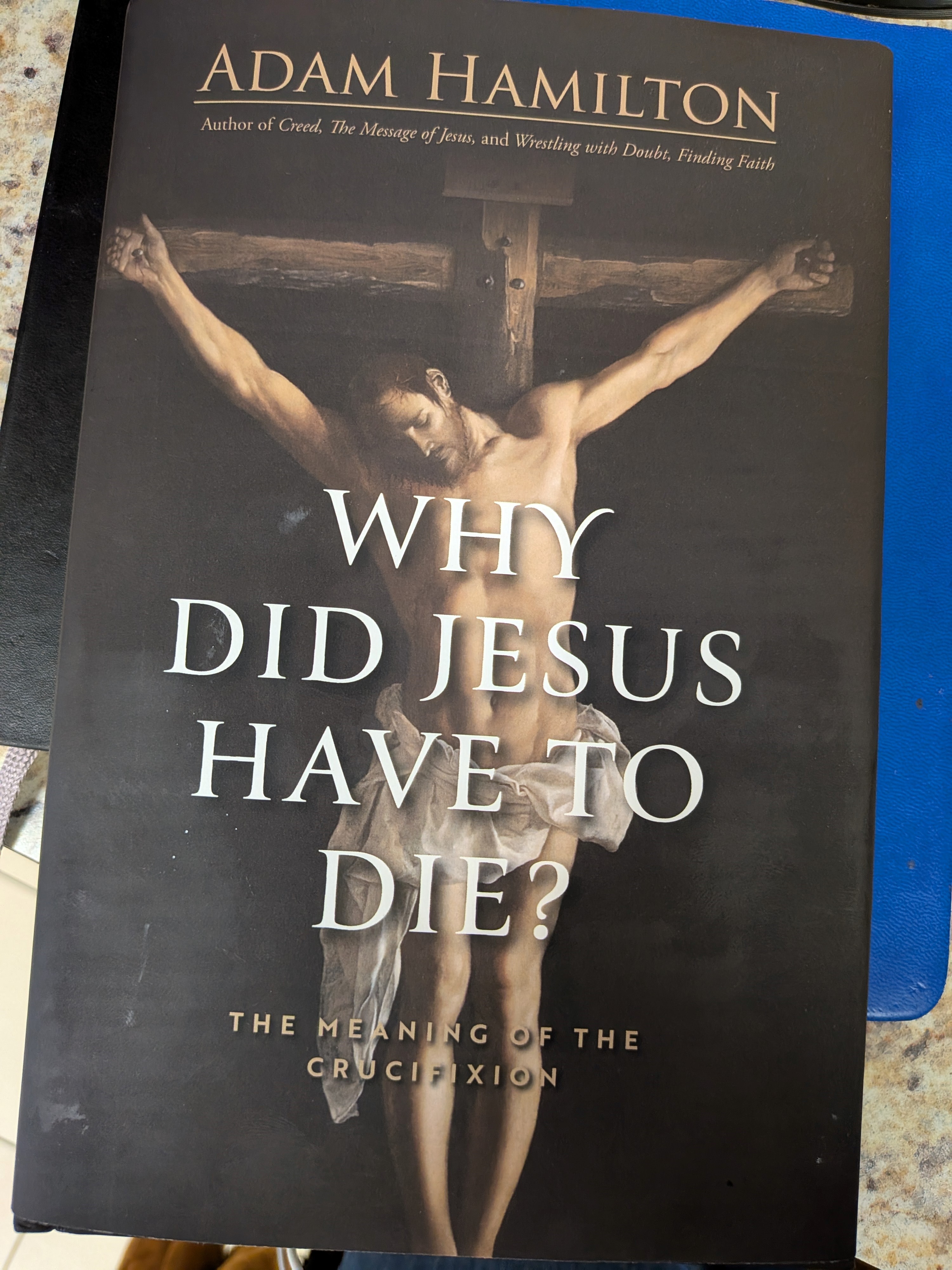
Adam Hamilton, Why Did Jesus Have to Die? See my review here!
Adam Hamilton, Why Did Jesus Have to Die? The Meaning of the Crucifixion (Abingdon Press, 2025)
Adam Hamilton is the pastor of the Church of the Resurrection in Leawood, KS, one of the largest Methodist churches in the country. He’s also the author of numerous books and bible studies where he’s tried to carve out what I would characterize as an irenic Christian orthodoxy for mainline Protestants. He’s “progressive” in the sense of supporting women in ministry and the full equality of LGBTQ+ folks in the church; but his theology is more in the spirit of a Lewisian “mere Christianity.”
I co-lead a small group at my church, and we’ve used a number of Hamilton’s books over the years. His latest book, Why Did Jesus Have to Die? is one of the more explicitly theological of his works. In it, he wrestles with several of the traditional “theories” of the Atonement – or how Christ’s death and resurrection reconcile us to God. Since this is a topic I’ve long struggled with, I was interested to see how Hamilton would approach it.
Maybe the most important move Hamilton makes is how he frames the Atonement. It’s a mistake, he argues, to treat theories of Atonement as though they describe the “mechanism” by which God effects our reconciliation. Instead, he says, we should see the cross as “God’s Word to humanity”:
Jesus incarnates God’s word, revealing God’s heart and character, God’s action on our behalf to reconcile and heal us, God’s word about the human condition, and God’s word concerning God’s will for our lives. Our task is to hear this word, to receive it, and to allow it to have its intended effect on our lives, and through us, on the world. (p. xviii)
Hamilton acknowledges that some might see this as a merely “subjective” interpretation of the cross. However, he notes “that claim fails to understand the power of God’s Word and how God works in our world”:
Throughout scripture God acts by speaking. “God said ‘Let there be light.’ And so light appeared. God saw how good the light was” (Gen. 1:3-4). God speaks and a stuttering sheepherd named Moses becomes the great deliverer. God speaks and the childless Abraham and Sarah conceive a child. God speaks through prophets and kingdoms rise and fall. Paul, as well as the writer of Hebrews, describes God’s word as a sword. But most importantly for our purposes, in his epic prologue, John describes Jesus himself as God’s Word. (p. xix)
In this perspective, the various New Testament motifs or metaphors for the salvation Jesus brings are better viewed as multifaceted images of the word God speaks in the death and resurrection of Jesus.
In the succeeding chapters, Hamilton provides an overview of various NT metaphors and the theories of the Atonement that have been built upon them. These include:
Recapitulation – Jesus is the new human archetype
Penal substitution – Jesus bears the punishment we deserve
Sacrifice – Jesus offers himself for our forgiveness
Passover Lamb – Christ delivers us from slavery and death
New Covenant – Jesus institutes a new covenant in his blood
Ransom – Christ frees us from the devil/powers of evil
Redemption – Jesus purchases our freedom
In all these cases, Hamilton thinks we can recover the power of these metaphors/images interpreted as aspects or facets of the word God speaks to us.
An instructive case study is that of penal substitution, which is both the most popular theory of atonement in some Christian circles and the most controversial in others. Hamilton offers strong criticisms of this theory as it’s often presented. These will be familiar to those who’ve followed the debate:
The idea that Jesus’ death was to appease God’s anger seems contrary to the gospel message.
It paints an unflattering image of a God who needs an innocent person to be tortured and killed in order to forgive.
It suggests God cannot forgive sin without punishment. But God is portrayed throughout Scripture as forgiving without punishment.
There are, of course, more sophisticated and nuanced presentations of penal substitution (e.g. John Stott’s The Cross of Christ). But even the most sophisticated interpretations of penal substitution tend to suggest that Christ’s suffering and death was something God needed in order to be gracious to us.
Hamilton does think, however, that the motif of Christ suffering for us can be helpful:
I believe it is we who needed Jesus’ death, not God. It was to change our hearts, not to change God’s heart. God can forgive anyone God chooses and does not require God’s Son’s torturous death in order to appease his anger.
As God’s Word, we can say that we see God demonstrating the pain he himself experiences as a result of human sin but also the lengths to which he is willing to go to save us from it. (p. 28)
I might put it this way: The cross reveals that God is always bearing the pain of our sin – and yet always offering mercy and forgiveness. The more “transactional” view suggests that there was a time when this wasn’t the case — that God had to be persuaded or paid off in order to be merciful. Attempts to salvage this by appealing to the Trintiy only get you so far, because you still end up having to say that God is paying Godself off or self-propitiating, which is an obscure idea to say the least.
Interestingly, given the reputation “moral exemplar” theories have had (almost as bad as penal substitution!), Hamilton spends to chapters expounding and defending multiple versions of this motif.
Essentially, Hamilton boils this down to two elements:
Christ provides an example of sacrificial love that we are to imitate.
Christ’s death reveals God’s loving heart to us.
It’s the second of these ideas that Hamilton says he finds the most compelling of the traditional atonement motifs. But what, one might ask, distinguishes the death of Jesus from the deaths of other heroic saints and martyrs throughout history?
What differentiates Jesus’ death … is his identity as God’s Word enfleshed. In John 14:11, Jesus said “I am in the Father and the Father is in me.” Christians believe that Jesus is the incarnation, the very embodied presence of God the Son. He is God’s anointed King. He is the Word of God enfleshed. He is God, the Son, who willingly dies not just for one person, but for all of humanity. (p. 80)
As Hamilton puts it:
[The Cross] reveals the very heart of God for humankind, and the motivation behind Christ’s death. It sees the story of Jesus as a love story portraying God’s steadfast love for humanity climaxing with the highest expression love might take — that of dying for another. When this love is experienced and accepted, it draws us to God, leads us to repentance, transforms our hearts, and, with the help of the Holy Spirit, compels us to live a life of selfless love. (pp. 80-81)
One could say that the death of Christ reveals God’s love because it was the (inevitable?) outcome of the kind of life he lived — the life of God’s love reaching out to us. God in Christ willed to be with humanity and creation, but human beings, in their sin, rejected God. However, this didn’t (indeed, can’t) deter God’s love, and God “loved his own to the end” (Jn. 13:1). (For a theology that puts God’s desire to be with us at the center, see Samuel Wells’ Constructing an Incarnational Theology.)
Fittingly, Hamilton concludes the book with an exposition of the “Christ the Victor” motif. All too often, Christian thought has separated the cross from the resurrection. This can suggest that it’s Christ’s death alone which saves us and this was the entire reason for his coming.
Through his death and resurrection Jesus overcomes the forces of evil. This doesn’t mean these forces have been destroyed — history and current experience give ample evidence that they still plague us. But the cross and resurrection demonstrate that God’s love is sovereign over these powers and they will ultimately be defeated once and for all. Importantly, this means that we can be freed from the fear of death and for works of love for our neighbors.
Summarizing, Hamilton offers some key takeaways:
Jesus didn’t have to die, but he believed God could use his death for a redemptive purpose.
Christ’s death is about forgiveness — but also more than forgiveness. It’s about transformation, new life, and victory over death, among other things.
Metaphors for atonement shouldn’t be confused with “mechanisms” that explain “how it works.”
I think some more transactional understandings of the Atonement appeal to our desire for things to be fixed through a quasi-magical act that doesn’t require anything from us. But Hamilton’s insistence that, in the cross, God is reaching out to us emphasizes the personal nature of this relationship. Ultimately, the cross and resurrection are God offering Godself to us through God’s Word, for our reconciliation, forgiveness, liberation and new life.
Someday–maybe next year, who knows?–I’ll get better about tracking the books I read. Heaven knows I read a bunch of stuff this year that has already slipped into the misty recesses of memory. But until I get my act together, I thought I’d note some books in theology and religion that stuck with me for various reasons:
Keith Ward, The Christian Idea of God (I blogged about it here.)
Amy Plantinga Pauw, Church in Ordinary Time (more here)
Charles Marsh, Strange Glory: A Life of Dietrich Bonhoeffer (technically a biography, but rich with theological significance)
Julian of Norwich, Revelations of Divine Love
While I don’t necessarily agree with all their conclusions, these were all books that made me think more deeply about various aspects of the Christian faith–the doctrine of God (Ward, Johnson), the mission of the church (Plantinga Pauw, Dueholm, Marsh), the nature of salvation (Johnson, Schmiechen) and ethics (Johnson, Schlesinger, Marsh).
Julian is, of course, in a category all her own. Not only did I re-read her Revelations, but I got to lead a discussion of her work at my church back in February, which was well received if I do say so myself. I currently have Denys Turner’s book on Julian on my shelf, which I’m hoping to get to sometime in the new year. And I may even remember something about it by next December.
I recently re-read Keith Ward’s Christ and the Cosmos, which was published in 2015, but which I didn’t feel like I really digested upon my first reading. (Not that I fully digested it this time either!)
In this book, Ward offers a multi-part trinitarian theology, fleshing out in more detail arguments he’s made elsewhere (particularly in his Religion and Creation; see here for my discussion). In doing so, he’s trying to accomplish a number of ambitious things: first, to defend a version of theism wherein God is conceived as the personal ground of being who interacts with and changes in response to the created world; second, to critique recent popular “social” accounts of the Trinity that picture God as a “society” comprising three distinct persons or centers of consciousness; and third, to explore the relationship between the “economic” and “immanent” Trinity in light of a modern scientific understanding of the universe.
Regarding the first point, Ward argues that although God’s nature is necessary and immutable, God nevertheless has certain contingent properties. This is because, since creation itself is contingent, how God relates to that creation must be subject to change. For example, God’s knowledge of the world is contingent upon features of the world that could be otherwise. If the world was different (and most of us assume it could be, at least in some respects), then God’s knowledge of it would be different. Or, as most theists have assumed, since God didn’t have to create a world, God’s knowledge, experience, etc. would be different had God chosen not to. Thus Ward sides with modern “passibilist” or “relational” forms of theism against classical theism, although he does not go as far as, say, process theology. Ward regards God as causally and metaphysically ultimate in ways that most process theologians don’t.
On the question of the social Trinity, Ward takes on some of its more prominent proponents, both in contemporary theology (e.g., Moltmann, Zizioulas and La Cugna) and analytic philosophy (e.g., Swinburne and Hasker). The argumentative thickets are fairly dense, drawing on the Bible, theology and philosophy, but Ward’s underlying contention is that it’s very difficult to provide a strong version of social trinitarianism that doesn’t end up looking like tri-theism. He argues that it’s better to think of God as a single subject—a single mind and will—that acts in a threefold way, or with three distinct aspects. He envisions God as (1) the creative source of being who (2) self-manifests in the created order as a pattern of rationality and beauty and (3) acts within created beings to unite them to Godself. This is not the ancient heresy of modalism, Ward says, because the three aspects or activities of the divine being are essential and permanent—not successive or transitory—features of the divine being. He thinks this does a better job than the social view of balancing faith in the Trinity with a proper commitment to monotheism.
Finally, Ward criticizes the tendency to collapse the distinction between the economic and immanent Trinity in recent Christian theology. Theologians are too quick, he says, to identify the Trinity as revealed in the biblical narrative with God’s inner life. He notes that some have gone so far as to say that “Father, Son and Holy Spirit” constitutes the “proper name” of God. He points out that such a name might well be meaningless to other creatures in the universe (supposing there are any), relying as it does on very earth-bound imagery. He recommends more metaphysical reserve; the Trinity as revealed still corresponds to an “inner” threefoldedness in God, but the Trinity as it appears to us cannot be simply projected into the inner divine life. The cosmos is much larger than our forebears realized, and we shouldn’t be too quick to think that the way God appears to us is universally valid.
Obviously no single book is going to settle all the controversies regarding the Trinity (and I’ve only touched on the arguments Ward deploys). But speaking for myself, I find Ward’s case for a more open-relational theism pretty appealing, as well as his criticism of strongly social doctrines of the Trinity. I also agree that Christian theologians shouldn’t be so eager to describe the “inner” life of God—Ward’s criticism of the views of Moltmann and Von Balthasar, with their suggestion of an almost metaphysical rupture between the Father and the Son, is a case in point. Perhaps it’s my Western bias, but I’m more inclined to begin with the divine unity and seek to understand how it can be threefold than to begin with three distinct “persons” or centers of consciousness.
That said, Ward himself, as a philosophical theologian, is maybe too quick to abstract from the biblical narrative in trying to describe the immanent Trinity. His triad of creative, expressive, and unitive being (he is indebted to John Macquarrie here) is suggestive, but it also smacks of the kind of speculation that he warns others against. The emphasis on the Trinity in recent theology was motivated in part, I think, by a desire to think about God in a distinctly Christian way, taking its lead from the gospels and not from a priori theorizing. While this might lead in some cases to a mistaken view of the Trinity (as I think it does in the case of Moltmann, et al.), the answer may lie in greater attention to the biblical narrative as a whole. After all, monotheism is a key tenet of Old Testament religion, which ought to inform, if not wholly determine, how Christians think about God.
Georgia Harkness (1891-1974) was a 20th-century theologian and church teacher who could hold her own with the theological bigwigs of the day (Barth, Tillich, Niebuhr) while writing accessible works of theology aimed at lay people. Her books have an almost C. S. Lewisian ability to convey profound theological ideas in lucid prose. (What she lacks in Lewis’s imaginative richness she arguably makes up for in a more solid grounding in academic theology.)
Harkness was a feminist, a pacifist, a proponent of the social gospel after it became unfashionable, and a defender of liberal theology (broadly speaking) in the face of challenges from fundamentalism and neo-orthodoxy. She called herself a “liberal evangelical”—a phrase that reflected her commitment to open inquiry and social improvement as well as a personalist evangelical piety informed by her life-long Methodism.
In her book Understanding the Kingdom of God Harkness considers the various ways Jesus’ message of the kingdom has been understood and develops her own approach, which combines many of the best elements of the others. She doesn’t fully align herself with any “school”—apocalyptic, prophetic, “realized” eschatology, Bultmannian existentialism—but finds strengths and weaknesses in each.
For Harkness, the kingdom as preached by Jesus has three key aspects: the present, kingly rule of God over all creation; our personal entry into the kingdom by accepting its ethical demands; and its future consummation. Harkness acknowledges that there was an apocalyptic element to Jesus’ teaching and preaching, and even that he may have expected an imminent end of the world, but she denies that this made up the entirety of his message. Just as important, if not more so, is the prophetic aspect of his teaching—“good news for the poor”—and the ethics of participating in the kingdom. She finds the heart of Jesus’ teaching about the kingdom in the parables, and the chapter discussing them is one of the book’s richest.
This is not to say that Harkness denies the eschatological. The kingdom is yet to be fully consummated, and this includes life beyond death for individuals, not just a this-worldly utopia. She is (wisely in my view) agnostic about the precise outlines of the eternal kingdom—will it be a “new heaven and earth”? eternal life beyond the spatio-temporal realm?—noting that the language we have in the Bible is highly symbolic and poetic. She grounds this hope in the character of God as revealed by Jesus and the biblical tradition more broadly.
Harkness laments that mainline churches have neglected the teaching of the kingdom, while the more conservative churches have turned it into apocalyptic escapism. The book was published in 1974, but I’m not sure how much has changed since then. Harkness argues that a better understanding of the kingdom can provide hope and motivate social action without leading to escapism or political utopianism. In a time when hope seems pretty fragile, Harkness’s words provide some: “What one can say in the midst of a complex and changing world is that it is still God’s world, and God is still working for good within it.”
One of my new year’s quasi-resolutions was to be a bit more intentional about recording and reflecting on the books I read. Looking back on 2016 I was dispirited by the number of books I could barely remember reading, much less had really digested.
To remedy this, I’m going to try to jot down at least a few thoughts about each book I read this year. (We’ll see how long this lasts!) Here’s what I’ve got so far:
Enns argues that we seriously misunderstand the Bible when we expect it to “behave”–that is, to answer the kinds of questions (theological, historical, etc.) we’d like it to in a straightforward, “objective” way. That’s not the kind of book the Bible is! First and foremost it’s a collection of stories that were written not to give sober, disinterested accounts of the past, but to provide meaning and direction for the people who wrote or edited them in their own time and place, and in their own social and cultural idiom.
Allowing the Bible to speak on its own terms largely sidesteps a lot of the problems raised by more literalistic, flat-footed readings. And, as Enns shows, the New Testament authors were highly creative in their own use of scripture to make sense of the events surrounding the life, death, and resurrection of Jesus. The Bible is a place where we encounter God, but it works best when we don’t try to force it to meet our expectations of what a sacred book “should” be.
Matthews argues that Thomas Jefferson represents a road not taken in American history, an alternative to the “liberal-capitalist” ethos of Madison and Hamilton. In Matthews’ account, Jefferson is not a liberal individualist in the Lockean tradition, but a “humanist,” “communitarian anarchist,” and “radical democrat” who dissented from the emerging ethos of the market society, atomistic individualism, and the leviathan state. This isn’t just an effort at historical reconstruction; Matthews thinks this Jeffersonian philosophy still has much to say to 20th (and 21st) century America. As the book’s subtitle suggests, Matthews is engaged in a self-consciously revisionist interpretation, taking issue with both “liberal” and “civic republican” portraits of Jefferson. On Matthews’ account, Jefferson is a veritable proto-socialist and apostle of “permanent revolution” in laws and property relations.
I’m not really qualified to assess the accuracy of Matthews’ reconstruction of Jefferson’s political philosophy (though aspects of it are corroborated by Joseph Ellis’s Jefferson biography American Sphinx); but it’s a stimulating alternative to what is often assumed to be Jefferson’s quasi-libertarianism or nostalgic agrarianism. One does suspect, however, that in contrasting Jefferson with Madison and Hamilton, Matthews isn’t being quite fair to the other two gentlemen, and his view of Jefferson tends toward the overly sunny (slavery gets fairly short shrift in the discussion, for example).
I also would’ve liked to see Matthews’ Jeffersonian philosophy brought into conversation with that of John Adams, the other “pole” of the American revolution (to use Benjamin Rush’s expression). In fairness, Matthews’ book came out in the 80s, before the mini-Adams renaissance of recent years, but Adams provides a contrasting example of someone who rejected Jefferson’s optimism (naiveté?) about human nature without embracing the philosophy of “acquisitive individualism” ascribed to the other founders.(David McCullough’s biography of Adams was one of the best books I read in 2016.)
This is my third, and favorite, Ishiguro novel so far. The blurb from Newsweek on the back cover of my copy–“quietly devastating”–about sums it up. It’s the story of a man who so perfectly inhabits a role that he never manages to live.
A short but rich discussion of the meaning of toleration and of the political conditions under which a diversity of race, ethnicity, religion and culture can flourish. Walzer discusses several historical “regime types” that have facilitated tolerance to various degrees, including the multi-national empire, the nation-state with an officially dominant culture, and the immigrant society. The U.S. is an example of the last, and its combination of multiculturalism and liberal individualism presents distinctive challenges in balancing the rights of individuals with respect for cultural, ethnic, and religious difference. Walzer offers insightful discussions of how this should play out over such areas as economic and social class, education, and religion, among others. In general, while he favors multiculturalism and affirmation of difference, he thinks individual rights understood in a broadly liberal sense should generally trump the rights of groups, which will inevitably lead to a certain “thinning” out of distinctive cultural/religious/ethnic ties.
At times, Walzer comes across as a bit dismissive of objections to liberal tolerance. For example, he assumes that it is straightforwardly good that conservative forms of religion will be forced, in liberal-pluralist societies, to become more accommodating over time. I happen to largely agree, but Walzer says very little that would convince a proponent of such a conservative view. (In fairness, maybe this isn’t ultimately possible.)
Moreover, Walzer argues that tolerance and multiculturalism go hand-in-hand with a commitment to greater economic equality, cutting across an often acrimonious debate in modern left/liberal political arguments. But one might well wonder whether the broadly egalitarian politics he favors can flourish among individuals with increasingly tenuous social ties. In other words, to what extent does the solidarity required to sustain social democracy rest on shared cultural and other pre-political ties? (He is aware of this latter challenge, but understandably doesn’t try to fully resolve it here.) Walzer also comes across at points as a bit too sanguine about the eventual triumph of liberal tolerance, something that recent events certainly seem to have called into question.
These quibbles notwithstanding, this book is certainly as timely as when it was published (about 20 years ago), if not more so.
I really enjoyed Rev. Adam Hamilton’s recent book Making Sense of the Bible. It’s an overview of the nature of the Bible—how and when it was written, how the books were compiled and ultimately canonized—and a persuasive effort to reconcile its very human character with its “God-breathed” status.
We mainline Christians usually emphasize that we reject “inerrancy” and other shibboleths of the more conservative churches, but we’re not always as clear about what positive role the Bible plays in our faith. Hamilton–the senior pastor of the Church of the Resurrection in Leawood, Kansas, and a prominent voice in United Methodism–distills a lot of mainstream scholarship to present the Bible as a record of people in specific contexts struggling to make sense of their experience of God and the world. He argues that “inerrancy” doesn’t do justice the nature of the Bible as we have it and as it was written.
That doesn’t mean that the Bible isn’t “inspired.” But Hamilton suggests that the inspiration at work isn’t different in kind from the way the Spirit works with people in all ages. The Spirit doesn’t override human freedom to ensure infallibility. Rather, because they were open to the Spirit, the Word of God was able to speak through the biblical authors, but not in a way that bypassed their finite human capabilities. The Bible is not “dictated” by God; it’s a record of humans struggling to articulate the revelation they have received.
For Christians, the Word of God is preeminently Jesus, the incarnate Word. The Bible is authoritative for us not because it was composed in some supernatural fashion that protects it from error (how would we know this in any event?). It’s authoritative because it contains the earliest, most authentic witness to Jesus. Accordingly, Hamilton argues that Jesus—his teachings, his life, and his death and resurrection—provide a prism or sieve for looking at the rest of the Bible.
This approach allows Hamilton to address some of the “challenging passages” of the Bible, such as those that seem to portray God as endorsing horrific violence, approve of slavery and the subordination or women, or teach things add odds with a scientific understanding of the universe. The Biblical authors (like us) were finite, sinful human beings, and they didn’t necessarily always get it right. Interpreting the Bible in the light of God’s definitive (for Christians) revelation in Jesus may lead us to set aside certain passages as no longer binding or reflecting the true character of God. (This is something Christians have always done, whether they admit it or not, most obviously in the book of Acts.)
As I said, most of what Hamilton writes is based on mainstream biblical scholarship, and his conclusions would be broadly accepted in mainline churches. It’s essentially the view that I’ve more-or-less held my entire adult Christian life (such as it is). But I’m not sure I’ve seen anyone articulate this understanding of the Bible so clearly, persuasively and accessibly.
ADDENDUM: I wrote this, on getting by without an infallible Bible, a couple of years ago, and I think it holds up pretty well. As it happens, it was inspired by an interview I read with Rev. Hamilton!
A vivid, searing exploration of religious, racial, sexual, and individual identity. An American classic.
Giovanni’s Room, James Baldwin
A very different book from Go Tell It On the Mountain, but still occupied with the nature of the self, its desires, and its self-deceptions.
Looking through the Cross: The Archbishop of Canterbury’s Lent Book of 2014, Graham Tomlin
Nothing particularly ground-breaking, but a sound and edifying set of meditations on how Christians should approach power, suffering, ambition, failure, reconciliation, and other areas of life, informed by a Luther-esque “theology of the cross.”
Past Event and Present Salvation: The Christian Idea of Atonement, Paul Fiddes
I’m not sure I’m fully convinced by Fiddes’ preference for “subjective” accounts of the atonement, but this is a helpful study of how the major models of how the cross saves (sacrifice, victory, love, etc.) can still speak to us.
I’ve just started reading, at the recommendation of Alastair Roberts, Moshe Halbertal’s On Sacrifice. I’m not very far into it, but it already promises to be quite good.
A compelling and readable (indeed, almost novelistic) account of the life and times of our 32nd president. Brands doesn’t gloss over his flaws, but I came away even more impressed with FDR’s political genius and his sincere desire to make the United States a better, fairer country.
A lovingly crafted story of the third Doctor and his arch-nemesis (and here temporary ally) the Master. Reynolds is a popular “hard” sci-fi writer, and he brings some of that ethos into this story, while remaining faithful to this particular era of Doctor Who (which also happens to be one of my favorites).
This was a re-read, and I’m still convinced this is one of the best contemporary introductions to the Christian faith. Organizing the book around the theme of the “trustworthiness” of God beautifully illuminates how the various parts of the creed hang together.
Grossman’s trilogy is a sort of mash-up of the Harry Potter and Narnia books filtered through the sensibility of a Brooklyn literary hipster. Which sounds kind of insufferable, come to think of it. But, despite the at-times aching self-awareness, Grossman manages to tell an original story about friendship and growing up infused with a genuine sense of wonder.
Heschel–refugee from European Naziism, mystic, rabbi, theologian, friend and comrade of both Martin Luther King and Reinhold Niebuhr–is a near-legendary figure. So I’m somewhat ashamed to admit this is the first time I read him. Even more, I’m sorry I waited so long. Heschel’s writing sits somewhere between poetic allusiveness and philosophical argument, but radiating at the core of this book is the insight that wonder–or what Heschel calls “radical amazement”–at the sheer contingency of being is our deepest clue to the existence of the transcendent–and to a worthwhile human life. I’m currently reading the companion volume, God in Search of Man, where Heschel lays out his vision more explicitly as a “philosophy of Judaism,” and am enjoying it even more. He is easily the religious writer I’ve been most excited to discover in years.
It seems inappropriate to call a book about a war “fun,” but Borneman’s history of the War of 1812 (meant for the general reader) is definitely written with a light touch. Borneman focuses mainly on the theaters of war (the Western frontier, the Great Lakes, the Eastern seaboard, and the Gulf Coast), and I for one would’ve liked to see a little more attention to the social and political context. But he brings to life the admirals and generals on both sides who executed the war, and deftly shows how the conflict helped put the “United” in “United States.” I knew very little about the particulars of the war going in, but after reading this, my appetite to learn more has been sufficiently whetted.
There’s a lot going on in Douglas Ottati’s Theology for Liberal Protestants–much more than I’m going to be able to cover in a blog post (or several). But as I’m nearing the end of the book, I think what will stick with me most is Ottati’s insistence on a cosmic theocentric piety.*
What does this mean? Mainly it’s about adjusting our theology and piety to the size and scope of the universe as modern science has revealed it. Christians often pay lip service to this, have we really adjusted our worldview accordingly? Many of us still think of humanity as the crowning achievement of creation, if not indeed the very reason for the creation of the entire cosmos. And we think of God’s activity as centered on the human race.
But this just isn’t realistic given what we know about the universe and our place in it. The universe is billions of years old and contains probably hundreds of billions of galaxies, themselves containing countless trillions of stars (the Milky Way alone contains something on the order of 400 billion stars) and, potentially, life-bearing planets. Add to this the fact that in all likelihood the human race will go extinct (quite possibly as the result of a self-inflicted wound) long before the universe itself winds down into a heat death or some other unimaginable final state. Taking these facts into account, it’s very heard to see humanity as particularly important to the cosmic drama. As Ottati puts it:
If all the cosmos is a stage, then it is far too vast and complex for us to plausibly consider it the stage for human history alone. Indeed, given the vast expanse of the cosmos, the staggering cosmic time frames, the astounding number of stars, planets, and meteors, the gases, chemicals, ice, and dust scattered through space, and so forth, perhaps the appropriate analogy is not a single stage but a world with many different venues, theaters, stages, and shows in many regions, cities, hamlets, and towns. (p. 227)
For Ottati, God is both the ground of the universe’s existence and the source of the processes that give it structure and coherence. And within this cosmos, humanity may be one of many “players,” and not a particularly central one. What we should hope for, he says, is a “good run”–we have our “place and time” to live out as participants in a vast, complex, cosmic ecology.
This prompts the shift from an anthropocentric to a theocentric perspective. If humans are displaced from the center of the cosmic drama, the cosmic ecology as a whole can nonetheless be seen as having value for God and as being a product of the divine creativity. This doesn’t mean that human beings don’t have a special value, but it’s as “good creatures with distinctive capacities,” not the “fulcrum . . . of all creation.” The proper religious response to this is to understand ourselves as participants in the cosmic ecology and ultimately as dependent on God as its mysterious ground and source. As Ottati summarizes it, the “chief end and vocation of human life” is “to participate in true communion with God in community with others” (p. 306).
The second, yet-to-be-published volume of Ottati’s theology will cover the traditional topics of sin, redemption, and eschatology. I’m intrigued to see how he reconciles these more down-to-earth (so to speak) topics with the wider, cosmic perspective he develops here.
———————————————–
*By “piety” Ottati means a pattern of sensibility or a general orientation toward God, self, and world.
 A Thinking Reed