Category: Bible

  • The Bible as fallen and redeemed

    Kenton Sparks’ Sacred Word, Broken Word: Biblical Authority and the Dark Side of Scripture cuts to the heart of how Christians understand revelation and the truth of the Bible. This is a more popularly pitched version of an argument that Sparks, a professor of biblical studies at Eastern University, made in his book God’s Word in Human Words: An Evangelical Appropriation of Critical Biblical Scholarship. The issue is: How can the Bible be a revelation from God and normative for Christian faith and practice when it contains passages that depict God in morally horrifying ways and ethical commands that seem downright evil, not only by modern standards, but by standards embedded in the Christian tradition itself?

    Sparks argues, correctly I think, that this presents a more difficult issue than biblical “errancy” regarding history or science. It’s relatively easy to make peace with the idea that the Bible did not adhere to modern standards of historical accuracy and that it was not meant to teach scientific cosmology or biology. However, the “texts of terror” threaten to undermine what Christians claim is the central message of the Bible: a revelation of God’s gracious character, will, and purposes for humanity and the world.

    The touchstone example Sparks uses is the story of the Canaanite genocide recorded in the book of Joshua. How can the God who commands Joshua to slaughter men, women, and children be the God of limitless compassion that Christians claim to believe in? Some of the church fathers dealt with these passages by adverting to allegorical interpretations: they should be interpreted as referring to our internal spiritual warfare against our sins, for example. Sparks argues (again, correctly, I think) that such readings will seem strained to modern readers. Instead, he says we should frankly admit that such passages are not part of God’s word, at least not directly.

    To articulate his position, Sparks draws an analogy between the “problem” of the Bible and the problem of evil as it’s usually discussed in the Christian tradition. Briefly, theologians–however much their specific approaches may differ–have generally maintained that creation is good but fallen and that the source of sin and disorder is in humanity not God. The Bible, Sparks says, is part of the fallen creation–it is not perfect or inerrant but reflects human sinfulness. “Scripture is a casualty of the fallen cosmos” (p. 66). But just as God uses fallen human beings to advance God’s purposes, God uses the Bible–taken as a canonical whole–as a medium for revelation. The Bible is both human and divine discourse.

    The inevitable question, though, is how we are supposed to distinguish the divine message from those parts of Scripture that reflect human error or sin. Sparks offers several responses to this: first, Scripture sometimes corrects itself, as in Jesus’ Sermon on the Mount, where he relativized certain parts of the Mosaic law; second, we should read individual passages in the context of the whole sweep of the biblical narrative and message; and third, we need to read the Bible in light of the ongoing activity of the Holy Spirit, the revelation of God in the natural world, the Christian tradition, and our own experience. Sparks emphasizes that most passages of the Bible admit of a surplus of meaning and we should be cautious in thinking we’ve arrived at the one true interpretation. He also points out that a key test of Christians’ Bible-reading is whether it leads to Christ-shaped lives.

    Sparks identifies, at least to some extent, as an evangelical, and much of what he says may not seem particularly controversial to mainline Christians, who generally admit that the Bible is a humanly conditioned document. But mainliners have not always been clear on what their positive doctrine of Scripture is; Sparks’ book clearly articulates a position that is honest about the text while also maintaining a “high” view of the Bible’s authority. Such a position should in principle be acceptable to a fairly broad swath of Christians, from fairly conservative to fairly liberal. My one complaint is that Sparks is vague (as he himself admits) on how he understands the Bible’s inspiration, as well as the closely related concept of revelation. For example, is the medium of revelation the text itself, an overall message or regula fidei derived from the text, or the events that the texts witness to? But on the whole, I’d recommend this book as a sane and balanced approach to a difficult topic.
  • Literalism vs. inerrancy

    I’ve been reading The Scope and Authority of the Bible by biblical scholar James Barr, and in it he clarifies something I’ve been thinking for a while. Barr wrote a well-known book on fundamentalism, and one of the essays in Scope… deals with fundamentalism.

    The point Barr makes is that, contrary to what is often said, fundamentalism doesn’t mean reading the Bible “literally.” Rather, its distinguishing mark is a doctrine of inerrancy that is frequently at odds with a literal reading:

    It is often said that fundamentalists are ‘people who take the Bible literally’. This however is a mistake. Fundamentalist interpretation concentrates not on taking the Bible literally, but on taking it so that it will appear to have been inerrant, without error in point of fact. Far from insisting that interpretation should be literal, it veers back and forward between the literal sense and a non-literal sense, in order to preserve the impression that the Bible is, especially in historical regards, always ‘right’. . . . It is the inerrancy of the Bible, especially its truth in historical regards, that is the fundamentalist position, and not the notion that it must always be interpreted literally. (pp. 77-8)

    We might think, for instance, of the strained attempts to “harmonize” the four gospels or to assemble the eschatological passages of the Bible into a coherent “end times” narrative.

    By contrast, Barr says,

    It is the critical interpretation of the Bible that has noticed, and given full value to, the literal sense. In this sense, as Ebeling and others have noticed, the critical movement is the true heir of the Reformation with its emphasis on the plain sense of scripture. It is precisely because of its respect for the literal sense that critical scholarship has concluded that different sources in (say) the Pentateuch, or the gospels, must be identified. . . . Characteristic conservative treatments, as I have shown, depart from the natural meaning of the texts in order to force upon them an apologetically-motivated harmonization which will evade the fact of the contradiction. (p. 78)

    In short, fundamentalism, Barr says, refuses to take the Bible as it is, but instead presents a homogenized version that fits safely into a preexisting theological scheme. (The appeal to the “original autographs” is another example of rejecting the Bible we have for an idealized one.) It’s noteworthy that the doctrine of inerrancy doesn’t arise directly from anything the Bible claims for itself, but has usually been imposed on the it as a conclusion from a theological argument about the kind of Bible God must have produced.

  • Evolution and “making God the author of evil”

    I’ve argued before that the question of a “historical” Adam and Eve and the related question of a “historical” Fall is not a “gospel issue.” That is to say, universal human sinfulness is such a self-evident fact that the question of its origin is secondary. The gospel speaks to this phenomenon of universal sinfulness with its offer of universal grace.

    But as Richard Beck points out in a thought-provoking post, the hard problem evolution poses for orthodox Christian theology isn’t one of soteriology (what are we saved from and how are we saved) but one of theodicy (how can an all-good God permit such evil as we see in our world). Beck is responding to a critique of evangelical scholar Peter Enns’ book The Evolution of Adam by neo-Calvinist theologian James K.A. Smith. Briefly, Smith doesn’t think Enns takes seriously enough the importance of the orthodox doctrine of the Fall. And Beck thinks that Smith may be right that Enns, by focusing on the origin of humanity, may overlook the broader context that brings the theodicy issue to the fore.

    The problem is this: if the evolutionary story of how life came into being is right (and it’s cleary the best account going), then it looks like evil (suffering, death, sickness, predation, etc.) is built into creation so to speak. In other words, if God uses evolution to bring life into existence–as “theistic” evolutionists contend–then it seems that God is directly responsible for the evil that attends this process. And if that’s so, then can we say that God is truly wholly good?

    Beck argues that the point of the traditional doctrine of the Fall isn’t so much to account for human sinfulness as it is to safeguard God’s goodness by exculpating God from responsibility for the existence of evil. He goes on to point out, however, that the orthodox story isn’t quite as air-tight in safeguarding God’s goodness as we might think. He notes, for instance, that in the Bible the serpent (representing evil?) is already present in the garden, tempting Adam and Eve. No account is given of its origin. Only much later was the story of a “fall” of Satan and his angels from heaven posited as a kind of prequel to the Adam and Eve story. And needless to say, this just pushes the problem back a step–after all, whence comes the angels’ propensity toward sin? St. Augustine, for one, rather famously wrestled with this question and never reached a wholly satisfactory solution.

    Beck concludes:

    At the end of the day, theodicy doesn’t really boil down to the origins of evil. It boils down to this: Why’d God do it in the first place? Why, given how things turned out, did an all-knowing and all-loving God pull the trigger on Creation? Why’d God do it?

    No one knows of course. Not Smith. Not Enns. Not me. My point here is simply to note that this is a live and acute question for everybody. So I think it right and proper for Smith to point this out for Enns. But the same question is pointed at orthodox theology and it doesn’t have any better answers, just a “mystery” that allows it, often in cowardly ways, to retreat from answering the questions directly.

    Theodicy has always been the root problem of Christian theology, orthodox or heterodox. There’s no getting around that. The problem is no less acute here than there.

    Readers may be aware of my ongoing interest in this problem. For instance, in my blogging on Christopher Southgate’s book on animal theodicy, I discussed his “only way” argument. This is the argument that creating by means of an evolutionary process–with all that entails in terms of evil and suffering–was the only way for God to get creatures like us in the context of a law-governed universe. God is “off the hook” as it were because there was no other way for God to achieve his ends. Whatever problems there may be with this view (and there are some), it does try to account for evil in a way that doesn’t make God the author of (avoidable) evil. But as Beck says, this is a challenge for all theology, whether it accepts evolution or not.

  • Is belief in a historical Adam a “gospel issue”?

    I came across this post by James McGrath–“Ten Really Bad Reasons to Believe in a Historical Adam“–which was a response to a post by Reformed blogger Kevin DeYoung arguing for the necessity of belief in a historical Adam.

    One reason DeYoung offers that I’ve seen emphasized elsewhere is that without belief in a historical Adam and a historical “Fall,” there is no need for the gospel.

    Here’s DeYoung:

    9. Without a historical Adam, Paul’s doctrine of original sin and guilt does not hold together.

    As James McGrath points out, there’s a bit of sleight-of-hand going on here when DeYoung refers to “Paul’s doctrine of original sin and guilt.” The traditional Reformed doctrine of original sin and guilt is one–and certainly not the only–interpretation of what Paul thought.

    That traditional Reformed view holds that from Adam’s original sin of disobedience the rest of humanity has inherited both a propensity toward sin and the guilt of that sin, which merits eternal damnation. Only, the story continues, by pleading the Atonement of Christ can we be delivered from that guilt and its attendant punishment.

    But if you don’t think this is an appropriate interpretation of the biblical teaching, then the alleged necessity of positing a historical Adam disappears. For example, the Eastern Orthodox churches don’t teach the doctrine of “orignial guilt” as formulated by, say, Augustine and the Reformers. They acknowledge that humanity has an innate tendency toward sin, but this isn’t the same thing as saying that we’re guilty for something Adam did.

    In fact, even leaving aside historical or biological considerations, the idea that God “imputes” Adam’s guilt to the rest of humanity is objectionable on moral grounds. How can it possibly be just for God to hold people accountable for–to the extent of condemning them to eternal hellfire–something over which they had no control and in fact happened before they were even born? You can avoid this problem by embraciing a voluntarist conception of divine goodness, but that’s a price many people aren’t willing to pay.

    What’s really puzzling to me about a view like DeYoung’s, though, is that it seems to imply that we need a historical Adam in order to recognize our need for salvation. But people don’t respond to the gospel because they’ve already accepted some theory about original sin; they respond to it because it addresses our experience of evil, suffering, and guilt. In other words, if someone asks “How do you know we need saved?”, the answer is “Look around!”

    You don’t need to believe in a historical Adam to see that the human situation is in need of healing. The human predicament is one of subjection to suffering and evil, and complicity in the ongoing cycle of victimization and violence. And the Christian gospel is that, in Jesus, God has done something about this situation: specifically, God has revealed and enacted the divine love and forgiveness, has come to share our life and our sufferings, has reconciled humanity to the divine nature, and has raised human nature to eternal life. As far as I can see, the truth of this doesn’t depend on accepting a particular theory about the historical existence of Adam or the origin of sin.

  • Gospel meditation for Advent 2

    Reading: Mark 1:1-8 (Common English Bible)

    The beginning of the good news about Jesus Christ, God’s Son, happened just as it was written about in the prophecy of Isaiah:

    Look, I am sending my messenger
    before you,
    He will prepare your way,
    a voice shouting in the wilderness:
    “Prepare the way of the Lord;
    make his paths straight.”

    John was in the wilderness calling for people to be baptized to show that they were changing their hearts and lives and wanted God to forgive their sins. Everyone in Judea and all the people of Jerusalem went out to the Jordan River and were being baptized by John as they confessed their sins. John wore clothes made of camel’s hair, with a leather belt around his waist. He ate locusts and wild honey. He announced, “One stronger than I am is coming after me. I’m not even worthy to bend over and loosen the strap of his sandals. I baptize you with water, but he will baptize you with the Holy Spirit.”

    When I re-read this passage this week, the phrase that stood out to me was Isaiah’s “Prepare the way of the Lord.” Because that’s a big part of what Advent is about, right? Preparing for the coming of the Lord.

    Like Lent, Advent is intended to be a penitential season. “Penitential,” of course, comes from the same root as “repent” and “repentance.” And “repent” in the Bible is often the English translation of metanoia–which scholars tell us means something more radical than simply feeling sorry for one’s sins. It denotes something more like a fundamental change in the direction of one’s life.

    According to Mark, John was calling people to be baptized “to show that they were changing their hearts and lives and wanted God to forgive their sins.” Changing our hearts and lives gets, I think, at the meaning of metanoia–and at the meaning of Advent as a time of preparation.

    “Prepare the way of the Lord”–we can also read this, I think, as “Make room for the Lord.” If God is going to come into our world, there needs to be a “place” for God to be. But we tend to fill our lives and our world up with other things. Many of us, if we reflect on it, find that this is particularly–and ironically–true around the holidays. Our days are so frantically filled with shopping, parties, and school and work events that we feel we’re missing “the reason for the season.”

    God wants to be in our world, and we need to “prepare the way.” But the mystery of the Incarnation is that God, in entering our world, becomes vulnerable. The Son of Man has nowhere to lay his head. Eventually, we shove God out of our world by killing him. God’s being in the world depends, in some way, on our response.

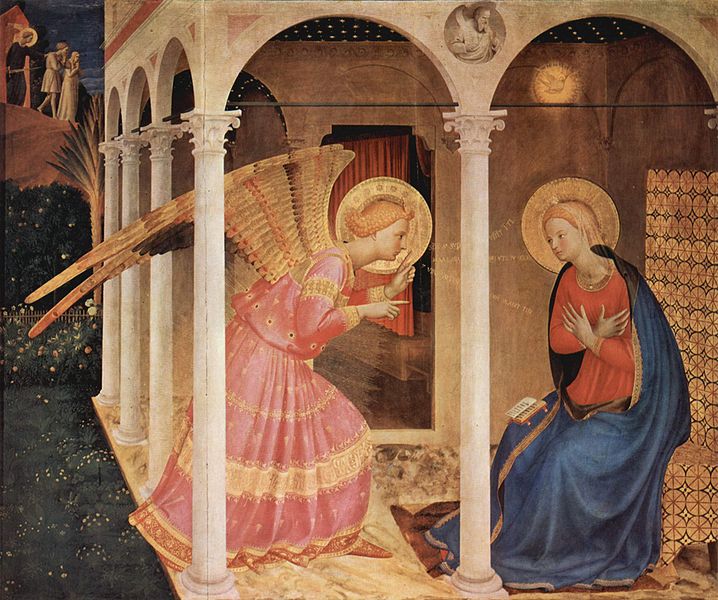
    What’s the alternative? Taking both the notions of metanoia and “making room” for God as keynotes of Advent, maybe part of that “change of life and heart” is to find ways to “make a place” for God in our lives and world. And maybe we can get some help for this by looking to the one the Christian church has always upheld as the paragon of discipleship. In assenting to God’s invitation to bear the Redeemer, Mary–literally!–makes a place, or a way, for God to be in the world. As Lutheran theologian Robert Jenson has written,

    To what did Mary, after all, assent, when she said to Gabriel, “Fiat mihi,” “Let it happen to me”? Of course it was her womb that with these words she offered, to be God’s space in the world. The whole history of Israel had been God’s labor to take Israel as his space in the world. And it indeed was a labor, for Israel by her own account was a resistant people: again and again the Lord’s angel announced his advent, begged indeed for space, and again and again Israel’s answer was “Let it be, but not yet.” Gabriel’s mission to Mary was, so to speak, one last try, and this time the response did not temporize. (“A Space for God,” in Mary, Mother of God, pp. 55-6)

    The Bible also tells us that Mary “pondered these things in her heart.” Mary’s receptivity and responsiveness go hand-in-hand with her contemplativeness. The penitential practices of Lent and Advent–fasting, Bible reading, prayer, and almsgiving–are intended, among other things, to foster this sense of contemplation and receptiveness by “emptying” us of the things we fill our lives up with. Like Mary, we empty ourselves in order to make a space for God.

    Collect for the Second Sunday of Advent:

    Merciful God, who sent your messengers the prophets to preach repentance and prepare the way for our salvation: Give us grace to heed their warnings and forsake our sins, that we may greet with joy the coming of Jesus Christ our Redeemer; who lives and reigns with you and the Holy Spirit, one God, now and for ever. Amen. (from the Book of Common Prayer)

    (As noted in my introductory post, the first person who comments on this post will be eligible for a free softcover copy of the Common English Bible.)

  • Common English Bible blog tour

    After I posted and tweeted about the new Common English Bible, I was invited to participate in a “blog-tour” for the new translation. I don’t think this makes me particularly special; it seems anyone who wants to can participate. In any event, what participating bloggers are asked to do is to post entries during the next few months that make use of the CEB in some way or another–such as commenting on Bible verses or discussing the translation. While the guidelines are quite flexible and there’s no minimum number of posts required, I should note that the publisher provided me with a complimentary thinline copy of the CEB.

    What I thought I’d do to participate is adapt a practice from a small group I was in a few years ago. We would meet on Wednesday evenings to read, reflect on, and discuss the gospel lesson for the upcoming Sunday. So my plan, during Advent, is to post on the appointed gospel lesson for the upcoming week (as determined by the Revised Common Lectionary). These will be loosely structured meditations based on my response to the text. It should be a nice way to “test drive” the CEB and a good spiritual discipline for me in its own right. My plan is to post these on Wednesdays during Advent (I realize I’ve already missed a week).

    The publisher also says that I can give away one free softcover copy of the CEB every week that I write a post participating in the blog tour. I figure that it would be fairest for it to go to the first person to comment on that week’s post. So, the first person to comment who wants one will need to provide their mailing address to me in an e-mail, which I’ll forward to the publisher.

  • The miracle of King James’ Bible

    Here is the miracle of the King James Bible in action. Words from a doubly alien culture, not an original text but a translation of ancient Greek and Hebrew manuscripts, made centuries ago and thousands of miles away, arrive in a dusty corner of the New World and sound as they were meant to—majestic but intimate, the voice of the universe somehow heard in the innermost part of the ear.

    You don’t have to be a Christian to hear the power of those words—simple in vocabulary, cosmic in scale, stately in their rhythms, deeply emotional in their impact. Most of us might think we have forgotten its words, but the King James Bible has sewn itself into the fabric of the language. If a child is ever the apple of her parents’ eye or an idea seems as old as the hills, if we are at death’s door or at our wits’ end, if we have gone through a baptism of fire or are about to bite the dust, if it seems at times that the blind are leading the blind or we are casting pearls before swine, if you are either buttering someone up or casting the first stone, the King James Bible, whether we know it or not, is speaking through us. The haves and have-nots, heads on plates, thieves in the night, scum of the earth, best until last, sackcloth and ashes, streets paved in gold, and the skin of one’s teeth: All of them have been transmitted to us by the translators who did their magnificent work 400 years ago.

    Read the rest here.

    I don’t think Christians should rely on the KJV as their primary translation, but there’s no denying its beauty and its importance, both religiously and as a shaper of the English language.

  • The Common English Bible–a new translation

    My dear wife got me an Amazon Kindle for my birthday, which I’ve been enjoying immensely. Poking around in the Kindle store, I decided I should download a version of the Bible. But which one? I usually read either the New Revised Standard Version or the Revised English Bible. But the Kindle version of the NRSV hasn’t been released yet, and I didn’t see one for the REB.

    Then I came across the Common English Bible. I hadn’t previously heard of it, but after a little investigation I discovered that the translation was just completed this year under the auspices of publishers associated with the Episcopal Church, Presbyterian Church (USA), United Methodist Church, Disciples of Christ, and United Church of Christ. The translation was made by scholars from “22 faith traditions,” according to its website, and is intended to be a Bible for “the whole church of Jesus Christ.”

    The intention of the CEB is to preserve the scholarly accuracy comparable to the NRSV while being more readable for the average person in the pew. It seems that it’s intended to fill a niche for mainliners similar to that of the New International Version in the evangelical world. Interestingly, Fuller Theological Seminary, the big evangelical seminary in Southern California, has approved the CEB for official use among faculty and students, replacing the NIV. It seems that the school was not pleased that the 2011 version of the NIV–which will replace the TNIV–is a less-gender-inclusive translation, and it determined that the CEB was a good alternative.

    In any event, I haven’t really dipped into the CEB much yet, but I’m looking forward to experiencing the Bible in a fresh translation. (Also, it was only about $5.00 for the Kindle version!)

  • Communicating the gospel after Christendom

    I urge everyone who cares about these things to read these two posts from bls at The Topmost Apple on how the church is dealing (or not) with our current “post-Christendom” situation. She makes two main points: first, the church often acts like it has nothing very interesting to communicate, and, second, what it does communicate is too often encased in impenetrable religious jargon that is meaningless to a lot of people. She thinks that the gospel carries the explosive truth about the human situation, but the churches are afraid, unwilling, or unable to offer that to people:

    I think the Gospels – and Paul – are making some really convincing claims about the facts of the world and the human condition – and that A.A. has (re-?)discovered some of these things almost by accident. I think Luther was really onto something in his parsing of “Law” and “Gospel”; it has taken me a couple of years to come to understand more about this-but it’s real. It’s true-and it’s actually backed up by quite a lot of real-world evidence. This kind of thinking really does change your point of view – and it’s philosophy as much as religion, really. It’s got legs.

    We need to be able to say these things to people who do not know our language already – and we need to offer people who do know the language a way for the faith to remain vital and alive – to continue to offer sustenance and excitement – in and for them, too. We need to make a case. “Mystery” and “mystification” are two completely different things; we really can retain the former and eliminate the latter, I believe. It’s clear to me from years of discussions about these things that many people are interested in religion – but just can’t get with some of its manifestations (mentioned above). And of course, we have the problem of some of the …. erm ….. more extravagant claims of the Christian faith (sometimes called “believing six impossible things before breakfast”). So I do not believe we can count anymore, my friends, on Christianity being “believed in” as it’s been “believed in” in the past. We are going to have to assume that many (most?) people will not be convinced about these “impossible things” much anymore – and we’re going to have to depend far more on Christianity’s fascinating unveiling of counterintuitive ideas and mystical insights.

    In a related vein, Ben Myers at Faith and Theology writes on the limitations of preaching from the lectionary:

    There’s a lot to be said for the use of a lectionary cycle. But the lectionary tends to presuppose, rather than to foster, a broad understanding of the biblical story. Lectionaries were designed for use in societies that were already implicitly Christian – societies in which the rhythms of the liturgical year, and the broad sweep of the biblical narrative, could be more or less taken for granted. In the Revised Common Lectionary (which my own church follows), just look at the theological subtlety with which the OT and NT readings are often connected: a subtlety that is quite lost on anybody without a good working knowledge of scripture and liturgical tradition. And preachers only exacerbate the problem when they take these subtle liturgico-theological connections as the theme of their proclamation, instead of preaching from the texts themselves. (Preachers, please note: the content of your proclamation is not the liturgical calendar, but the Word of God!)

    I think most churches–primarily in the U.S. and European context–have still not come to grips with the fact that a large number of people no longer consider religion particularly important or interesting. Not that they necessarily reject it passionately like the new atheists; they just don’t see why they should be much concerned about it at all. Moreover, they don’t necessarily have the background familiarity with the Bible, the church, and Christian claims that might once have been taken for granted. Those of us who take a special interest in theology and religion, either as professionals or amateurs, tend to become embedded in the language, history, and arcana of the church. As a result, we lose sight of what all this must look like to someone on the outside. If we believe that the gospel offers people something decisive and meaningful for their lives that they can’t get (or maybe more modestly aren’t getting) elsewhere, we have to find ways to communicate it. In a way, this is just a recapitulation of the insight of theologians like Paul Tillich and Dietrich Bonhoeffer: we have cordoned off matters of faith to a special “religious” sphere; but if the gospel is true, its truth is for our “secular,” ordinary, quotidian lives.

  • The God of Israel and the King Jesus gospel

    Scot McKnight of Jesus Creed (the book and the blog) has a new book out called The King Jesus Gospel, which purports to recover the “original good news.” What does this mean? I haven’t read the book, but on his blog, McKnight says that the way we typically think about the gospel–as a scheme for individual salvation–is unfaithful to the witness of the New Testament. He calls this the “soterian” gospel. But the gospel as presented in the earliest preaching of the church is a “story gospel”:

    The soterian gospel and the apostolic gospel are framed differently; the soterian gospel frames everything by elements by elements in the doctrine of salvation. The apostolic gospel frames the gospel as Israel’s Story coming to fulfillment in Jesus as King (Messiah) and Lord who saves. Hence, one frames things as the plan for personal salvation; the other frames things as a Story come to its completion/fulfillment in Jesus who saves.

    The soterian gospel says that Jesus is fundamentally about how individuals “get right with God.” By contrast, the story gospel (which McKnight maintains is the original, apostolic gospel) is a more communal-corporate story about God’s plans for creation and how they’re fulfilled through the story of Israel; the life, death, and resurrection of Jesus; and the calling of the church as a corporate body to witness to God’s kingdom.

    What strikes me here is the similarity between what McKnight is trying to do and R. Kendall Soulen’s reconstruction of the Bible’s “canonical narrative” in The God of Israel and Christian Theology. Like McKnight, Soulen is trying to re-frame the gospel as a story about God’s program of blessing-in-difference for all creation–a story in which individual sin and redemption play a subordinate role. And both shift emphasis from a supposedly “universal” scheme of human sinfulness and the need for redemption to the particular history of God’s covenant with creation and specifically with the people Israel as the means through which God’s purposes are realized. I’d be interested to see if there are further parallels or if McKnight is explicitly influenced by Soulen’s work here.