Category: Bible

  • Consider the beasts

    Death Before the Fall: Biblical Literalism and the Problem of Animal Suffering, Ronald E. Osborn (IVP Academic, 2014)
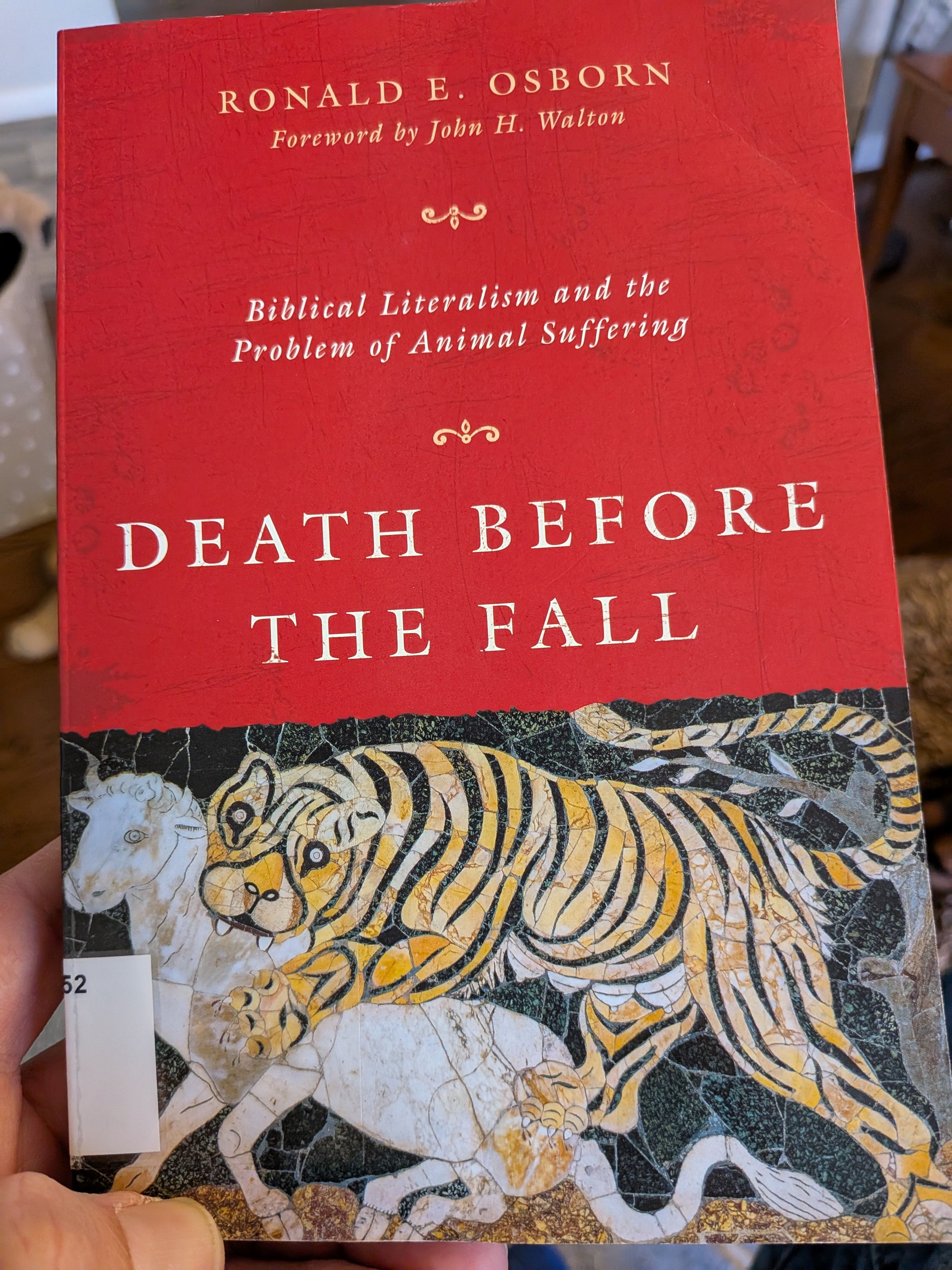
    Much traditional Christian theology has taught that death and suffering entered the world when Adam and Eve fell into sin. Prior to the fall, many theologians have assumed, the world was free from suffering, sickness and death — and this included the nonhuman world. The prelapsarian world, on this account, was free from predation, parasitism, natural disaster and anything else that causes suffering in the animal kingdom. It was humanity’s sin that, somehow, resulted in all of creation being cursed, leading to the widespread suffering and death that is so evident in nature.

    One advantage of this account is that it, at least ostensibly, exempts God from any moral blame for the suffering of the non-human world. If animal suffering is the result of human sin — either as a penalty or through some more metaphysical connection — then creation as originally made by God did not include these morally troublesome features. God made creation perfect; it was humans who messed it up.

    However, one of the downsides of the traditional view is that it seems to conflict with the well-established findings of modern science. Not only evolutionary biology, but geology, paleontology, and other disciplines, seem to have established beyond a reasonable doubt that death, along with predation, parasitism, natural disasters, and their attendant suffering, long preexisted the appearance of humans on the scene. Accordingly, any theology that wants to make its peace with evolutionary science seems to be presented with a heightened theodicy question: Why would a good God create a world that contains so much animal suffering?

    In Death Before the Fall, Ronald E. Osborn, a scholar and theologian working out of the Seventh-Day Adventist tradition, wrestles with the problem of animal suffering in the context of a rejection of biblical literalism and creationism. This may seem somewhat counterintuitive given the Adventist Church’s affirmation of a literal, six-day creation. But Osborn is one of a number of Adventist scholars who dissent from his church’s official teaching on this point.

    In fact, Osborn spends over half of the book critiquing young-earth creationism and the literalist-fundamentalist readings of the Bible that support it. He argues that creationism ironically adopts an enlightenment-modernist model of knowledge and expects Scripture to conform to the same canons of evidence and factuality as modern science. However, creationism proceeds in a deductive rather than inductive fashion: a literalist reading of the creation story is treated as an unassailable foundation that can’t be questioned. Any facts that seem to contradict it either need to be denied or explained away via increasingly byzantine auxiliary hypotheses.

    This is both bad philosophy and a bad reading of scripture, according to Osborn. For example, he highlights some of the mental gymnastics creationists resort to in order to render the two creation stories in the first chapters of Genesis into one seamless account. These are hardly the result of a “plain” reading of the text!

    Not only does Osborn critique the intellectual supports of creationism, but he also argues that it leads believers into a quasi-gnostic enclave mentality in which any dissent is treated as the first step on the slippery slope to apostasy.

    Osborn has a high view of the inspiration and authority of scripture, but he maintains that this is consistent with reading the creation stories as symbolic-metaphorical narratives (or “saga” to use Karl Barth’s term). He marshals witnesses from history — Augustine, Maimonides, Calvin and Barth — to show that faithful believers have had a range of views on how these stories should be interpreted.

    For me, this was mostly well trod ground since I’ve never been particularly tempted by biblical literalism or been part of a tradition that taught it. But Osborn’s thorough critique allows him to clear the ground for the problem of how, if we reject creationism and a “deathless” prelapsarian world, to reconcile the violence and suffering of nature with the goodness of God the creator.*

    Wisely, in my view, Osborn doesn’t claim to offer an airtight defense or a knock-down solution to the problem of evil. Rather, he points to resources in scripture and tradition that indicate an alternative way of thinking about God’s relationship to creation.

    These resources include the idea of a “cosmic” fall demonic powers as articulated by C.S. Lewis (which is at least in theory consistent with cosmic history as science tells it), the depiction of an untamed creation that is nevertheless loved by God in the book of Job, and the self-emptying life of Jesus as a clue to how God relates to creation. Readers will likely vary in how persuasive they find these responses — but I think the picture that emerges is broadly consistent and appealing. Osborn sees God as creating a “space” where creation can operate according to its own immanent principles, which allow for the possibility that suffering could emerge as a concomitant of these processes. Nevertheless, God works from within creation to draw it toward its fulfillment, and that action is characterize by the “cosuffering humility, nonviolent self-limitation and liberal self-donation” exemplified in Jesus.

    This could be described as a version of the “free process” defense (analogous to the “free will” defense) articulated by John Polkinghorne and others. Essentially, it says that creation has a real, albeit limited, autonomy because God recognizes that it is a great good for created beings to exercise their own causal powers, even if it may lead to consequences God doesn’t’ intend. Many readers will note affinities here with various strains of “open and relational” theology, which is not coincidental, based on some of the references in Osborn’s book. And, cards on the table, my own sympathies are largely with some version of that theology. Certainly, I find it more compelling than the omni-causal deterministic God found in some versions of reformed theology.

    Osborn concludes his book with some reflections on the ethical implications of his vision. One I found particularly interesting was his argument for a recovery of Sabbath-observance as a recognition that human beings are not masters of this world but were made to share in God’s own rest. The Adventist church is one of the few Christian denominations that has maintained observance of the Sabbath, and Osborn suggests that it is importantly distinct from celebrating the Lord’s Day and it could be one way of repenting of Christianity’s long history of anti-Judaism.

    More directly relevant to the topic of the book, he also offers a passionate call for improving our treatment of animals and the rest of God’s non-human creation (it’s worth noting that Adventists are generally expected to practice vegetarianism):

    Herein, it seems to me, lies the most pressing theological dilemma of our age–not the theodicy dilemma of evolutionary biology but the anthropodicy dilemma of late capitalism. Is it still possible to justify the existence of that species that has become a force of such destruction on the planet that it is no longer clear that other species will survive? Does the imago Dei remain, or shall we devour the earth that was left in our care without restraint until it is an utterly scorched desert? Any credible answer to these questions, which grow in urgency every day, must take the form not of the detached theologizing but of concrete and ethical action that brings sabbath peace to our brothers and sisters in the animal kingdom. Their blood may or may not be upon God’s hands. On the third planet of the sun there can be no doubt that it is now upon our own. (p. 175)

    As I perhaps hinted above, I might’ve preferred if Osborn had spent less time critiquing creationism and biblical literalism and more time fleshing out his alternative approach. But that may just be a case of whishing an author wrote a different book than they did. (Readers interested in pursuing some of these ideas further might consult the volume The Work of Love: Creation as Kenosis, edited by John Polkinghorne.) That minor quibble aside, this was a thoroughly stimulating and largely compelling read on a topic that is crucial (and sadly still much neglected) for any credible Christian theology.

    ———————————-

    *It’s worth noting that creationism’s “solution” to the problem of animal suffering isn’t as straightforward as it seems. As Osborn points out, it’s far from clear that it’s just of God to condemn the entire animal creation to untold amounts of suffering as a “punishment” or “curse” resulting from the sin of human beings!
  • Will Marcion win after all?

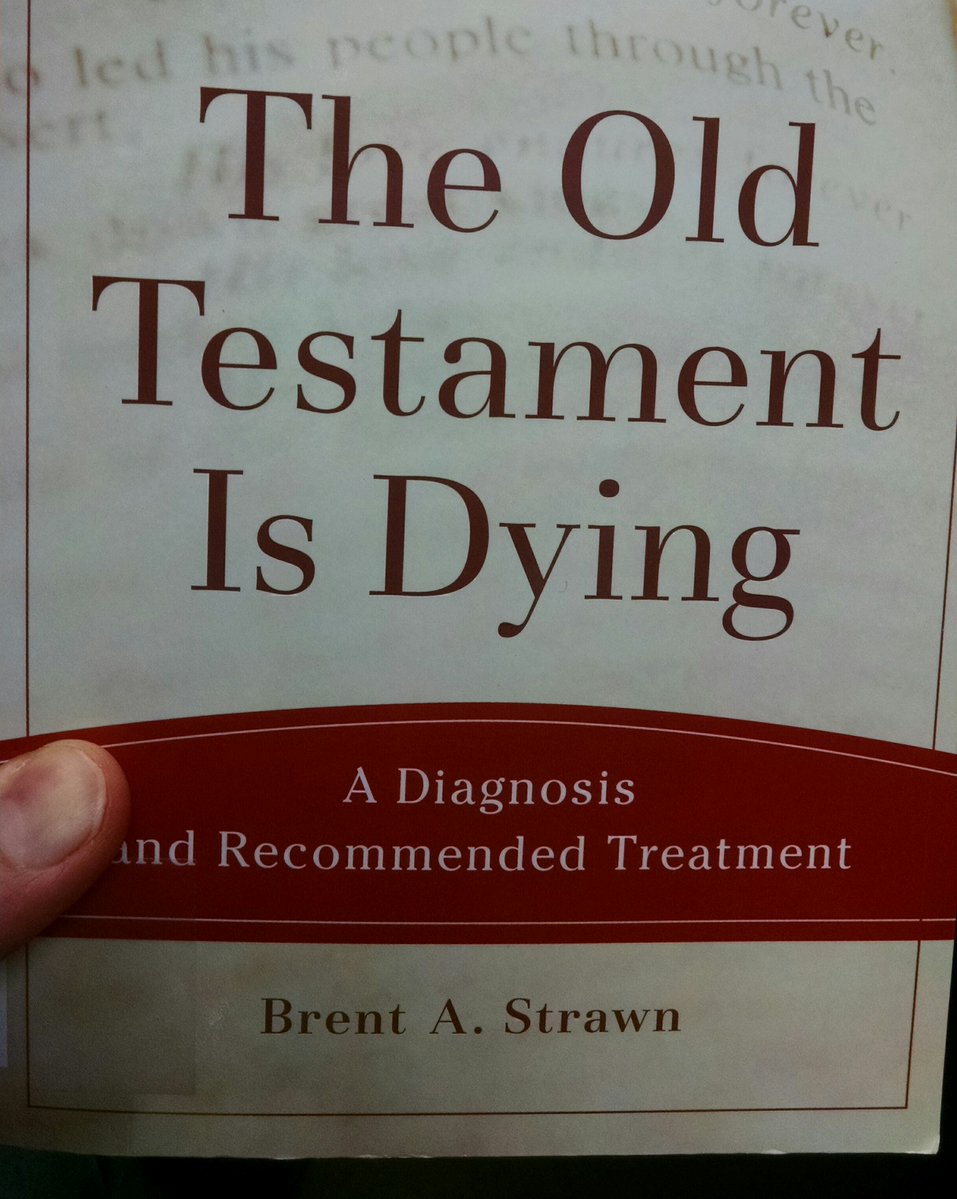
    In his recent book, Princeton Theological Seminary professor Brent Strawn makes a provocative case that American Christians are in imminent danger of losing the Old Testament—and with it much of the substance of Christian faith.

    DCIVX5cVYAA_IAA

    Drawing on a variety of evidence, Strawn argues that we are losing our grip on the OT, making it comparable to a dying language. He bases this assessment on a survey of religious knowledge among Americans, an analysis of the content of sermons, the way the OT is used (or not used) in hymns, and the highly selective use of the OT in the Revised Common Lectionary. He concludes that American Christians’ faith is subsisting on a drastically reduced diet of Old Testament.

    Pursuing the linguistic analogy, Strawn looks at how the use of the OT has become “pidginized”—its use reduced to a very basic, almost childlike “vocabulary”—and “creolized”—combined with other non- or sub-biblical thought-and-language systems. In the first category, he places the New Atheists, who often deploy a radically simplistic understanding of the OT in their anti-religious polemics. They latch on to a few verses supposedly demonstrating the barbarism and immorality of the OT and its God, without bothering to understand the Bible in all its complexity. The problem is that many Christians are themselves so devoid of OT knowledge that they can’t muster effective counterarguments.

    Strawn sees this “pidginized” understanding of the OT at the root of the church’s recurrent temptation toward the arch-heresy of Marcionism. This is what’s going on, for example, whenever the “mean,” “violent,” “judgmental” God of the OT is contrasted with the “tolerant,” “peaceful,” “forgiving” God of the New Testament/Jesus. The historical Marcion took this to an extreme in seeking to explicitly excise the OT (and large swaths of the NT) from the Christian canon, but neo-Mariconite tendencies are at work whenever (often well meaning) preachers, teachers, liturgists, etc. elide or omit large portions of the OT (especially certain “troubling” passages) from Christian worship, prayer, and education.

    Like nature, theology abhors a vacuum, and the void left by the OT is often filled by sub-biblical and sub-Christian discourse. This is what Strawn compares to linguistic creolization—snippets of biblical language are grafted on to another belief-system, resulting in new hybrid that loses much of the biblical substance. The clearest example of this is the prosperity gospel, where quasi-biblical language and concepts are combined with a debased form of American civil religion/capitalist ideology.

    Languages can die, and once they do, it’s extremely difficult to resurrect them. As with a dying language, American churches suffer from too few competent “speakers” of the OT, and based on the available evidence they aren’t doing a great job of making new ones. If use of the OT continues to trail off, it may soon be too late to bring it back.

    Strawn’s key point of emphasis is that Christianity without the Old Testament front and center isn’t actually Christianity at all, at least not in any sense continuous with the earliest Christians. Many Christians have too long treated the OT as, at best, a kind of preface to the NT. Strawn maintains, on the contrary, that it has its own integrity for preaching, teaching and worship, and–considering that it makes up the vast majority of Christian scripture–that it should have a much more prominent place than it currently does. (To show how this can be done, he highlights Walter Brueggemann as one of the few prominent Christian theologian/preachers who draws primarily on the OT.)

    As a course of treatment for this perhaps fatally ill patient, Strawn offers several recommendations: lectionaries that make fuller use of the OT in worship; sermons that preach primarily, if not exclusively, from the OT readings; hymns that reflect a more biblically-based theology, as well as more use of the psalms in corporate worship; and Christian education that teaches people to wrestle with the full scope of scripture.

    One may wonder if even these steps would be enough if the problem is as deep and pervasive as Strawn has suggested. Of course, even these actions are unlikely to be taken if church leaders aren’t facing up to the problem. Getting Strawn’s book into as many of their hands as possible would be a good start. The Old Testament may be dying, but we have it on good authority that God is in the resurrection business.

  • Making sense of the Bible with Adam Hamilton

    I really enjoyed Rev. Adam Hamilton’s recent book Making Sense of the Bible. It’s an overview of the nature of the Bible—how and when it was written, how the books were compiled and ultimately canonized—and  a persuasive effort to reconcile its very human character with its “God-breathed” status.

    We mainline Christians usually emphasize that we reject “inerrancy” and other shibboleths of the more conservative churches, but we’re not always as clear about what positive role the Bible plays in our faith. Hamilton–the senior pastor of the Church of the Resurrection in Leawood, Kansas, and a prominent voice in United Methodism–distills a lot of mainstream scholarship to present the Bible as a record of people in specific contexts struggling to make sense of their experience of God and the world. He argues that “inerrancy” doesn’t do justice the nature of the Bible as we have it and as it was written.

    That doesn’t mean that the Bible isn’t “inspired.” But Hamilton suggests that the inspiration at work isn’t different in kind from the way the Spirit works with people in all ages. The Spirit doesn’t override human freedom to ensure infallibility. Rather, because they were open to the Spirit, the Word of God was able to speak through the biblical authors, but not in a way that bypassed their finite human capabilities. The Bible is not “dictated” by God; it’s a record of humans struggling to articulate the revelation they have received.

    For Christians, the Word of God is preeminently Jesus, the incarnate Word. The Bible is authoritative for us not because it was composed in some supernatural fashion that protects it from error (how would we know this in any event?). It’s authoritative because it contains the earliest, most authentic witness to Jesus. Accordingly, Hamilton argues that Jesus—his teachings, his life, and his death and resurrection—provide a prism or sieve for looking at the rest of the Bible.

    This approach allows Hamilton to address some of the “challenging passages” of the Bible, such as those that seem to portray God as endorsing horrific violence, approve of slavery and the subordination or women, or teach things add odds with a scientific understanding of the universe. The Biblical authors (like us) were finite, sinful human beings, and they didn’t necessarily always get it right. Interpreting the Bible in the light of God’s definitive (for Christians) revelation in Jesus may lead us to set aside certain passages as no longer binding or reflecting the true character of God. (This is something Christians have always done, whether they admit it or not, most obviously in the book of Acts.)

    As I said, most of what Hamilton writes is based on mainstream biblical scholarship, and his conclusions would be broadly accepted in mainline churches. It’s essentially the view that I’ve more-or-less held my entire adult Christian life (such as it is). But I’m not sure I’ve seen anyone articulate this understanding of the Bible so clearly, persuasively and accessibly.

    ADDENDUM: I wrote this, on getting by without an infallible Bible, a couple of years ago, and I think it holds up pretty well. As it happens, it was inspired by an interview I read with Rev. Hamilton!

  • Was St. Paul a Christian?

    Pamela Eisenbaum’s Paul Was Not a Christian (thanks to Matt Frost for the recommendation) makes a nice companion volume to Amy-Jill Levine’s The Misunderstood Jew. Like Levine, Eisenbaum is a practicing Jew who studies Christian origins and thus brings an important and distinctive perspective to bear on the subject. In some ways, Eisenbaum has the harder task: While nearly everyone at least pays lip service to Jesus’s Jewishness, Paul is widely regarded, even by Jews, as “the first Christian”–someone who broke decisively from his ancestral faith to effectively lay the foundation for Christianity as we know it.

    Eisenbaum sets out to show, however, that throughout his life Paul remained firmly planted in the soil of Judaism. She does this through a two-pronged approach: first, by providing background on Second-Temple and Hellenistic Judaism to show that Paul’s ideas are not as far outside the Jewish mainstream as they’ve been made out to be; second, by looking closely at key passages in Paul’s letters,* with the controlling assumption that their intended audience is almost exclusively Gentiles. Paul was first and foremost, Eisenbaum argues, an apostle to the Gentiles–someone who believed the long-foretold time had come when the God of Israel would gather all the nations of the earth into the Abrahamic family.

    The argument of Eisenbaum’s book owes a lot to the so-called new perspective on Paul, associated with E.P. Sanders, N.T. Wright and others. But she goes beyond the new perspective toward what she calls a radical “new paradigm.” In Eisenbaum’s account, there is not a “problem of the law” that needs to be solved by Jesus, at least not for Jews. Even new perspective authors, while toning down the anti-Judaism of traditional Christian interpretations of Paul, still see Jewish “works-righteousness” as something Paul is fighting. On this account, excessive Jewish pride in belonging to the covenant and having the Torah led to xenophobia toward Gentile Christians; Paul’s emphasis on justification by grace is thus his means of breaking down the barriers between these two groups. For the new perspective version of Paul, Both Jews and Gentiles stand on the same ground, namely the grace of Christ.

    Eisenbaum argues, however, that Paul’s concern about “works of the law” is directed exclusively at Gentiles. The problem isn’t Jewish smugness; it’s how Gentiles can be brought into God’s family now that the end times are at hand. For Jews, Eisenbaum argues, Paul regarded covenant-belonging and keeping Torah as sufficient to remain in good standing with God. Jews belong to the covenant by grace, and there are provisions in the Torah for making atonement for their sins. But Gentiles, who have been outside the covenant, need something else.

    Because Gentiles have not had the advantage of Torah, they have heaped up a massive debt of guilt due to their sins, idolatry chief among them. The death of Jesus is thus the means by which God cancels this debt and makes it possible for Gentiles to turn from idolatry and become progeny of Abraham. What this looks like for Gentiles is not Torah observance, per se, but imitation of Christ’s own faithfulness. Thus, Eisenbaum maintains, for Paul, Jesus is a solution to a specifically Gentile problem. The seemingly negative things Paul says about the law are aimed at Gentiles who (mistakenly) think they have to become Torah-observant. This doesn’t mean that Paul’s gospel has no implications for Jews, though: They are called to recognize that the end of time is at hand and God is acting through Paul’s preaching to reconcile all the nations to the one true God.

    I learned a lot from Eisenbaum’s book and find much of it persuasive. It’s certainly a bold step beyond the “new perspective.” However, I couldn’t help but wish she’d addressed some nagging loose ends. For example, she says very little about Paul’s own religious practice. Did he remain a Torah-observant Jew? What about the position of Jewish Jesus-followers more generally?

    More broadly, I’m not sure Eisenbaum fully accounted for just how important Jesus was to Paul. What I have in mind here is what’s sometimes referred to as Paul’s “Christ-mysticism,” or his sense of being “in Christ.” There’s also his notion that Christ is the new Adam–the source and paradigm of a renewed humanity. These elements of Paul’s thought suggest, to me at least, that Jesus is not only (mainly?) the mechanism by which God brings in the Gentiles.

    That said, Eisenbaum’s argument (which I obviously can’t do full justice to in a blog post) definitely seems to move the ball forward. She has provided a credible anti-supersessionist reading of Paul, which, she notes, has implications for contemporary discussions of religious pluralism. Whether or not she has done justice to the centrality of Christ in Paul’s religious thought, I’m less sure of. But I highly recommend the book.

    —————————————

    *Eisenbaum generally limits her discussion to the seven letters whose Pauline authorship is undisputed by scholars: Romans, 1 and 2 Corinthians, Galatians, Philippians, 1 Thessalonians, and Philemon.

  • Jesus’s Jewish parables

    I don’t know if I’ve ever mentioned it here on the blog, but I’ve recommended Amy-Jill Levine’s The Misunderstood Jew: The Church and the Scandal of the Jewish Jesus to a number of people. In fact, I consider it almost a must-read for any Christian given how saturated our tradition is with anti-Judaism.

    I’d recommend Levine’s newest book, Short Stories By Jesus: The Enigmatic Parables of a Controversial Rabbi, almost as heartily. In the same scholarly yet accessible manner as her previous work, Levine deconstructs the negative stereotypes about Jews and Judaism that have pervaded much interpretation of Jesus’s parables. We see this, for example, in interpretations of the Good Samaritan that attribute the priest’s and the Levite’s passing by the robbed man to their horror of ritual impurity. Or readings of the Prodigal Son that say the elder son represents Jewish “works-righteousness.” And this is not confined to “conservative” churches and scholars; in fact, many of Levine’s targets are liberal scholars who like to contrast Jesus’s progressivism with a supposedly reactionary and oppressive 1st-century Judaism.

    But Levine’s book isn’t just a polemic. Her goal is to try to recover the impression the parables–which by their very nature admit of multiple interpretations–may have made on the the people who first heard them. To this end, she reads them as dealing with very concrete issues of daily life, and not necessarily as allegories or Christological symbols. Her goal is to show that, when stripped of the more obvious messages people sometimes take away (like it’s good to be persistent in prayer, or you should help people in need), these stories can still move us to reexamine our priorities and how we live our lives. In particular, Levine shows that Jesus’s stories speak not only to our “spiritual” condition but also have implications for the very earthly (and still relevant) issues like economic injustice and violence. I personally found the chapters on the Good Samaritan, the Tax Collector and the Pharisee, and the Rich Man and Lazarus to be the most thought-provoking.

    As a Jewish scholar of the New Testament, Levine doesn’t confess Jesus as Lord and Savior. But Christians can still benefit from the readings she offers, not only as a corrective to still-too-common anti-Jewish interpretations, but in the conviction that the there is more truth yet to break forth out of our Lord’s words.

  • The survival of chaos after the victory of God

    Jon D. Levenson’s Creation and the Persistence of Evil: The Jewish Drama of Divine Omnipotence is one of the most stimulating theology books I’ve read in a long time. I was expecting something different–a theodicy of sorts; but what I got instead was more interesting. Levenson argues that key passages in the Tanakh/Jewish Bible present creation not as “creation out of nothing,” but as God’s “mastery” of the forces of chaos. These forces continually threaten to reemerge and will not be fully vanquished until God’s final victory at the end of time; hence the “persistence of evil.”

    While Levenson recognizes that creatio ex nihilo has become the more-or-less orthodox view in Judaism (as well as in Christianity and Islam), he demonstrates–rather convincingly–that the Bible contains an only partially submerged motif of “creation from chaos.” That is, YHWH creates by defeating those forces that threaten to undo the divinely constituted order, stability, and peace that characterize creation. This victory, however, is precarious or incomplete: violence, disorder, and suffering are all-too-familiar parts of our experience, suggesting “the survival of chaos after the victory of God.” Contrary to many other interpreters, Levenson sees affinities with as much as differences from other Near Eastern creation myths–such as the Babylonian–that posit a primordial battle out of which the world order emerged. Through analysis of key texts, including of course the beginning of Genesis but also several Psalms, Job, and others, Levenson reveals traces of the creation from chaos motif.

    A key implication of this view is that evil and suffering are not the result of an inscrutable divine will, but rather of the incomplete, tentative, and agonistic nature of YHWH’s mastery of the forces of chaos, which continually resist his benevolent ordering. Peace, justice, and stability continually threaten to lapse back into the chaos out of which they were brought. This is vividly brought home for long stretches of Israel’s history, and the biblical traditions of lament and apocalyptic can be seen as a cry for God to finally bring about the decisive victory over the elements that threaten God’s good creation.

    Importantly, the Bible also attests to the role human beings are to play in this victory. When Israel keeps the commandments of God–including its cultic and ritual obedience–it is expanding the area over which the divine will holds sway in the world. (In this regard, Levenson allows himself some shots at certain Christian theologies that minimize the importance of human action.) The completion of creation only comes when the forces of evil and chaos are vanquished both in external history and in the human heart.

    Creation from chaos can seem a bit mythological, and Levenson generally avoids trying to cash it out in more rationalistic or metaphysical terms. Process theology is the most obvious candidate for a compatible philosophical account, but Levenson seems to prefer to let the tension between divine omnipotence and the “groaning” of creation stand. The point is that God’s sovereignty, or omnipotence, is not a static fact, but a true dramatic achievement:

    The operative dichotomy, thus, is not that between limitation and omnipotence, but that which lies between omnipotence as a static attribute and omnipotence as a dramatic enactment: the absolute power of God realizing itself in achievement and relationship. What this biblical theology of dramatic omnipotence shares with the theology of the limited God is a frank recognition of God’s setbacks, in contrast to the classical theodicies with their exaggerated commitment to divine impassibility and their tendency to ascribe imperfection solely to human free will, the recalcitrance of matter, or the like. . . . But whereas the theology of the limited God provides exoneration of a sort for God’s failures (for, in Kantian terms, how can we say God ought to do what he cannot?), the theology of omnipotence as dramatic enactment allows people to fault God for the persistence of evil (including, on occasion, human evil) and to goad him into reactivating his primal omnipotence, which is never relinquished but often agonizingly, catastrophically dormant. One might call this latter position a theology of omnipotence in potentia, omnipotence recollected from the cosmogonic past and expected in the eschatological future but only affirmed in faith in the disordered present.

    In any event, metaphysical speculation seems less important here than fidelity to experience. Faith in the God who is the source of all good can’t help but stand in tension with our manifest experience of evil and suffering. In this light, Levenson’s conclusion to his discussion of Job could (and probably does) double as a conclusion to the book as a whole:

    Though the persistence of evil seems to undermine the magisterial claims of the creator-God, it is through submission to exactly those claims that the good order that is creation comes into being. Like all other faith, creation-faith carries with it enormous risk. Only as the enormity of the risk is acknowledged can the grandeur of the faith be appreciated.

    Theodicy–in the sense of explaining why evil exists–is an inherently unsatisfying undertaking. Would you really be satisfied to learn that some tragedy that befell you or someone you loved was the inevitable outworking of the divine plan or the fundamental metaphysical principles of the universe? What Levenson’s biblical account evokes instead is a kind of holy impatience with evil and suffering and a faith–albeit one often sorely tested–in the One who laid the foundations of the world and who will “swallow up death for ever and . . . wipe away tears from all faces.”

  • Why early Christians confessed Jesus as divine

    In his review of Bart Ehrman’s How Jesus Became God, Luke Timothy Johnson readily concedes that neither the empty-tomb stories nor the accounts of Jesus’ appearing to the disciples after his crucifixion prove–or could prove–the Christian confession that Jesus is divine. Rather, Johnson says, this confession was rooted in the early Christians’ experience of being made “new creations” through the power of the Holy Spirit:

    To close that gap [between the appearances and the confession of Jesus’ divinity] we must turn to a register of language in the New Testament’s earliest writings (the letters of Paul) that Ehrman’s historicist blinders do not allow him to consider. Paul speaks of the “new creation” as a reality that is experienced, not by a few visionaries, but by all the members of his churches. This new creation is at work through the presence of a personal, transcendent, and transforming power called the Holy Spirit.

    The Resurrection experience, in Paul’s letters, is not something that happened to Jesus alone. It is happening now to those who have been given this power through the one Paul speaks of in 1 Corinthians 15:45 as having become “life-giving spirit”—a statement oddly absent from Ehrman’s discussion of that chapter in First Corinthians. Similarly, Ehrman fails to consider 1 Corinthians 12:3, where Paul states emphatically that “no one can say ‘Jesus is Lord,’ except by the Holy Spirit.” The presence of the transforming power of the Spirit among believers is the basis for Paul’s remarkable language about the Holy Spirit “dwelling” in them (Rom 8:9) and their being “in the Holy Spirit” (1 Cor 12:2–3). In the same way, Paul speaks about Christ “dwelling” in his followers, and their being “in Christ ” (Rom 8:9–10).

    In short, it was not the reports concerning an empty tomb or claims about post-mortem visions among a few of Jesus’ followers that caused the early Christians to recognize Jesus’ divinity. It was the shared experience of divine power—manifested in a variety of wonders and gifts and new capacities of existence—among those who had all “drunk the same spirit” and had become members of “Christ’s body” (1 Cor 12:12–27).

    As Schleiermacher would say, the heart of Christian piety is the experience of redemption in Christ. This, not “proofs” derived from historical reconstructions, is the basis for Christian faith. As Johnson notes, both Christian apologists and their critics like Ehrman tend to argue on the positivist ground of historical criticism. “But the good news is not and never has been based in verifiable fact; from the beginning and still today, it is based in the experience of God’s power.”

  • What happens when we pray the Psalms?

    According to Walter Brueggemann, in his essay “The Counter-World of the Psalms,”* the Psalms mediate to us a “counter-world” that subverts our “closely held world”–that is, the narrative or worldview we commonly live by.

    What is this “closely held” world like? For Brueggemann, it is a picture of the world characterized by anxiety and scarcity, self-sufficiency, denial, amnesia, and normlessness. That is, we are anxious because we believe that we have to compete for a limited set of resources and cannot depend on others, who are our rivals and competitors for these resources. We deny that this is a dysfunctional way to live and we block out or forget the toll this way of living takes on human well-being. This all leads to a sense that “everything is permitted”–that there is no meaning to life other than what we individually and privately impose on it. This is essentially what Brueggemann elsewhere refers to as a “military consumerist mentality.”

    But how do the Psalms counter this? In Brueggemann’s telling, the various types of Psalms (praise, lament, history, wisdom, etc.) counter the elements of our closely held world at every turn. By reciting, praying, and meditating on the Psalms, we are inducted into a world of trustful fidelity, abundance, ultimate dependence, abrasive truth telling, hope, lively remembering, and normed fidelity. In the Psalms, God is the trustworthy ground of existence who creates a world that, in Gandhi’s words, “provides enough to satisfy every man’s need but not for every man’s greed.” It is a world in which trust in God goes hand in hand with neighborly interdependence, we can tell the truth about ourselves and our own failings and even complain to God when things go awry, and in which we believe that God will act to bring about shalom. It is a world in which we remember God’s mighty acts of salvation as both the reason for hope in the future and the basis for fidelity to God’s revealed path to human flourishing (Torah).

    At the center of the Psalms stands YHWH, the God of Israel–“a lively character, and an agent of firm resolve who brings transformative energy and empancipatory capacity to all our social transactions” (p. 27). The living God of the Psalms stands in stark contrast to the mute and lifeless idols of nationalism, capitalism, and mastery; of a “conservative scholasticism” that tries to encase the truth in a set of propositions; and of a progressivism that reduces the scope of divine action to the confines of a narrow Enlightenment rationalism.

    The Psalms “witnesses to and makes available a God of agency who shatters the serene sedation of our closely held world” (p. 29). By “performing” the Psalms, our familiar world is broken open, and the alternative of abundance, trust, truthfulness, hope, memory, and fidelity comes alive. “It is the work of the Psalter to populate our world with the character of this God. Where this God governs, the world is transformed and transformable” (p. 35).

    It’s often said that the Psalms provide an expression of every human experience or emotion. But on Brueggemann’s account, they are also tools of transformation–of refining that raw material of human experience with the truth of God’s self-revelation. This provides a strong reason for keeping the Psalms at the center of both public worship and private devotion, as has been the case in both Jewish and Christian traditions for centuries.

    ————————————

    *Found in his book From Whom No Secrets Are Hid: Introducing the Psalms.

  • Keep the Bible weird!

    Peter Enns recounts a conversation he had with a Jewish colleague in graduate school about the story of Adam and Eve:

    So my classmate and I were having lunch talking about this story and I mentioned casually the “fall” of humanity.

    “The what?

    “The fall of humanity. You know, Adam and Eve’s sin plunged all subsequent humanity into a state of alienation from God.”

    “Never heard of it.”

    “Really? That’s odd, since it’s so obvious.”

    “No it’s not. The story nowhere says what you just said it says.”

    “Well then what do you make of Satan tempting Eve with the forbidden fruit….”

    “Who?”

    “What do you mean ‘who?’”

    “Satan? There’s no Satan in the story. There’s a serpent, just a serpent. He’s called the most ‘crafty’ of the creatures that God had put into the garden. He’s a serpent. A crafty creature. That’s what the text says.”

    “But the serpent is talking.”

    “Because it’s a story.”

    It came as a bit of a shock to me that what I thought I “knew” the story of Adam and Eve was about wasn’t really “in” the story itself, but how I had been taught to interpret the story. The dominant Christian reading is rooted in the apostle Paul, in the book of Romans, where Paul seems to place at Adam’s feet (not Eve’s, curiously) the blame for human misery.

    I was reading a Bible story book to my kids the other night and was struck by how much interpretation had been imported into its version of the Garden of Eden story. It included a full-blown quasi-Miltonian account of the serpent as Satan, the fallen angel who had rebelled against God. This isn’t exactly explicit in the original text, to put it mildly. This rubbed me the wrong way, because I felt like the Bible wasn’t being allowed to speak for itself, but was being overlaid with the “official” Christian interpretation.

    Of course, it would be naive to suggest that you could have a story without some kind of interpretation. But the Bible’s stories can and have generated multiple meanings over the centuries, even within a broadly Christian framework. As Enns points out, the “fall into sin” is a particularly Western Christian understanding of that story–one that is absent from, or at least less emphasized in, Eastern Christianity.

    I don’t have a good solution to this, but as I’ve been exposing my kids to the Bible, I’ve become more aware of the fact that many of the interpretations we take for granted are less than obvious. While I want my children to be inculcated with the Christian narrative, I don’t want to drill into them an overly pat understanding of the Bible. The Bible is often richer, weirder, and more interesting than our familiar theology leads us to think. Instead of thinking they have all the answers, I’d rather my kids experienced what Karl Barth called the “strange new world” within the Bible.

  • Evolution, Adam, Paul, and the Gospel

    I’m not sure I was part of the target audience for Peter Enns’ book The Evolution of Adam, but I still got a lot out of it. Enns reviews the scholarship around the composition and authorship of the creation story, as well as its historical context, and argues that the Adam story (i.e., the version of the creation story found in Genesis 2 and the story of the fall in Genesis 3) simply isn’t trying to answer the question of human origins in the way that a scientific account would.

    Rather, the creation story (and the OT more generally) is, Enns says, an exercise in Israelite national and theological self-definition in light of competing religions and a history of unfaithfulness, exile, and calamity. In particular, the Genesis creation story can be read as responding to the similar (though also very different) creation stories of the surrounding cultures (Egyptian, Babylonian, etc.), and enunciating the distinctive Israelite view of who God is.

    Placing Genesis in its ancient Near Eastern setting strongly suggests that it was written as a self-defining document, as a means of declaring the distinctiveness of Israel’s own beliefs from those of the surrounding nations. In other words, Genesis is an argument, a polemic, declaring how Israel’s God is different from all the other gods, and therefore how Israel is different from all the other nations. (p. 6)

    If this is right, Enns says, there is no inherent conflict between Genesis and evolution: the accounts are simply answering different questions.

    Christians today misread Genesis when they try to engage it, even minimally, in the scientific arena. Rather, they must follow the trajectory of the postexilic Israelites and ask their own questions of self-definition as the people of God: In view of who and where we are, what do these ancient texts say to us about being the people of God today? (p. 33)

    However, things are a bit different when we come to Paul. Enns notes that Adam doesn’t play much of a role in the rest of the OT, and there is certainly no developed theory of “original sin.” Moreover, later Jewish tradition creatively interpreted the Adam story in a variety of ways, many at variance with what became the standard Christian version.

    But Paul does seem to think (as demonstrated most clearly in Romans) that Adam was the first human being, historically speaking, and that his disobedience has infected the rest of humanity. For Paul, Adam’s transgression is the cause of sin and death—the predicament from which we are delivered by God’s great act in Jesus. Thus, many have argued, Paul’s gospel only makes sense if there was a historical Adam and a historical fall.

    But this is too quick. As Enns argues, Paul is working backwards from the death and resurrection of Jesus, not forward from a theory of original sin. Paul’s reading of the Adam story is not a “straight” reading, but a creative reinterpretation in light of the crucified and risen Messiah (as was much of his use of the OT). As Enns puts it:

    In making his case, Paul does not begin with Adam and move to Christ. Rather, the reality of the risen Christ drives Paul to mine Scripture for ways of explicating the wholly unexpected in-breaking of the age to come in the crucifixion and resurrection of the Son of God. Adam, read as “the first human,” supports Paul’s argument about the universal plight and remedy of humanity, but it is not a necessary component for that argument. In other words, attributing the cause of universal sin and death to a historical Adam is not necessary for the gospel of Jesus Christ to be a fully historical solution to that problem. To put it positively, as Paul says, we all need the Savior to deliver us from sin and death. That core Christian truth, as I see it, is unaffected by this entire discussion. (p. 81)

    I’ve tried to make a similar point before. I don’t think that when people responded to Jesus it was because they saw him as a  solution to “the Adam problem.” They experienced a concrete liberation from something that oppressed them: illness, possession, guilt, etc. This experience of liberation was not contingent on some prior theory about the origins of sin, suffering, and death. The Adam story can powerfully express the universal human predicament, but we needn’t take it as history to make sense of the Gospel.