Month: June 2017

  • Tom Paine, the Bible and wealth redistribution

    I enjoyed this interview with University of Michigan philosopher Elizabeth Anderson on how workplaces effectively function as “private governments” and often act in oppressive ways toward their employees.

    That lead me to this piece by Anderson on Tom Paine as an early theorist of social insurance. In Anderson’s telling, Paine was responding to revolutionary communist tendencies among some thinkers during the French Revolution.
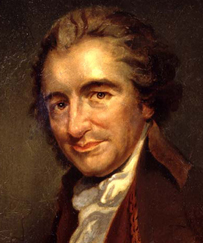
    thomas_paine2
    The other Tom of the American (and French) Revolutions

    He wanted to save private property and freedom while also solving the problem of poverty–the very problem that led some to embrace extreme, communist-like solutions.

    Paine called for an unconditional grant of money to every citizen funded by a tax on inherited wealth. For him, this was not a matter of charity, but of justice. The earth belongs to everyone, so others are owed some recompense when property is appropriated to private ownership. Moreover, the value of any property depends in part on the social context in which it exists.

    As Paine says in his essay Agrarian Justice:

    I have made the calculations stated in this plan, upon what is called personal, as well as upon landed property. The reason for making it upon land is already explained; and the reason for taking personal property into the calculation is equally well founded though on a different principle. Land, as before said, is the free gift of the Creator in common to the human race. Personal property is the effect of society; and it is as impossible for an individual to acquire personal property without the aid of society, as it is for him to make land originally.

    Separate an individual from society, and give him an island or a continent to possess, and he cannot acquire personal property. He cannot be rich. So inseparably are the means connected with the end, in all cases, that where the former do not exist the latter cannot be obtained. All accumulation, therefore, of personal property, beyond what a man’s own hands produce, is derived to him by living in society; and he owes on every principle of justice, of gratitude, and of civilization, a part of that accumulation back again to society from whence the whole came.

    What’s striking about Paine’s arguments is that they anticipate later views about the common origin of property, the social construction of property rights and the duties that property owners have to society. (Recall President Obama’s (in)famous “You didn’t build that” line.)

    I’d add that, although Paine was a Quaker-turned-Deist, this general viewpoint is consonant with Christian thinking. The earth does not belong to any human being; rather we hold it in trust as a gift of the creator. The Old Testament sets explicit limits on property rights, calling for fields and vineyards to be left fallow for the poor (and animals!) to eat from every seventh year (see Exodus 23). There is no absolute right of private property in the Bible, and any scheme of property rights that leaves some in destitution is unjustifiable and wicked.

    With the Fourth of July upon us, remember that Paine is at the very least an honorary founding father, so wealth redistribution turns out to be as American as apple pie. 😉


  • Is penal substitutionary atonement the “core of Christian faith”?

    According to this story, the Southern Baptist Convention just adopted a resolution at its annual meeting that re-affirms the “penal substitutionary” view of Christ’s atonement. This was passed in the face of what were described as efforts to “weaken” the doctrine.

    Proponents of PSA (penal substitutionary atonement)–the view that on the cross God was punishing Jesus for the sins of humanity–often treat it as a non-negotiable part of Christian orthodoxy, or even the very essence of the gospel. In the article linked above, Southern Baptists seminary professor Owen Strachan is quoted as saying the following:

    “there is no doctrine in Scripture more beautiful than penal substitutionary atonement,” yet at the same time “there may be no doctrine that is more hated.”

    “In truth, the biblical precept that the righteous must die for the wicked is the very core of Christian faith,” Strachan said. “Here is the burning heart of divine love: Christ crucified for us.”

    By contrast, many other Christians will concede that PSA, properly interpreted, is one legitimate way of understanding the cross, but they insist that it be balanced with other images and motifs from Scripture, such as Christus Victor or moral exemplar.

    What strikes me about the pro-PSA side of the argument is that, considering it’s supposed to constitute the essence of the gospel, it actually takes a lot of work to make the case for it from the Bible. Nowhere does Scripture unambiguously say in so many words that God was punishing Jesus on the cross. (And there’s a lot of biblical data that would tell against such an interpretation.) The case for PSA draws primarily on certain passages in Paul, Isaiah, and a few other books, and these passages admit of various interpretations. One has to stretch, to say the least, to find PSA in the gospels and much of the rest of the NT. Even Paul himself draws on a variety of images for understanding what happened on the cross, not all of them obviously consistent with PSA. It seems to me that the death-and-resurrection of Jesus is, for the NT authors, a cosmic event that eludes neat and tidy explanations in the form of any particular theory.

    You’d think that if the atonement, understood specifically in a penal, substitutionary sense, really was the “core of Christian faith” it would be presented a bit more unambiguously in the Bible. Given that it isn’t, it seems a sin against Christian liberty to require people to believe in PSA. As the Anglican articles of religion put it,

    HOLY Scripture containeth all things necessary to salvation: whatsoever is not read therein, nor may be proved thereby, is not to be required of any man, that it should be believed as an article of the Faith, or be thought requisite or necessary to salvation. (Article VI)

    It’s a little ironic that a free-church tradition like the SBC would try to impose more restrictions on Christian consciences than the church of Queen Elizabeth.