Month: November 2011

  • Gospel meditation for Advent 2

    Reading: Mark 1:1-8 (Common English Bible)

    The beginning of the good news about Jesus Christ, God’s Son, happened just as it was written about in the prophecy of Isaiah:

    Look, I am sending my messenger
    before you,
    He will prepare your way,
    a voice shouting in the wilderness:
    “Prepare the way of the Lord;
    make his paths straight.”

    John was in the wilderness calling for people to be baptized to show that they were changing their hearts and lives and wanted God to forgive their sins. Everyone in Judea and all the people of Jerusalem went out to the Jordan River and were being baptized by John as they confessed their sins. John wore clothes made of camel’s hair, with a leather belt around his waist. He ate locusts and wild honey. He announced, “One stronger than I am is coming after me. I’m not even worthy to bend over and loosen the strap of his sandals. I baptize you with water, but he will baptize you with the Holy Spirit.”

    When I re-read this passage this week, the phrase that stood out to me was Isaiah’s “Prepare the way of the Lord.” Because that’s a big part of what Advent is about, right? Preparing for the coming of the Lord.

    Like Lent, Advent is intended to be a penitential season. “Penitential,” of course, comes from the same root as “repent” and “repentance.” And “repent” in the Bible is often the English translation of metanoia–which scholars tell us means something more radical than simply feeling sorry for one’s sins. It denotes something more like a fundamental change in the direction of one’s life.

    According to Mark, John was calling people to be baptized “to show that they were changing their hearts and lives and wanted God to forgive their sins.” Changing our hearts and lives gets, I think, at the meaning of metanoia–and at the meaning of Advent as a time of preparation.

    “Prepare the way of the Lord”–we can also read this, I think, as “Make room for the Lord.” If God is going to come into our world, there needs to be a “place” for God to be. But we tend to fill our lives and our world up with other things. Many of us, if we reflect on it, find that this is particularly–and ironically–true around the holidays. Our days are so frantically filled with shopping, parties, and school and work events that we feel we’re missing “the reason for the season.”

    God wants to be in our world, and we need to “prepare the way.” But the mystery of the Incarnation is that God, in entering our world, becomes vulnerable. The Son of Man has nowhere to lay his head. Eventually, we shove God out of our world by killing him. God’s being in the world depends, in some way, on our response.

    What’s the alternative? Taking both the notions of metanoia and “making room” for God as keynotes of Advent, maybe part of that “change of life and heart” is to find ways to “make a place” for God in our lives and world. And maybe we can get some help for this by looking to the one the Christian church has always upheld as the paragon of discipleship. In assenting to God’s invitation to bear the Redeemer, Mary–literally!–makes a place, or a way, for God to be in the world. As Lutheran theologian Robert Jenson has written,

    To what did Mary, after all, assent, when she said to Gabriel, “Fiat mihi,” “Let it happen to me”? Of course it was her womb that with these words she offered, to be God’s space in the world. The whole history of Israel had been God’s labor to take Israel as his space in the world. And it indeed was a labor, for Israel by her own account was a resistant people: again and again the Lord’s angel announced his advent, begged indeed for space, and again and again Israel’s answer was “Let it be, but not yet.” Gabriel’s mission to Mary was, so to speak, one last try, and this time the response did not temporize. (“A Space for God,” in Mary, Mother of God, pp. 55-6)
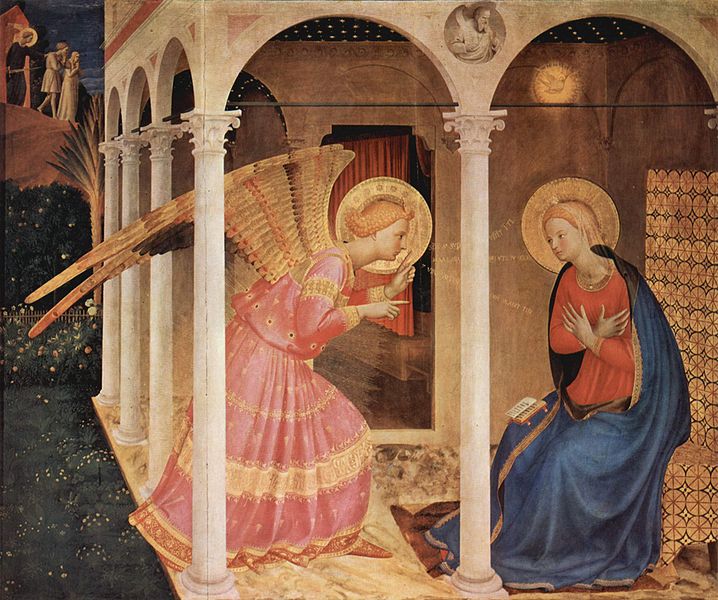
    The Bible also tells us that Mary “pondered these things in her heart.” Mary’s receptivity and responsiveness go hand-in-hand with her contemplativeness. The penitential practices of Lent and Advent–fasting, Bible reading, prayer, and almsgiving–are intended, among other things, to foster this sense of contemplation and receptiveness by “emptying” us of the things we fill our lives up with. Like Mary, we empty ourselves in order to make a space for God.

    Collect for the Second Sunday of Advent:

    Merciful God, who sent your messengers the prophets to preach repentance and prepare the way for our salvation: Give us grace to heed their warnings and forsake our sins, that we may greet with joy the coming of Jesus Christ our Redeemer; who lives and reigns with you and the Holy Spirit, one God, now and for ever. Amen. (from the Book of Common Prayer)

    (As noted in my introductory post, the first person who comments on this post will be eligible for a free softcover copy of the Common English Bible.)

  • Common English Bible blog tour

    After I posted and tweeted about the new Common English Bible, I was invited to participate in a “blog-tour” for the new translation. I don’t think this makes me particularly special; it seems anyone who wants to can participate. In any event, what participating bloggers are asked to do is to post entries during the next few months that make use of the CEB in some way or another–such as commenting on Bible verses or discussing the translation. While the guidelines are quite flexible and there’s no minimum number of posts required, I should note that the publisher provided me with a complimentary thinline copy of the CEB.

    What I thought I’d do to participate is adapt a practice from a small group I was in a few years ago. We would meet on Wednesday evenings to read, reflect on, and discuss the gospel lesson for the upcoming Sunday. So my plan, during Advent, is to post on the appointed gospel lesson for the upcoming week (as determined by the Revised Common Lectionary). These will be loosely structured meditations based on my response to the text. It should be a nice way to “test drive” the CEB and a good spiritual discipline for me in its own right. My plan is to post these on Wednesdays during Advent (I realize I’ve already missed a week).

    The publisher also says that I can give away one free softcover copy of the CEB every week that I write a post participating in the blog tour. I figure that it would be fairest for it to go to the first person to comment on that week’s post. So, the first person to comment who wants one will need to provide their mailing address to me in an e-mail, which I’ll forward to the publisher.

  • Mumford & Sons, “Winter Winds”

    I’m not feeling very metal this week; I have, however, been enjoying the heck out “Sigh No More”–Mumford & Sons’ album from last year, which I first heard only recently. It’s also happens to be chock-a-block full of Christian themes and imagery, which is pretty interesting for a mainstream pop album.

    Hope everyone is having a happy Thanksgiving weekend!

  • The miracle of King James’ Bible

    Here is the miracle of the King James Bible in action. Words from a doubly alien culture, not an original text but a translation of ancient Greek and Hebrew manuscripts, made centuries ago and thousands of miles away, arrive in a dusty corner of the New World and sound as they were meant to—majestic but intimate, the voice of the universe somehow heard in the innermost part of the ear.

    You don’t have to be a Christian to hear the power of those words—simple in vocabulary, cosmic in scale, stately in their rhythms, deeply emotional in their impact. Most of us might think we have forgotten its words, but the King James Bible has sewn itself into the fabric of the language. If a child is ever the apple of her parents’ eye or an idea seems as old as the hills, if we are at death’s door or at our wits’ end, if we have gone through a baptism of fire or are about to bite the dust, if it seems at times that the blind are leading the blind or we are casting pearls before swine, if you are either buttering someone up or casting the first stone, the King James Bible, whether we know it or not, is speaking through us. The haves and have-nots, heads on plates, thieves in the night, scum of the earth, best until last, sackcloth and ashes, streets paved in gold, and the skin of one’s teeth: All of them have been transmitted to us by the translators who did their magnificent work 400 years ago.

    Read the rest here.

    I don’t think Christians should rely on the KJV as their primary translation, but there’s no denying its beauty and its importance, both religiously and as a shaper of the English language.

  • 25 books every Christian should read(?)

    That is, according to a book recently published by Harper under the auspices of Renovare, the evangelical-ish spiritual renewal movement. (Actually, since this book has the list, aren’t there 26 books every Christian should read? Seems like some sort of paradox there…)

    In any event, here’s the list, with titles I’ve read in bold. An asterisk means I’ve read at least selections.

    1. On the Incarnation, St. Athanasius
    2. Confessions, St. Augustine
    3. The Sayings of the Desert Fathers, Various
    4. The Rule of St. Benedict, St. Benedict
    5. The Divine Comedy, Dante Alighieri*
    6. The Cloud of Unknowing, Anonymous
    7. Revelations of Divine Love (Showings), Julian of Norwich
    8. The Imitation of Christ, Thomas a Kempis
    9. The Philokalia, Various
    10. Institutes of the Christian Religion, John Calvin*
    11. The Interior Castle, St. Teresa of Avila
    12. Dark Night of the Soul, St. John of the Cross
    13. Pensees, Blaise Pascal
    14. The Pilgrim’s Progress, John Bunyan
    15. The Practice of the Presence of God, Brother Lawrence
    16. A Serious Call to a Devout and Holy Life, William Law
    17. The Way of a Pilgrim, Unknown Author
    18. The Brothers Karamazov, Fyodor Dostoevsky
    19. Orthodoxy, G.K. Chesterton
    20. The Poetry of Gerald Manley Hopkins*
    21. The Cost of Discipleship, Dietrich Bonhoeffer
    22. A Testament of Devotion, Thomas R. Kelly
    23. The Seven Storey Mountain, Thomas Merton
    24. Mere Christianity, C.S. Lewis
    25. The Return of the Prodigal Son, Henri J.M. Nouwen

    Of the ones I haven’t read, I most feel like I should read Benedict and Julian. One glaring omission that jumps out at me is Martin Luther. If I were adding something it would probably be his On Christian Liberty.

    Anyone care to suggest other titles they’d add to (or subtract from) the list?

    UPDATE: Tony Jones offers an alternative list he and some friends came up with here. It includes some good additions like Origen, Anselm, Wesley, and Luther, as well as some worthy books from more recent times (Barth, Gutierrez).

  • Resurrection and Docetism

    People sometimes argue against “spiritual” interpretations of the Resurrection of Jesus on the grounds that they are “Docetic”–that is, they deny the full reality of the Incarnation after the fashion of the ancient heresy of Docetism, which said that Jesus only appeared to be fully human. Specifically, it held that Jesus’ body was an illusion and he was not really crucified.

    Interestingly, however, in a dialogue on the Resurrection between British theologians Geoffrey Lampe and Donald MacKinnon published in the 60s, Lampe makes precisely the reverse argument:

    He shared our human death; and I remain convinced that his entry into life beyond death was not dissimilar in its mode from ours. What may await us on the other side of death must not, if the Incarnation is real and Christ is the second Adam, be a room into which his presence has not preceded us. Unless we take an impossibly ‘spiritualist’ view of our human make-up, we cannot lightly contemplate the dissolution of the body without which we are unable, since we are physical beings, to conceive of a personality. Yet the dissolution of the body is most certainly part of the universal lot of man. I do not find it possible to believe that bodily corruption, that ultimate negation, as it seems, of all human endeavor, aspiration and hope, can be something from which the manhood of Christ was exempt. If God will raise us from death to a new life of fuller communion with himself then this will be sheer miracle: God’s re-creative Word affirming us in the moment of our utter nothingness. And if Christ is the firstfruits of the dead, his Resurrection cannot be of a different order from this. A Resurrection of his physical body, such as is implied by the empty tomb and by some of the stories in the Gospels of his appearances, would point towards a docetic Christ who does not fully share the lot of men; unless, indeed, bodily corruption were to be regarded as being bound up with the sinfulness of man which Christ did not share (but, unless we accept an impossibly literalistic interpretation of Genesis 3 as factual history, it is impossible to hold that physical dissolution is not part of the Creator’s original and constant intention for his creatures in this world). Such a Resurrection, moreover, would offer in itself no promise of risen life beyond death for those who have to face both death and corruption. The miracle which we need would never yet have taken place.

    Lampe’s argument seems to boil down to this:

    1. For Jesus’ Resurrection to be meaningful to us, it must be similar in kind to the resurrection we hope for for ourselves.

    2. But we cannot hope for a “fleshly” resurrection (Lampe writes that “we clearly cannot expect to be raised in our fleshly bodies”).

    3. Therefore, Jesus’ Resurrection must not have been “fleshly.”

    I think Lampe is at least partly right about this. Christians sometimes gloss over what it means to talk about the “resurrection of the body”, but whatever it means it presumably can’t be that we will be raised in the very same bodies we have now. This is because human bodies decay, get eaten, get blown to bits, etc., and the particles they comprise end up in other material objects (including other people’s bodies). So it’s hard, if not impossible, to conceive how we could all be raised in our selfsame physical bodies.

    What we have to suppose instead, I think, is that we will be raised in new bodies–“spiritual” bodies, to use St. Paul’s phrase. These will be bodies that are fitted to whatever environment in which we will exist (“heaven” or the “new heaven and new earth” or whatever one’s preferred symbol is). In short, Christian hope is that we will, after death, enjoy fellowship with God and the blessed company of heaven. This requires, presumably, some medium of self-expression and interaction–which is what the “spiritual body” provides.

    Now, I’m not as convinced that it follows from this that Jesus’ Resurrection didn’t include the raising of his physical body or that his tomb wasn’t empty. Certainly the appearance stories in the gospels suggest that the form taken by the risen Jesus transcended the usual limitations of physicality. But could it be that his physical body was transmuted into the substance of his “spiritual body”? Maybe this indicates–as John Polkinghorne and others have suggested–that the new heavens and new earth will be, in some mysterious way, composed of the “stuff” of this universe, but “transposed” into a spiritual key. On that view, we could still speak of a degree of continuity between this physical world and the world to come, even if there isn’t a direct continuity between our fleshly bodies and our spiritual ones.

    Addendum: This isn’t directly relevant to the main point of the post, but I also like Lampe’s way of describing how judgment and mercy are united on the Cross:

    I cannot set acceptance over against judgement as though there were any incompatibility between them. The Cross is a place of judgement and condemnation. Not of any judgement or condemnation of Jesus by God the Father. The judge is Jesus. Calvary is a place of execution, the execution of the Son of God by sinners, but by becoming this it is made to be Christ’s judgement seat. Man’s sin is disclosed there in its fullest odiousness. It is shown up and condemned by its encounter with steadfast love. Christ’s acceptance of sinners is no easy tolerance. He offers no sanction for that artificial, blindly uncritical, ‘Christian goodwill’ which sometimes does duty for true charity. The Cross itself is the measure of the cost of acceptance. The width of the gulf between heaven and hell is revealed there, where the greatest act of human sin is wrought out in a darkness that covered all the land. Acceptance at the hands of the victim of that sin is itself the judgement and condemnation of sin; for it is only when the sinner is accepted that the judgement of his sin becomes effective, and only divine love is able to condemn sin by accepting the sinner. It makes no compromise with sin, nor does it need to be safeguarded from contamination by sinners, for it has sovereign power to reclaim them in the act of accepting them. Acceptance and judgement do not have to be balanced against each other. At the Cross the divine mercy, justice and truth are united, for they are inseparable aspects of that definitive declaration of the ways of God to man. [Emphasis added–L.M.]

  • The Common English Bible–a new translation

    My dear wife got me an Amazon Kindle for my birthday, which I’ve been enjoying immensely. Poking around in the Kindle store, I decided I should download a version of the Bible. But which one? I usually read either the New Revised Standard Version or the Revised English Bible. But the Kindle version of the NRSV hasn’t been released yet, and I didn’t see one for the REB.

    Then I came across the Common English Bible. I hadn’t previously heard of it, but after a little investigation I discovered that the translation was just completed this year under the auspices of publishers associated with the Episcopal Church, Presbyterian Church (USA), United Methodist Church, Disciples of Christ, and United Church of Christ. The translation was made by scholars from “22 faith traditions,” according to its website, and is intended to be a Bible for “the whole church of Jesus Christ.”

    The intention of the CEB is to preserve the scholarly accuracy comparable to the NRSV while being more readable for the average person in the pew. It seems that it’s intended to fill a niche for mainliners similar to that of the New International Version in the evangelical world. Interestingly, Fuller Theological Seminary, the big evangelical seminary in Southern California, has approved the CEB for official use among faculty and students, replacing the NIV. It seems that the school was not pleased that the 2011 version of the NIV–which will replace the TNIV–is a less-gender-inclusive translation, and it determined that the CEB was a good alternative.

    In any event, I haven’t really dipped into the CEB much yet, but I’m looking forward to experiencing the Bible in a fresh translation. (Also, it was only about $5.00 for the Kindle version!)

  • American “multarchy”

    Philosopher Gary Gutting writes that America doesn’t have a democracy, but a “mutlarchy”–a system that includes elements of the five types of government delineated by Plato in The Republic. These are

    aristocracy: “rule by the ‘best’, that is, by experts specially trained at governance”
    timarchy: “rule by those guided by their courage and sense of honor”
    oligarchy: “rule by a wealthy minority”
    democracy: “rule by the people as a whole—a ‘mob’ as Plato saw it”
    tyranny: “rule by a despot answerable to no one but himself”

    We don’t have a single form of government, but “a complex interweaving of many forms of government.” Gutting says that the political task is not to eliminate any of these elements, since they are probably unavoidable, but finding the appropriate balance among them. This means we should avoid superficial slogans like “less government”:

    Much of our current debate over this challenge focuses on the question of whether we have “too much government,” where “government” means the federal bureaucracy. Our “Platonic” analysis suggests that this is at best a gross oversimplificaton. The question, rather, is precisely how should we calibrate the relative strengths of all five elements of our multocracy. Current calls for “less government” actually mean less power for elected leaders and for the bureaucracies that serve them and more power for the “oligarchy” of millionaires and corporations. Such calls also imply less power for the people (the democratic element), since, while elected leaders are directly responsible to those who vote, those whose power is based on wealth are not. In fact, many of us who bristle at any government interference with our freedom and privacy, accept, as an economic necessity, similar interference from the companies we work for or do business with.

    What we need is an integrated debate about all the powers that govern us, along with a recognition that all of them have essential roles but also pose dangers. In particular, “How can we recognize legitimate corporate interests while avoiding plutocracy?” is as essential a question as “Is the federal bureaucracy a threat to personal freedom?” Those worried about the evils of Big Government need to look not only at the executive branch in Washington but also at the executive offices of our major corporations.

    I think this is a helpful analysis. It shows that we define “freedom” too narrowly if we understand it simply as freedom from (federal) government interference. These other “governments” can limit people’s freedom in ways that are just as harmful.