Month: July 2009

  • Quote of the day

    Comes from Matt Yglesias:

    Personally, I consider myself someone who enjoys nostalgia. But this article (via Alyssa Rosenberg) about the boom in twentysomething nostalgia mostly reminded me of bad times via the phrase “three of the biggest bands of the period — Blink-182, Limp Bizkit and Creed — have each reunited for summer tours.” What a bleak period! Those bands are terrible. Any time you have a list of bands such that Blink-182 is by far the best, you’re in big trouble.

    Amen, brother. Makes me glad I came of age in the late 80s/early 90s when actual good music was popular. Of course, if you’re up for Gen-X nostalgia, Alice in Chains, Pearl Jam, and Collective Soul all apparently have new albums on the way. (I’m actually looking forward to the new AiC.)

    p.s. You can hear the new AiC song, “A Looking In View,” here. (The new singer is very Staley-esque.)

  • WASM 2: Engaging the powers

    Having established the moral significance of animal suffering, Linzey goes on in chapter 2 to ask why, if the importance of animal suffering is so clear, has it been so often ignored? After all, as Stephen R. L. Clark has pointed out, it’s hard to identify a more obvious moral truism than “Avoid being the cause of unnecessary suffering.”

    What is needed, Linzey says, is to confront “the powers that be,” the patterns of thought and language and the institutionalized practices that make animal suffering virtually invisible. Animals in our society are routinely mis-described (as “dumb brutes,” “beasts,” etc.) and mis-represented (as unthinking organisms that operate entirely by instinct, or that lack any sentience or inner awareness). Our attention is mis-directed, away from animal suffering (often with lofty-sounding pretensions to scientific skepticism), and, perhaps most fundamentally, animals are mis-perceived by us. That is, we see them as parts of a landscape, or as things–commodities that exist solely for human benefit. Actually seeing animals as “subjects of a life” (to use Tom Regan’s term), beings with their own lives and interests, can require a paradigm shift in the way we look at the world (or as Linzey says, a “Eureka!” or “Aha!” experience).

    Linzey points out that these obstacles to seeing the moral significance of animal suffering are institutionally reinforced: “where animal abuse differs from most others is that it is socially legitimised and institutionalised” (p. 57). Drawing on the social criticism of Noam Chomsky, particularly his analysis of the “propaganda system” in democratic societies, Linzey highlights some of the ways in which animal abuse is reinforced and what is required to expose it. This falls under the general heading of “cultivating and institutionalizing critical awareness.” Injustices persist in large part because critical voices are excluded from the debate. In liberal democracies this doesn’t happen through the outright suppression of speech, but from the assumptions and implicit premises embedded in the official and quasi-official organs of information.

    Linzey suggests that discovering and disseminating the truth about animal abuse requires cultivating the just the kind of critical awareness Chomsky recommends. This entails:

    (1) discovering the facts: most, if not all, the information we’re exposed to comes already value-laden or embedded in a particular narrative; disentangling the underlying facts allows us to take a critical stance toward the “official” narrative or interpretation of events.

    (2) retaining the focus on the ethical: moral issues are often smuggled off the public stage by focusing on such supposedly value-free terms as “cost,” “need,” “science,” etc. When moral considerations are allowed to intrude, Linzey says, it’s usually in the form of a particularly vulgar or popularized utilitarianism. Advocates of social change should not let the central moral issues recede from view.

    (3) recognizing the limitations of the media:
    the way that controversial issues are presented in the media already presupposes a great deal of background agreement. Anyone who wants to present a genuinely radical alternative to the status quo is required to challenge a great many assumptions taken for granted. The media, particularly the broadcast media, aren’t well-suited to this kind of critical examination. Anyone promoting an unconventional point of view needs to understand this.

    (4) establishing alternative sources of information:
    this speaks for itself. The Internet, of course, has made alternative sources of information available on a previously undreamed of scale. Though, there’s no substitute for patient study of more in-depth sources like actual books (you can’t get all your information from blogs and Twitter).

    (5) institutionalizing critical awareness:
    just as the moral status quo is supported by its institutionalization, any revision to the status quo requires institutional support. Linzey mentions law-making, consumer choice, and education as institutional channels through which a more enlightened understanding of animal suffering can be expressed and reinforced.

    I think the discussion here is important. It’s often assumed that if people just “see” intellectually the case for better treatment of animals, changes in behavior will follow automatically. But there are powerful forces that militate against such change, from the assumption–shared by nearly everyone around us–that objectively cruel treatment of animals is normal and even “necessary” to the powerful economic interests that stand to lose from any large-scale shift in attitudes. People’s attitudes and behavior are shaped as much, if not more, by the sort of institutional factors Linzey (and Chomsky) identify as by rational argument. Cultivating and institutionalizing a critical awareness of those factors is a necessary condition for any significant change.

    One other thing I wish Linzey had touched on is the importance of alternative communities. This is implicit in some of the other points, but could probably benefit from separate treatment. Reality–or at least our understanding of it–is socially constructed and reinforced. We take our cues on how to behave from our social groups. It’s a rare fish who can swim against the stream her whole life. Thus, any sustainable social change is going to require ways of living together that reinforce values that differ from the mainstream values that are the object of critique.

    While I’m wary of some of the more extreme claims made on behalf of the church as a “counterculture” or a “polis” unto itself, I do think churches (along with other intentional communities, religious or not) can be places where people learn a different way of living, one based on values of gentleness, peace, and compassion, which should surely include changes in the way we treat our animal cousins.


  • “Statism” revisited

    John makes some fair points in his response to this post. In particular, I probably did paint with too broad a brush in characterizing conservatives and libertarians as “mostly deny[ing] that [the environment, health care, etc.] are problems and/or that government has any role in addressing them.”

    At the same time, John is painting what strikes me as a bit too rosy a picture in some cases. For instance, is the mainstream conservative position really to favor carbon taxes instead of cap-and-trade? I think the mainstream conservative position (i.e., the position adhered to by most self-described conservatives) is to favor doing nothing about global warming either because a) it isn’t happening, b) humans aren’t causing it, or c) technology will save us. It’s true that some smart conservatives have made the case that a carbon tax is preferable to cap-and-trade, but I’m unconvinced they’re anything but a tiny minority. (Indeed, it’s usually lefty environmentalists who favor carbon taxes over against cap-and-trade because they don’t like the “trade” part.) I would be delighted to be proven wrong here, though, since it would mean that real progress on this front should be possible.

    That’s not to deny that conservatives do often provide alternative policy proposals for various problems, as John points out, but I still think that “anti-statism” functions as more of an article of faith on the Right than “pro-statism” does on the Left. It’s not uncommon for conservatives to denounce the New Deal and the Great Society in toto, which collectively constitute much of the framework of the regulatory and welfare state. This may be largely rhetorical posturing (though conservatives have put a lot of political muscle behind efforts to “privatize” Social Security among other things), but it is evidence of a particular mindset that instinctively distrusts government efforts to do much more than protect life and property.

    I don’t want to get hung up on a terminological debate, though; I agree with John that “the real debates are over what, in each instance that seems to call for a role for government, the appropriate role will be.” John is a conservative (of some kind or another) and I suppose I’m a liberal (of some kind or another), so we’re likely to disagree about the appropriate role for government in many (though not all) cases, but I’d be much happier to see the debate carried on in those terms.

  • WASM 1: The difference that difference makes

    In chapter 1 of Why Animal Suffering Matters, Linzey identifies several differences between humans and non-human animals that are typically offered as justifications for disregarding the interests of animals. In a neat twist, though, he aims to show that, properly understood, they call for a greater consideration of animal interests.

    Animals as natural slaves: Aristotle and St. Thomas contend that “brute” creatures are naturally made for the use of human beings. Linzey counters that Aristotle confuses a natural hierarchy with a moral one and St. Thomas’s account of power is insufficiently Christian. Christianity portrays a God who sacrificies himself for his creation – the “higher” for the “lower.” Being “higher” on the scale doesn’t give you unlimited rights over the “lower.”

    Animals as non-rational: The suffering of rational creatures is held to be more morally significant than that of non-rational ones. Humans experience existential dread, foreboding, and a sense of their own mortality, for example. But this can cut both ways: a human prisoner may be able to understand his plight and devise some comforts, but an imprisoned animal will be unable to understand what’s going on, heightening its terror and suffering.

    Animals as non-linguistic: Animals lack language–at least a language we can understand. But this implies that they lack the ability to represent their interests to us or to consent to things being done to them. This increases rather than decreases the burden of proceeding cautiously in our treatment of them.

    Animals as non-moral: Animals are not moral agents, at least not in the full-fledged sense that (most) humans are. But this means that they are morally innocent and cannot deserve to have suffering inflicted on them, much less benefit morally from any such pain, as humans might sometimes be thought to.

    Animals as soulless: Animals are frequently taken to lack an immortal soul that can survive death. But, if anything, this implies that it’s worse to treat them badly since they can’t receive recompense in the afterlife for their suffering. Linzey quotes C.S. Lewis’s essay on vivisection: “animals cannot deserve pain, nor profit morally by the discipline of pain, nor be recompensed by happiness in another life for suffering in this. Thus all the factors that render pain more tolerable or make it less than totally evil in the case of human beings will be lacking in the beasts. ‘Soullessness’ in so far as it is relevant to the question at all, is an argument against vivisection” (p. 27).

    Animals as devoid of the divine image: Human beings are said to be the only animals created in the image of God. But Linzey contends that recent OT scholarship shows that this shoud be understood in a “functionalist” sense: human beings are God’s representatives on earth, and their task is to treat creation with loving kindness. Even more, a “Christ-shaped” notion of lordship suggests service to creation, not mastery over it. Thus “dominion” means caring for the rest of creation, including animals.

    Linzey’s analysis yields a reconfigured list of differences that support, rather than undermine, solicitude for animals’ well-being:

    –Animals cannot give or withhold consent

    –Animals cannot represent or vocalize their own interests

    –Animals are morally innocent

    –Animals are vulnerable and relatively defenseless

    Linzey points out that these characterisitics are also shared by very young children, and our general sense is that these characteristics impose greater obligations to look out for children’s interests, not a license to exploit them. He notes that both animals and children are “exceptional cases” that don’t fit comfortably into traditional moral theories. Those theories tend to take rational, adult humans as the paradigm of moral concern and, consequently, are driven to more or less ad hoc measures to make room for children and animals. But the differences between “normal” adult humans on the one hand and children and animals on the other calls for a de-centering of our moral thinking:

    The practical upshot is that we cannot continue to privilege human suffering as if it stands alone as a unique source of moral concern. Some animal-friendly philosophers advance solicitude for animals on the basis that they are, inter alia, like us. But my thesis is that their very alterity in many respects should underpin their moral claim. The usefulness of animals, paradoxically, is that they help us to grapple with the moral relevance (as well as irrelevance) of difference. (p. 37)

    Linzey concludes the chapter with a reflection on a Good Friday sermon by John Henry Newman in which Newman compares the suffering of Christ on the cross to that of an innocent lamb. That suffering–the suffering of one who is completely innocent and vulnerable–ought to call forth our greatest reserves of sympathy and moral concern.

  • Statism

    “Statism” is a word that obscures more than it clarifies. Conservatives and libertarians tend to use it for any government program they don’t like. But everyone who’s not an anarchist admits the need of a state of some sort. The question is what the appropriate duties of the state are.

    Hence, I don’t find this column by Gene Healy (via John), fretting about the “statism” of the so-called Millenial generation, very persuasive:

    In May, the Center for American Progress released a lengthy survey of polling data on Millennials, concluding that they’re a “Progressive Generation,” eager to increase federal power.

    CAP is the leading Democratic think tank, so it has a vested interest in that conclusion. But they’re on to something. In the last election, 18-to-29 year-olds went for Barack Obama by a 34-point margin.

    The CAP report shows that Gen Y is substantially more likely to support universal health care, labor unions, and education spending than older voters. And other surveys support CAP’s “Progressive Generation” thesis.

    In 2008, the nonpartisan National Election Study asked Americans whether “the free market” or “a strong government” would better handle “today’s complex economic problems.” By a margin of 78 to 22 percent, Millennials opted for “strong government.”

    Kids today are a credulous bunch. The 2007 Pew Political Values survey revealed “a generation gap in cynicism.” Where 62 percent of Americans overall view the federal government as wasteful and inefficient, just 42 percent of young people agree.

    No wonder, then, that GenNext responds to President Obama’s call for “public service,” roughly translated as “a federal paycheck.”

    Here, they differ dramatically from their skeptical “Generation X” predecessors. A 1999 survey asked Gen X college seniors to name their ideal employers; they “filled the entire list with for-profit businesses like Microsoft and Cisco.” What a difference a generation makes. In the same poll today, Gen Y prefers the State Department, Teach for America, and the Peace Corps. That’s a problem for a country built on the entrepreneurial spirit.

    What I think is missing from Healy’s analysis (and, let it be said, I think he’s written some fantastic stuff on executive power) is any distinction between the appropriate functions of the market and the state. No one in the U.S., left, right, or center, thinks we can dispose of the market or yearns to implement a Soviet-style command economy.

    But what many people–not just those naive youngsters–conclude is that the market does not, left to its own devices, magically solve our “complex economic problems.” What exactly is the “free market” solution to the fact that tens of millions of Americans lack health insurance? Or to environmental problems? Or to ensuring an adequate education for all kids? Funny how Microsoft and Cisco haven’t taken care of all this. Would these companies pick up the slack if we axed what Healy calls our “wealth-destroying Social Security system”?

    Conservatives and libertarians are, of course, free to propose solutions to these problems that are more in keeping with their philosophy, but what they mostly do is deny that they are problems and/or that government has any role in addressing them. Liberals, progressives, social democrats, and others, by contrast, see a role for government in stepping into the gaps left by the market. If that’s statism, I’m happy to be counted among the statists.

  • Boldly not going

    At the risk of sounding crassly utilitarian, I think it’s frankly a dumb idea to send manned space missions to Mars (or even back to the Moon) when there are plenty of problems here on planet Earth whose amelioration could benefit from that sort of concerted national effort and cash (take your pick: extreme poverty, global ecological catastrophe, etc.).

    Not to mention, from what I’ve been able to glean, non-manned missions serve useful purposes and are much more cost-effective. Beating the Chinese (or whoever) on a race to Mars just isn’t a very persuasive justification, even if it is the sort of grandiose national project that makes neocons’ hearts go pitter-pat.

  • Coming attractions

    Last week I received my copy of Andrew Linzey’s new book, Why Animal Suffering Matters. I’ve only just started it, but it looks like Linzey develops in more detail an argument that he’s deployed in some of his other works: the differences between animals and humans, instead of justifying a lower moral status for animals, actually justifiy a radical revision in the way we treat them. This is because those characteristic differences (e.g., moral innocence, relativie helplessness) are such that they call for a response of mercy and compassion on our part. I expect to do some more in-depth blogging on this as time allows.

  • Got to admit it’s getting better

    Marvin writes that he hasn’t been inspired to do much blogging lately, partly because things are so much better than they were a few years ago:

    Politically, everything’s coming up roses. Brick by brick, the Obama administration and the Democratic Congress are laying the foundation for a progressive future.

    I think a lot of liberal bloggers, or even just non-right-wing ones, have had trouble finding their voice during these first months of the new administration. During the Bush years, outrage came easy since so much of what the administration was doing was simply egregious.

    With the Obama Administration though, things are a little more subtle. There has undoubtedly been progress on several fronts: the disavowal of torture, the beginnings of a withdrawal from Iraq, a re-evaluation of our policy of prisoner detainment, a return to a more multilateral foreign policy, the first steps toward a rational policy on climate change, and moves toward long-needed health care reform.

    At the same time, though, there’s plenty to criticize. But it’s usually along the lines that the administration isn’t going far enough: no formal move yet to hold people accountable for the torture regime, uncertainty about when or if a full withdrawal from Iraq will occur, elements of an unacceptable prisoner detainee policy still in place, a cap-and-trade bill whose emission targets are well below what the most current science says we need to stave off catastrophic climate change, and a health care reform bill that looks good in that it provides a public option for people who can’t afford insurance, but may not do enough to control costs and may well be gutted by insurance industry lobbyists before it becomes law. Add to this bailouts to banks that have been criticized by both the Right and the Left and a “surge” in Afghanistan with an unclear mission.

    That’s a more complicated message than the full-throated opposition the Bush Administration evoked. Unfortunately, it’s much easier (and more fun) to write posts mocking and criticizing the right-wing rump of the GOP than to provide constructive criticism of the new administration. The “Go team!” mentality is alive and well in the blogosphere.

  • A berry enjoyable morning

    It’s been uncharacteristically pleasant weather here for July. Today we drove to Homestead Farm in Maryland for some pick-your-own produce (blackberries and some peaches).

    Berry Picking 016

    Berry Picking 017

    Berry Picking 018

    Berry Picking 019

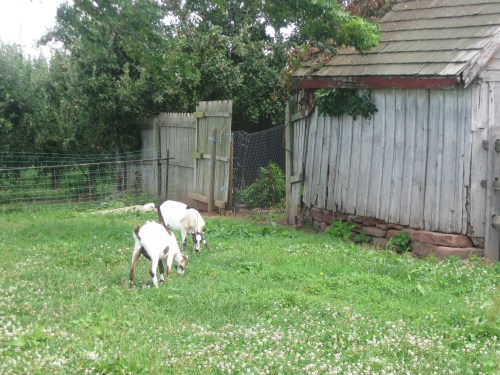
    Goats!
    Goats!

    I commented on Facebook on the irony of doing something for leisure that others do as backbreaking labor. Seems a bit decadent. On the other hand, blackberries are actually pretty easy to pick, if you can avoid the thorns (which I managed to do for the most part).