Via Jeremy, a review Michael Pollan’s new book at Slate. Laura Shapiro defends Pollan from charges that he’s a mere “lifestyle guru” uninterested in political changes that could actually change the way we eat. That Pollan is interested in motivating political change should be clear to anyone who’s read his articles over the past year in the New York Times.
Month: December 2007
-
Where’s the anti-war mojo on the Left?
With all the hype around the Ron Paul candidacy (admittedly still a long shot), I’ve wondered why there hasn’t been a comparable anti-war insurgency on the Left. Why, for instance, hasn’t Dennis Kucinich‘s campaign taken off? Is it that Democratic voters aren’t motivated primarily by the war, or is it that they regard the top tier candidates as “anti-war enough”?
None of the “big three” are calling for anything like immediate withdrawal from Iraq, nor have they repudiated the Bush Doctrine in principle, however much they may have criticized the conduct of the Bush administration. Clinton and Edwards have both made hawkish statements about Iran, and Obama got flak for suggesting we might need to invade Pakistan. All in all, I don’t think you can say that the Dems are set to field anything like a “peace candidate” in the fall. So why has the base been so quiet about this? It’s doubly odd considering that you had a significant anti-war challenge in 2004 (namely, Howard Dean) at a time when the war was considerably more popular than it is now.
-
Confession
I really want to see National Treasure: Book of Secrets. Unfortunately, I can’t seem to convince anyone I know to go with me. Why do all my friends have to have such good taste in movies?
-
The menace of Rudy
Speaking of executive power-grabbing, The American Conservative has put out a special anti-Rudy issue. Glenn Greenwald writes about Rudy’s authoritarian tendencies, while Michael Desch looks at his ultra-hawkish foreign policy.
-
Will a Democratic president remember the lessons of the last seven years?
Jack Balkin is worried that, when it comes to executive power, ostensible Democratic critics may learn to love the imperial presidency if a Dem takes the White House in 2008.
It’s worth recalling that conservatives used to complain about the imperial presidency, especially during a time of strong popular liberal presidents. And, more recently, Republicans were the dovish party, many of them opposing Bill Clinton’s various interventions. But we can see how that’s all changed.
The cynical interpretation is that both parties will embrace whatever seems to be in their immediate interest without much regard for structural or procedural soundness.
-
Faith and factuality
The question of the Virgin Birth is just one example of a broader issue in the life of faith: how much of what the Bible describes as historical fact must be accurate for faith to have solid foundations? There are two extreme positions that can, and have been, taken here. One insists on literal factuality for all the details of the biblical stories; this is the position of modern Fundamentalism. The other minimizes, to the point of vanishing, any necessary historical basis for Christian faith. This approach is sometimes associated with Rudolf Bultmann and theological liberalism, but can also sometimes be seen in certain “postmodern” versions of Christian theology, such as versions of narrative theology. Liberals tend toward the position that the essential truths of faith are “existential” truths or truths of “meaning” not tied to particular historical events. Post-liberals, by contrast, are more likely to take refuge in a kind of epistemic relativism that disarms the claims of critical historical investigation, making faith immune to historical disconfirmation. (Though moderate post-liberals like William Placher tend to affirm the factuality of the key historical events of at least the New Testament, even while admitting that these can’t be shown to be factual by appealing to “neutral” historical research.)
At the risk of taking a milquetoast middle of the road approach, I think that Christian faith has to take the results of historical investigation into account and to allow, in principle, that they can affect the content of religious belief. Christianity, maybe most of all major religions, can’t jettison its historical foundation. Its essential claim is that God enters history to share the condition of creaturely life and to redeem it. This can’t be reduced to an ahistorical truth: the Christian claim is that because of the life, death, and resurrection of Jesus our situation before God and with each other has been decisively changed. This is a variation on Paul’s dictum that “if Christ has not been raised … your faith is in vain.” Meaning can’t be separated from the question of factuality.
This doesn’t mean that all the apparent factual claims of the Bible are essential to the faith, though. At one end of the spectrum you have apparently trivial details like where a certain conversation Jesus had took place or the particular wording of the Sermon on the Mount. At the other you have the essential facts about Jesus’ life: that he lived, had a certain character, that his preaching involved particular key themes, etc., not to mention the central mystery of his death and resurrection. In the middle, it seems to me, you have a variety of apparent historical facts whose significance isn’t immediately apparent: I would include here at least some of Jesus’ miracles, particular sayings, and so on. Is it essential to believe, for instance, that Jesus healed people and performed exorcisms? Is it essential to believe he performed all the specific healings and exorcisms mentioned in the New Testament? I’d probably put the Virgin Birth in this middle category somewhere.
Now, as someone with a generally conservative disposition, I’m happy to give the benefit of the doubt to many of the borderline events in the Bible. And philosophically, I’m unconvinced that there’s any metaphysical barrier to God performing miracles. On the other hand, I’m pretty sure that the monologues in John’s gospel aren’t verbatim accounts of things the historical Jesus actually said (though I think John may well be more historically reliable than many critics allow). But if I became convinced that the central facts of the story of Jesus were untrue, then I would have to regard Christian faith as radically undermined.
The resurrection, obviously, is a special case. On the one hand it is rightly regarded as the foundation of Christian faith: if there had been no resurrection, then the early Jesus movement was based on some kind of delusion. And yet, it’s impossible to simply see the resurrection as a historical event like others whose occurrence can be demonstrated by means of the canons of historical research. Some Christian apologists seem to have taken just this view, but I think they underestimate the degree to which different people’s background philosophical and theological beliefs affect their estimation of the likelihood of particular events, especially something as extraordinary as the resurrection. The resurrection is an event of history, but it isn’t “historical” in the sense of being explicable as part of a normal series of cause and effect.
So, Christians are in a rather precarious position in that their faith is dependent on the reality of something historical which can’t be verified by historical investigation. Kierkegaard identified this dilemma as the requirement of absolute commitment in the face of objective uncertainty. It seems that we are guilty of not apportioning our beliefs and actions to the evidence. This isn’t quite the same thing as saying that faith is “belief without evidence,” as some critics of religious belief have it. But there is a degree of commitment that goes beyond the evidence. The way I think of this, which may well be defective, is that we walk in the direction that our best judgment points us, but in the hope that over time (and ultimately beyond this life) the reality that we commit ourselves to will reveal itself to us with greater clarity. Our commitment to the road of faith is a function of a confluence of influences: the historical record, but also value judgments, aesthetic considerations, and philosophical reasoning. This is a highly personal act that can’t be reduced to any kind of algorithmic process, but which presupposes a reality independent of ourselves to which we respond.
-
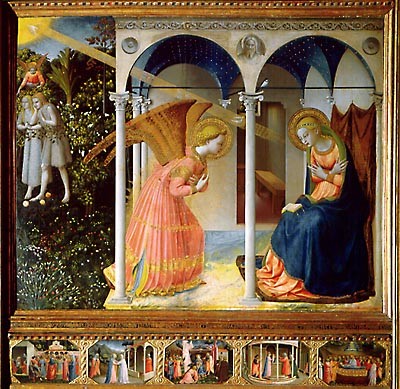
A further argument for the Virgin Birth: the argument from beauty
The Annunciation is one of the most beloved images in Western history, having given rise to some of its most enduring piety, art, and music:
-
The Virgin Birth: does it matter?
Via Graham, here’s an article in the (UK) Spectator that asked a variety of public figures whether or not they believe in the Virgin Birth. The answers range from the thoughtful, to the flippant, to the downright idiotic (someone named Colin Wilson declaims that “you’ll have some difficulty finding any educated person who believes in it, or any other Christian dogma”). I find the idea of treating the Virgin Birth as a discrete item proposed for our belief rather strange. For starters, if you can swallow the camel of the Resurrection, why strain at the gnat of the Virgin Birth? But more importantly, the Virgin Birth only really has significance in the context of the entire Christian story.
I think Rowan Williams is right when he says that the “recognition of the uniqueness and newness of Jesus is a recognition of the absolute freedom of God to break the chains of cause and effect that lock us into our sins and failures; the virginal conception is an outward sign of this divine freedom to make new beginnings.” That is to say, the Virgin Birth has a certain “fittingness.” On the other hand, I don’t think that the Virgin Birth is on a par with the Resurrection as an essential item of Christian belief: I think that Christians believe in the Virgin Birth because they believe in Christ’s divinity, not vice versa. And the Resurrection acts as a warrant for belief in Christ’s divinity in a way that the Virgin Birth generally doesn’t, not least because the latter wasn’t a public event in the usual sense.
In his response, Keith Ward says that the “point of the Biblical account is to see Jesus as the start of a new creation, fulfilling the hopes of the ‘virgin Israel’.” And this doesn’t stand or fall with the literal truth of the Virgin Birth. That said, though, it is virtually the unanimous view of the tradition (I’m not aware of any significant dissenting tradition in the early church), and only a dogmatic refusal to concede the possibility of miracles can rule it out entirely. But the reasons for believing in the Virgin Birth aren’t, in my view, independent of the reasons for affirming the unique identity of Jesus.
 A Thinking Reed