Month: May 2007

  • I left my heart in Boston, but the rest of me is in San Francisco

    I’m here in beautiful San Francisco for a company meeting, set up in a posh hotel on Nob Hill. You forget how great this place is when you’ve been away: perfect weather, beautiful architecture, terrific restaurants,… sigh.

    I flew in last night from Boston and boy are my arms tired! Ba-dum-bum!

    But seriously folks…

    I woke up this morning at the crack of dawn as my body’s still on east coast time, and since the sessions I’m supposed to attend don’t start till noon I got up and went for a run (boy those SF hills are rough!), came back, checked email and then walked up to Grace Episcopal Cathedral, which is just about a block up the hill from where I’m staying. I got there just in time for Morning Prayer. There were five of us, including the officiant, a layman by all appearances; it was straight Rite II, no liberal funny business. ;). I lingered around the cathedral for a while and got to see the Keiskamma Altarpiece, a huge triptych created by women in a poverty and AIDS-stricken village in South Africa. Obviously this resonates tremendously with the Cathedral community which has its own (much smaller) triptych created by Keith Haring which is housed in their AIDS memorial chapel which commemorates the ravages of the disease here. It was a very moving piece of work and a testament to the faith and resilience of those folks who’ve suffered so much.

    After that I took a stroll around the area in the perfect Bay Area weather (currently sunny, upper 70s and breezy), sauntering through North Beach, got a cup of coffee from an Italian bakery and did a little browsing at City Lights books. It’s days like this that make you wonder why you left…

  • Notes on a theocentric ethic of creation, 3

    Heavenly Father, your Holy Spirit gives breath to all living things; renew us by this same Spirit, that we may learn to respect what you have given and care for what you have made, through Jesus Christ our Lord. – Andrew Linzey

    This prayer from Andrew Linzey nicely encapsulates the themes of a genuine Christian ethic of creation. I think in light of earlier posts on this topic, what’s needed is a way of reconciling a due respect and care for God’s creation with a proper commitment to human flourishing.

    However, given that a lot of what seems to drive our abuse of creation is our relentless pursuit of material wealth, and that this pursuit may actually at some point hinder human happiness rather than promote it, the reconciliation may not be as difficult as it first appears.

    For Christians in particular, human well-being isn’t measured by increases in material well-being. It’s important, of course, and we’re called to make sure that those in need have adequate material sustenance. But the energy and resources we devote to what earlier generations of Christians would’ve contemptously referred to as “luxury” may indicate that we’ve strayed considerable from a Christian vision of the good life.

    In a liberal society wealth-creation offers a convenient lowest common denominator-type goal that everyone can agree on despite differences over religious values, the meaning of life, etc. But if we’re pushing against the limits of what is sustainable, this won’t be a viable option must longer.

    What we need to learn, and what any public philosophy founded essentially on self-interest seems incapable of fostering, is self-limitation. What Christians may need to recover is the practice of asceticism, not understood as a form of joyless self-denial, but as a way of orienting the self to love of God and neighbor, the contemplation of truth and beauty and the pursuit of genuine human flourishing.

    In this interview, Linzey points out that there are aspects of the world that our practices of reducing creation to mere “resources” blind us to:

    [Our mistreatment of animals is] an impediment to spiritual pleasure. That’s why I think vegetarianism is implicitly a theological act. It’s not about saying “No” but about saying “Yes.” About enjoying the lives of other creatures on this earth so much that even the thought of killing them is abhorrent. I think God rejoices in Her creatures, takes pleasure in their lives, and wants us to do so too. So much of our exploitation of animals stems from a kind of spiritual blindness: if we sensed and really felt the beauty and magnificence of the world, we would not exploit it as we do today.

    From this point of view, something like vegetarianism may serve as a spiritual practice that actual allows us to see the world differently. Of course, there are other ways of doing this. The novelist and philosophy Iris Murdoch wrote that the necessary precondition for moral growth is learning to perceive reality as existing in itself and not as something for us. She thought art was particularly suited to this since it’s goal is to make reality present to us. By learning to attend to something for its own sake, which often involves hard work, we go out of ourselves and gradually inhabit a less self-centered, and therefore more accurate, perspective on reality. This is the key to human flourishing.

    Obviously human beings need, as Wendell Berry reminds us, to use the world. But spiritual disciplines that teach us to look at the world as something more than mere material for our use may lead us to redefine what our needs are, and to distinguish genuine needs from spurious ones. And, somewhat paradoxically, genuine human flourishing can only occur when we stop seeing ourselves as the center of the world. But Christians of all people should be ok with this, since we have it on good authority that self-seeking is the surest path to self-destruction and that only by losing our lives to we truly find them.

  • The Middle East: not that important?

    I don’t agree with everything in this Edward Luttwak article (particularly the stuff about the hopeless backwardness of Arab culture and the “perfectly understandable hostility of convinced Islamists towards the transgressive west”), but he makes some points that need making. Our political class is way over-invested in the idea that the Middle East is of tantamount importance. Also, it’s obvious that our support for Israel is the cause of a lot of the anger aimed at the US in that part of the world. However, I’m not convinced we should abandon our support of Israel even if that were a political possibility. It would be better, I think to work for a just settlement of the Israeli-Palestinian conflict in order to defuse some of the hostility toward the US and otherwise get the heck out of there. With the Cold War over and the OPEC oil cartel weakened, what strategic interest does America have in maintaining a major presence in the Middle East?

  • Jesus Our Redeemer

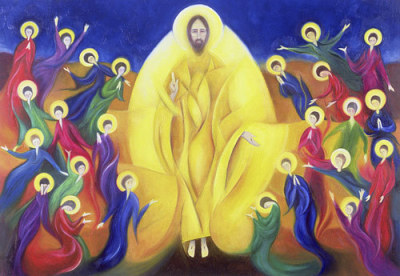
    Gerald O’Collins, S.J. is an Australian Jesuit who’s taught at Gregorian University in Rome since the 70s. I greatly enjoyed his book on the Trinity (and blogged a bit about it here), so was pleased to discover that early this year he published Jesus Our Redeemer: A Christian Approach to Salvation in which O’Collins offers a systematic soteriology. He covers the topics of creation, original sin, atonement, the role of the Holy Spirit and the church, the salvation of non-Christians, the final resurrection, and the redemption of creation. I just received the copy that I ordered and am eager to dig in. Expect posts soon.

    It also has a really lovely cover image from Sophie Hacker a contemporary religious artist:

    resurrection-icon.jpg

  • Notes on a theocentric ethic of creation, 2

    In addition to theocentricity and what I’ve called a “qualified” anthropocentrism, any Christian ethic of creation needs to address the issue of the “fallenness” of creation. This is a controversial topic since, while most theologians have no problem with the idea of human fallenness (in some sense), the idea that the non-human creation is somehow not what it should be seems to smack of pre-modern mythological thinking. Given what we know about the scientific laws of the universe, do we need to posit some pre-historic cosmic cataclysm to explain the existence of suffering, predation, death, natural disasters and the like? The view sometimes put forth that all these things are somehow the result of human (or maybe angelic) sin seems incredible to many Christians.

    However, I don’t think we can dismiss the idea of a cosmic Fall so easily. If we take nature as it is, how do we reconcile the presence of so much suffering and death with the existence of a Creator of unlimited love and power? Certain modernist theologians have contended that a universe structured the way ours is, with all its attendant pain and suffering, is necessary to bring into existence rational, personal creatures who can respond to and enter into a relationship with the Divine. This line of thought is supported by the oft-noted “anthropic” features of the cosmos that make it appear to be “fine-tuned” for the emergence of life. But this is unsatisfactory for a couple of reasons. First, it seems to relegate the entire non-human creation to a mere ancillary role in God’s plan. Second, as it stands it doesn’t address the moral issue raised by the suffering of so many sentient creatures, who, on this telling, are mere means to the creation of rational beings like ourselves.

    If I can wax Anselmian for a minute, it strikes me as “unfitting” that God would create solely to bring into existence human beings (and perhaps other rational creatures elsewhere) but have no additional purposes for creation. The Bible, for one, seems to envision a redeemed creation, not simply a redeemed humanity.

    Another attempt to have Christian theology without the Fall is found in the “creation spirituality” of Matthew Fox. Fox posits an “original blessing” (as opposed to original sin) and thinks that we should embrace the ethos of nature as unambiguously good and not in need of redemption. Unfortunately, this and similar views border on pantheism and nature worship and overlook the fact that deriving our ethics from the natural world can yield cruelty as much as compassion. Nature is God’s good creation, but it’s also “red in tooth and claw” and can’t set the standard for our ethics or theology in any straightforward way.

    But does this mean that there was some pre-historical state of perfection from which the created world fell, as the result of human or angelic sin? David B. Hart has defended such an idea in his book The Doors of the Sea. But, as I argued previously, I think Hart comes dangerously close to gnosticism in his positing of a perfect eternal creation that somehow “preceded” the world as it exists now. It’s hard, on Hart’s account, to identify the empirical world we see around us with God’s good creation. Just as our doctrince of original sin shouldn’t efface the basic goodness of human nature, any doctrince of cosmic fall and redemption shouldn’t obscure the goodness of the world as we actually experience it.

    The view I lean toward is that creation is good, but incomplete and in need of redemption, or deliverance from evil. God’s world will not ultimately contain the evils of suffering and death, but this is because it will be transformed, not annihilated. This view doesn’t require the existence of a pre-historic cosmic fall, but it does see the story of the Fall as containing the important truth that creation is unfinished and not what it should be. This prevents us from treating death and suffering as “natural” in the deepest sense (and therefore good), but it also avoids Hartian quasi-gnosticism about the natural world.

    This implies, at a minimum, that we not take the “struggle for survival” as the template for our thinking about the natural world, much less mimic it in our relationships with one another. But it should also caution us against utopian attempts to remake nature in a way that is free from the inherent limitations of a fallen creation. Nature is neither perfect as it is, but nor is it “fixable” by us. This side of the eschaton it would be pointless and cruel to try and make the lion lie down with the lamb.

    But what I think it does point to is that we shouldn’t exacerbate the violence of nature with our own violence. Whatever we think about the story of the Fall, it’s clear that we now have the power to “corrupt” nature with our sinfulness in a very straightforward way. Our ability to change natural processes, to pollute, to deforest, and to manipulate the natures of living creatures far outstips anything our ancestors had, and in all likelihood outstrips our wisdom. But another part of our uniqueness as human beings is our ability to look toward, and in some degree anticipate, that redeemed state that we hope for.

    In part three I’ll try to tie some of these threads together…

  • Notes on a theocentric ethic of creation, 1

    As a kind of follow up to yesterday’s post, I’ve been thinking a bit more about what a Christian environmental (or better “creation”) ethic might look like that steers between anthropomorphism and misanthropy.

    I think a key concept here is theocentricity. A theocentric ethic would recognize that human beings, while perhaps the most valuable creature we know of, are not the center of the universe. Many theologians have been de facto anthropocentrists in claiming that all other creatures are essentially here for our use, but this isn’t quite what the Bible says and it’s in conflict with what I regard as some of the best insights of the Christian tradition.

    What a theocentric view of the world would emphasize, I think, is that creation ultimately exists for God’s sake. As philosopher Stephen R.L. Clark puts it:

    Some modernist theologians explain the apparent failings of our present world as God’s chosen way of creating rational individuals. Everything, by their account, exists for us to use. The God of orthodoxy has no need of secondary causes of this sort. Whatever He creates, He creates for its own sake, because He chooses to. Some have held that He created every possible creature; others that He actualizes only some real possibilities; others again that even God the Omniscient cannot inspect all possible, so-far non-existent, beings (because there can be no criteria for their identity beyond what God makes real in creating some `of them’). Whatever the truth of this, we can be confident that He creates exactly what He wants, for its own sake or `for His glory’. Nor does the God of orthodoxy need to make particular creatures co-existent: as far as we can see He may have randomized creation, since His chosen must, in any case, relate to anyone at all who is their neighbour, irrespective of their nature or their merits. Nor does He select for special treatment just those creatures that a finite observer might expect: nothing in the long ago determined Him to raise up mammals, hominids, or Abram. So orthodox theocentrism is far less committed to the notion of a Visible Plan than atheistic critics have supposed.

    Creatures exist first and foremost because God wants them to. They are pronounced by him as “good”; they have value in their own right. And they have lives to live, or forms of existence, that aren’t reducible to how they may be of use to us.

    Arguably one of the main sources of our mistreatment of the natural world and the creatures that dwell therein is the view that all of nature is one vast “resource” for our use. Once our fellow-creatures are reduced to the value they have as resources, it’s virtually impossible for us to see them as existing in their own right and for their own sake. A theocentric perspective would view them as existing for God, as having their own lives to live that aren’t automatically forfeit to human whim or even need.

    Still, the Bible tells us that human beings are created in the image of God, and that they are given “dominion” of the earth. For many environmental thinkers this is the “original sin” of western civilization. This dominion has led ineluctably to the exploitation of nature (and, perhaps, the exploitation of women, children, and non-white races who have all too often been identified with “nature” over against the “male” principle of rationality that has frequently been taken to be the meaning of God’s image in us).

    Recent theologians, however, have questioned whether this is an accurate understanding of what the Bible means by dominion and the imago Dei. In their essay “The Chief End of All Flesh,” Stanley Hauerwas and John Berkman write:

    [T]he only significant theological difference between humans and animals lies in God’s giving humans a unique purpose. Herein lies what it means for God to create humans in God’s image. A part of this unique purpose is God’s charge to humans to tell animals who they are, and humans continue to do this by the very way they relate to other animals. We think there is an analogous relationship here; animals need humans to tell them their story, just as gentiles need Jews to tell them their story.

    This idea of humans telling animals their story seems not unlike the notion sometimes expressed by theologians that human beings are the “priests” of creation. We give voice to the praise of God that is properly given by all creatures.

    Another rethinking of the imago Dei and “dominion” is offered by Andrew Linzey who reconceptualizes the role of humans as the “servant species.” For Linzey this is essentially a Christological clam: Jesus, who came to serve and not to be served, is the true image of God and, as such, this stance of service is normative not only for our relations with each other, but for our relationship with creation. “Dominion” means that we are deputized as it were to rule over creation in accordance with God’s will; but the nature and character of that will is expressed in the life of Jesus, a life of self-giving love.

    Even with these qualifications of traditional ideas of human uniqueness in mind, I think most of us still want to affirm some kind fo qualified anthropocentrism. Human beings, we feel and think, simply are more valuable than other creatures, and it would be morally abhorrent to suggest sacrificing a human life to save the life of an elephant, or a redwood, or what have you. And this hierarchy does seem grounded in the kinds of characteristics that different creatures display: the human capacities for rational judgment, moral action, self-giving love, and spiritual awareness do seem to set us apart from animals, even if the line isn’t quite as bright and distinct as we used to think.

    Another fact that has to be considered is what I would call the particularity of our loves. There’s a tension in ethics between the duties we owe to other people as such and the duties we owe to those who are especially close to us, even though that closeness may seem to be the result of morally irrelevant characteristics such as accident of birth. Nevertheless, rare is the ethicist, much less normal person, who would claim that our duties to all are identical. I have a greater duty to care for my own children or parents than I do for strangers in some distant country. Similarly, we might suggest that we have greater duties to our “kin” who are our conspecifics. I owe more to a fellow human than to a non-human animal not just because she ranks higher in some objective hierarchy of being, but because we are more closely related. If the strength of our duties of care radiates outward from kith and kin to more distant relations, I don’t see why the same might not be said with respect to other species.

    So, it seems to me we have two principles that need to find a place in any satisfying ethic of “creation care.” The first is a theocentrism that puts our claims in perspective. We are one kind of creature among many, and all other creatures don’t exist merely for our sake. The other is a qualified anthropocentrism which recognizes the greater value of human beings, both in an objective sense and as a consequence of our greater solidarity with those to whom we are more closely related.

    More to come…