Month: April 2007

  • Respect for life as a communal value

    In yesterday’s Boston Globe, Harvard political philosopher Michael J. Sandel accused President Bush of moral inconsistency with respect to the President’s position on federal funding for embryonic stem cell research (ESCR). According to Sandel, if Bush regards the destruction of embryos as tantamount to killing a full-grown person, then he ought logically call for a total ban on ESCR, since it would be morally equivalent to murder.

    I think there are two problems with Sandel’s argument. First, it assumes that pro-lifers can never engage in piecemeal, pragmatic politics or compromise. Many pro-lifers would like to see abortion banned, but in the interim they’re also quite happy to see policies that limit abortion enacted such as bans on federal funding of abortion, parental notification laws, bans on partial-birth abortion, etc. Bush could well be following a similar tactic, recognizing that a ban on ESCR has no chance of being enacted.

    The second problem, though, is that Sandel doesn’t address the possibility that one can oppose the destruction of embryos for scientific research without conceding that an embryo is morally equivalent to a full-grown person. This isn’t dispositive, but I imagine that most of us, if faced with the choice between rescuing a child from a burning building or a dish with fertilized ova in it, would have no problem deciding to save the child. This suggests that we don’t regard embryos as morally equivalent to human persons.

    But it doesn’t follow from this that embryos have no value, or that it’s unproblematic to use them as raw materials for research. There are several objections one might make to this practice that don’t rely on the supposition that an embryo is morally equivalent to a human person. One is that the use of embryos in research is another step on the road of regarding all of nature and life as a “resource” to be used for our benefit. This denies their intrinsic value and makes human utility the measure of all things. To draw a line and say that certain things mustn’t be done to embryos is a way of affirming the intrinsic value of nascent human life.

    It’s very difficult to make these kinds of arguments in a political culture based on concerns of utility or on rights, since embryos don’t seem at first blush like the sorts of entities that can have their utility diminished or their rights violated. But it’s noteworthy that Sandel, a noted communitarian thinker who has criticized “procedural liberalism”, wouldn’t be more sensitive to ethical concerns that go beyond this rather narrow set of concerns. A polity might, on communitarian grounds, affirm its respect for life by making certain kinds of research off limits. Of course, Bush hasn’t generally made his case in these terms, and one can question whether such a policy reflects the values of our polity considering that it has been maintained only by presidential veto. Still, I would think that Sandel would recognize that such a case could be made since it’s more congenial to his approach to political philosophy.

  • Easter!

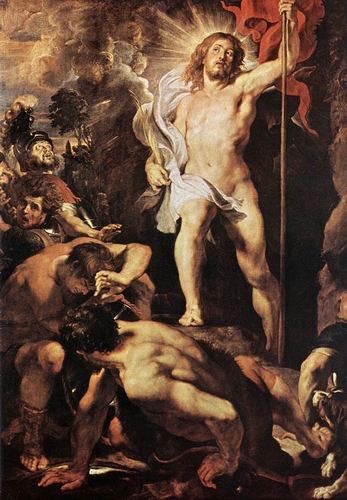
    rubens_resurrection_christ.jpg

    Now, brothers, I want to remind you of the gospel I preached to you, which you received and on which you have taken your stand. By this gospel you are saved, if you hold firmly to the word I preached to you. Otherwise, you have believed in vain.
    For what I received I passed on to you as of first importance: that Christ died for our sins according to the Scriptures, that he was buried, that he was raised on the third day according to the Scriptures, and that he appeared to Peter, and then to the Twelve. After that, he appeared to more than five hundred of the brothers at the same time, most of whom are still living, though some have fallen asleep. Then he appeared to James, then to all the apostles, and last of all he appeared to me also, as to one abnormally born.

    For I am the least of the apostles and do not even deserve to be called an apostle, because I persecuted the church of God. But by the grace of God I am what I am, and his grace to me was not without effect. No, I worked harder than all of them—yet not I, but the grace of God that was with me. Whether, then, it was I or they, this is what we preach, and this is what you believed.

    But if it is preached that Christ has been raised from the dead, how can some of you say that there is no resurrection of the dead? If there is no resurrection of the dead, then not even Christ has been raised. And if Christ has not been raised, our preaching is useless and so is your faith. More than that, we are then found to be false witnesses about God, for we have testified about God that he raised Christ from the dead. But he did not raise him if in fact the dead are not raised. For if the dead are not raised, then Christ has not been raised either. And if Christ has not been raised, your faith is futile; you are still in your sins. Then those also who have fallen asleep in Christ are lost. If only for this life we have hope in Christ, we are to be pitied more than all men.

    But Christ has indeed been raised from the dead, the firstfruits of those who have fallen asleep. For since death came through a man, the resurrection of the dead comes also through a man. For as in Adam all die, so in Christ all will be made alive. But each in his own turn: Christ, the firstfruits; then, when he comes, those who belong to him. Then the end will come, when he hands over the kingdom to God the Father after he has destroyed all dominion, authority and power. For he must reign until he has put all his enemies under his feet. The last enemy to be destroyed is death. For he “has put everything under his feet.” Now when it says that “everything” has been put under him, it is clear that this does not include God himself, who put everything under Christ. When he has done this, then the Son himself will be made subject to him who put everything under him, so that God may be all in all.

    1 Corinthians, 15:1-28

  • Good Friday

    Psalm 22

    My God, my God, why have you forsaken me?
    Why are you so far from saving me, from the words of my groaning?
    O my God, I cry by day, but you do not answer,
    and by night, but I find no rest.
    Yet you are holy,
    enthroned on the praises of Israel.
    In you our fathers trusted;
    they trusted, and you delivered them.
    To you they cried and were rescued;
    in you they trusted and were not put to shame.

    But I am a worm and not a man,
    scorned by mankind and despised by the people.
    All who see me mock me;
    they make mouths at me; they wag their heads;
    “He trusts in the LORD; let him deliver him;
    let him rescue him, for he delights in him!”

    Yet you are he who took me from the womb;
    you made me trust you at my mother’s breasts.
    On you was I cast from my birth,
    and from my mother’s womb you have been my God.
    Be not far from me,
    for trouble is near,
    and there is none to help.

    Many bulls encompass me;
    strong bulls of Bashan surround me;
    they open wide their mouths at me,
    like a ravening and roaring lion.

    I am poured out like water,
    and all my bones are out of joint;
    my heart is like wax;
    it is melted within my breast;
    my strength is dried up like a potsherd,
    and my tongue sticks to my jaws;
    you lay me in the dust of death.

    For dogs encompass me;
    a company of evildoers encircles me;
    they have pierced my hands and feet–
    I can count all my bones–
    they stare and gloat over me;
    they divide my garments among them,
    and for my clothing they cast lots.

    But you, O LORD, do not be far off!
    O you my help, come quickly to my aid!
    Deliver my soul from the sword,
    my precious life from the power of the dog!
    Save me from the mouth of the lion!
    You have rescued me from the horns of the wild oxen!

    I will tell of your name to my brothers;
    in the midst of the congregation I will praise you:
    You who fear the LORD, praise him!
    All you offspring of Jacob, glorify him,
    and stand in awe of him, all you offspring of Israel!
    For he has not despised or abhorred
    the affliction of the afflicted,
    and he has not hidden his face from him,
    but has heard, when he cried to him.

    From you comes my praise in the great congregation;
    my vows I will perform before those who fear him.
    The afflicted shall eat and be satisfied;
    those who seek him shall praise the LORD!
    May your hearts live forever!

    All the ends of the earth shall remember
    and turn to the LORD,
    and all the families of the nations
    shall worship before you.
    For kingship belongs to the LORD,
    and he rules over the nations.

    All the prosperous of the earth eat and worship;
    before him shall bow all who go down to the dust,
    even the one who could not keep himself alive.
    Posterity shall serve him;
    it shall be told of the Lord to the coming generation;
    they shall come and proclaim his righteousness to a people yet unborn,
    that he has done it.

  • Notes on Anselm’s Cur Deus Homo: 10

    Faced with the need for some kind of satisfaction for sin, Anselm deduces that “If it be necessary, therefore, as it appears, that the heavenly kingdom be made up of men, and this cannot be effected unless the aforesaid satisfaction be made, which none but God can make and none but man ought to make, it is necessary for the God-man to make it” (Bk. Two, Ch. VI). No fallen human being can possibly make satisfaction for sin; only God can do so. And yet, it’s appropriate that a human being be the one who makes satisfaction, since “as Adam and his whole race, had he not sinned, would have stood firm without the support of any other being, so, after the fall, the same race must rise and be exalted by means of itself” (Bk. Two, Ch. VIII).

    Anselm affirms the traditional Chalcedonean definition of Christ’s two natures: he is fully God and fully man. The two natures aren’t mixed and they do not compose some tertium quid neither fully God nor fully human. “For God will not do it, because he has no debt to pay; and man will not do it, because he cannot. Therefore, in order that the God-man may perform this, it is necessary that the same being should perfect God and perfect man, in order to make this atonement” (Bk. Two, Ch. VII).

    But how, exactly, does Anselm think that the God-man makes atonement for sin? We have seen that Anselm thinks that any rational creature, by its very nature, owes God perfect obedience. Humanity has failed at this, and as a consequence we now owe God our death. However, the God-man, while he owes God obedience as all rational creatures do, doesn’t owe God his death, because he hasn’t sinned. “For, if Adam would not have died had he not committed sin, much less should this man suffer death, in whom there can be no sin, for he is God” (Bk. Two, Ch. X).

    The God-man, then, in voluntarily giving up his life, renders to God something which was not owed, and this gift outweighs the debt of human sin. To show this, Anselm asks Boso to engage in a thought experiment. Imagine, he says, that the God-man was standing before you and that you were told that the entire created universe would be destroyed if you didn’t kill him. Would it be right to do it? He further tells Boso to suppose that if he didn’t kill the God-man “all the sins of the world will be heaped upon you.”

    Boso replies: ” I would far rather bear all other sins, not only those of this world, past and future, but also all others that can be conceived of, than this alone. And I think I ought to say this, not only with regard to killing him, but even as to the slightest injury which could be inflicted on him” on the grounds that a “sin committed upon his person exceeds beyond comparison all the sins which can be thought of, that do not affect his person.”

    Anselm praises Boso for his answer and adds that “sins are as hateful as they are evil, and that life is only amiable in proportion as it is good. And, therefore, it follows that that life [i.e. the life of the God-man] is more lovely than sins are odious.” So, for the God-man to lay down his life is to offer a git that “surpasses all the sins of men.”

    Recall that Anselm has said earlier that Christ was not killed by God, but that his life of perfect obedience in a sinful world led to his death. So, in what sense does he lay down his life? Anselm’s view is that death isn’t natural to human nature, but only occurs as a result of sin. So the God-man, being sinless, wouldn’t naturally have died. However, he could voluntarily give up his life and did so precisely to offer that priceless gift that “taketh away the sin of the world.”

    I imagine that for us this strikes a bit of a false note. Contemporary theology has so strongly emphasized the humanity of Jesus that it sounds strange, to say the least, to say that he was somehow naturally immune to death. It seems to make more sense to say that if, somehow, Jesus hadn’t been killed by the religious and political authorities of his day he still would’ve died eventually of natural causes. Knowing what we know about human nature we no longer think of death as unnnatural, but as part of the natural process by which living things come into and pass out of being. As part of the process of life, death seems necessary.

    Maybe Anselm could accept the foregoing and point out that it still wasn’t necessary for Christ to die a violent, shameful death. That is, he chose to throw his lot in with sinners, to be found among them, to be tortured as one of them, and finally killed. Might not this gift be understood to contain the saving power Anselm describes as his voluntarily laying down his life? It might be said that even if incarnation necessarily entails mortality, the Son of God, being sinless, couldn’t possibly have owed God this kind of death. And indeed, it’s this identification with sinners that gives the story of Jesus’ life and death so much of its power, it seems to me.

    Of course, even given all this, we might still wonder how this gift is applied to us? How does the God-man’s life of perfect obedience, culminating in his freely offered death, reconcile us with God?

    Anselm’s argument goes like this:

    The Son of God’s gift of himself, his obedience, his life, and his death, is a gift that “surpasses all the sins of men,” and this unsurpassable gift earns for the Son a reward from the Father.

    But, how “can a reward be bestowed on one who needs nothing, and to whom no gift or release can be made?” In other words, everything that belongs to the Father also belongs to the Son, so he has no need of reward. Yet “if a reward so large and so deserved is not given to him or any one else, then it will almost appear as if the Son had done this great work in vain.” Therefore, the reward “must be bestowed upon some one else, for it cannot be upon him.”

    And what, Anselm asks, could be more proper than that the reward be bestowed “upon those for whose salvation, as right reason teaches, he became man; and for whose sake, as we have already said, he left an example of suffering death to preserve holiness?” Namely, human beings, who “weighed down by so heavy a debt, and wasting through poverty, in the depth of their miseries, he should remit the debt incurred by their sins, and give them what their transgressions had forfeited.”

    The interesting thing here is that Anselm makes no mention of faith or works as necessary conditions for reaping the benefits of Christ’s sacrifice. And, if his gift of himself is so surpassing in beauty and goodness that it outweighs the entire world’s sin, why not embrace universalism? Obviously Anselm doesn’t draw this conclusion, and indeed he specifically says that there are human beings who will not be saved, but if the gift really does blot out all the sins of the world, it’s hard to see on what grounds he shouldn’t draw this conclusion. After all, if God the Son asks that the merits of his death be applied to his brethren, what grounds, apart from some inscrutable will, would there be for applying it to some and denying it to others. After all, ex hypothesi, we are all completely unable to atone for our own sins.

    As Holy Week is drawing to a close I think I’m going to make this the last post on this topic. There are other topics Anselm discusses which might make worthy tangents, such as an argument for something like the Immaculate Conception, as well as his discussion of in what sense Christ is an example for us. But I’ll put that off for another time.

    My goal hasn’t been to argue that Anselm provides the correct account of the Atonement (assuming we’re even capable of such a thing). But I hope I have given some indication that his thought is more complex, interesting, and even appealing than it’s often given credit for. Far from being an arbitrary tyrant, Anselm’s God is defined by his goodness, which upholds the order and beauty of the universe, and, when we had fallen into sin, finds a way to restore us to himself while maintaining that beauty and blotting out the evil of sin. The God-man is the incarnate expression of the love of God the Son for God the Father, whereby he gives himself back to the Father in a trinitarian movement that, in George Lindbeck’s words, “irradiat[es] the universe and mak[es] it a far, far better place than it would ever have been without Christ’s coming and inevitable death.”
  • Ratzinger vs. vicarious atonement?

    Continuing with the Holy Week theme, Pontifications has posted an excerpt from then-Cardinal Ratzinger’s Introduction to Christianity that seems quite opposed to the traditional idea of vicarious atonement:

    In the Bible the Cross does not appear as part of a mechanism of injured right; on the contrary, in the Bible the Cross is quite the reverse: it is the expression of the radical nature of the love that gives itself completely, of the process in which one is what one does and does what one is; it is the expression of a life that is completely being for others. To anyone who looks more closely, the scriptural theology of the Cross represents a real revolution as compared with the notions of expiation and redemption entertained by non-Christian religions, though it certainly cannot be denied that in the later Christian consciousness this revolution was largely neutralized and its whole scope seldom recognized. In other world religions, expiation usually means the restoration of the damaged relationship with God by means of expiatory actions on the part of men. Almost all religions center around the problem of expiation; they arise out of man’s knowledge of his guilt before God and signify the attempt to remove this feeling of guilt, to surmount the guilt through conciliatory actions offered up to God. The expiatory activity by which men hope to conciliate the Divinity and to put him in a gracious mood stands at the heart of the history of religion.

    In the New Testament the situation is almost completely reversed. It is not man who goes to God with a compensatory gift, but God who comes to man, in order to give to him. He restores disturbed right on the initiative of his own power to love, by making unjust man just again, the dead living again, through his own creative mercy. His righteousness is grace; it is active righteousness, which sets crooked man right, that is, bends him straight, makes him correct. Here we stand before the twist that Christianity put into the history of religion. The New Testament does not say that men conciliate God, as we really ought to expect, since, after all, it is they who have failed, not God. It says, on the contrary, that “God was in Christ reconciling the world to himself” (2 Cor 5:19). This is truly something new, something unheard of—the starting point of Christian existence and the center of New Testament theology of the Cross: God does not wait until the guilty comes to be reconciled; he goes to meet them and reconciles them. Here we can see the true direction of the Incarnation, the Cross.

    More here.

  • Denying penal substitution ≠ heresy

    This radio talk by Anglican priest Jeffrey John attracted the usual accusations of liberal heresy before it was even actually broadcast, but upon reading the transcript I don’t see anything particularly unorthodox. Granted John takes issue with the theory of penal substitution, but he’s hardly the first to do so, and the universal church hasn’t established it as the definitive way of understanding the Atonement.

    John says:

    The cross, then, is not about Jesus reconciling an angry God to us; it’s almost the opposite. It’s about a totally loving God, incarnate in Christ, reconciling us to him. On the cross Jesus dies for our sins; the price of our sin is paid; but it is not paid to God but by God. As St paul says, God was in Christ reconciling the world to himself. Because he is Love, God does what Love does: He unites himself with the beloved. He enters his own creation and goes to the bottom line for us. Not sending a substitute to vent his punishment on, but going himself to the bitter end, sharing in the worst of suffering and grief that life can throw at us, and finally sharing our death, so that he can bring us through death to life in him.

    Whether or not this is a fully adequate account of the Atonement, it seems to me that this is an entirely orthodox perspective. I’ve written before that a theory of atonement is secondary to the central Christian affirmation: that God became incarnate in Jesus in order to save us from sin and death. The various theories of atonement are ways of understanding how that works, but they aren’t the thing itself.

  • Notes on Anselm’s Cur Deus Homo: 9

    Okay, the argument so far: Anselm has contended that humankind has fallen into sin by failing to render to God the honor due him (i.e. obedience). As a result we threaten to fail to acheive God’s intended purpose for us, namely, being part of the “celestial estate” and consequently we disrupt the order and beauty of God’s good creation. God won’t suffer the order of creation to be disrupted, since otherwise he would not be all-good and all-powerful. For the order to be restored and the goodness of creation to be upheld sin must be punished or satisfaction must be made for it. Human beings, already owing everything they have to God, are unable to make satisfaction for sin. And yet if God were simply to punish sin his purpose for humankind – their sharing in the celestial estate – would be frustrated. Therefore, God will make satisfaction for sin.

    In Book Two, Anselm turns to discuss in more detail how it is that God makes satisfaction for sin. In Book Two, Chapter Five Boso raises the objection that saying that God must make satisfaction for sin seems to put God under the constraints of some kind of compulsion or necessity. Moreover, if God acts of necessity why should we be grateful for what he does?

    But, Anselm replies, this isn’t an absolute necessity, but only necessary given that God has purposes for human beings and will do whatever is necessary to make those purposes effective. God’s original grace to us is our creation and that he destines us for eternal life; how much more grace, then, does he show in that he stoops to bring us to that destination even after we have fallen into sin?

    Much more, therefore, do we owe all thanks to God for completing his intended favor to man; though, indeed, it would not be proper for him to fail in his good design, because wanting nothing in himself he begun it for our sake and not his own. For what man was about to do was not hidden from God at his creation; and yet by freely creating man, God as it were bound himself to complete the good which he had begun. In fine, God does nothing by necessity, since he is not compelled or restrained in anything. And when we say that God does anything to avoid dishonor, which he certainly does not fear, we must mean that God does this from the necessity of maintaining his honor; which necessity is after all no more than this, viz., the immutability of his honor, which belongs to him in himself, and is not derived from another; and therefore it is not properly called necessity. Yet we may say, although the whole work which God does for man is of grace, that it is necessary for God, on account of his unchangeable goodness, to complete the work which he has begun.

  • Animal time travelers

    Here’s a NY Times article on some recent research which seems to indicate that at least some animals have a sense of the past and the future.

    The general trend of research in these areas seems to be toward showing that the mental lives of animals are more complex than has often been thought. This really shouldn’t be surprising considering our shared evolutionary past; what would be surprising is if animal consciousness didn’t anticipate human consciousness in a lot of respects.

  • Oakes on Girard, Balthasar, and Atonement

    Fr. Edward T. Oakes has a rumination on Rene Girard and the Atonement over at the First Things blog.

    I’ve only read Girard’s I See Satan Fall Like Lightning, but found it very thought-provoking. However, I think Fr. Oakes is on to something when he points out that Girard can’t make sense of the traditional idea that God was at work in the Cross of Christ. I also can’t help but think that Girard’s scheme of mimesis-and-scapegoating offers a reductive understanding of (non-Christian) religions. Though my knowledge of his work is admittedly limited.

  • Children of Men

    Warning: spoilers ahoy!

    When I first read P.D. James’s Children of Men back in January I wondered how in the world they’d managed to make a Hollywood movie out of it. After all, here’s a book where the heroes are a band of Christian terrorists, the villain is an overweening government that subsidizes euthanasia, and in which a recurring theme is the possibility that the universal infertility that has stricken the human race is a punishment from God.

    Well, having seen the film version just last night, I now know the answer: they didn’t make a movie out of James’s book. Sure there are similar ideas and plot contrivances, and characters who at least have the same names as some of James’s characters, but that’s about it. The movie seems to aspire to being a thinly-veiled diatribe against the Bush/Blair axis of evil and evacuates virtually all of the Christian themes and imagery.

    Still present is the broad theme of Theo, the main character, learning to sacrifice for something bigger than himself, but while in the novel he’s a self-absorbed and despondent academic who becomes sensitized to the possibly transcendent mystery of the first human birth in eighteen years, the movie version has him as an ex-radical who rediscovers the joys of stickin’ it to the man (complete with an old pot smoking hippie mentor played by Michael Caine). The question of human infertility frankly almost seems like little more than a distraction with the real issue being the government’s treatment of refugees (‘fugees) and the police state that rounds them up like animals in the name of “fighting terrorism” (in case you don’t get the connection, a cell that the heroes are herded into is helpfully labeled “Department of Homeland Security”).

    James’s book, by contrast, explores the despair and futility that afflicts a world without children. This makes the first birth in a generation far more powerful. “The Five Fishes” – the band of somewhat hapless dissidents whose name seems to have a distinctly Christian reference, made completely inexplicable in the film – have a simple faith that if they can just protect the mother untill the baby is born somehow everything will be ok. In the film, by contrast, rather than trusting in any kind of providence, you have a shadowy cabal of scientists to act as the deus ex machina.

    All of which is not to say that Children of Men is a bad movie. It certainly has its moments, and the cinematography is top-notch. It’s just a shame when such rich and interesting source material gets wasted so someone can take shots at George Bush and Tony Blair.